Contract clause
Information rights clause: what investors are told and when
An information rights clause sets the financial and operating information a company must give its shareholders or investors, how often and by what deadline. It usually covers management accounts, annual accounts, budgets and material events, and may add inspection of records or a board observer, with confidentiality obligations on everyone who receives the information.
Minority investors in a private company have very limited statutory access to its books, so what they see in practice is whatever the agreement promises. For founders, the clause sets a reporting workload that has to be realistic for a small finance team.
Nuwan Madhusanka · Co-founder
4 min read · Published
Sample clause
a shareholders agreement for Wombat Payroll Systems Pty Ltd, a fictional Canberra software company with two founders and three investors, the largest holding 18 per cent
10. Information Rights 10.1 The Company must give each Major Investor, being an Investor holding at least 5 per cent of the Shares: (a) monthly management accounts, including a profit and loss statement, balance sheet and cash position, within 20 Business Days after the end of each month; (b) the annual budget at least 30 days before the start of each financial year; (c) audited annual financial statements within 120 days after the end of each financial year; and (d) an updated capitalisation table within 10 Business Days after any issue or transfer of Shares. 10.2 The Company must notify each Major Investor within 5 Business Days of any litigation, regulatory investigation or event that could reasonably be expected to have a material adverse effect on the Company. 10.3 A Major Investor may inspect the Company's financial records on 10 Business Days notice, at its own cost. 10.4 Each Investor must keep all information received under this clause confidential.
Sample wording, not legal advice.
Variants
All shareholders, lighter reporting
Smaller companies with many angel or employee shareholders, where monthly packs would overwhelm the finance team.
The Company must give every Shareholder a quarterly update, within 30 days after the end of each quarter, stating revenue, operating costs, cash at bank and the number of months of expected runway, and must give every Shareholder the annual financial statements within 5 months after the end of each financial year. No Shareholder has any other right to information under this agreement.
Board observer for a lead investor
A lead investor that does not take a board seat but wants to see board discussion.
While Greyhaven Capital holds at least 10 per cent of the Shares, it may appoint one Observer who may attend and speak at Board meetings and receive all Board papers at the same time as the directors, but may not vote. The Board may exclude the Observer from any part of a meeting, or withhold papers, where attendance or disclosure would risk legal privilege or involve a conflict of interest.
United States style information and inspection rights
Companies raising from US funds, where information rights usually sit in an investors' rights agreement and state law separately gives stockholders inspection rights.
So long as an Investor holds at least 500,000 shares of Preferred Stock, the Company shall deliver to it unaudited quarterly financial statements within 45 days after each fiscal quarter and audited annual financial statements within 120 days after each fiscal year, and shall permit it to inspect the Company's properties and books during normal business hours on reasonable notice. These rights terminate immediately before an initial public offering.
What to negotiate
Who qualifies
Investors want information rights for every holder they bring in. Founders prefer to limit detailed rights to major investors above a percentage or investment amount, and to exclude competitors from receiving sensitive information at all. The common settlement gives detailed monthly information to major investors and a quarterly or annual summary to everyone else.
Audit cost
Audited accounts are a real cost for a young company that may not otherwise need an audit. Founders ask for reviewed rather than audited accounts until revenue or funding reaches a threshold, or for investors to meet the cost. Investors with their own reporting obligations often insist on an audit from the first year.
Confidentiality and competitors
Information flows freely only if the company trusts it will stay inside the investor's fund. Companies ask for confidentiality obligations, a ban on sharing with competing portfolio companies, and the right to withhold trade secrets. Investors accept those while keeping the right to report to their own investors in summary form.
When the rights end
Information rights designed for a private company clash with continuous disclosure after a listing, where selective disclosure to some holders creates problems. Clauses therefore usually end the rights on an initial public offering, and sometimes when the investor's holding falls below the qualifying threshold for a set period.
The risk of leaving it out
Without an information rights clause, a minority shareholder in an Australian proprietary company has no general right to inspect the financial records, and a small proprietary company may not have to prepare an annual financial report unless holders of at least 5 per cent of the votes direct it to. An investor can learn about a cash crisis at the same time as the creditors.
The report table in words
A practical schedule for a young company runs like this. Monthly management accounts go to major investors within 20 business days of month end. A quarterly update on revenue, customers, cash burn and runway goes to all shareholders within 30 days of quarter end. The annual budget goes to major investors 30 days before the financial year starts, for board approval. Audited or reviewed annual accounts go to all shareholders within 120 days of year end. An updated capitalisation table goes to all shareholders within 10 business days of any change, and material events are notified to major investors within 5 business days.
Statutory rights are narrow
The Corporations Act gives members limited information rights. Members can inspect the share register and the minute books, but can inspect the financial records only if the directors or a general meeting authorise it, or a court orders it. Holders of at least 5 per cent of the votes in a small proprietary company can direct it to prepare a financial report and directors' report. In the UK, companies must send annual accounts to every member, and in Delaware stockholders can demand to inspect books and records for a proper purpose.
Where it sits in a generated document
A generated shareholders agreement can set out the reports, deadlines and recipients as a table inside the information rights clause, with the confidentiality obligation as a numbered sub clause beneath it. Deadlines and thresholds are written in as content. The document does not cite the Corporations Act, so statements about statutory inspection rights in a draft should be checked.
Documents that carry this clause
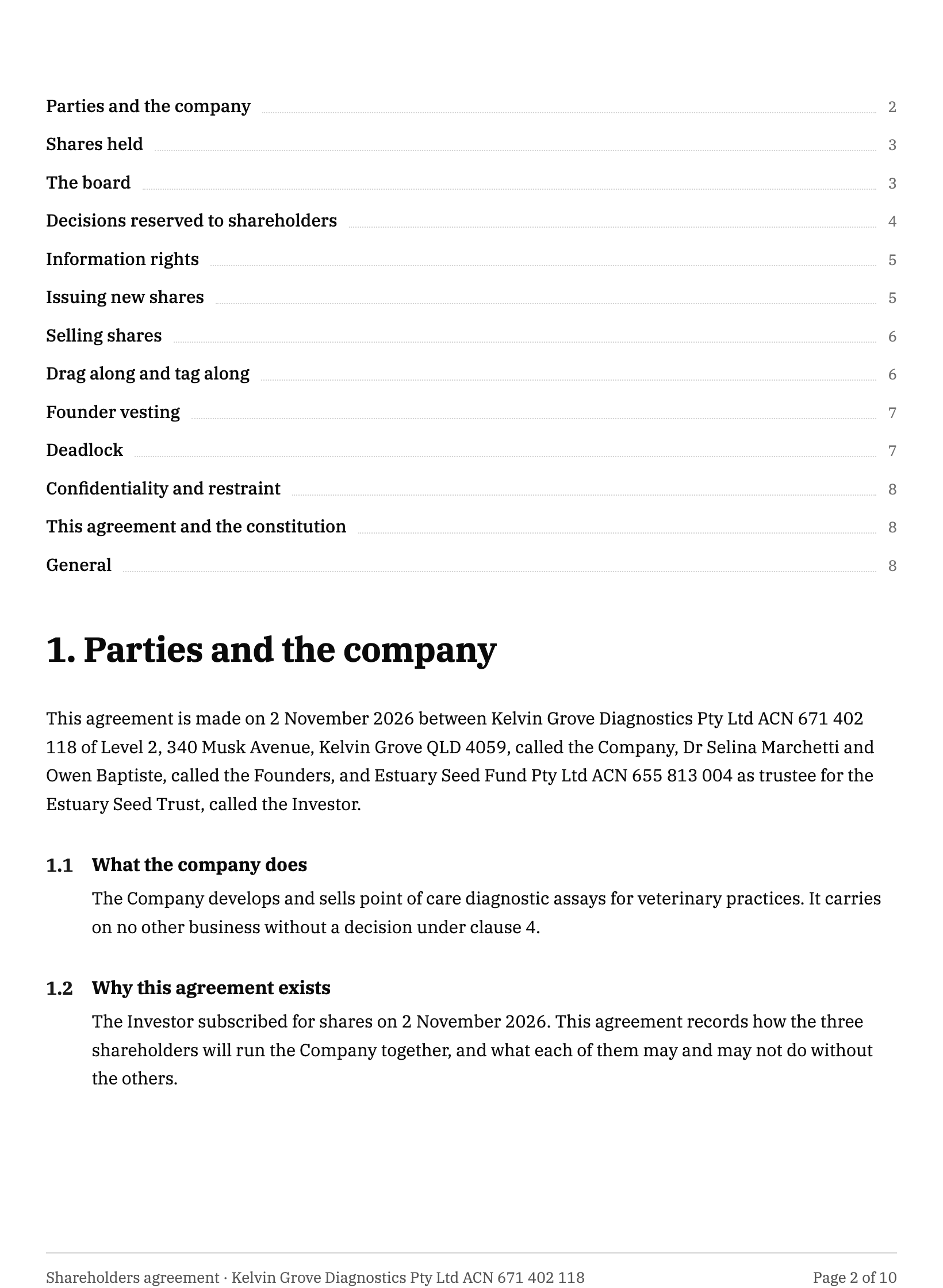 Shareholders agreement templateA veterinary diagnostics company has just taken $1.5 million from one seed fund. The founders keep 80 percent between them, so the whole agreement turns on a single number: the 75 percent consent threshold that puts the investor on one side of every decision that matters.
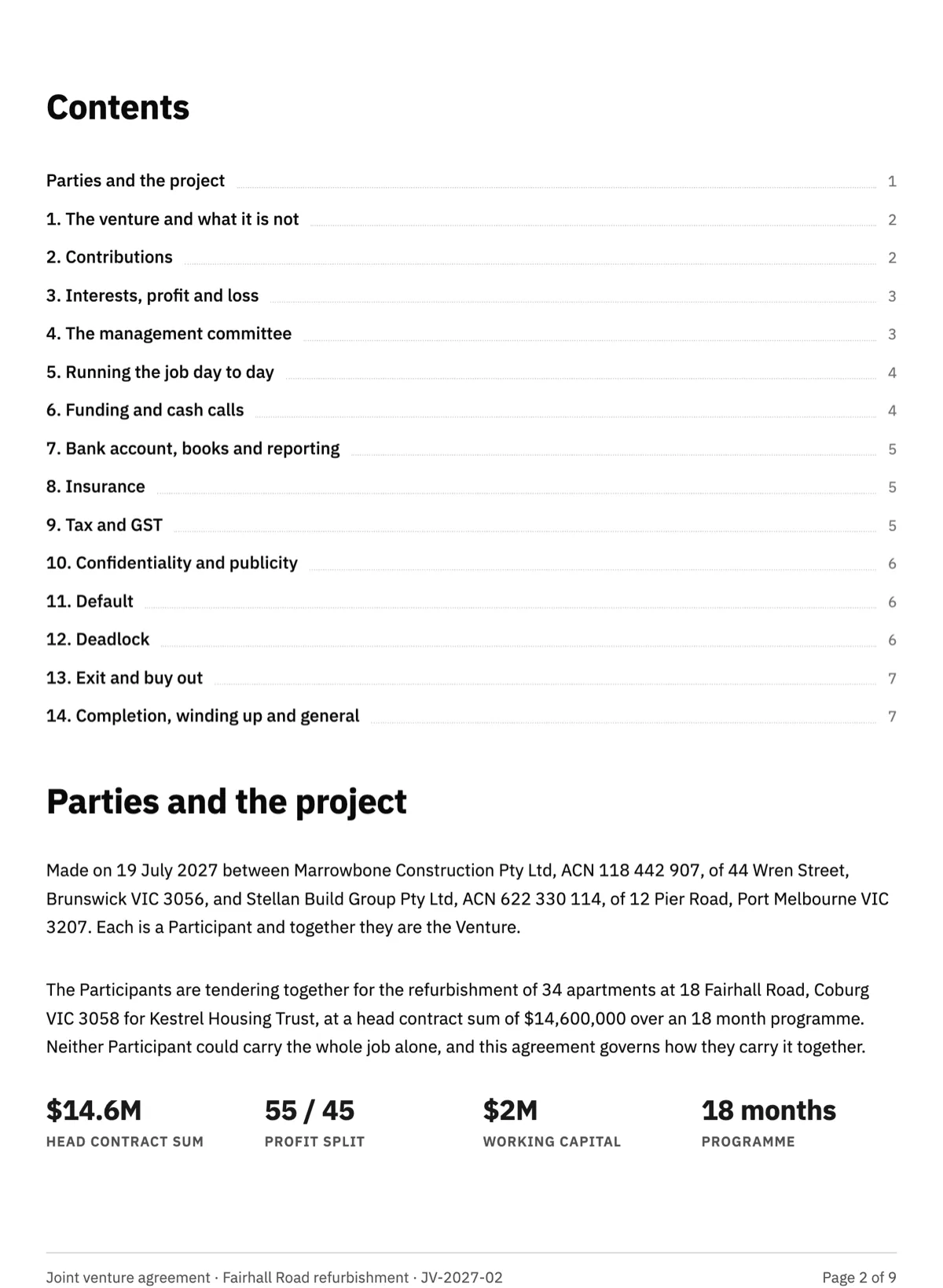 Joint venture agreement template with contributions and splitAn unincorporated joint venture has no company to fall back on, so everything a company structure would supply has to be written down. This one puts two builders together for a single $14.6 million refurbishment, splits it 55/45, and sets out who funds it, who decides, how a deadlock breaks and how either of them gets out.
Questions people ask
What information rights do shareholders have in Australia by law?
Fewer than many investors expect. Members can inspect the share register and the minute books of general meetings, but access to the financial records needs authorisation from the directors or a general meeting, or a court order. Holders of 5 per cent of the votes in a small proprietary company can require an annual financial report to be prepared.
What is a major investor for information rights?
It is a defined term in the agreement, usually an investor holding at least a set percentage of the shares, such as 5 per cent, or a set number of shares or dollar amount invested. Major investors typically receive monthly or quarterly detailed information, while smaller holders receive annual accounts and occasional summaries.
Can a company refuse to give information to a shareholder who competes with it?
It can if the agreement allows it. Many clauses exclude competitors from information rights or let the board withhold commercially sensitive information from any holder that competes. Without such wording, the company must comply with the clause as written and rely only on the confidentiality obligation to protect what it hands over.
What is a board observer?
A board observer is a person, usually nominated by an investor, who may attend board meetings and receive board papers but cannot vote. An observer is not a director, although the company should still require confidentiality and reserve the right to exclude the observer from privileged discussions or those involving the investor's own conflicts.
How quickly should monthly management accounts be delivered?
Common deadlines are 15 to 30 days, or business days, after month end. Twenty business days is realistic for a small company with an outsourced bookkeeper, while investors in later stage companies may expect 15 days. The deadline should match the company's actual month end close, or it will be missed every month.
Do information rights continue after an IPO?
Usually not. Once a company is listed, continuous disclosure rules require price sensitive information to be released to the market, and giving it privately to some shareholders creates problems. Agreements normally end information rights immediately before listing, after which every holder relies on the company's public disclosure.
Put the clause in a finished document
The button opens the document generator with a starting description already filled in. Change it to match your own agreement before you run it.
Create a document with OneCraftRelated clauses
- Anti dilution clause: protecting an investor's price in a down roundAn anti dilution clause adjusts an investor's price if later shares are issued cheaper. Sample weighted average wording, a worked example and a full ratchet.
- Pre emptive rights clause: first right to buy new sharesA pre emptive rights clause gives existing shareholders first right to new shares in proportion. Sample wording, a 10 business day offer and over allocation.
- Deadlock clause: breaking a tie in a 50 50 companyA deadlock clause sets how a 50 50 company breaks a tie between its owners. Sample wording with escalation, mediation, a shotgun buy sell and variants.
- Confidentiality clauseA confidentiality clause inside a wider contract, not a standalone NDA. Sample consulting wording, mutual and one way variants, the tail period and exceptions.
For everything the document generator can do, see the document maker.
Step by step in the builder: Create a document with AI, then Document builder components.
Written and checked by the OneCraft team. Last checked .