Contract clause
Deadlock clause: breaking a tie in a 50 50 company
A deadlock clause sets out what happens when the owners or directors of a company, usually split 50 50, cannot agree on a decision that needs both of them. It defines when a deadlock exists and runs through a sequence of steps, such as escalation, mediation and a buy sell mechanism, so the business is not left stuck.
Equal ownership feels fair on day one and becomes a trap the first time the owners disagree about something that matters. A deadlock clause decides in advance whether the tie is broken by talking, by a third party, or by one owner buying the other out.
Nuwan Madhusanka · Co-founder
4 min read · Published
Sample clause
a shareholders agreement for Tidewater Brewing Pty Ltd, a fictional Geelong craft brewery owned equally by the holding companies of its two founders
16. Deadlock 16.1 A Deadlock exists if a Reserved Matter is put to two Board meetings held at least 10 Business Days apart and is not approved at either. 16.2 Either Shareholder may then give a Deadlock Notice, and the managing directors of both Shareholders must meet within 10 Business Days to try to resolve it. 16.3 If the Deadlock is not resolved within 20 Business Days after the Deadlock Notice, it must be referred to mediation by a mediator agreed by the Shareholders or, failing agreement, appointed at the request of either Shareholder by the president of the law society in Victoria. 16.4 If the Deadlock remains unresolved 30 Business Days after mediation begins, either Shareholder (the Offeror) may serve a Buy Sell Notice stating a cash price per Share. 16.5 Within 30 Business Days the other Shareholder must either buy all the Offeror's Shares, or sell all its own Shares to the Offeror, at that price. 16.6 Until the Deadlock is resolved, the Company continues to operate in the ordinary course under the current Business Plan.
Sample wording, not legal advice.
Variants
Casting vote for the chair
Companies where one owner runs the business and the other is a passive investor who accepts the operator deciding day to day matters.
If the Board cannot reach a decision on any matter other than a Reserved Matter, the Chair, who is appointed by Harbour Holdings, has a casting vote. Harbour Holdings may not use the casting vote to approve a transaction with itself or its associates. Reserved Matters continue to require the approval of both Shareholders and are dealt with under clause 16.
Texas shoot out by sealed bids
Owners who worry that a shotgun lets the wealthier party name a low price the other cannot match.
If a Deadlock is unresolved after mediation, each Shareholder must, within 15 Business Days, deliver to an independent accountant a sealed bid stating the cash price per Share at which it will buy the other Shareholder's Shares. The accountant opens both bids together, and the Shareholder with the higher bid must buy, and the other must sell, all the other's Shares at the higher price within 40 Business Days.
Winding up as the last step
Joint ventures formed for a single project, where neither owner wants to run the business alone.
If a Deadlock remains unresolved 60 Business Days after the Deadlock Notice, either Shareholder may by notice require the Company to be wound up. Each Shareholder must vote in favour of a special resolution for a members' voluntary winding up, provided the Company is solvent, and the liquidator must offer the business for sale as a going concern before selling assets individually.
What to negotiate
What counts as a deadlock
A trigger that is too easy lets one owner manufacture a crisis to start a buyout. Owners usually limit it to reserved matters or essential decisions, such as the budget, borrowing or a sale, failing at two meetings over a set period. Ordinary operational disagreements are left to management or a casting vote rather than the buyout mechanism.
Shotgun fairness
A shotgun clause keeps prices honest because the offeror may end up on either side, but it favours the owner with ready cash, who can name a price the other cannot fund. The less liquid owner asks for a longer acceptance period to raise finance, payment by instalments, or a sealed bid alternative instead.
Cooling off before the buyout
Owners who want the business to survive insist on escalation and mediation first, with fixed timeframes so the steps cannot be used simply to delay. A short cooling off period after a deadlock notice often resolves the issue on its own, because both owners can see the buyout clause coming.
Running the business meanwhile
A deadlock over one issue should not freeze everything else. Clauses require the company to continue under the last approved budget and business plan, protect existing contracts and employees, and stop either owner acting outside the ordinary course of business until the process has run its full course.
The risk of leaving it out
Without a deadlock clause, owners of a 50 50 company who cannot agree have few options apart from litigation. An Australian court can wind a company up on the just and equitable ground where deadlock has made it unworkable, but that route is expensive and slow, and it usually destroys the value both owners were trying to protect.
Resolution methods compared
A casting vote is quick but ends the equality of ownership. Escalation to senior people is cheap and keeps the relationship, but may only delay. Mediation is confidential and often works, but binds nobody. Expert determination suits valuation or technical disputes and is binding. An independent director breaks ties continuously, at a cost and only if both trust the appointee. A shotgun buy sell is fast and fair on price, but favours the owner with more cash, as does a Texas shoot out using sealed bids. Put and call options give a defined exit. Winding up is the last resort, because it usually destroys value.
What happens without a clause
The Corporations Act allows a court to order a company wound up where that is just and equitable, and deadlock between equal owners of a company run like a partnership is a recognised example. The court can instead make other orders in some cases, such as requiring one member to buy another's shares. In the UK, members can seek relief from unfair prejudice under the Companies Act 2006. ASIC's guidance on disputes in small proprietary companies limits its role to recommending legal advice, so the contract is the owners' main tool.
Where it sits in a generated document
A generated shareholders or joint venture agreement carries the deadlock clause as a numbered sequence of steps, each with its day count, and the reserved matters it depends on appear in their own numbered clause. The timeframes and the buy sell mechanics are written in as content. The document does not cite the Corporations Act, and each owner signing is a separate signature block party.
Documents that carry this clause
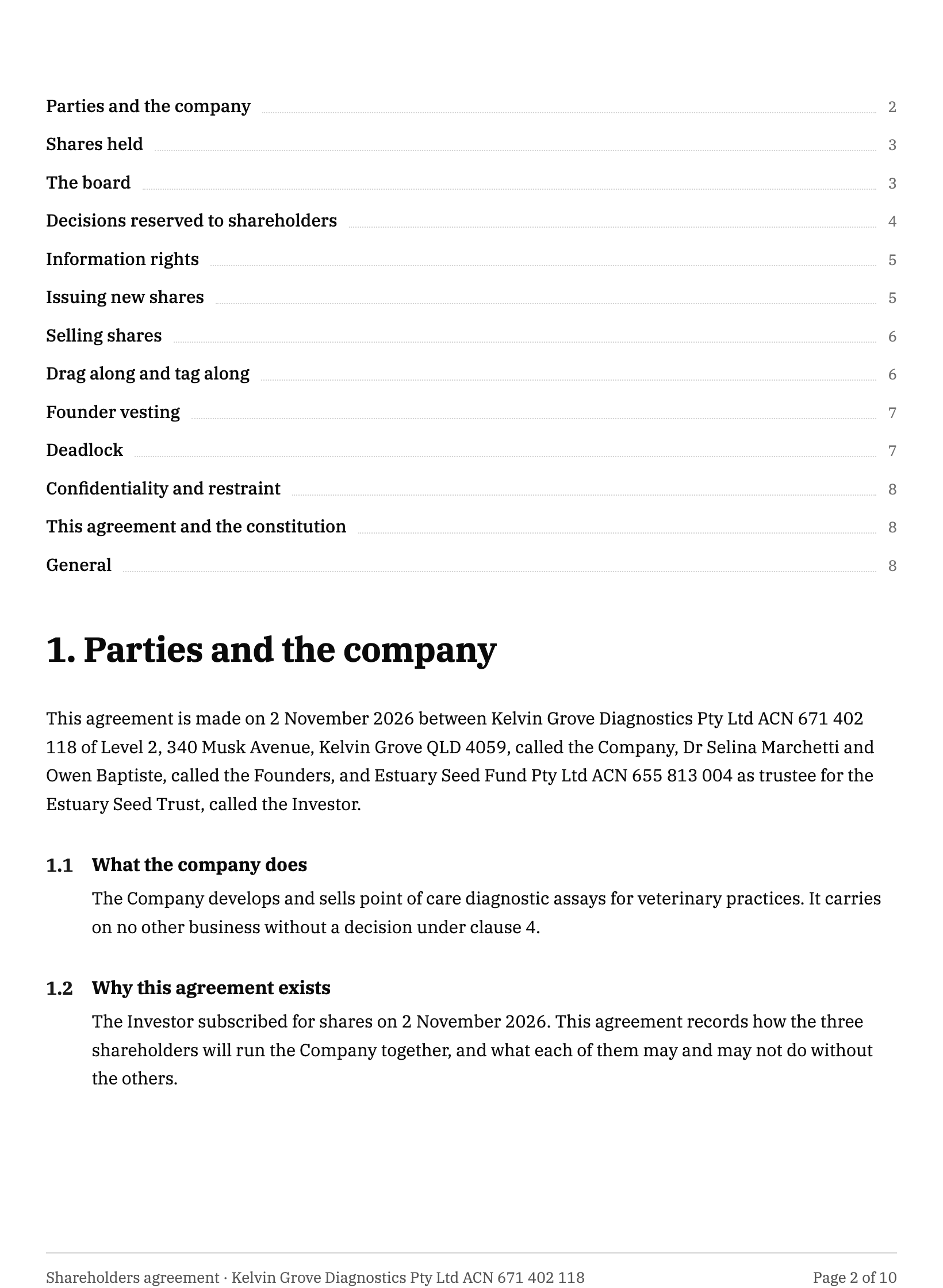 Shareholders agreement templateA veterinary diagnostics company has just taken $1.5 million from one seed fund. The founders keep 80 percent between them, so the whole agreement turns on a single number: the 75 percent consent threshold that puts the investor on one side of every decision that matters.
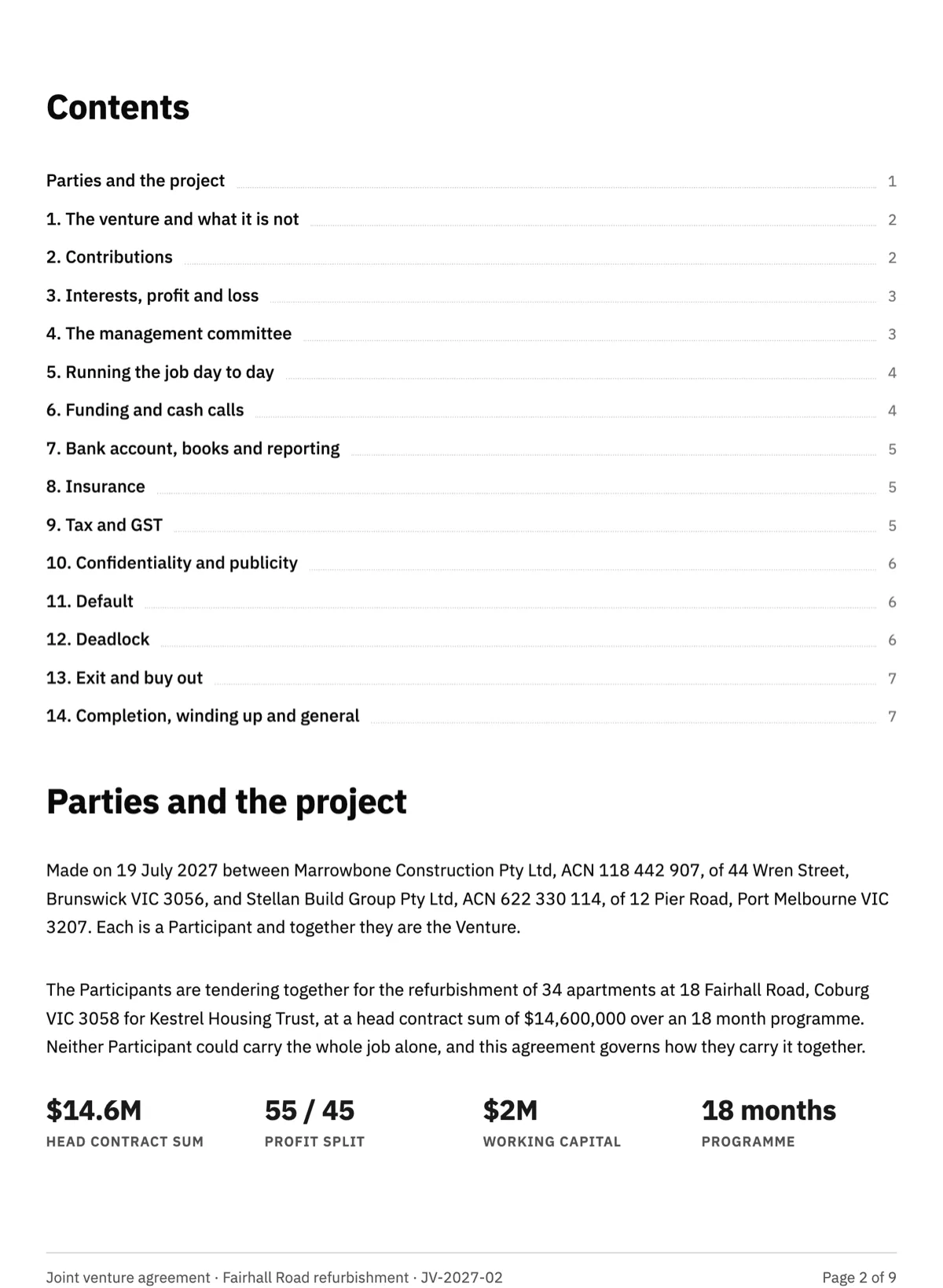 Joint venture agreement template with contributions and splitAn unincorporated joint venture has no company to fall back on, so everything a company structure would supply has to be written down. This one puts two builders together for a single $14.6 million refurbishment, splits it 55/45, and sets out who funds it, who decides, how a deadlock breaks and how either of them gets out.
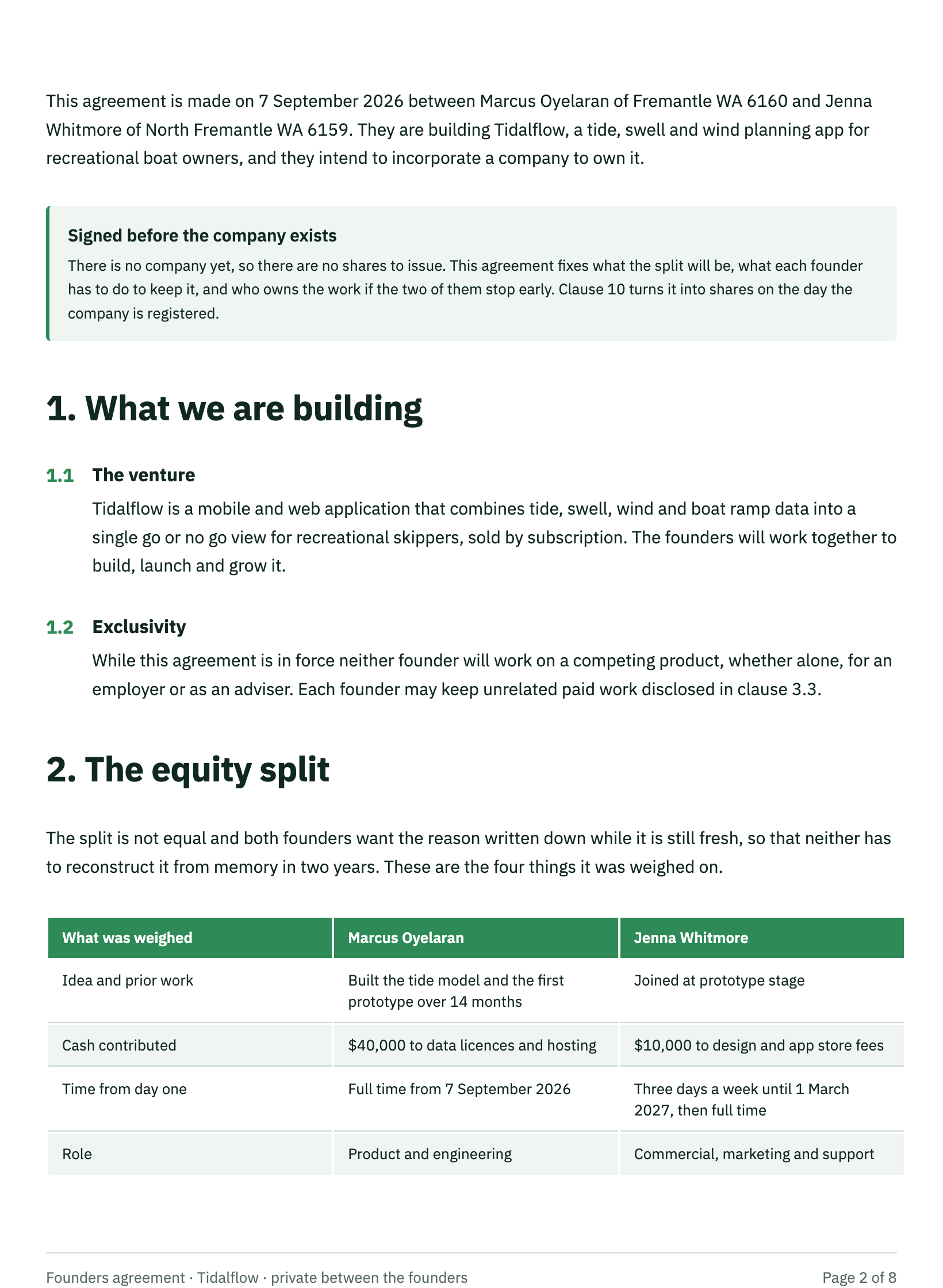 Founders agreement templateTwo people in Fremantle are building a tide and swell planning app and have not registered a company yet. There are no shares to issue, so this agreement fixes the split, records why it is 55/45 while the memory is fresh, and turns itself into shares on the day the company exists.
Questions people ask
What is a shotgun clause?
A shotgun clause, also called a Russian roulette or buy sell clause, lets one owner name a price per share, after which the other owner must either buy the first owner's shares or sell its own at that price. Because the offeror may end up buying or selling, it has a strong incentive to name a fair price.
What is a Texas shoot out?
It is a deadlock mechanism in which both owners submit sealed bids stating the price at which they would buy the other out, and the higher bidder must buy at its own bid. Some versions use rounds of open bidding instead. It suits owners who want both sides to put a price forward rather than react to one.
Does a 50 50 company need a deadlock clause?
It is strongly advisable. With equal votes, any decision requiring both owners can stall indefinitely. The replaceable rules give the chair of a directors' meeting a casting vote, but equal owners often remove it because it hands every tie to one side. A deadlock clause is cheap to agree at the start and far harder to negotiate once the owners are already in dispute.
Can a court break a deadlock between shareholders?
A court can order a company to be wound up on the just and equitable ground where deadlock makes it unworkable, particularly in a company run like a partnership, and in some cases may make other orders such as a share purchase. Litigation is slow and costly, so owners usually prefer a contractual process that keeps them out of court.
What decisions usually trigger a deadlock clause?
Reserved matters that need the approval of both owners, such as adopting the annual budget, borrowing above a limit, issuing shares, selling the business, appointing senior executives or entering major contracts. Everyday operational decisions are usually excluded, so a disagreement about minor spending cannot be used to force a buyout of the other owner.
Is a casting vote a good way to avoid deadlock?
It is quick, but it ends the equality of a 50 50 company, because the owner who appoints the chair wins every tied vote. It suits companies where one owner operates the business and the other is a passive investor. Where both owners are active, a casting vote is usually limited to routine matters.
Put the clause in a finished document
The button opens the document generator with a starting description already filled in. Change it to match your own agreement before you run it.
Create a document with OneCraftRelated clauses
- Exit clause in a shareholders agreement: planning the sale or listingAn exit clause in a shareholders agreement sets when and how owners pursue a sale or listing. Sample wording with an exit window, exit events and variants.
- Right of first refusal clause: matching an outside offer for sharesA right of first refusal clause lets shareholders match an outside offer before shares are sold. Sample wording with 20 business days and a ROFO comparison.
- Information rights clause: what investors are told and whenAn information rights clause sets which reports investors receive and when. Sample wording with monthly accounts, audited accounts in 120 days and variants.
For everything the document generator can do, see the document maker.
Step by step in the builder: Create a document with AI, then Send a document for signature.
Written and checked by the OneCraft team. Last checked .