Contract clause
Right of first refusal clause: matching an outside offer for shares
A right of first refusal clause requires a shareholder who has an offer from an outsider to give the other shareholders, or the company, the chance to buy the shares on the same terms first. Only if they decline within the stated period can the seller complete the sale to the outsider, and then on no better terms.
Private company owners care who they end up in business with, and this clause is the usual way they keep control over it. It also affects the price a seller can get, because an outside buyer knows its offer may simply be matched.
Indunil Asanka · Co-founder
4 min read · Published
Sample clause
a shareholders agreement for Banksia Dental Group Pty Ltd, a fictional company owning three dental practices in Canberra, held by four dentist shareholders
11. Right of First Refusal 11.1 A Shareholder that receives a bona fide offer from a third party to buy any of its Shares, and wishes to accept it, must first give a Transfer Notice to the Company and every other Shareholder, attaching a copy of the offer. 11.2 The Transfer Notice is an offer to sell those Shares to the other Shareholders at the same price per Share and on the same terms as the third party offer. 11.3 The other Shareholders may accept for all, but not some, of the Shares within 20 Business Days after receiving the Transfer Notice, with the Shares allocated among those accepting in proportion to their holdings. 11.4 If the offer is not accepted in full, the Seller may sell all the Shares to the third party within 60 days, at a price not lower than and on terms not more favourable than those in the Transfer Notice. 11.5 A third party buyer must sign a deed agreeing to be bound by this agreement before its transfer is registered. 11.6 Non cash consideration in a third party offer is valued at its cash equivalent by an independent valuer appointed by the Board.
Sample wording, not legal advice.
Variants
Right of first offer
Sellers who want to avoid scaring off outside buyers, and holders content to make the first bid.
A Shareholder wishing to sell any Shares must first give notice to the other Shareholders, who may within 15 Business Days make a written offer to buy all of them at a stated price. If an offer is made and the Seller does not accept it, the Seller may for 90 days sell the Shares to a third party, but only at a price higher than the highest offer received under this clause.
Company first, then investors
Agreements following US venture practice, where the company holds the first option and investors take any shares the company does not buy.
The Company has the first right to buy all or any of the Offered Shares on the terms in the Transfer Notice by giving notice within 15 Business Days, subject to the share buy back rules of the Corporations Act. Any Offered Shares the Company does not elect to buy are then offered to the Major Investors, who have a further 10 Business Days to elect to buy them in proportion to their holdings.
First offer followed by first refusal
Holders who want both a first bid and a last look, accepting that it slows any sale.
A Seller must first offer its Shares to the other Shareholders under clause 11A at a price it names. If they decline, the Seller may seek a third party buyer, but before accepting a third party offer at a price less than 95 per cent of the price named under clause 11A, the Seller must give the other Shareholders a further right to buy at the third party price within 10 Business Days.
What to negotiate
All or nothing
Sellers want holders to buy all the offered shares or none, so the outside buyer is not left with a smaller parcel it never wanted. Holders sometimes want to buy only part. Most clauses require the whole parcel to be taken up across the accepting holders, with over allocation between them, before the right counts as exercised.
Non cash and packaged offers
A third party may offer shares in its own company, deferred payments or a deal covering other assets. Holders cannot easily match those terms, so clauses convert non cash consideration to a cash equivalent set by a valuer. Sellers ask that the valuer be independent and that the matching period start only once the value is known.
Permitted transfers
Shareholders want to move shares to a family trust, a holding company or a superannuation fund without triggering the right. Other holders accept a list of permitted transfers, provided the transferee signs a deed and the shares come back if it stops being controlled by the original shareholder.
The effect on outside buyers
Outside buyers dislike spending money on due diligence for a deal that can be matched. Sellers therefore sometimes push for a right of first offer instead, or a short matching period and a break fee for the outsider. Holders resist both where they value control over who joins the register more than the speed of a sale.
The risk of leaving it out
Without a first refusal right, a shareholder in a proprietary company can agree to sell to anyone, subject only to any power in the constitution for directors to refuse to register the transfer. The remaining owners may find a competitor or a stranger on the register, or be left relying on a director discretion that is harder to exercise properly than a clear contractual right.
ROFR and ROFO compared
A right of first refusal is triggered by a real outside offer, while a right of first offer applies before the seller looks for a buyer. Under a refusal right the outsider sets the price, and under a first offer the holders or seller set it. A refusal right can deter outside bidders who fear being matched, while a first offer does not. A refusal right gives the seller a genuine market test but adds delay after a deal is found, whereas a first offer is quicker to run but may leave the seller wondering whether an outsider would have paid more.
The statutory background
Many Australian proprietary companies rely on the replaceable rule that lets directors refuse to register a transfer of shares, and some constitutions add pre emption on transfer. Directors must exercise that power for a proper purpose, which makes it an uncertain protection on its own. UK private companies using the model articles have a similar director discretion to refuse registration. A contractual first refusal right is more predictable because it fixes the process, the price and the timing.
Where it sits in a generated document
A generated shareholders agreement carries the right of first refusal as the first numbered clause in the share transfer section, with tag along and drag along following it, so the transfer notice defined there can be reused. The matching period and the sale window are written in as content. The document does not cite the Corporations Act or the model articles.
Documents that carry this clause
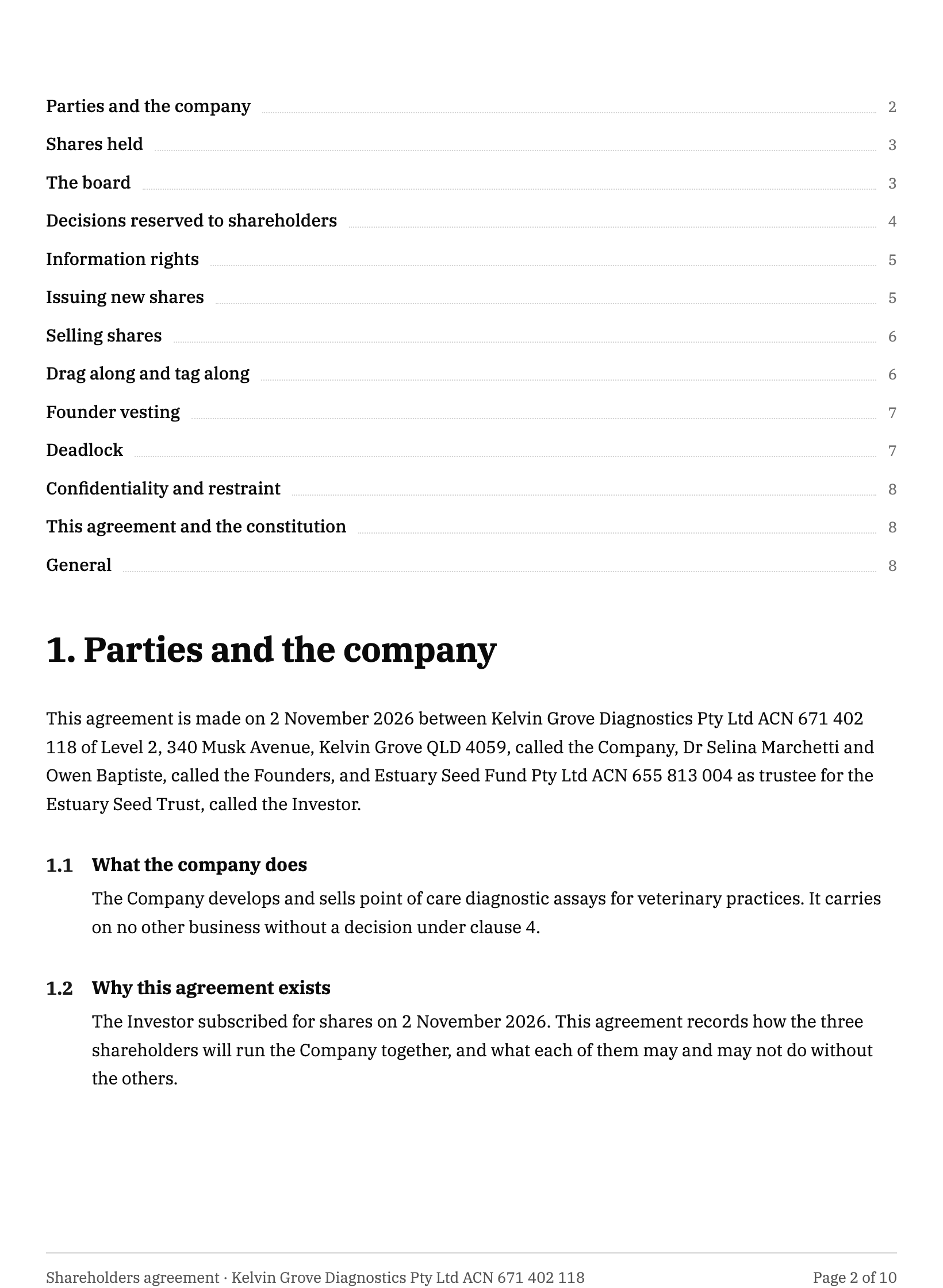 Shareholders agreement templateA veterinary diagnostics company has just taken $1.5 million from one seed fund. The founders keep 80 percent between them, so the whole agreement turns on a single number: the 75 percent consent threshold that puts the investor on one side of every decision that matters.
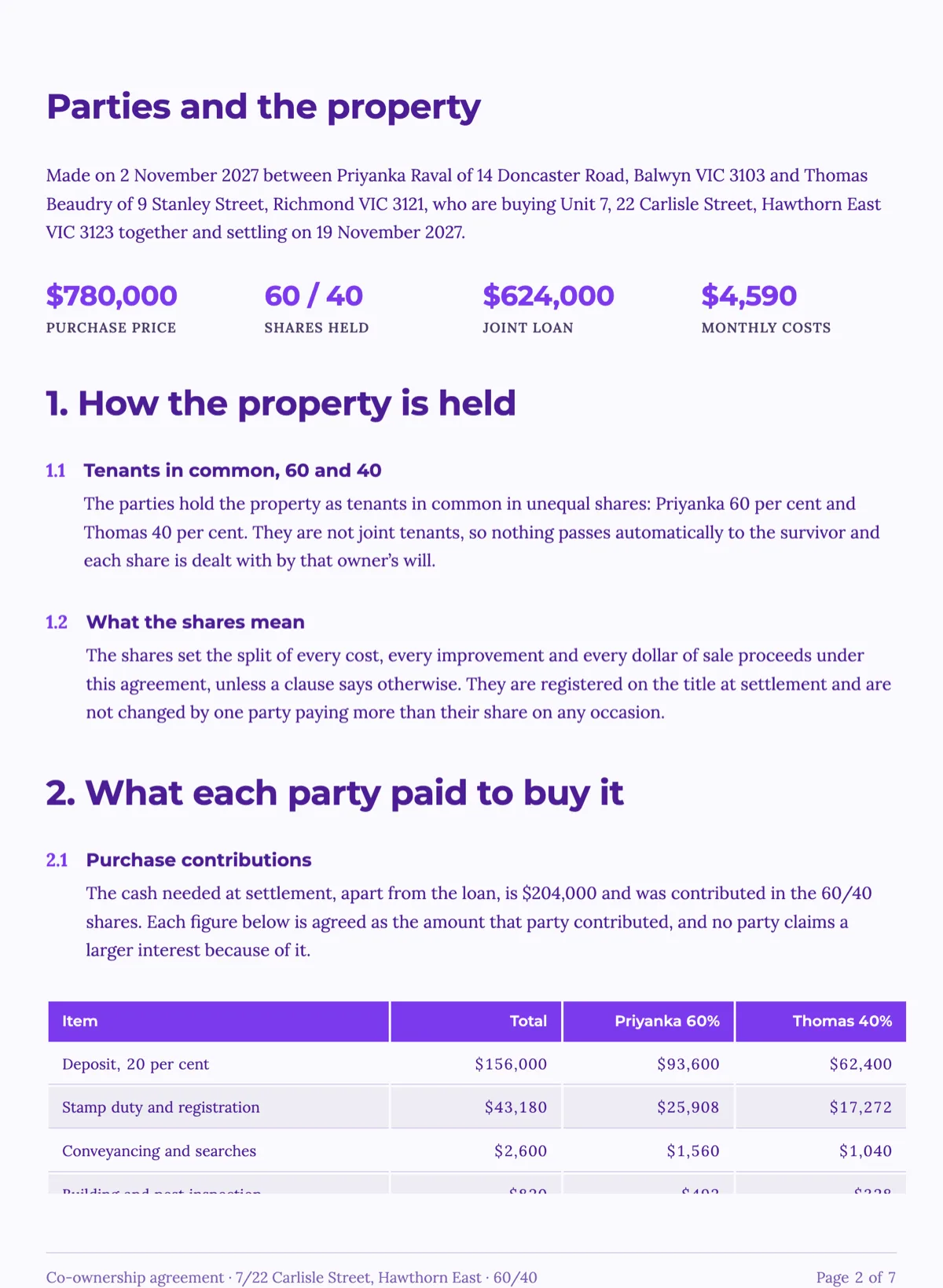 Co-ownership agreement template for shares, costs and exitA co-ownership agreement is what two people write before they buy together, not after something goes wrong. This one covers a $780,000 unit held 60/40 as tenants in common, with tables for who paid what at settlement, who pays what each month, and how either of them gets out.
Questions people ask
What is the difference between a right of first refusal and a right of first offer?
A right of first refusal lets holders match an offer the seller has already received from an outsider. A right of first offer requires the seller to offer the shares to holders before looking for an outside buyer, and then limits the price it can accept from others. The first tends to favour existing holders, the second favours sellers.
Does a right of first refusal reduce the price a seller can get?
It can. Outside buyers may bid less, or not bid at all, if they expect to be matched after spending time and money on due diligence. Sellers reduce that effect with short matching periods and clear rules, or by negotiating a right of first offer instead, which does not put a completed outside deal at risk.
How long should existing holders have to match an offer?
Commonly 15 to 30 business days after they receive a complete notice with the offer attached. A longer period gives holders time to arrange funds but increases the risk that the outside buyer walks away. Where non cash consideration needs to be valued, the period should start only once the valuation has been delivered.
Can the company itself exercise a right of first refusal?
It can be given the right, but an Australian company buying its own shares must follow the share buy back rules in the Corporations Act, including the requirement not to materially prejudice its ability to pay creditors. That is why many agreements give the right to the other shareholders, or let the board nominate a buyer instead.
Does a right of first refusal apply to transfers within a family?
Usually not, if the agreement lists permitted transfers. Typical permitted transferees are a family trust, a holding company or a self managed superannuation fund controlled by the shareholder, and sometimes a spouse or child. The transferee normally signs a deed agreeing to be bound, and the shares must come back if control changes.
What happens if a shareholder sells without following the clause?
The transfer is a breach of the shareholders agreement, and where the constitution contains the same restriction, the directors can refuse to register it. The other shareholders may seek an injunction or damages, and some agreements treat the breach as a default event that triggers a compulsory sale of the defaulting shareholder's shares at a discount.
Put the clause in a finished document
The button opens the document generator with a starting description already filled in. Change it to match your own agreement before you run it.
Create a document with OneCraftRelated clauses
- Pre emptive rights clause: first right to buy new sharesA pre emptive rights clause gives existing shareholders first right to new shares in proportion. Sample wording, a 10 business day offer and over allocation.
- Tag along clause: letting minority shareholders join a saleA tag along clause lets minority shareholders join a sale on the same terms as the seller. Sample wording with a 25 percent trigger, pro rata tag and variants.
- Drag along clause: making minority shareholders join a saleA drag along clause lets majority shareholders make minorities join a sale of the company. Sample wording with a 75 percent threshold, protections and variants.
- Good leaver bad leaver clause: pricing a departing founder's sharesA good leaver bad leaver clause prices a departing founder's shares by why they left. Sample wording, a leaver price table, three variants and the penalty risk.
For everything the document generator can do, see the document maker.
Step by step in the builder: Create a document with AI, then Document builder components.
Written and checked by the OneCraft team. Last checked .