Contract clause
Good leaver bad leaver clause: pricing a departing founder's shares
A good leaver bad leaver clause decides what happens to a departing founder's or employee's shares, and at what price, depending on why they left. A good leaver, such as someone who dies, becomes incapacitated or is made redundant, usually sells at fair value, while a bad leaver sells at a much lower price.
Founders leave for every reason from illness to misconduct, and shares held by someone who fell ill should not be treated like shares held by someone who walked out to join a competitor. The classification is what gets fought over, because it can move the value of a stake by millions.
Indunil Asanka · Co-founder
4 min read · Published
Sample clause
a shareholders agreement for Currawong Freight Tech Pty Ltd, a fictional Melbourne logistics software company with three founders and a venture investor
15. Leavers 15.1 When a Founder ceases to be a director or employee of the Company, the Board may, within 60 days, require the Leaver to sell all Shares held by the Leaver to buyers nominated by the Board or to the Company by way of buy back. 15.2 A Good Leaver is a Leaver who ceases because of death, permanent incapacity, redundancy or dismissal other than for Cause, or who resigns more than 24 months after the Commencement Date. 15.3 A Bad Leaver is any Leaver who is not a Good Leaver, including a Leaver dismissed for Cause or found to have breached clause 18 (Restraint). 15.4 The price for a Good Leaver's vested Shares is Fair Value, and for its unvested Shares is the lower of their issue price and Fair Value. 15.5 The price for all of a Bad Leaver's Shares is the lower of their issue price and Fair Value. 15.6 Fair Value is determined by an independent valuer appointed by the Board, without any discount for a minority holding. 15.7 The Board may, with Investor Majority consent, treat a Bad Leaver as a Good Leaver.
Sample wording, not legal advice.
Variants
Three tier with an intermediate leaver
Founders who argue that resigning after a few years is neither good nor bad and should sit in between.
An Intermediate Leaver is a Founder who resigns after the first anniversary but before the third anniversary of the Commencement Date, other than as a Good Leaver. An Intermediate Leaver keeps its vested Shares and must sell its unvested Shares at the lower of their issue price and Fair Value. A Bad Leaver must sell all its Shares at that lower price, and a Good Leaver keeps all its vested Shares.
Good leavers keep their shares
Companies content for good leavers to stay on the register as passive investors.
A Good Leaver may keep all of its vested Shares, and the Company may buy back its unvested Shares at their issue price. A Bad Leaver must, if the Board so requires within 60 days, sell all of its Shares at the lower of their issue price and Fair Value. A Leaver who keeps Shares remains bound by this agreement but loses any right to appoint a director.
Bad leaver pricing limited to recent vesting
Founders who accept a price penalty for bad leaving but not the loss of value earned over many years.
On ceasing to provide services, a Founder's unvested Shares are bought back at their issue price. Its vested Shares are bought at Fair Value if it is a Good Leaver. If it is a Bad Leaver, Shares that vested in the 12 months before it ceased are bought at the lower of issue price and Fair Value, and all its other vested Shares are bought at Fair Value.
What to negotiate
Where resignation falls
Investors want voluntary resignation in the early years treated as bad leaving, since a founder walking away can hurt the company as much as misconduct. Founders argue resignation is not wrongdoing. Common settlements treat resignation after a set period as good leaving, or create an intermediate category that keeps vested shares at fair value but loses unvested ones.
How fair value is set
The price turns on the valuation. Leavers want an independent valuer, no discount for a minority holding, and the value of the whole company divided pro rata. Companies want a quicker method, such as the price in the last funding round, and sometimes a minority discount. An agreed method written into the clause prevents a second dispute after the first.
What cause means
Bad leaver status on dismissal depends on the definition of cause. Founders want it limited to serious misconduct, fraud and material breach left unremedied after notice. Investors want wider triggers, such as persistent underperformance. Because the definition can strip most of the value from a stake, founders also ask that a genuine dispute about cause pause the transfer until it is resolved.
Penalty risk and restraint breaches
A forced sale at a nominal price because a founder breached a restraint can be challenged as a penalty. The UK Supreme Court in Cavendish Square Holding v Makdessi upheld a lower transfer price as protecting a legitimate interest, and Australian courts apply a similar legitimate interest test. Prices tied to a genuine commercial reason, rather than punishment, are far more defensible.
The risk of leaving it out
Without leaver provisions, a founder who leaves keeps all their shares and shares in every future increase in value, even after joining a competitor. The remaining founders and investors can only negotiate a buy back at whatever price the leaver will accept, usually at the moment the company can least afford a dispute.
Leaver events and the price for each
Under the sample clause, death or permanent incapacity makes the founder a good leaver, with vested shares at fair value. Redundancy or dismissal without cause is also good leaving. Resignation more than 24 months after commencement is good leaving, with vested shares at fair value and unvested shares at the lower of cost and fair value. Resignation within 24 months is bad leaving, and every share goes at the lower of cost and fair value. Dismissal for cause, such as fraud or serious misconduct, and a breach of the restraint are bad leaving on the same price. The board, with investor consent, can always move a leaver into the better category.
Buy backs, transfers and the law
In Australia a company buying a leaver's shares must follow the share buy back rules in the Corporations Act, which require that the buy back does not materially prejudice the company's ability to pay its creditors and that the correct approval procedure is used, so many agreements let the board nominate other shareholders or an incoming executive as buyer instead. The penalty doctrine, which the High Court now applies through a legitimate interest test, can reach prices fixed well below value, and restraint of trade rules apply to the restraints that often trigger bad leaver status.
Where it sits in a generated document
A generated shareholders or founders agreement carries the leaver provisions as a numbered clause directly after vesting, with good leaver, bad leaver and fair value as defined terms. The leaver categories and prices are written in as content, so each founder can see the outcome for every reason for leaving. The document does not cite the Corporations Act or case law.
Documents that carry this clause
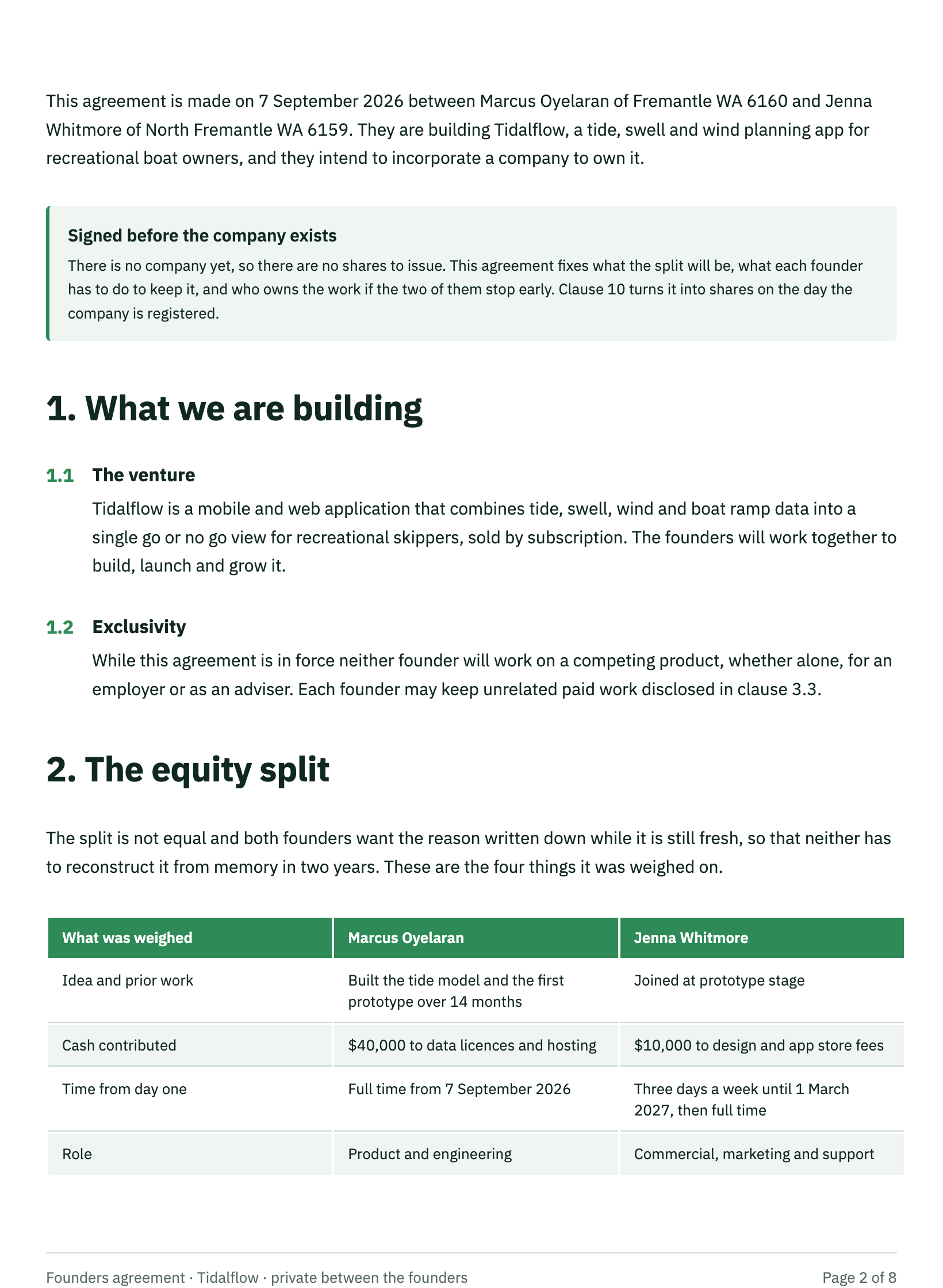 Founders agreement templateTwo people in Fremantle are building a tide and swell planning app and have not registered a company yet. There are no shares to issue, so this agreement fixes the split, records why it is 55/45 while the memory is fresh, and turns itself into shares on the day the company exists.
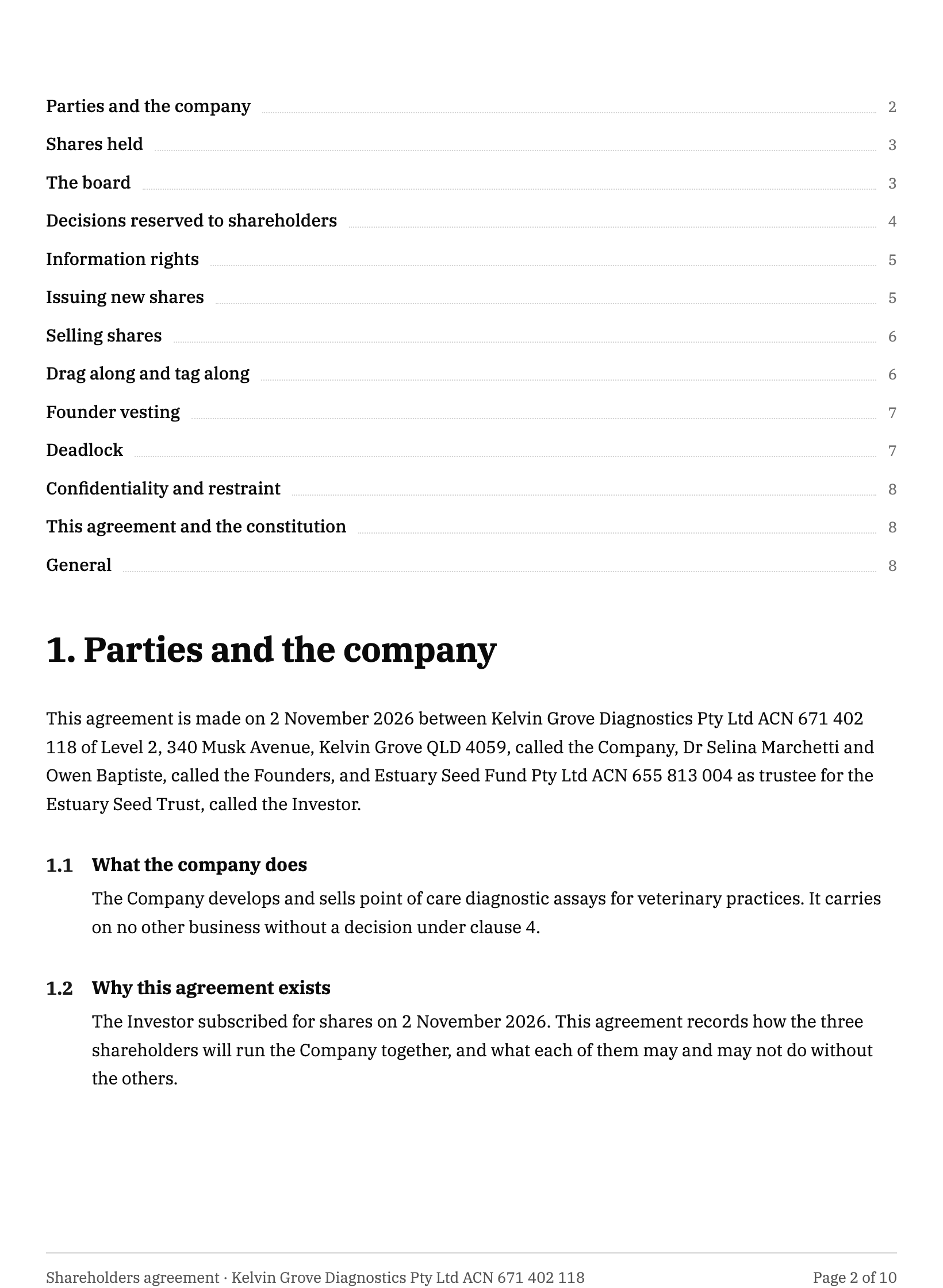 Shareholders agreement templateA veterinary diagnostics company has just taken $1.5 million from one seed fund. The founders keep 80 percent between them, so the whole agreement turns on a single number: the 75 percent consent threshold that puts the investor on one side of every decision that matters.
Questions people ask
Who is a good leaver?
Whoever the agreement says. Typical good leaver events are death, permanent incapacity, redundancy, dismissal without cause and, in many agreements, resignation after a minimum period. Some agreements also let the board, with investor consent, treat any leaver as a good leaver, which gives flexibility for a founder leaving on good terms for a reason the list does not cover.
What price does a bad leaver get for their shares?
Usually the lower of what they paid and fair value, which for founders who received shares at a nominal price can mean almost nothing. Some agreements apply the lower price only to unvested shares or to shares that vested recently. Because the difference can be large, the definition of bad leaver is the most negotiated part of the clause.
Is resigning a bad leaver event?
It depends on the agreement. Investor friendly drafts treat any resignation within the first few years as bad leaving, while founder friendly drafts treat resignation on proper notice as good leaving. Many land in between, with resignation after 24 or 36 months treated as good leaving, or an intermediate category that keeps vested shares but loses unvested ones.
Can bad leaver provisions be a penalty?
They can be challenged as one if the price is out of all proportion to a legitimate interest the company is protecting. Courts in Australia and the UK have upheld lower transfer prices where they protect real interests, such as goodwill and loyalty. A clause tied to clear reasons, with a price method that can be explained, is far easier to defend.
How is fair value determined for leaver shares?
By the method the agreement sets, commonly an independent valuer appointed by the board or agreed by the parties, valuing the company as a whole and applying the leaver's proportion without a minority discount. Some agreements use the latest funding round price for speed, with a right for either side to require a valuer if that round is old.
Do leaver provisions apply to employees with share options?
Employee option plans usually have their own leaver rules, which commonly let good leavers keep vested options for a limited exercise period and cause unvested options to lapse, while bad leavers often lose all options. The shareholders agreement leaver clause mainly deals with founders and others who already hold shares, so the two sets of rules should be read together.
Put the clause in a finished document
The button opens the document generator with a starting description already filled in. Change it to match your own agreement before you run it.
Create a document with OneCraftRelated clauses
- Vesting clause: earning founder shares over timeA vesting clause makes founder or employee shares earned over time. Sample wording with a 4 year schedule and 1 year cliff, a vesting table and acceleration.
- Right of first refusal clause: matching an outside offer for sharesA right of first refusal clause lets shareholders match an outside offer before shares are sold. Sample wording with 20 business days and a ROFO comparison.
- Termination for cause clauseA termination for cause clause ends a contract for serious breach. Sample wording, what counts as material, cure periods and immediate termination events.
For everything the document generator can do, see the document maker.
Step by step in the builder: Create a document with AI, then Document builder components.
Written and checked by the OneCraft team. Last checked .