Contract clause
Vesting clause: earning founder shares over time
A vesting clause makes founder or employee shares, or options, subject to being earned over time or on milestones, so that shares not yet vested when a person leaves can be bought back or forfeited. It sets the vesting start date, any cliff, the schedule, what happens on leaving, and whether a sale speeds vesting up.
Equity handed out on day one assumes everyone will stay, and without vesting the co founder who leaves in month four keeps half the company. Vesting ties ownership to contribution, which is also why investors expect to see it before they put money in.
Indunil Asanka · Co-founder
4 min read · Published
Sample clause
a founders agreement for Moonah Labs Pty Ltd, a fictional Hobart climate software company where each of two founders holds 4,800,000 ordinary shares
7. Founder Vesting 7.1 The 4,800,000 Shares held by each Founder are Vesting Shares, subject to this clause from 1 March 2027 (the Vesting Start Date). 7.2 No Vesting Shares vest before the first anniversary of the Vesting Start Date, when 1,200,000 vest. 7.3 After the first anniversary, 100,000 Vesting Shares vest on the first day of each month, so that all Vesting Shares have vested by the fourth anniversary. 7.4 Vesting stops on the date a Founder ceases to provide services to the Company. 7.5 The Company may, within 90 days after that date, buy back or nominate a buyer for all unvested Shares of the departing Founder at the lower of their issue price and Fair Value, subject to the Corporations Act. 7.6 If a Sale of the Company completes and the Founder's services are ended without cause within 12 months afterwards, all remaining Vesting Shares vest immediately.
Sample wording, not legal advice.
Variants
Time based vesting with credit for past work
Founders who worked on the business before incorporating and want that time recognised.
The Vesting Start Date is 1 September 2026, being the date the Founders began working on the Business together, even though the Shares were issued later. The first 25 per cent of each Founder's Vesting Shares vest on 1 September 2027, and the remainder vest in equal monthly instalments over the following 36 months, provided the Founder continues to provide services to the Company on each vesting date.
Milestone vesting
A founder joining to deliver a defined result, such as a product launch or a first round of funding.
The Technical Founder's 1,500,000 Vesting Shares vest in three equal tranches of 500,000: on the Company's first paid commercial release of the Platform, on the Company reaching $1,000,000 in annual recurring revenue, and on completion of a Series A investment of at least $5,000,000. Any tranche not vested by 30 June 2030 lapses, and the Shares in it may be bought back under clause 7.5.
Single trigger acceleration on a sale
Founders with bargaining power who want every unvested share to vest on a sale, whatever happens afterwards.
All unvested Vesting Shares vest in full immediately before completion of a Sale of the Company, whether or not the Founder continues to provide services after completion. For this clause, a Sale of the Company includes a sale of all or substantially all of the Company's business and assets and any transaction in which a person acquires more than 50 per cent of the Shares.
What to negotiate
Length and cliff
Four years with a one year cliff is the familiar default, drawn from US venture practice and common in Australia. Founders who have already built the product ask for a shorter schedule or credit for past work. Investors resist a short schedule, because the point of vesting is to keep the team together through the period their money is being spent.
Acceleration
Single trigger acceleration vests everything on a sale, which founders like and buyers dislike, since the team may leave with full value. Double trigger acceleration vests on a sale only if the founder is then dismissed without cause, which is the more common compromise. Partial acceleration, such as twelve extra months of vesting, is also used.
Buy back mechanics and price
An Australian company cannot simply cancel a founder's shares. Unvested shares are usually bought back under the Corporations Act procedures, transferred to a nominee, or held on trust until they vest. Founders negotiate the price, commonly the lower of issue price and fair value for unvested shares, and how long the company has to act.
Tax treatment
Vesting can change when tax arises. Employees acquiring interests under an employee share scheme may qualify for Australian start up concessions, and US founders often make a section 83(b) election within 30 days of receiving restricted shares. The structure should be checked with a tax adviser before signing, because it changes the result.
The risk of leaving it out
Without vesting, a founder who leaves early keeps every share while the remaining founders do the work that builds their value. Investors see that as a risk to the company they are funding, so a missing vesting clause often surfaces at due diligence and is imposed then, on terms the founders have far less room to negotiate.
The schedule for one founder
Using the sample figures for a founder with 4,800,000 Vesting Shares: at 11 months nothing has vested; at 12 months 1,200,000 shares vest, 25 per cent; at 24 months 2,400,000 have vested, 50 per cent; at 36 months 3,600,000, 75 per cent; and at 48 months all 4,800,000. Each month after the cliff adds 100,000 shares, about 2.08 per cent of the total. A founder leaving at month 30 would hold 3,000,000 vested shares and 1,800,000 unvested shares subject to buy back.
How vesting is structured in Australia
Australian startups use two main structures. Founders usually receive ordinary shares at incorporation, with vesting enforced by a right for the company or a nominee to buy back unvested shares when a founder leaves. Employees more often receive options or rights under an employee share scheme, which vest before they can be exercised. The Corporations Act regulates share buy backs and employee share scheme offers, and the tax outcome under the ATO's rules can differ between the two, so the structure matters as much as the schedule.
Where it sits in a generated document
A generated founders or shareholders agreement carries vesting as a numbered clause with the cliff, monthly instalments and acceleration as sub clauses, and the leaver clause can refer back to it by number. Share numbers and dates are written in as content. The document does not cite the Corporations Act or tax rules, so buy back and tax statements in a draft need to be checked.
Documents that carry this clause
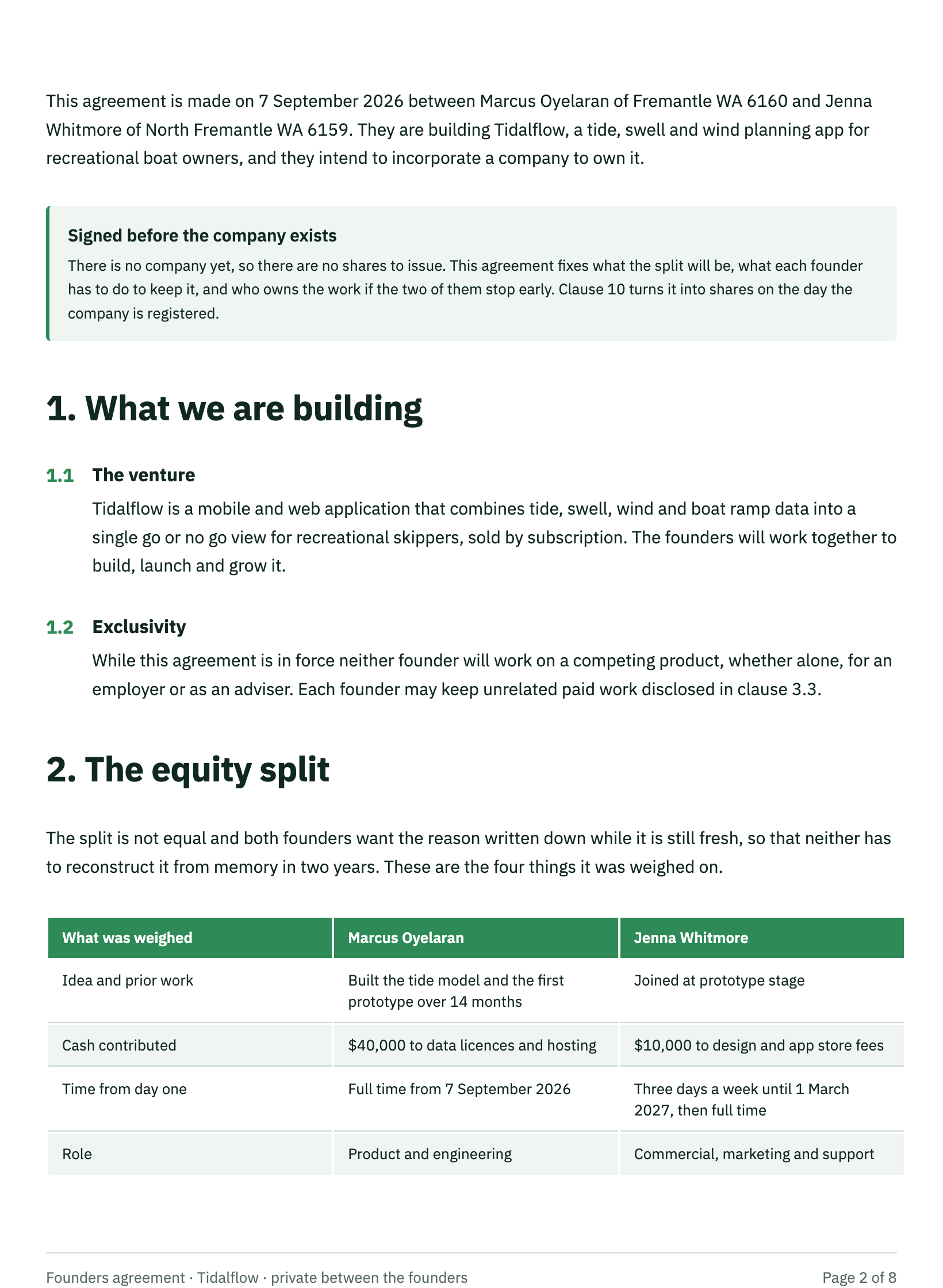 Founders agreement templateTwo people in Fremantle are building a tide and swell planning app and have not registered a company yet. There are no shares to issue, so this agreement fixes the split, records why it is 55/45 while the memory is fresh, and turns itself into shares on the day the company exists.
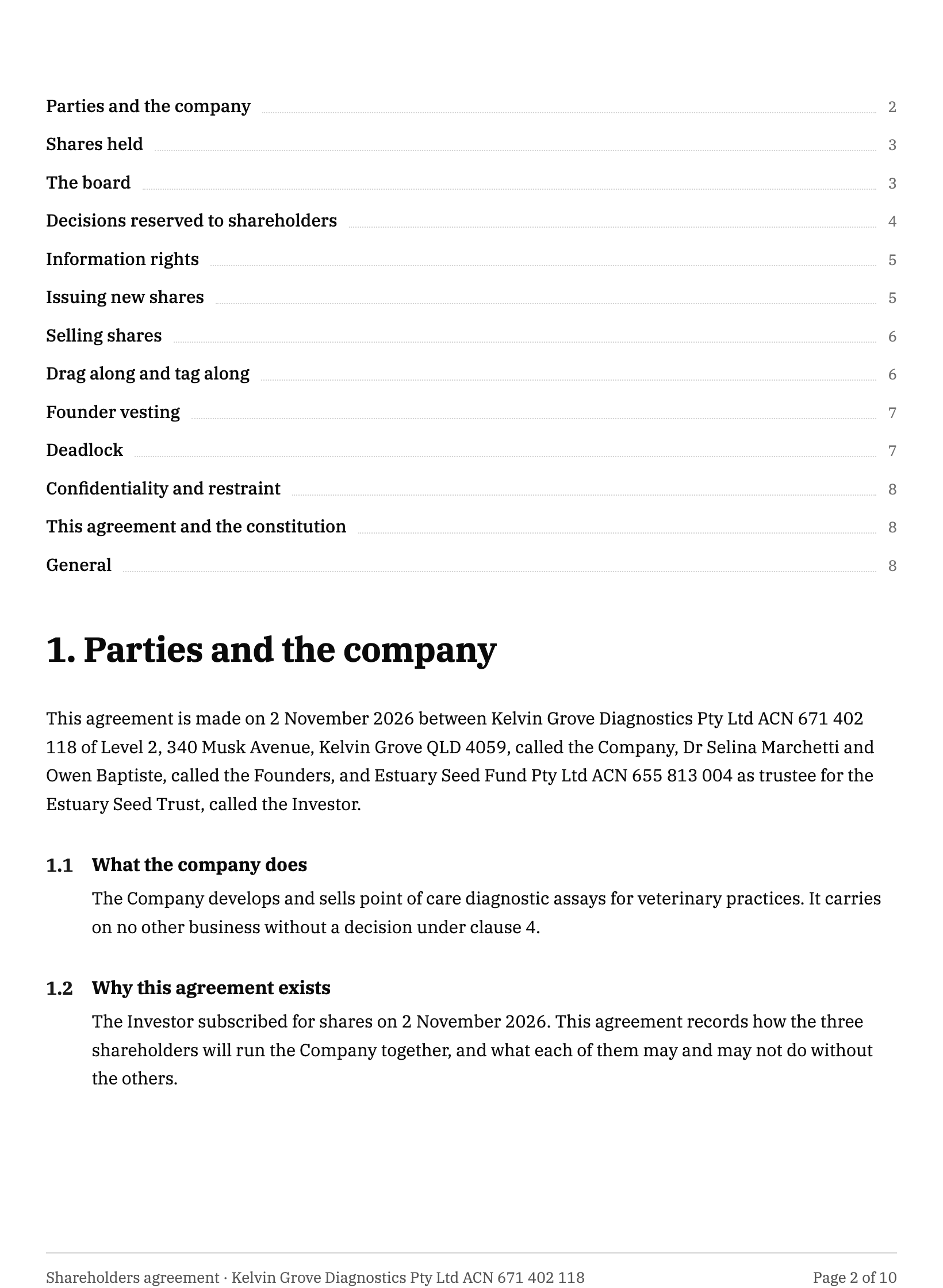 Shareholders agreement templateA veterinary diagnostics company has just taken $1.5 million from one seed fund. The founders keep 80 percent between them, so the whole agreement turns on a single number: the 75 percent consent threshold that puts the investor on one side of every decision that matters.
Questions people ask
What is a vesting cliff?
A cliff is an initial period during which nothing vests. With a one year cliff on a four year schedule, a founder who leaves after eleven months keeps none of the vesting shares, while one who stays twelve months vests 25 per cent at once and the rest monthly afterwards. The cliff protects the company against very early departures.
Is four years with a one year cliff standard in Australia?
It is the most common starting point for founders and employees in venture backed Australian companies, largely following US practice. Variations are frequent: credit for time already worked, a shorter three year schedule, or quarterly rather than monthly instalments. The right schedule depends on how long investors expect the team to need to reach the next milestone.
What happens to unvested shares when a founder leaves?
The clause decides. Usually the company or a nominee may buy back the unvested shares at a low price, often the lower of issue price and fair value, within a set period. Vested shares are dealt with under the leaver provisions, which may let the founder keep them or require a sale depending on why the founder left.
What is double trigger acceleration?
It speeds up vesting only if two things happen: a sale of the company, and the founder's employment or engagement ending without cause within a set period afterwards. It protects founders who are pushed out by a buyer while keeping an incentive for those who stay. Single trigger acceleration vests shares on the sale alone.
When does tax arise on vesting shares in Australia?
It depends on how the equity was acquired. Shares a founder buys at market value at incorporation are generally not treated as discounted employee share scheme interests, while interests employees acquire at a discount fall under the ATO's employee share scheme rules, including start up concessions where eligible. A tax adviser should confirm the position for each person.
Can vesting be based on milestones rather than time?
Yes. Milestone vesting ties tranches to results such as a product release, a revenue target or a funding round. It suits people hired for a defined outcome, but milestones need precise definitions and a long stop date, because an ambiguous milestone invites disputes about whether it was met and who decides.
Put the clause in a finished document
The button opens the document generator with a starting description already filled in. Change it to match your own agreement before you run it.
Create a document with OneCraftRelated clauses
- Good leaver bad leaver clause: pricing a departing founder's sharesA good leaver bad leaver clause prices a departing founder's shares by why they left. Sample wording, a leaver price table, three variants and the penalty risk.
- Exit clause in a shareholders agreement: planning the sale or listingAn exit clause in a shareholders agreement sets when and how owners pursue a sale or listing. Sample wording with an exit window, exit events and variants.
- Drag along clause: making minority shareholders join a saleA drag along clause lets majority shareholders make minorities join a sale of the company. Sample wording with a 75 percent threshold, protections and variants.
For everything the document generator can do, see the document maker.
Step by step in the builder: Create a document with AI, then Send a document for signature.
Written and checked by the OneCraft team. Last checked .