Contract clause
Exit clause in a shareholders agreement: planning the sale or listing
An exit clause in a shareholders agreement sets out how and when the shareholders will pursue a liquidity event, such as a trade sale or a listing, and how the proceeds are divided. It can fix a target exit window, oblige shareholders to cooperate with a sale process, name who runs it, and say what happens if no exit occurs.
Investors buy into a private company planning to sell one day, while founders may be happy running it indefinitely, and that difference is best surfaced before the money goes in. The exit clause turns an unspoken expectation into a process with dates, an adviser and consequences.
Indunil Asanka · Co-founder
4 min read · Published
Sample clause
a shareholders agreement for Blue Wren Aged Care Software Pty Ltd, a fictional Sydney company owned by two founders and Harbourview Growth Fund, a fictional investor that came in during 2026
19. Exit 19.1 The Shareholders intend that an Exit occurs between 1 July 2031 and 30 June 2032 (the Exit Window). 19.2 An Exit means a sale of all the Shares, a sale of all or substantially all of the Company's business and assets, or a listing of the Company's Shares on a recognised securities exchange. 19.3 If no Exit has been agreed by 1 July 2031, the Board must, at the request of Harbourview Growth Fund, appoint an independent corporate adviser, chosen from a shortlist of three approved by both Founders, to run a sale process for the Company. 19.4 Each Shareholder must act in good faith and use reasonable endeavours to cooperate with that process, including by providing information and signing documents on customary terms. 19.5 Nothing in this clause obliges a Shareholder to sell its Shares at a price below Fair Value, or to give warranties other than as to title and capacity, except under clause 12 (Drag Along). 19.6 On an Exit, proceeds are distributed in accordance with the Constitution.
Sample wording, not legal advice.
Variants
Agreed exit date with a drag backstop
Investors with a fund life that ends on a known date, and founders willing to commit to a sale process by then.
If no Exit has completed by 30 June 2032, Shareholders holding at least 60 per cent of the Shares may require the Board to accept the highest bona fide cash offer received in a sale process run by the Corporate Adviser, and the drag along provisions in clause 12 apply to that sale as if the 75 per cent threshold were 60 per cent, provided the price per Share is not less than Fair Value.
Investor put option
An investor that wants a guaranteed route out if the founders decline to sell, and founders able to fund a purchase.
If no Exit has completed by 30 June 2032, the Investor may require the Founders, jointly and severally, to buy all of the Investor's Shares at Fair Value within 180 days after notice. If the Founders do not complete the purchase within that time, the Investor may run a sale process under clause 19.3 without any further Founder consent, and each Founder must cooperate with it.
Founder initiated exit
Founders who want the right to bring a sale to investors without waiting for a fixed window.
At any time after 1 July 2029, the Founders acting together may give notice that they wish to pursue an Exit. The Board must then appoint a corporate adviser and run a sale process, and the Investor must not unreasonably withhold its consent to a resulting sale if the price per Share gives the Investor a return of at least two times its Subscription Amount.
What to negotiate
Obligation or intention
Founders resist a promise to sell by a date, because the right price may not exist when the date arrives. Investors want more than a statement of intention. Most clauses land on a stated window, an obligation to run a process with an independent adviser, and a price floor, rather than a guarantee that a sale will actually complete.
Who controls the process
The party that picks the adviser and approves the buyer list shapes the outcome. Investors want the right to trigger and oversee the process once the window opens. Founders want a say in choosing the adviser and protection against a sale to a competitor that would end their roles on poor terms.
Liquidation preference and the waterfall
The headline price matters less than how proceeds are divided. Investors with preference shares want their money back first, sometimes a multiple of it, before ordinary shareholders share the rest. Founders negotiate non participating preferences and caps, because a large preference can leave the team with little from a modest sale.
Founder terms after the exit
Buyers often want founders to stay for a transition period, sometimes with part of the price deferred as an earn out. Investors are wary of founders taking value through employment terms rather than the share price. Clauses often require any founder benefit linked to the sale to be disclosed and approved before it is agreed.
The risk of leaving it out
Without an exit clause there is no agreed expectation about when or whether the company will be sold, and a minority investor has no statutory right to force a sale. The investor's practical routes out are selling its stake privately, usually at a discount, or pressing for a sale in a way that sours the relationship with the founders.
Exit events and what each involves
A trade sale of all the shares gives every holder cash or buyer shares at once, usually with drag along support. A sale of the business and assets leaves the company holding cash that then reaches shareholders through a distribution, buy back or winding up, with different tax results. A listing makes shares tradable, often with founder and early investor shares held in escrow for a period. A secondary sale lets one investor sell its stake to a new investor while the company carries on. A merger or court approved scheme of arrangement suits larger companies. A buy back of an investor's shares needs the company to have capacity. A managed winding up is the last resort.
The legal machinery for each route
A sale of all the shares in a private company depends on every holder agreeing, which is why an exit clause works hand in hand with drag along rights. A sale of the business is a board decision, often with shareholder approval under the constitution, and returning the proceeds must satisfy the Corporations Act rules on distributions and capital. A listing requires a disclosure document and compliance with the securities exchange's rules. Whatever the route, the liquidation preference in the constitution then decides who receives what.
Where it sits in a generated document
A generated shareholders agreement carries the exit clause as a numbered clause near the end of the share transfer provisions, with the exit window, the adviser process and the price floor as sub clauses that refer to drag along by number. Dates and thresholds are written in as content. The document does not cite the Corporations Act or exchange rules.
Documents that carry this clause
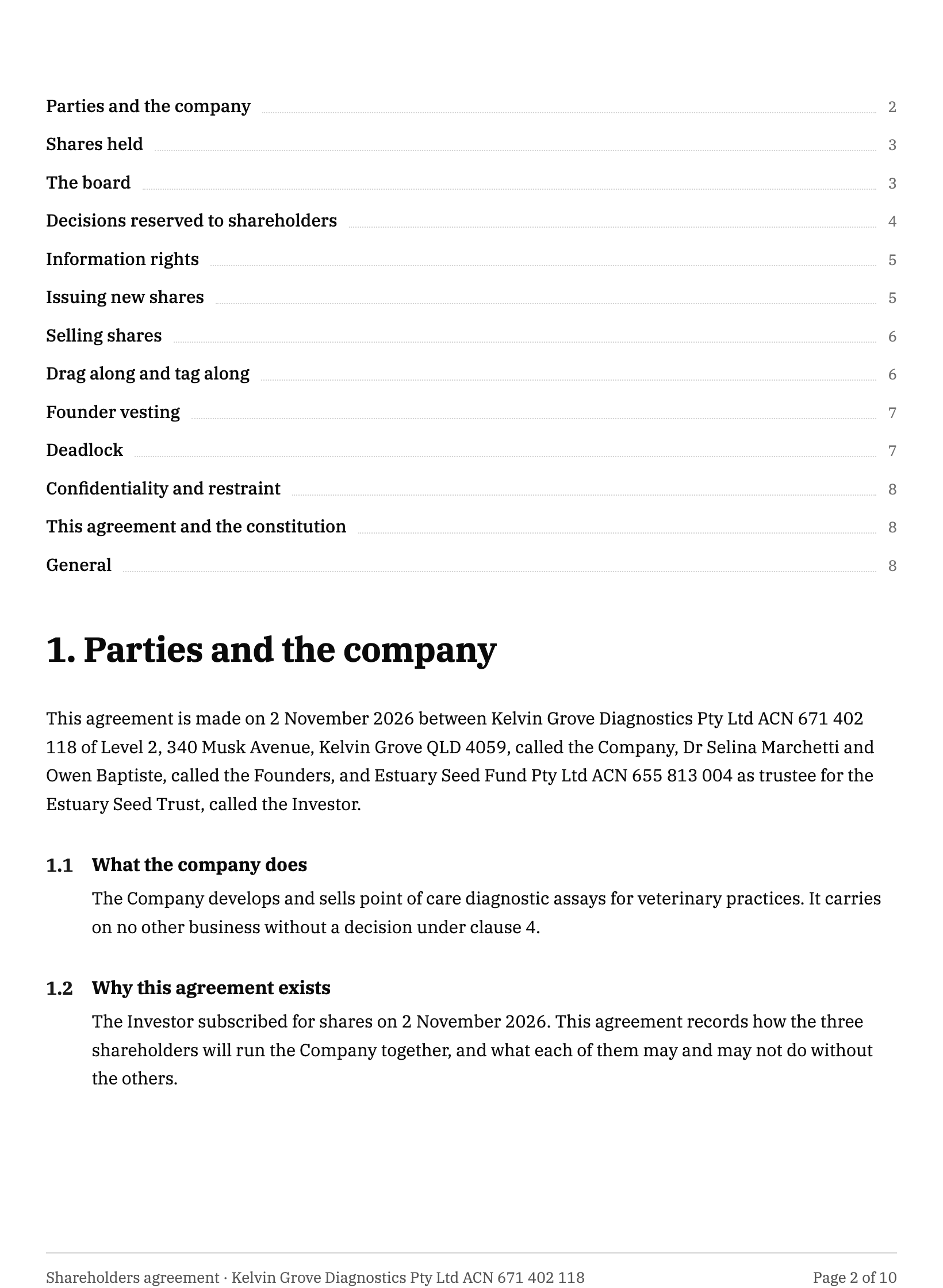 Shareholders agreement templateA veterinary diagnostics company has just taken $1.5 million from one seed fund. The founders keep 80 percent between them, so the whole agreement turns on a single number: the 75 percent consent threshold that puts the investor on one side of every decision that matters.
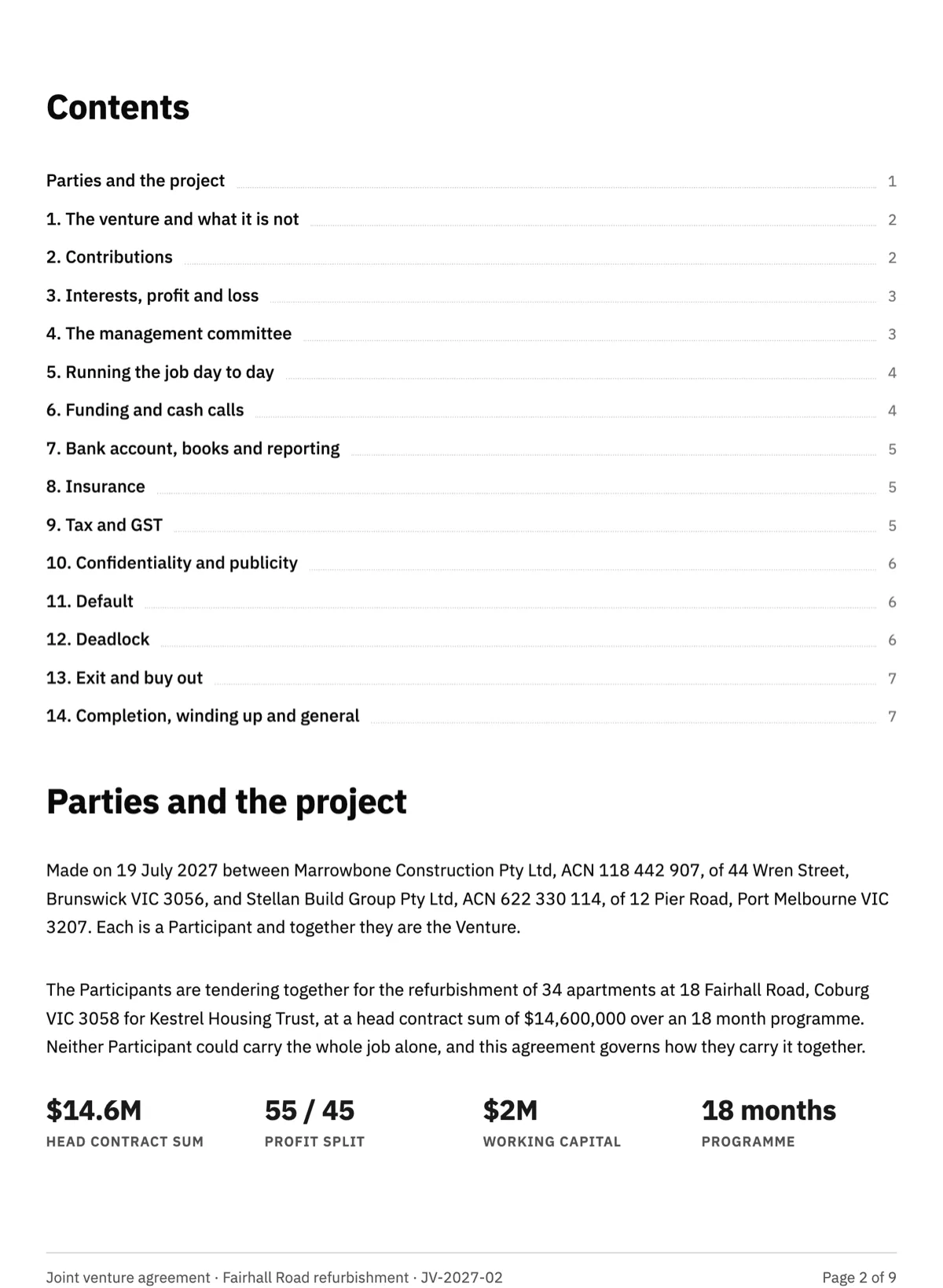 Joint venture agreement template with contributions and splitAn unincorporated joint venture has no company to fall back on, so everything a company structure would supply has to be written down. This one puts two builders together for a single $14.6 million refurbishment, splits it 55/45, and sets out who funds it, who decides, how a deadlock breaks and how either of them gets out.
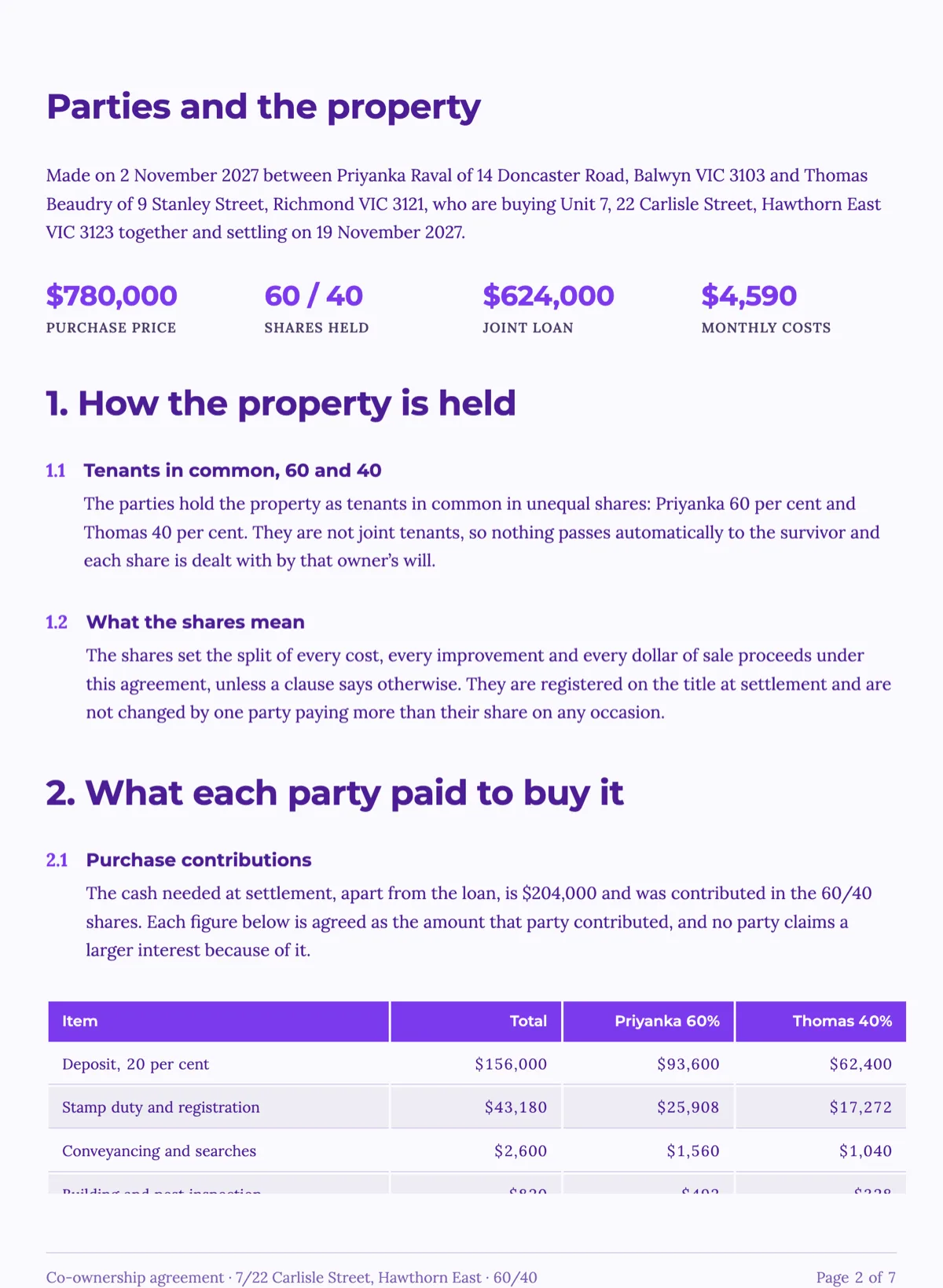 Co-ownership agreement template for shares, costs and exitA co-ownership agreement is what two people write before they buy together, not after something goes wrong. This one covers a $780,000 unit held 60/40 as tenants in common, with tables for who paid what at settlement, who pays what each month, and how either of them gets out.
Questions people ask
What is an exit event in a shareholders agreement?
An exit event is a transaction that lets shareholders turn their shares into cash or tradable securities, usually a sale of all the shares, a sale of the business and assets, or a listing on a securities exchange. The agreement defines which events count, because liquidation preferences, vesting acceleration and drag along rights often depend on that definition.
Can investors force a company to sell?
Only if the agreement gives them a way to. Common mechanisms are a drag along right with a threshold the investor can meet, a right to run a sale process after an exit window, or a put option requiring founders or the company to buy their shares. Without contractual rights, a minority investor has no general legal right to force a sale.
What happens if no exit occurs within the exit window?
It depends on the clause. Some agreements simply expect the parties to discuss options, while others trigger a sale process run by an independent adviser, a put option for the investor, or a lower drag along threshold. The consequences should be clear before signing, because they decide who holds the leverage when the window closes.
What is a liquidation preference?
A liquidation preference gives holders of preference shares the right to receive a set amount, commonly their original investment, from sale or winding up proceeds before ordinary shareholders receive anything. A participating preference also shares in the remaining proceeds, while a non participating one does not. The preference terms usually sit in the constitution and apply on any exit.
Is a listing easier than a trade sale?
Rarely for a small company. A listing requires a disclosure document, audited accounts, compliance with exchange rules and ongoing disclosure costs, and founders and early investors often have their shares held in escrow for a period. A trade sale is usually faster and gives immediate cash, although it depends on finding a buyer at an acceptable price.
Should founders agree to a fixed exit date?
Founders are usually cautious about any obligation to sell by a date, since market conditions may be poor when it arrives. A window, an obligation to run a process in good faith, and a price floor give investors a credible path without forcing a sale at the wrong time. Put options in particular deserve professional advice before they are agreed.
Put the clause in a finished document
The button opens the document generator with a starting description already filled in. Change it to match your own agreement before you run it.
Create a document with OneCraftRelated clauses
- Drag along clause: making minority shareholders join a saleA drag along clause lets majority shareholders make minorities join a sale of the company. Sample wording with a 75 percent threshold, protections and variants.
- Tag along clause: letting minority shareholders join a saleA tag along clause lets minority shareholders join a sale on the same terms as the seller. Sample wording with a 25 percent trigger, pro rata tag and variants.
- Deadlock clause: breaking a tie in a 50 50 companyA deadlock clause sets how a 50 50 company breaks a tie between its owners. Sample wording with escalation, mediation, a shotgun buy sell and variants.
- Vesting clause: earning founder shares over timeA vesting clause makes founder or employee shares earned over time. Sample wording with a 4 year schedule and 1 year cliff, a vesting table and acceleration.
For everything the document generator can do, see the document maker.
Step by step in the builder: Create a document with AI, then Send a document for signature.
Written and checked by the OneCraft team. Last checked .