Contract clause
Termination for cause clause
A termination for cause clause lets one party end the contract because the other has broken it seriously enough to justify that. It normally names the failures that count, gives the party at fault a period to fix what can be fixed, and lists the events that allow an immediate exit.
The word material is doing most of the work in this clause, and most contracts never define it. Naming three or four failures that always count turns a judgement call into something both sides can check against the document.
Nuwan Madhusanka · Co-founder
4 min read · Published
Sample clause
a managed services agreement between Copperleaf Technology and Northgate Cleaning, a fictional commercial cleaning business in Geelong
1. Termination for Cause. A party may end this agreement immediately by written notice if the other party commits a material breach and, where the breach can be remedied, does not remedy it within 14 days after receiving written notice describing the breach and what is required to fix it. 1.1 Each of the following is a material breach: failure to pay an undisputed invoice within 30 days of the due date; a breach of clause 8 (Confidentiality); a breach of clause 12 (Work Health and Safety); and a failure to meet the same service level in three consecutive months. 1.2 A party may end this agreement immediately, with no remedy period, if the other party commits a breach of clause 8 that has caused Confidential Information to be published, or is convicted of an offence involving dishonesty connected with this agreement. 2. Notice. A notice under clause 1 must identify the clause breached, the facts relied on, and the date by which the breach must be remedied. 3. Effect. Termination under clause 1 does not affect any right that accrued before the effective date.
Sample wording, not legal advice.
Variants
Material breach with a cure period
The default commercial form, where most failures can be fixed and neither side wants a hair trigger.
Either party may end this agreement by written notice if the other commits a material breach of it and fails to remedy that breach within 20 business days after receiving written notice specifying the breach and requiring it to be remedied. If the breach cannot by its nature be remedied, the party not in breach may end this agreement by written notice with immediate effect. Termination under this clause does not limit any other right or remedy of the party giving notice.
Listed events allowing immediate termination
Contracts where certain failures are so serious that a remedy period would itself cause the harm.
The Customer may end this agreement immediately by written notice if the Supplier does any of the following: discloses Confidential Information in breach of clause 8; fails to hold the insurances required by clause 11 for more than five business days; is removed from a licence or register required to perform the Services; or subcontracts the Services without the consent required by clause 6. No remedy period applies to an event listed in this clause, and the Customer may also recover the reasonable cost of engaging a replacement supplier.
Escalating notices for repeated failures
Service contracts where any single failure is minor but a pattern of them is the real problem.
If the Supplier fails to meet a Service Level in any month, the Customer may issue a performance notice. If the Supplier receives three performance notices for the same Service Level in any rolling six month period, the Customer may require a remediation plan within 10 business days. If the Supplier fails to deliver an acceptable plan, or fails to meet that Service Level again in the following three months, the Customer may end this agreement on 20 business days written notice.
What to negotiate
What counts as material
Leaving material undefined means the question is answered later, by whoever is most willing to litigate. Suppliers want a short closed list; customers want an open definition plus named examples. The common settlement is an open test with a list of failures that are deemed material, which gives certainty for the cases that matter without excusing everything else that goes wrong.
The length of the remedy period
Fourteen or twenty business days is usual for commercial breaches, but a single period rarely fits every failure. Suppliers ask for longer where a fix needs a subcontractor or a part; customers ask for zero where the harm is immediate. Tiered periods solve most of it: a standard window, a shorter one for payment, and no window for confidentiality and safety.
Whether repeated minor breaches count
A supplier can fail small and often, remedy each time, and never trigger the clause. Customers ask for a repeat breach rule so that three notices in a period allow termination. Suppliers want the rule limited to the same failure rather than any failure, and want a chance to deliver a remediation plan first. Both features usually survive.
What happens to the exit obligations
Customers want transition help even after terminating for cause, because they still need the service to keep running. Suppliers argue that a party at fault should not also control the handover. The practical answer is that transition assistance applies however the contract ends, paid at the standard rate, with the customer's right to claim damages left untouched.
The risk of leaving it out
Without the clause the party wanting to leave falls back on the general law, and must show the breach went to the root of the contract or was a repudiation. That is a high test and an uncertain one. Ending a contract without a sufficient right is itself a breach, so a business with no clear cause right often keeps performing while it takes advice.
What material breach actually means
There is no fixed legal definition, which is why the drafting matters more than the label. At general law a party can end a contract for breach of an essential term, for a sufficiently serious breach of an intermediate term, or for repudiation. A contractual cause clause sits on top of that and can be narrower or wider than the general law allows. The useful pattern is a general test combined with a deemed list: failures to pay undisputed invoices, breaches of confidentiality, breaches of safety obligations, loss of a licence. Each is easy to prove from documents, which is exactly what a party needs when it is about to send a notice.
Notices are where these clauses fail
More cause terminations come apart over the notice than over the breach. A notice that does not identify the clause breached, the facts relied on and the remedy required can be treated as ineffective, which means the termination that followed it was invalid and the party who sent it is now the one in breach. Sending the notice to the wrong address or the wrong person has the same effect. The safest practice is to follow the notices clause exactly, describe the failure in enough detail that the other side knows what to fix, and state the deadline as a date rather than a number of days.
Where it sits in a generated document
The document generator writes an agreement as numbered content, so a cause right normally appears in the termination clause with the deemed material breaches as a numbered list beneath it. The generated text is written from the description it is given and it never prints citations, so any remedy period or cross reference in a draft has to be checked before the document is used. Listing the failures that should count as material in the description is worth the extra sentence, because a generic request produces a generic clause.
Documents that carry this clause
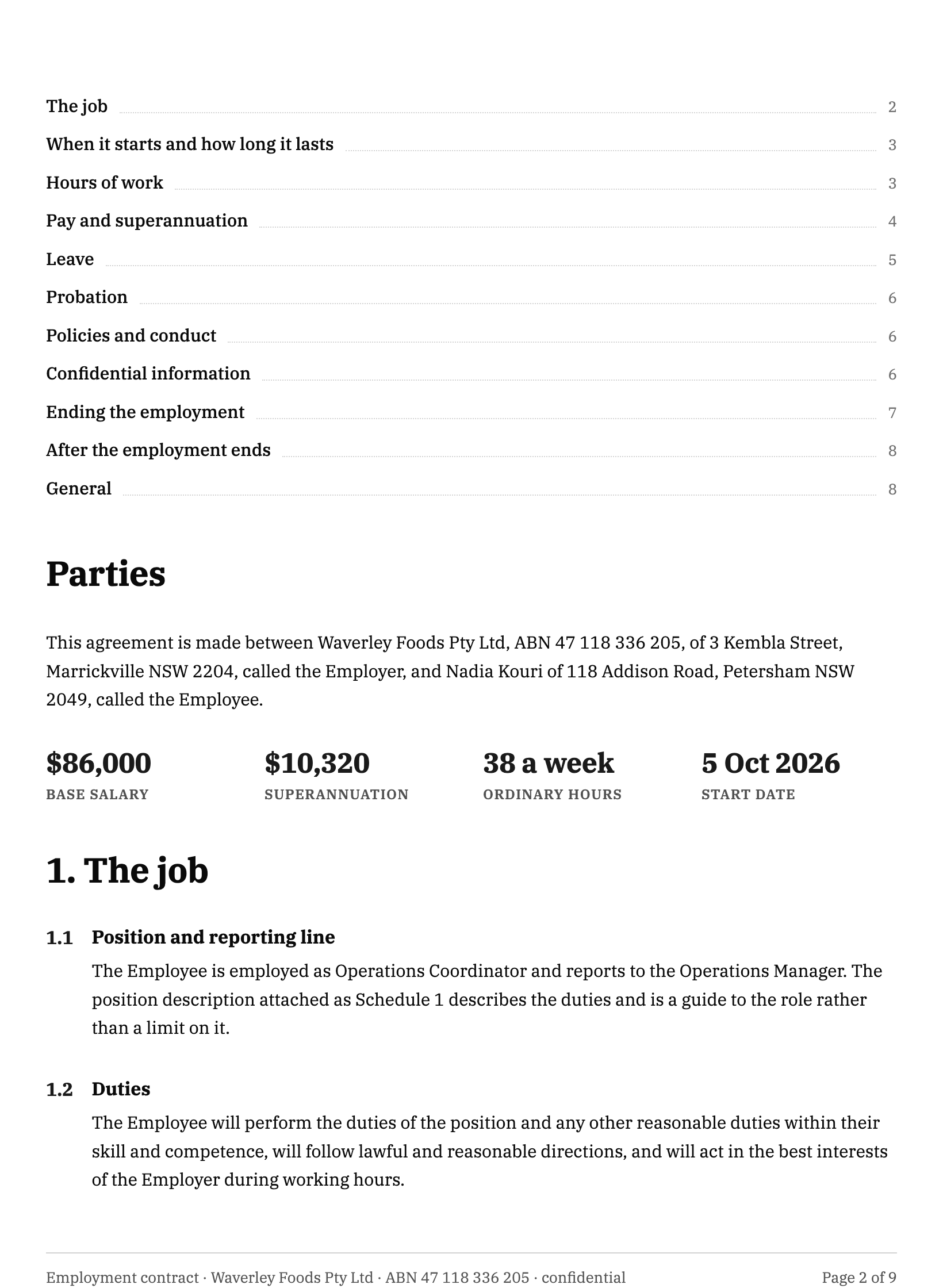 Employment contractA full time ongoing contract for an operations coordinator on $86,000 plus $10,320 of superannuation. Eleven numbered clauses, a leave table drawn from the National Employment Standards, and a notice table that scales with service.
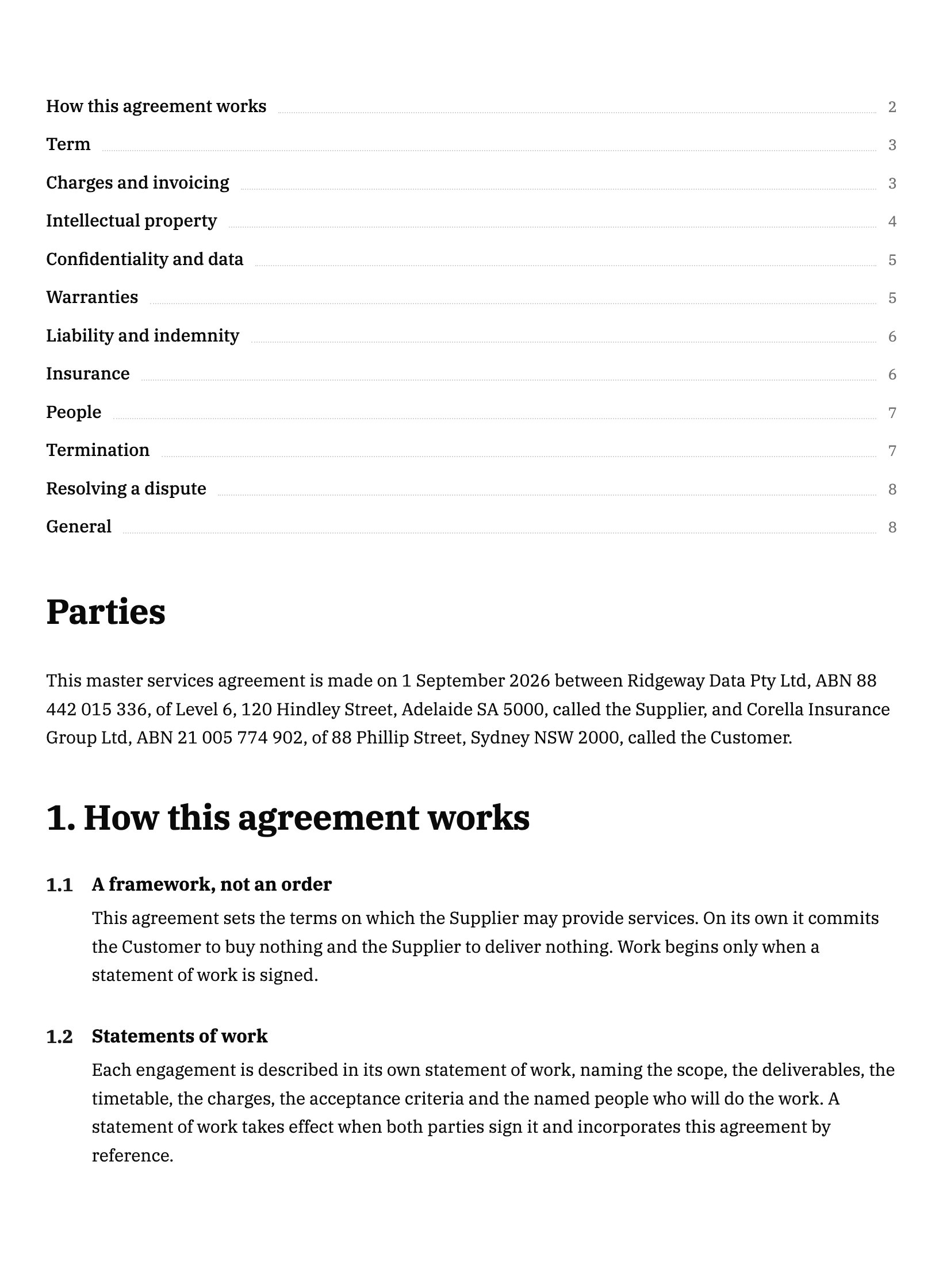 Master services agreementA data consultancy and an insurer sign this once and then buy work under it for three years. It is the rare contract whose whole purpose is to make the next twenty contracts short.
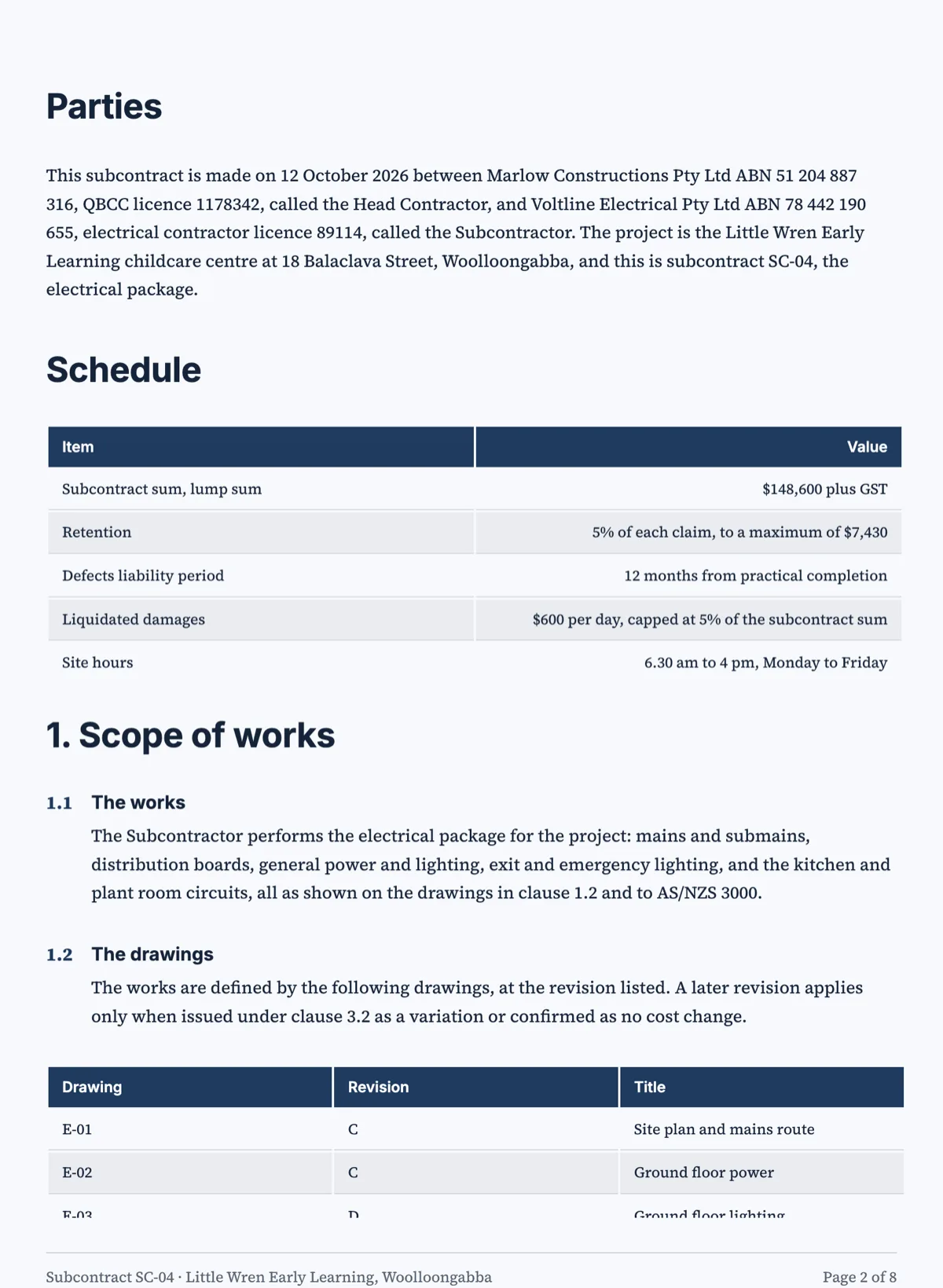 Subcontractor agreement template that flows the head contract downA subcontract exists to pass the head contract's obligations down one level and move the money back up on time. This one names the scope by drawing, sets the progress claim dates against the security of payment rules, holds retention and states the insurances, so the trade knows exactly when it is paid and for what.
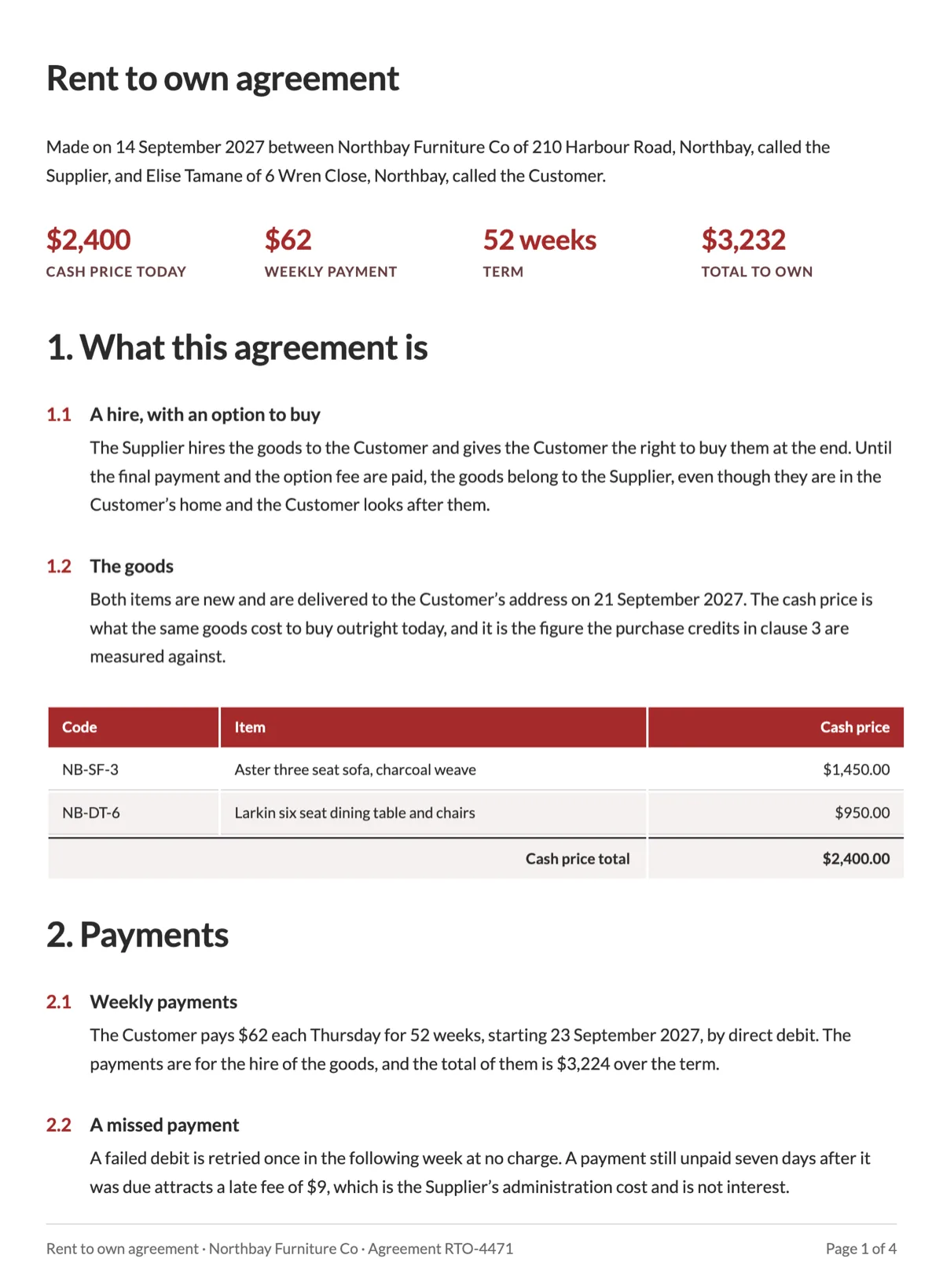 Rent to own agreement template with credits, price and defaultA rent to own agreement is a hire with an option to buy at the end, so the goods stay with the supplier until the last payment. This one covers a $2,400 sofa and dining set paid off at $62 a week for 52 weeks, with a table showing what has been credited and what the payout figure is at four points in the term.
Questions people ask
What counts as a material breach?
There is no universal definition, which is why good contracts name examples. A failure that deprives the other party of a substantial part of what it bargained for will usually qualify. Naming specific failures as deemed material, such as non payment of undisputed invoices or a confidentiality breach, removes the argument for the cases that matter most.
Does the other party always get a chance to fix it?
Not always. Most clauses give a remedy period for breaches that can be remedied and allow immediate termination for those that cannot, such as a disclosure that has already happened. Contracts also list events where no remedy period applies at all, usually confidentiality, safety, loss of a licence, and unauthorised subcontracting.
What should a termination notice contain?
The clause relied on, the facts that make out the breach, what must be done to remedy it, and the deadline stated as a date. It should be delivered exactly as the notices clause requires. A vague or misdelivered notice is the most common reason a cause termination fails, and a failed termination can itself be a breach.
Can repeated small breaches justify termination?
Only if the contract says so, or if the pattern amounts to a repudiation at general law. The usual drafting solution is an escalation: performance notices for each failure, a remediation plan after a set number, and a termination right if the plan is not delivered or the failure recurs. That converts a pattern into something provable.
Is termination for cause better than termination for convenience?
It preserves a damages claim and can avoid an exit payment, but it has to be proved. Where a convenience right exists, many businesses use it even when there is a breach, because it ends the relationship without a fight. The trade off is giving up the claim tied to the breach, so the choice depends on how much is at stake.
Does terminating for cause end the transition obligations?
It should not. A customer that terminates because the supplier failed still needs its data and its service continuity. Well drafted contracts make transition assistance apply however the agreement ends, paid at the standard rate, and keep the terminating party's right to claim damages separate from the handover.
Put the clause in a finished document
The button opens the document generator with a starting description already filled in. Change it to match your own agreement before you run it.
Create a document with OneCraftRelated clauses
- Cure period clauseA cure period clause gives a party time to fix a breach before termination. Sample wording, tiered periods, repeat breach rules and what to negotiate.
- Termination for convenience clauseA termination for convenience clause lets a party end a contract on notice with no breach. Sample retainer wording, mutual and one sided versions, exit costs.
- Termination for insolvency clauseA termination for insolvency clause ends a contract when the other side fails. Sample wording, trigger lists, and the Australian ipso facto stay since 2018.
- Liquidated damages clauseA liquidated damages clause fixes what delay costs before it happens. Sample fit out wording, the Australian penalty test, caps, and what each side negotiates.
For everything the document generator can do, see the document maker.
Step by step in the builder: Create a document with AI, then Document builder components.
Written and checked by the OneCraft team. Last checked .