Contract clause
Termination for convenience clause
A termination for convenience clause lets a party end the contract on notice without anyone having broken it. Nothing has to go wrong first, which is why the clause almost always comes with rules about what is paid for work already done and what happens to material in progress.
Ending a contract for cause means proving a breach and surviving the argument about whether it was serious enough. A convenience right skips that entirely, and the price of it is agreed up front rather than fought over later.
Indunil Asanka · Co-founder
4 min read · Published
Sample clause
a marketing retainer between Fernhill Consulting and Saltbush Brewing, a fictional craft brewery in Ballarat
1. Termination for Convenience. Either party may end this agreement at any time by giving the other 30 days written notice. No reason needs to be given. 1.1 During the notice period the Agency must continue to deliver the Services, and the Client must continue to pay for them. 2. Payment on Termination. On the effective date of termination the Client must pay the Agency for Services delivered up to that date, together with any work in progress at the hourly rates in Schedule 1, and any third party costs the Agency has committed that it cannot cancel. 2.1 The Agency must use reasonable efforts to cancel or reduce committed third party costs, and must produce evidence of any amount claimed under clause 2. 3. Prepaid Fees. Any fees the Client has paid for Services not yet delivered must be refunded within 20 business days of the effective date of termination. 4. Handover. On termination the Agency must deliver the Client's brand files, campaign data and account access within 10 business days.
Sample wording, not legal advice.
Variants
Mutual right on equal notice
Two businesses of similar size, where neither will accept a right the other does not have.
Either party may end this agreement for any reason by giving the other 30 days written notice. The party giving notice must state the effective date in the notice. Up to that date each party must continue to perform its obligations in full. On termination under this clause the Client must pay for Services delivered and work in progress to the effective date, and the Agency must refund any fees prepaid for Services that will not be delivered. Neither party owes the other compensation for the termination itself.
Customer only, with a wind down payment
The customer holds the commercial power and the supplier wants the exit cost recognised rather than argued about.
The Client may end this agreement for any reason on 60 days written notice. The Agency has no equivalent right. On termination under this clause the Client must pay for Services delivered to the effective date, plus the Agency's reasonable demobilisation costs, plus 50 per cent of the fees that would have fallen due in the 30 days after the effective date. The Agency must give the Client a written breakdown of demobilisation costs within 15 business days and must mitigate those costs where it reasonably can.
Convenience right only after a minimum period
The supplier has invested up front and needs the first months of revenue to be secure.
Neither party may end this agreement for convenience during the first six months of the Term. After that period either party may end it on 45 days written notice. If the Client gives notice under this clause before the end of the first 12 months, the Client must also pay the unamortised balance of the setup fee shown in Schedule 3, calculated on a straight line basis over 12 months from the Commencement Date.
What to negotiate
Whether the right is mutual
Customers often propose a right they hold alone, which leaves the supplier committed while the customer is not. Suppliers argue that a one sided right in a standard form small business contract is exactly the shape a regulator looks at. The usual landing point is either a mutual right on the same notice, or a customer only right paired with a longer notice period and a wind down payment.
How long the notice period runs
Notice length is really a staffing question. A supplier with people assigned to the account wants long enough to redeploy them, commonly 60 or 90 days. Customers want out quickly. Terms often settle at 30 days for a retainer, longer where the supplier holds dedicated staff or equipment, and shorter in the first months where little has been committed.
What gets paid on the way out
Work delivered is never in dispute. The arguments are about work in progress, committed third party costs and unamortised setup. Suppliers want all three covered; customers want evidence and a duty to mitigate. The settlement is usually payment for delivered work and work in progress, plus committed costs the supplier can show it could not cancel.
Whether handover is part of the exit
A convenience right that leaves the customer without its own data is a right it cannot use. Customers ask for files, access and a short knowledge transfer as a condition of the exit. Suppliers accept a defined list with a deadline, and often ask for anything beyond that list to be paid at standard rates under a transition assistance clause.
The risk of leaving it out
Without the clause a party that wants out has to find a breach, prove it is serious enough to justify ending the contract, and accept the risk of being wrong. Getting that judgement wrong is itself a repudiation, so a business with no convenience right often keeps paying for a service it no longer wants rather than take the chance.
Why a convenience right changes the negotiation
Once either side can leave on notice, every other lever in the contract loses some of its force. Long terms stop protecting revenue, minimum commitments stop being minimums, and price increases become easier to resist because the answer to them is a notice letter. That is why suppliers resist a customer side convenience right, or price it. The usual compromise is not to remove the right but to condition it: a minimum period before it can be used, a notice period long enough to redeploy people, and a defined exit payment so that leaving early is a known cost rather than a free option.
Termination for convenience against termination for cause
The two rights do different jobs and both belong in most contracts. A cause right ends the agreement because the other side failed, usually after a notice to remedy, and it carries consequences such as loss of transition help or a claim for damages. A convenience right ends the agreement because circumstances changed, and it carries a payment rather than a claim. Using a convenience right to exit a supplier that has actually breached is common and sensible, because it avoids the argument about whether the breach was material, but it also gives up any damages claim tied to the breach.
Where it sits in a generated document
The document generator writes an agreement as numbered content, so a convenience right usually appears inside the termination clause with the payment consequences as sub clauses under it. The generated text is written from the description it is given and it never prints citations, so any notice period or percentage in a draft has to be checked against the deal before the document is used. Describing both the notice period and what is paid on exit produces both as numbered provisions, which is easier than editing them in afterwards.
Documents that carry this clause
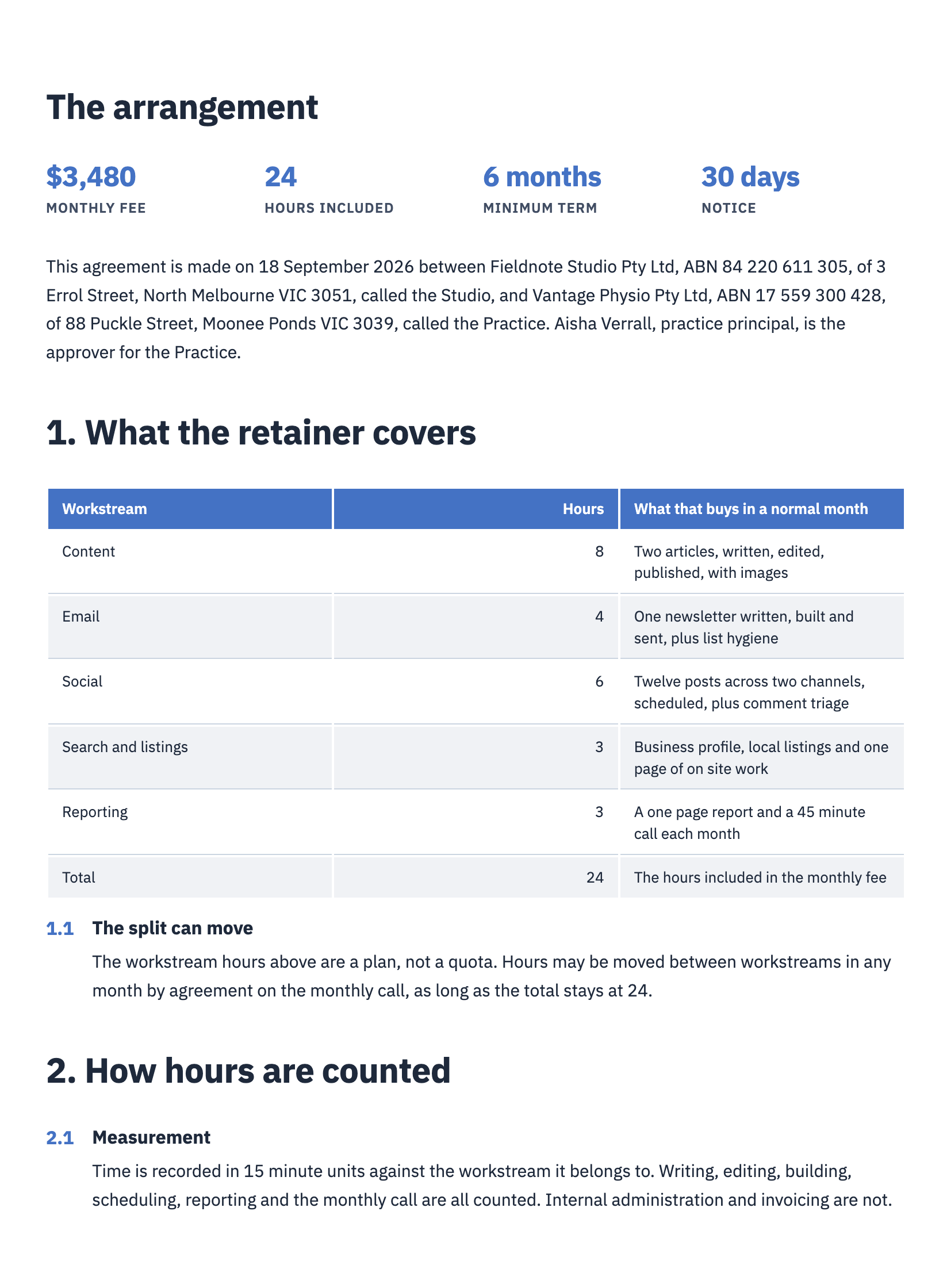 Monthly retainer agreementA studio sells a physio practice twenty four hours a month. Almost every clause exists to answer one question that ordinary contracts duck: what happens to the hours nobody used.
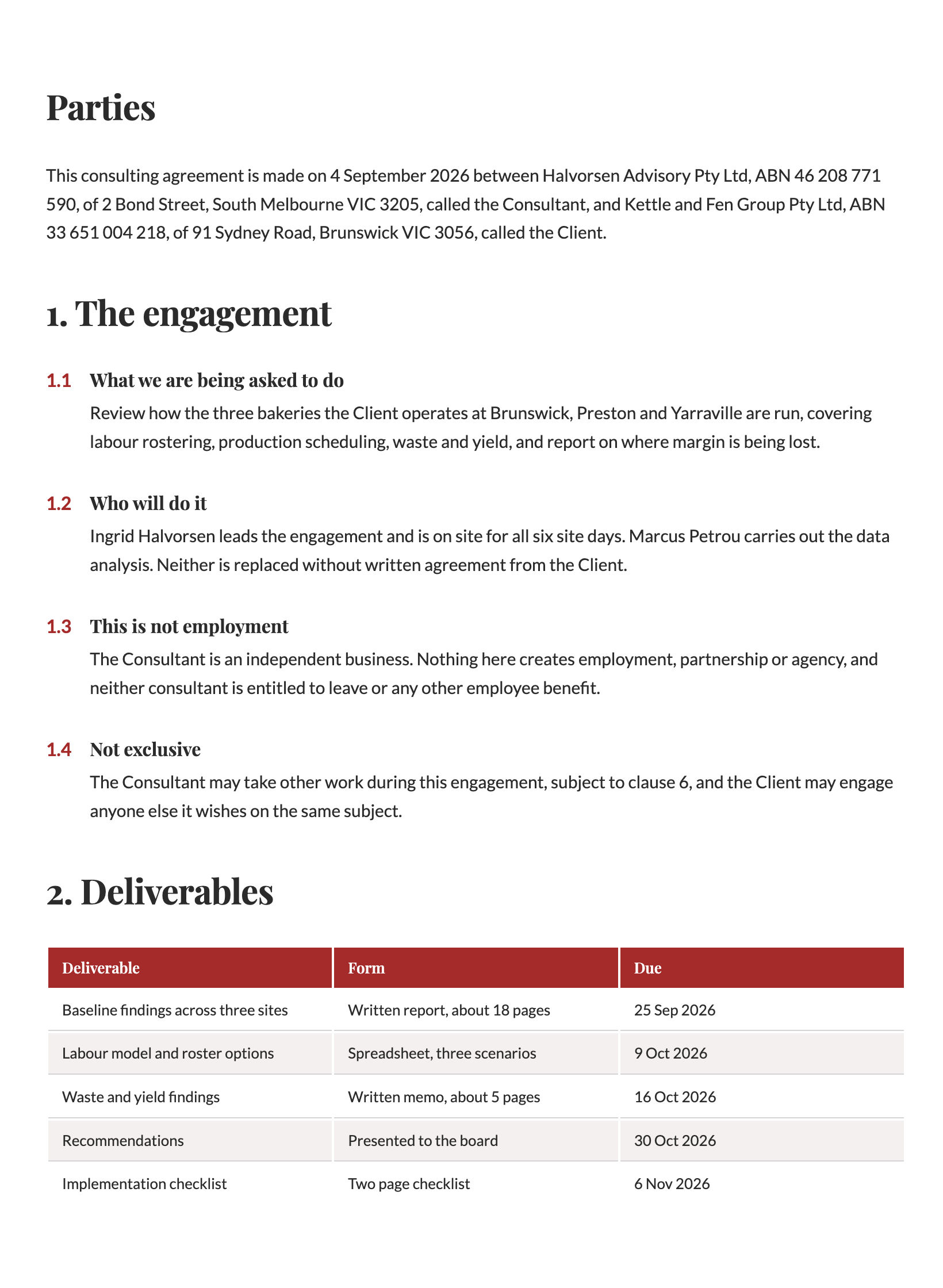 Consulting agreementAn advisory firm reviews three bakeries over seven weeks. What makes this agreement useful is not the fee clause but the two clauses that say what the advice is not.
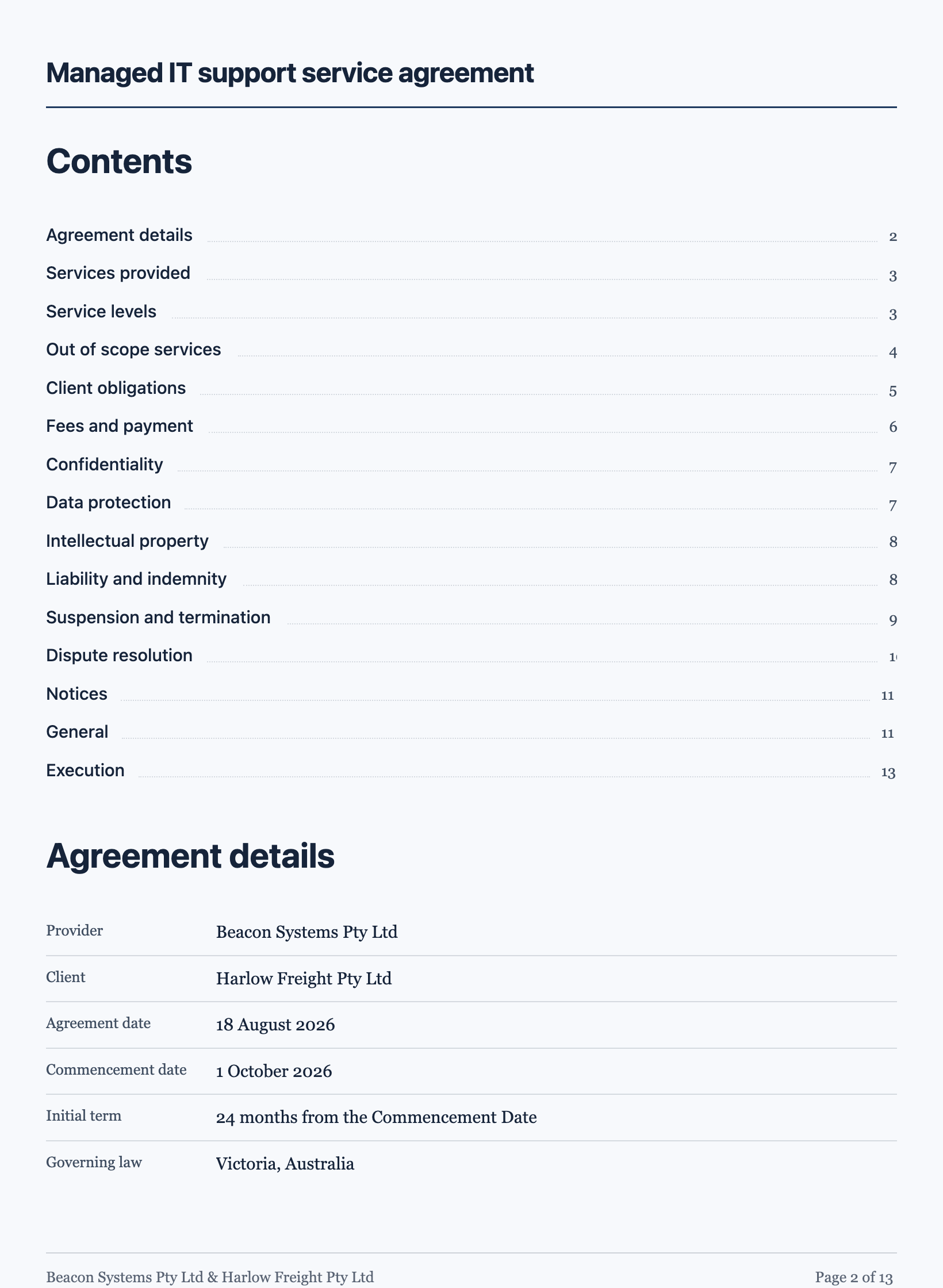 Service agreementBeacon Systems supports Harlow Freight’s IT for an initial 24 months from 1 October 2026 at $8,400 a month plus GST, with 40 hours included and $220 an hour beyond them. Twelve numbered clauses cover the services, a four level severity table, client duties, fees with a CPI adjustment, confidentiality, privacy, IP, a liability cap, termination and a three step dispute ladder.
Questions people ask
Can a termination for convenience clause be one sided?
It can, and customer only rights are common in procurement. The risk is that a one sided right in a standard form small business contract can be examined under the unfair contract terms regime, particularly when it is paired with a long commitment on the other side. Balancing it with a longer notice period and a defined exit payment is the usual answer.
Do you have to give a reason?
No, and that is the point of the clause. A convenience right is exercised by notice alone, which avoids any argument about whether a breach occurred or whether it was serious enough. Giving a reason anyway is generally unhelpful, because it can turn a clean exit into a dispute about whether the stated reason was accurate.
What is usually paid when a contract ends for convenience?
Work delivered to the effective date, work in progress at agreed rates, and third party costs the supplier has committed and cannot cancel. Prepaid fees for undelivered work are refunded. Some contracts add demobilisation costs or the unamortised balance of a setup fee, which matters where the supplier priced the setup below cost to win the work.
How much notice is normal?
Thirty days is the common default for a retainer or a subscription. Sixty or ninety days is usual where the supplier holds dedicated staff, leased equipment or a site presence that takes time to unwind. Very short notice periods appear in early stage arrangements where neither side has committed much, and in trial periods.
Is termination for convenience the same as cancellation?
In practice they describe the same act, but the contract language matters. A clause labelled cancellation often carries a fee, while a convenience right usually carries payment for work done. What decides the outcome is the wording of the consequences, not the heading, so read the payment sub clause rather than the title of the clause.
Should the supplier get a convenience right too?
Usually yes, on the same or a longer notice. Without one, a supplier is committed for the full term while the customer can leave at will, which prices badly and reads poorly. Customers sometimes resist because they depend on continuity, and the compromise is a longer supplier notice period plus a transition assistance obligation.
Put the clause in a finished document
The button opens the document generator with a starting description already filled in. Change it to match your own agreement before you run it.
Create a document with OneCraftRelated clauses
- Termination for cause clauseA termination for cause clause ends a contract for serious breach. Sample wording, what counts as material, cure periods and immediate termination events.
- Termination notice clauseA termination notice clause says how notice must be given for it to count. Sample wording, delivery methods, deemed receipt rules and who is allowed to sign.
- Early termination fee clauseAn early termination fee clause charges for ending a contract before the term ends. Sample wording, sliding scales, the penalty test and unfair terms limits.
For everything the document generator can do, see the document maker.
Step by step in the builder: Create a document with AI, then Document builder components.
Written and checked by the OneCraft team. Last checked .