Contract clause
Termination notice clause
A termination notice clause sets out how a party must communicate that it is ending the agreement, where the notice goes, and when it takes effect. It decides whether an email at 6pm on a Friday counts, and whether the clock started that day or the next business day.
Most failed terminations are failures of process rather than of substance. The right was there, the notice went to the wrong address or the wrong person, and the agreement kept running.
Indunil Asanka · Co-founder
4 min read · Published
Sample clause
a facilities services agreement between Northgate Cleaning and Quayside Property Group, both fictional Australian businesses
1. Form of Notice. A notice ending this agreement must be in writing, must identify the clause relied on, and must state the effective date of termination. 2. Delivery. A notice is given if it is delivered by hand to the recipient's registered office, sent by prepaid post to that office, or emailed to the address listed for that party in Item 4 of the Schedule. 3. When a Notice Takes Effect. A notice delivered by hand takes effect on delivery. A notice sent by post takes effect on the sixth business day after posting. A notice sent by email takes effect at the start of the next business day after it is sent, unless the sender receives an automated message reporting that delivery failed. 4. Authorised Signatories. A notice ending this agreement is valid only if signed by a director or by the person named as the Contract Manager for that party in Item 5 of the Schedule. 5. Change of Details. A party must notify the other within 5 business days of any change to its address or email address for notices.
Sample wording, not legal advice.
Variants
Email accepted as a primary method
Modern service agreements where nobody keeps a registered post account and both parties work from named inboxes.
A notice under this agreement must be in writing and may be given by email to the address recorded for the recipient in Item 4 of the Schedule, with a copy to the recipient's Contract Manager. An emailed notice takes effect at the start of the next business day in the place of the recipient, unless the sender receives an automated non delivery message, in which case the notice has not been given and must be delivered by hand or by prepaid post.
Registered post required for termination only
Longer term agreements where ordinary notices travel by email but ending the relationship needs a paper trail.
Notices other than termination notices may be given by email. A notice ending this agreement must be delivered by hand or sent by registered post to the recipient's registered office, and a copy must be emailed to the recipient's Contract Manager on the same day. A termination notice delivered by hand takes effect on delivery, and one sent by registered post takes effect on the date of the delivery record kept by the postal service.
Notice with reasons required
Contracts where the ground for termination affects what is paid, so the other party needs to know which right is being used.
A notice ending this agreement must state whether it is given under clause 11.1 for convenience or clause 11.2 for cause, and if under clause 11.2 must identify the breach relied on and the facts supporting it. A notice that does not state the clause relied on is treated as a notice under clause 11.1 for convenience, and the payment consequences of that clause apply. A party may not change the stated ground after the notice has taken effect.
What to negotiate
Which delivery methods count
Email is now the practical answer and the one most contracts accept, but only where the address is named in a schedule rather than left to whoever is on the thread. Parties who want a paper trail ask for registered post or hand delivery for termination specifically. The usual settlement is email for ordinary notices and a stricter method reserved for ending the agreement.
When a notice is deemed received
Deemed receipt rules exist so nobody argues about whether an email was read. A sender wants receipt deemed early; a recipient wants a business day buffer so a notice sent late on a Friday does not consume the weekend. The common landing point is the start of the next business day in the recipient's location, with an exception where the sender gets a delivery failure message.
Who is allowed to sign
A termination signed by a project manager with no authority is a gift to the other side. Contracts increasingly name the roles that may sign a termination notice, usually a director or a named contract manager. The party being bound wants the list short and verifiable; the party sending the notice wants at least two named people so a single absence cannot delay an exit.
Whether the ground must be stated
Stating the clause relied on gives certainty about what is paid on exit, which is why customers often want it. Suppliers are wary, because a stated ground can be attacked while a bare notice cannot. A common compromise is to require the clause number but not the evidence, with a default to the convenience right if nothing is stated.
The risk of leaving it out
Without a notice clause the parties fall back on general rules about communication, and every termination invites an argument about whether notice was properly given, to whom, and when it took effect. A notice found invalid leaves the agreement running and can turn the party who sent it into the one in breach, because it has usually already stopped performing.
Why notice clauses decide cases
The substance of a termination is often uncontroversial. The fight is about the mechanics: the notice went to a trading address rather than the registered office, it was emailed to a person who had left, or it was signed by somebody the contract did not authorise. Courts read notice provisions as machinery that the parties chose and generally expect them to be followed. The practical discipline is to open the notices clause and the schedule before drafting the letter, confirm the address and the signatory, and keep evidence of delivery. A notice that fails on any of these can be worse than sending none, because the sender has usually already acted as though the agreement is over.
Deemed receipt and the business day trap
Deemed receipt rules exist to remove the question of whether a notice was actually read, and they cut both ways. An email deemed received when sent means a notice at 6pm on a Friday starts a cure period that runs over the weekend. An email deemed received at the start of the next business day gives the recipient a fair chance to act, which is why it is the common form. Business day definitions matter here too: a contract between parties in different states should say whose business days count, since public holidays differ and a day either way can decide whether a deadline was met.
Where it sits in a generated document
The document generator writes an agreement as numbered content, so the notices clause normally sits near the end with the general provisions, and the addresses go in a schedule the parties can update. The generated text is written from the description it is given and it never prints citations, so any address, deemed receipt rule or signatory role in a draft has to be checked before the document is used. Where the document ends in a signature block, each party in that block becomes one signer, which is a useful place to record who is authorised to send notices.
Documents that carry this clause
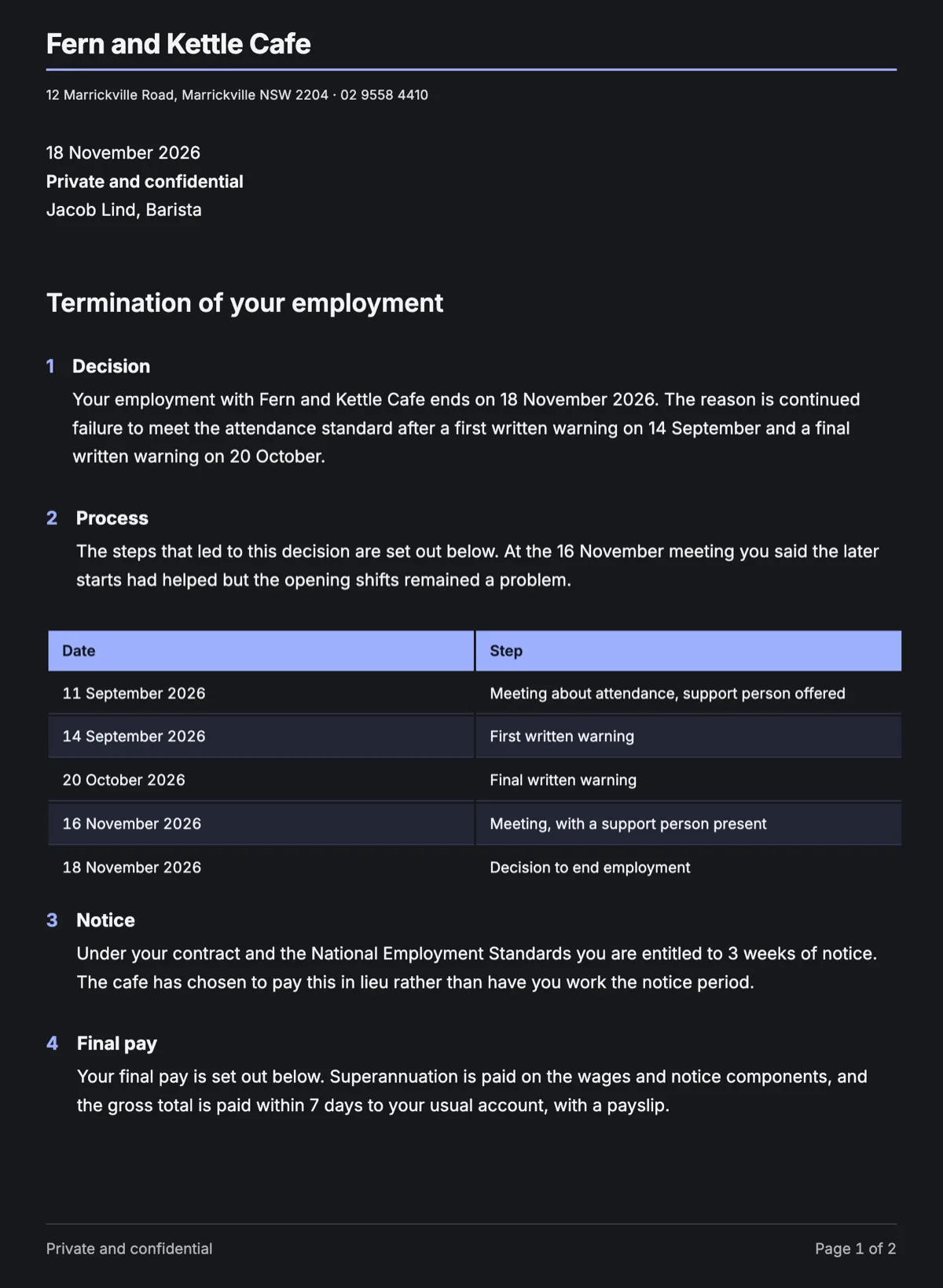 Termination letter template that shows the final payA termination letter is read twice, once by the employee in the meeting and once by a lawyer or a tribunal months later, and both need the same facts. This one states the reason and the process in dates, shows the final pay as a table with each component, and says what happens next, so there is nothing to ask afterwards.
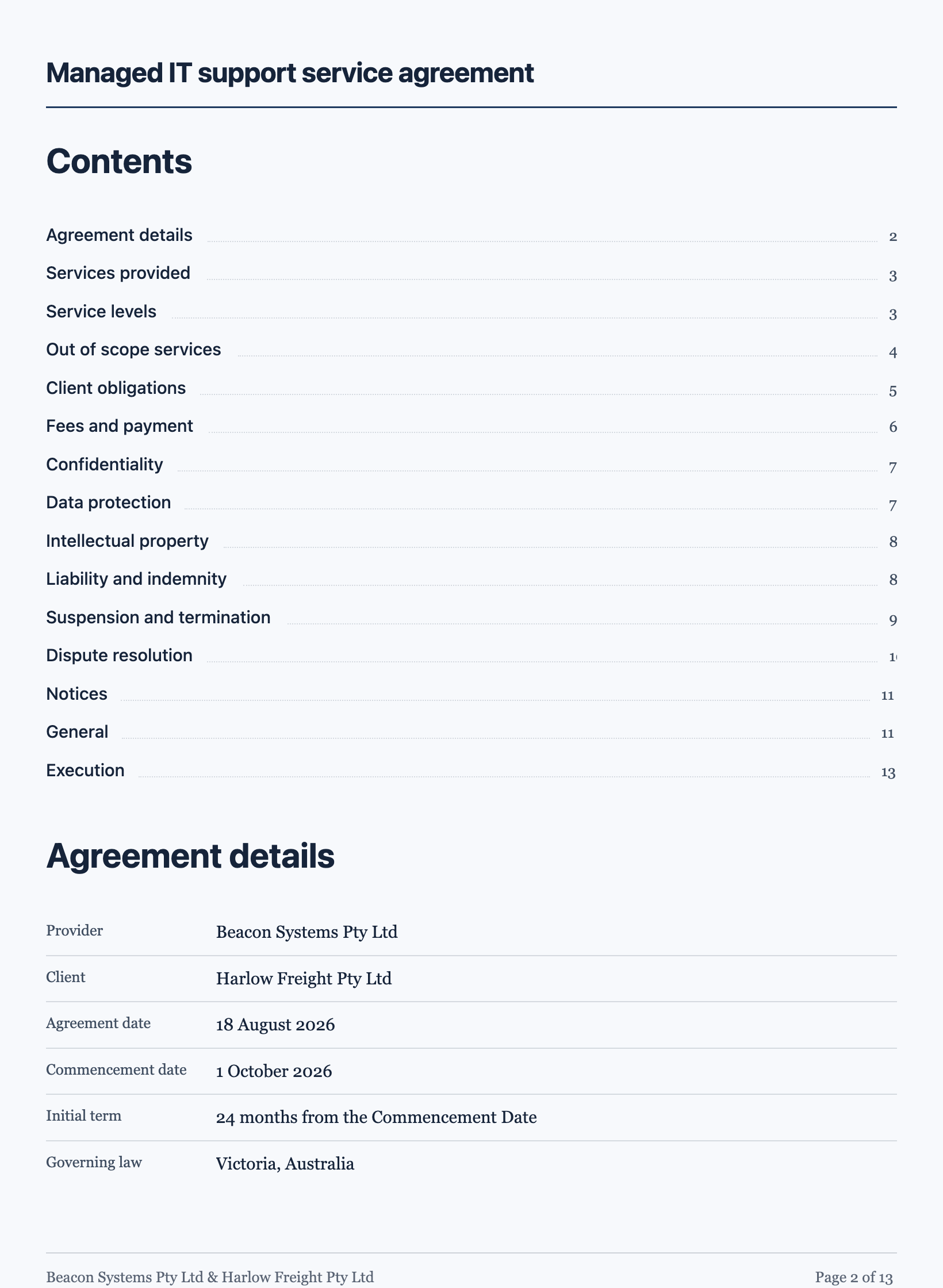 Service agreementBeacon Systems supports Harlow Freight’s IT for an initial 24 months from 1 October 2026 at $8,400 a month plus GST, with 40 hours included and $220 an hour beyond them. Twelve numbered clauses cover the services, a four level severity table, client duties, fees with a CPI adjustment, confidentiality, privacy, IP, a liability cap, termination and a three step dispute ladder.
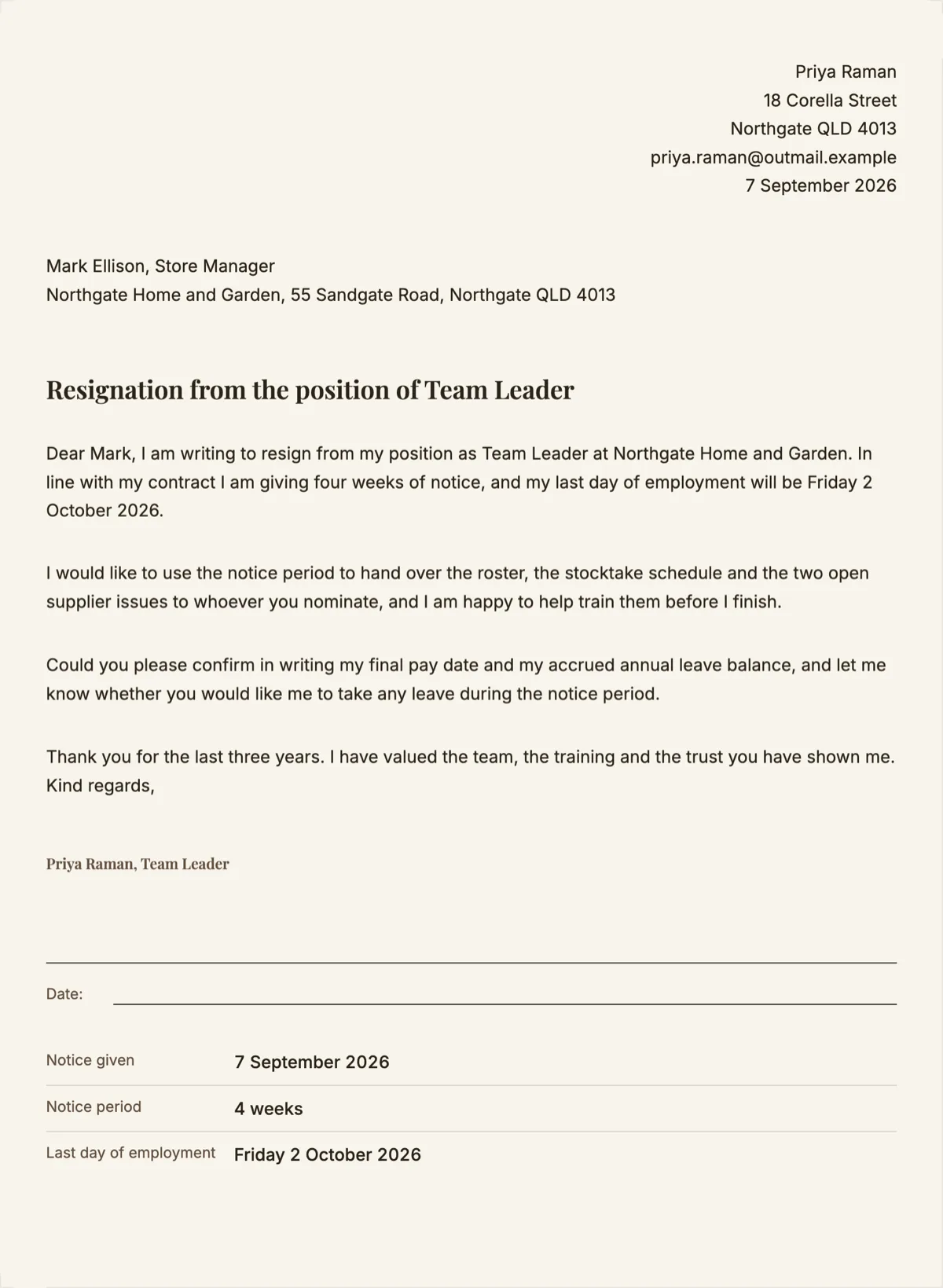 Resignation letter template that says the last day and stopsA resignation letter template has one job, to start the notice period on a date nobody can dispute, and every extra sentence is a risk. This finished example names Friday 2 October 2026 as the last day, offers a handover of three named things, asks for the final pay date and leave balance in writing, and is six sentences long.
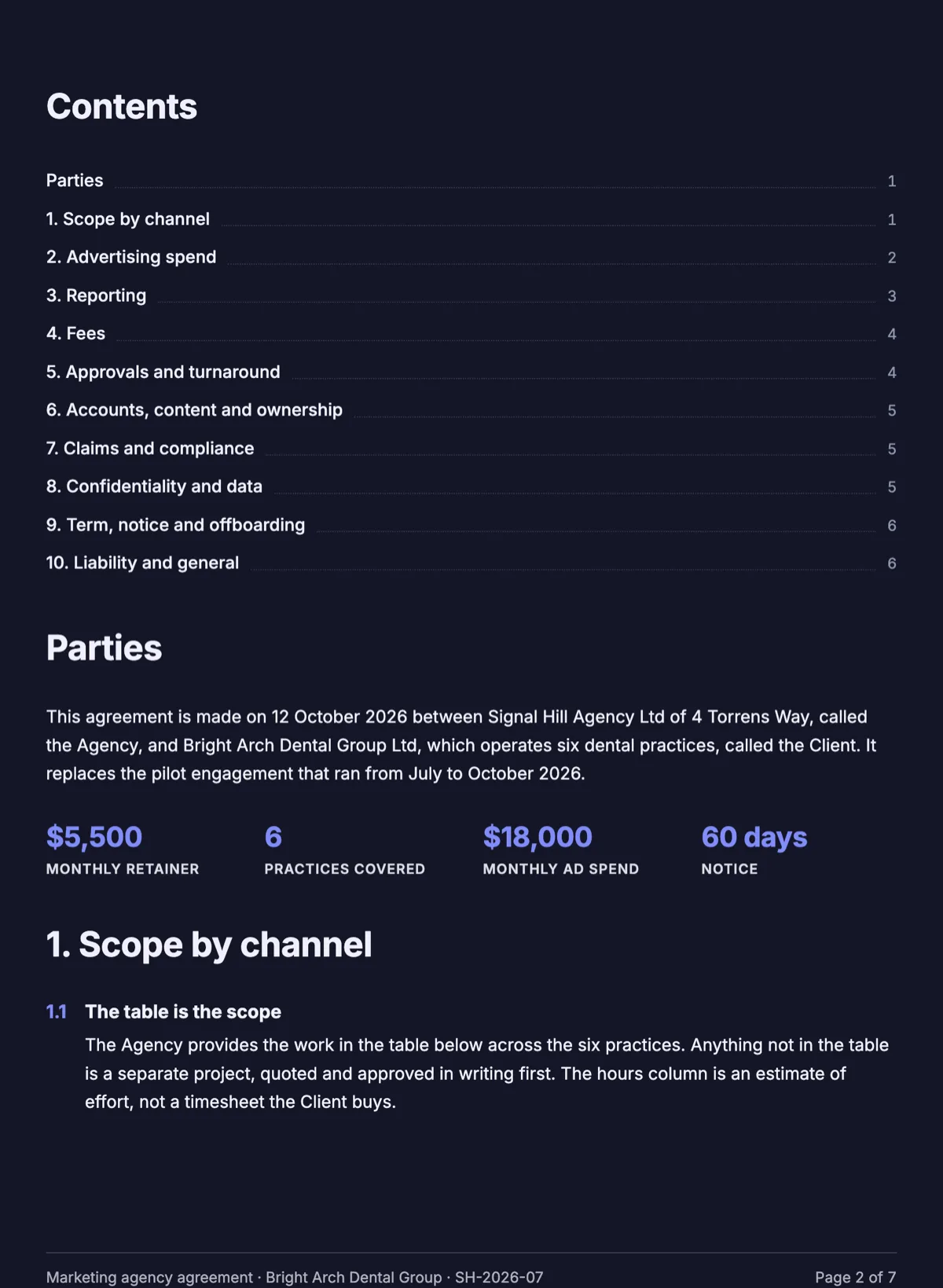 Marketing agency agreement with a channel scope and ad spend held apartThe two things that break an agency relationship are a scope nobody can point at and a fee that quietly includes the advertising budget. This retainer puts the work in a table with the hours and the reported metric for each channel, then keeps every dollar of ad spend in the accounts of the client where it belongs.
Questions people ask
Does a termination notice have to be in writing?
Almost every commercial contract requires it, and it is sensible even where the contract is silent. Writing fixes the date, the ground and the sender, which are the three things that get disputed later. An oral termination followed by a written confirmation is common practice, but the written document is what the parties will rely on.
Can a termination notice be sent by email?
Yes, where the contract allows it. Most modern agreements name an email address for notices in a schedule and add a deemed receipt rule. Sending to an address that is not the one named, or to an individual who has left, is a frequent reason a notice fails, so the schedule should be checked and kept current.
When does a termination notice take effect?
On the date the contract says, not the date it was sent. Hand delivery usually takes effect on delivery, post on a set number of business days after posting, and email at the start of the next business day. Where the notice also states an effective date for termination, that date governs what each party must keep doing until then.
Does the notice need to give a reason?
Only if the contract requires it. Where a contract has both a convenience right and a cause right, naming the clause matters, because the money that changes hands on exit is different for each. Some contracts treat a notice with no stated ground as a convenience termination, which is a sensible default to include.
Who can sign a termination notice?
Whoever the contract says. Many agreements name a role, such as a director or the contract manager listed in a schedule. A notice signed by somebody without that authority can be challenged, which is why the authority should be confirmed before the letter goes out rather than after the other side responds.
What happens if the notice is defective?
The agreement usually keeps running, and the party who sent the notice may itself be in breach if it stopped performing. The fix is normally to send a fresh, compliant notice as soon as the problem is spotted, which restarts any cure period. That is a delay, but it is far better than defending a claim for wrongful termination.
Put the clause in a finished document
The button opens the document generator with a starting description already filled in. Change it to match your own agreement before you run it.
Create a document with OneCraftRelated clauses
- Termination for convenience clauseA termination for convenience clause lets a party end a contract on notice with no breach. Sample retainer wording, mutual and one sided versions, exit costs.
- Cure period clauseA cure period clause gives a party time to fix a breach before termination. Sample wording, tiered periods, repeat breach rules and what to negotiate.
- Consequences of termination clauseThe consequences of termination clause says what each party must do once a contract ends. Sample wording, an exit checklist, accrued rights and final invoices.
For everything the document generator can do, see the document maker.
Step by step in the builder: Create a document with AI, then Send a document for signature.
Written and checked by the OneCraft team. Last checked .