Contract clause
Consequences of termination clause
An effect of termination clause sets out what happens on the day an agreement ends: what stops, what must be returned, what is still payable and by when. It turns the end of a contract into a checklist rather than a negotiation held after the relationship has broken down.
Termination rights get all the attention in a review, and the clause that says what actually happens afterwards is often three lines long. That is where the equipment, the data and the last invoice are decided.
Indunil Asanka · Co-founder
4 min read · Published
Sample clause
an equipment hire and site services agreement between Marlow Logistics and Ironbark Interiors, both fictional Australian businesses
1. On Termination. On the effective date of termination or expiry of this agreement: 1.1 the Supplier must stop providing the Services, except any Services the Customer asks it to continue under clause 15 (Transition Assistance); 1.2 the Supplier must return the Equipment to the Customer's depot at Kewdale within 10 business days, in the condition required by clause 6, fair wear and tear excepted; 1.3 each party must return or destroy the other's Confidential Information under clause 9; 1.4 the Supplier must delete Customer Data from its systems within 30 days, except copies held in routine backups, which must be deleted within 90 days; and 1.5 the Supplier must revoke the site access cards issued to its personnel. 2. Final Invoice. The Supplier must issue a final invoice within 15 business days of the effective date, covering Services delivered and any amounts payable under clause 11, and the Customer must pay it within 30 days. 3. Accrued Rights. Termination does not affect any right or liability that accrued before the effective date.
Sample wording, not legal advice.
Variants
Services agreement
The Services stop, the data moves, and the argument is usually about access during the handover.
On termination the Supplier must stop providing the Services, deliver the Customer Data in the formats listed in Schedule 4 within 15 business days, provide read only access to the Supplier's systems for a further 30 days, and delete the Customer Data within 60 days of the last export. The Customer must pay for Services delivered to the effective date and for any transition assistance it has requested, and each party must return the other's Confidential Information.
Goods and equipment
Physical property has to move, and its condition on return is worth stating before anybody loads a truck.
On termination the Hirer must make the Equipment available for collection at the Site during business hours within 5 business days, cleaned and with all consumables removed. The Owner must inspect the Equipment within 10 business days of collection and notify the Hirer of any damage beyond fair wear and tear, with photographs. Risk in the Equipment passes back to the Owner on collection. Any hire charges accrued to the effective date remain payable, and prepaid charges for unused days must be refunded.
Employment
An employment relationship ending, where statutory entitlements sit on top of anything the contract says.
On the last day of employment the Employee must return all Company property, including the laptop, mobile telephone, access pass and any documents containing Confidential Information, and must delete Company material from personal devices. The Company must pay all outstanding wages, accrued annual leave and any other entitlement required by law on or before the next scheduled pay day. The post employment obligations in clauses 12 and 13 continue to apply according to their terms.
What to negotiate
Data return and the deletion deadline
Customers want their data back in a usable format before anything is deleted, and suppliers want a firm deletion date so they are not holding somebody else's records indefinitely. The usual sequence is export first, confirm receipt, then delete within a stated period, with a longer window for routine backups because no operations team can pull a single customer out of a backup on demand.
Who pays for the exit work
Returning equipment, exporting data and revoking access all cost something. Suppliers want the work paid at standard rates; customers argue that basic return of their own property is part of the deal. Most contracts split it: return of property and a standard data export are included, and anything beyond that, such as bespoke formats or knowledge transfer, is paid under a transition assistance clause.
The timing of the final invoice
A final invoice that arrives months later is difficult to check and difficult to budget for. Customers ask for a deadline, commonly 15 to 30 business days after the effective date, with the invoice treated as final. Suppliers accept the deadline but ask for an exception where a third party cost has not yet been billed to them, which is a reasonable carve out to include.
Condition of returned property
Fair wear and tear is the phrase every hire agreement uses and few define. The party receiving property back wants an inspection right and a short window to notify damage with photographs. The party returning it wants a deadline after which no claim can be made. Both features together make the clause workable, because the dispute is otherwise about the condition of something already collected.
The risk of leaving it out
Without this clause the parties leave the practical questions to be settled after the relationship has already failed. Equipment sits where it was, data is held or deleted on whatever timetable suits the holder, access cards stay active, and the final invoice arrives whenever it arrives. Each of those is easy to agree in advance and slow to agree afterwards.
An exit checklist belongs in the contract
The useful version of this clause reads like a list of tasks with owners and deadlines, because that is what the parties will actually follow. Stop the services. Return the property, in a stated condition, to a stated place. Export the data, in stated formats, then delete it after a stated period. Revoke access, both physical and system. Issue the final invoice by a deadline and pay it by another. Confirm the return or destruction of confidential information. Six lines drafted while both parties are cooperative replace six weeks of email once they are not, and the same list gives an incoming supplier something concrete to plan around.
Accrued rights and the final settlement
Ending a contract does not cancel what was already owed, but a clause that says so removes an argument. The sentence preserving accrued rights protects both parties: the supplier keeps its claim for delivered work, and the customer keeps its claim for a breach that happened during the term. Some contracts go further and settle everything on exit, which is a different bargain entirely and should be drafted as a release rather than hidden inside an effect of termination clause. Anyone signing a document that describes the final payment as full and final settlement is giving up claims, and that deserves its own clause and its own decision.
Where it sits in a generated document
The document generator writes an agreement as numbered content, so an effect of termination clause works well as a numbered list of obligations with deadlines attached to each. The generated text is written from the description it is given and it never prints citations, so every period and cross reference in a draft has to be checked before the document is used. Listing the exit tasks in the description produces them as separate sub clauses, which is easier to follow than one long sentence.
Documents that carry this clause
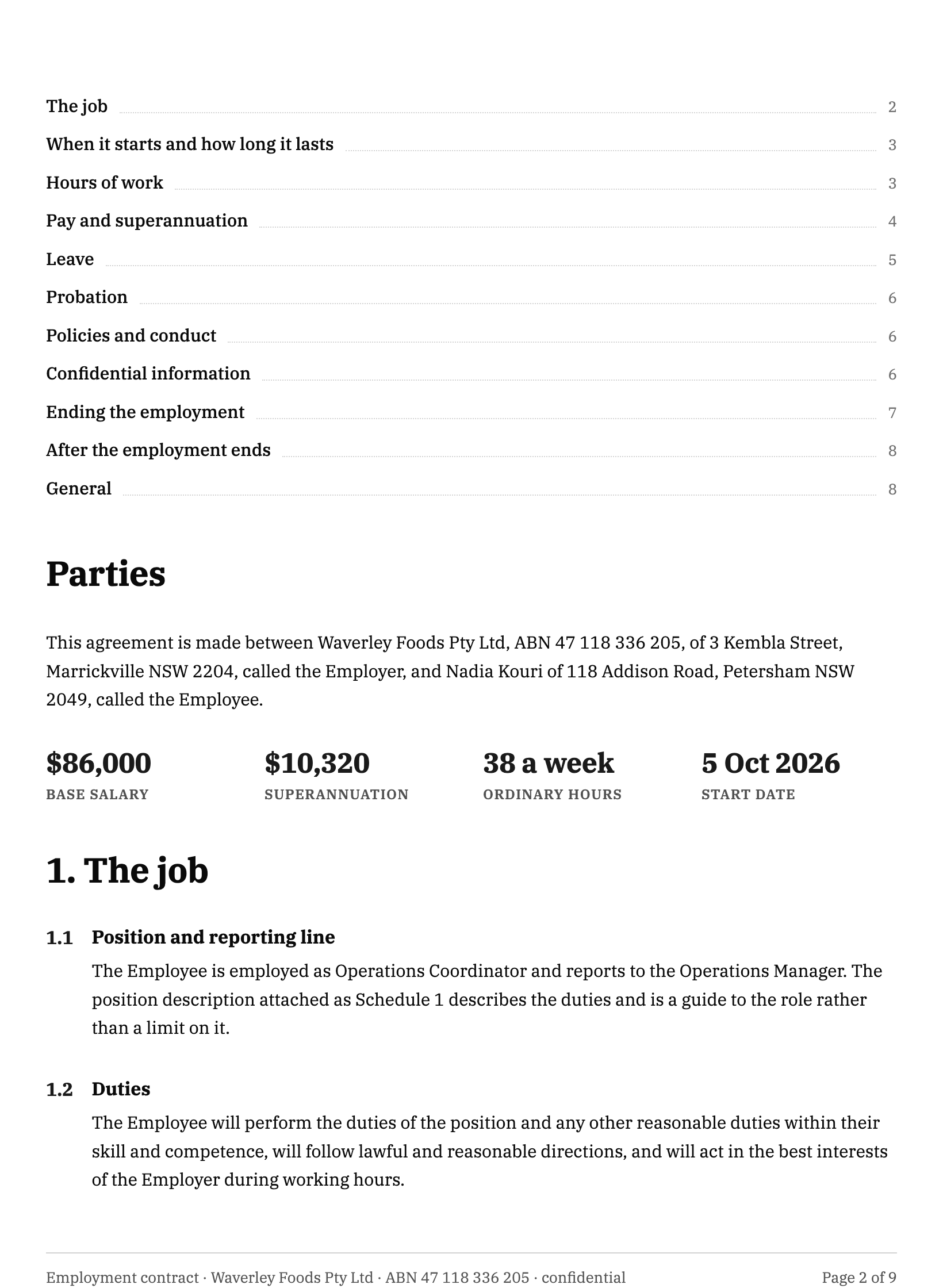 Employment contractA full time ongoing contract for an operations coordinator on $86,000 plus $10,320 of superannuation. Eleven numbered clauses, a leave table drawn from the National Employment Standards, and a notice table that scales with service.
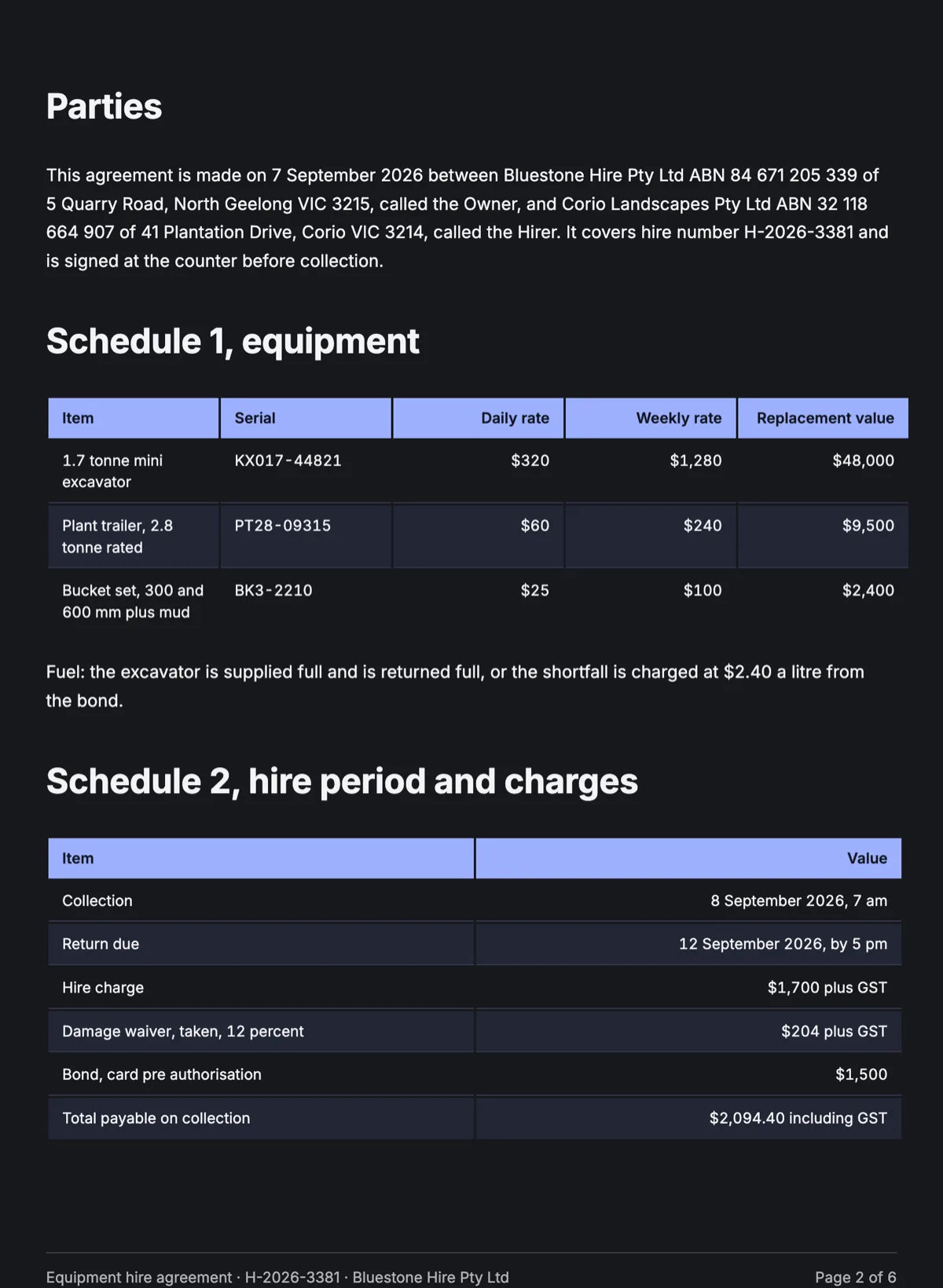 Equipment hire agreement template with the rates in a scheduleA hire agreement is a price list, an insurance decision and a return date, and the argument is always about the day it came back. This one puts the equipment and rates in a schedule, makes the damage waiver a choice with its price, and defines late return in hours so there is nothing to interpret.
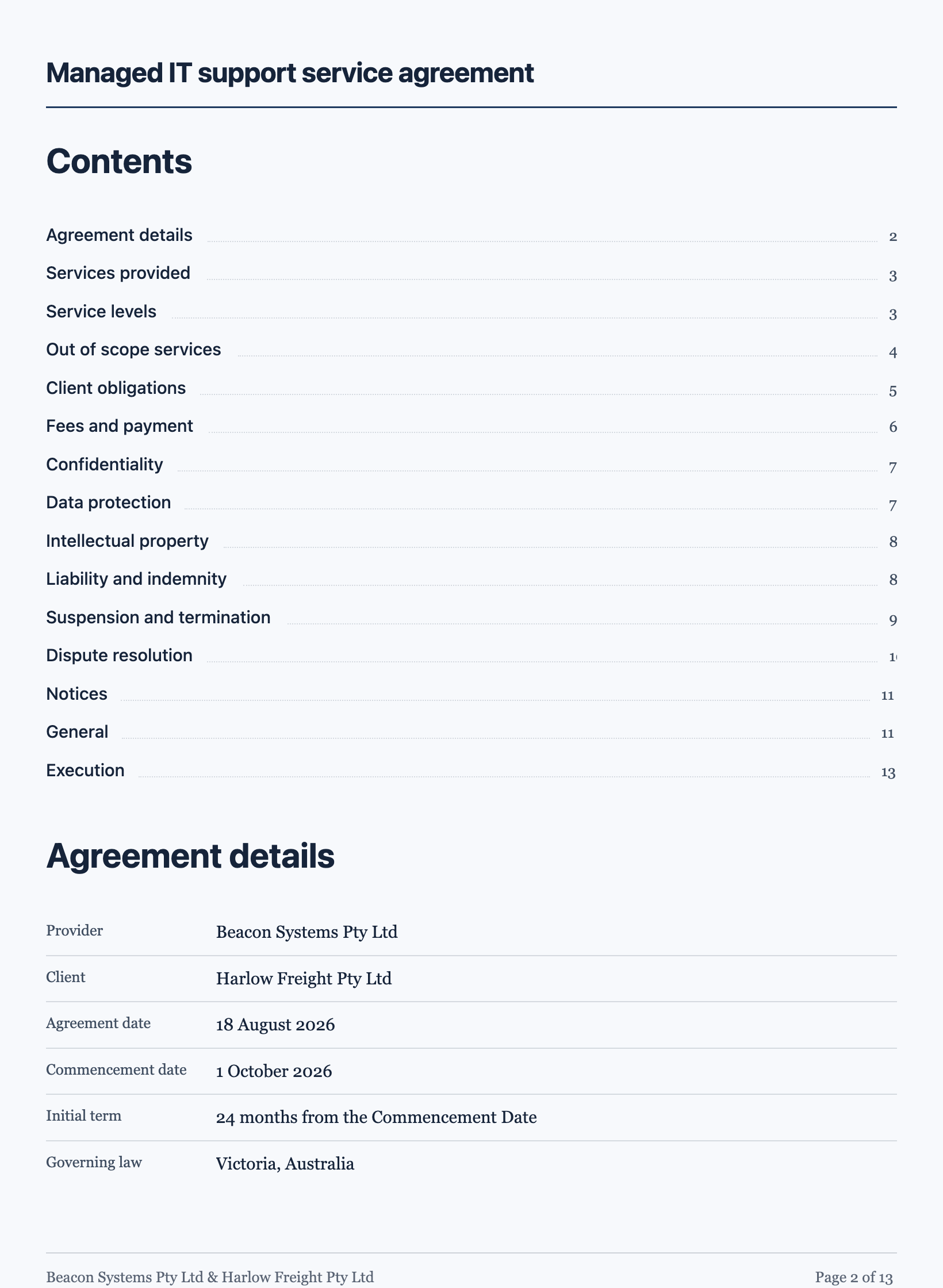 Service agreementBeacon Systems supports Harlow Freight’s IT for an initial 24 months from 1 October 2026 at $8,400 a month plus GST, with 40 hours included and $220 an hour beyond them. Twelve numbered clauses cover the services, a four level severity table, client duties, fees with a CPI adjustment, confidentiality, privacy, IP, a liability cap, termination and a three step dispute ladder.
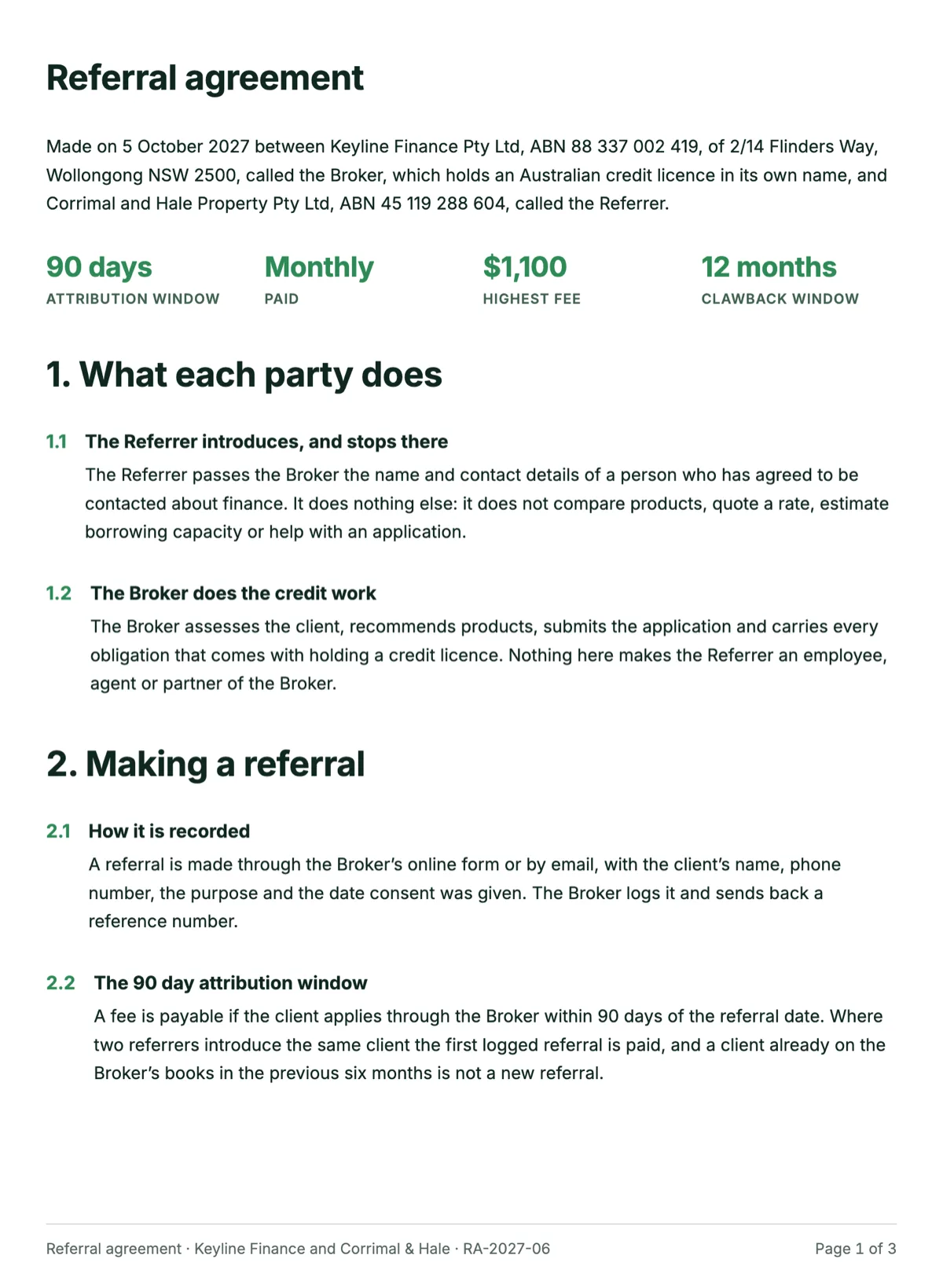 Referral agreement template with a fee table by productA referral agreement works when it is clear where the referral stops and the advice starts. This one has a real estate agency passing buyers to a mortgage broker for a fee that ranges from $250 to $1,100 by product, attributed for 90 days, paid monthly, and clawed back if the lender claws back first.
Questions people ask
What happens to data when a contract ends?
Whatever the contract says, which is why the clause matters. The workable sequence is export in an agreed format, confirmation that the customer has received it, then deletion within a stated period, with a longer window for routine backups. Without a clause, a supplier may hold data indefinitely or delete it faster than the customer expected.
Is the final invoice always payable?
Amounts accrued before the effective date remain payable, and most contracts confirm that in an accrued rights sentence. What varies is what else can be charged, such as demobilisation costs or committed third party spend. Setting a deadline for issuing the final invoice keeps the total checkable while the people who know the detail are still available.
Who pays for the handover work?
Return of the customer's own property and a standard data export are usually included in the fees already paid. Anything beyond that, such as bespoke export formats, extended system access or knowledge transfer sessions, is normally paid at standard rates under a transition assistance clause rather than absorbed by the outgoing supplier.
Does termination cancel obligations that already existed?
No. Rights and liabilities that accrued before the effective date survive, including unpaid invoices and claims for earlier breaches. A short accrued rights sentence makes that explicit, which is worth having because the alternative is arguing about it at the exact moment the relationship is least cooperative.
What does fair wear and tear mean on returned equipment?
It covers deterioration from ordinary use over the hire period, not damage from misuse or neglect. Because the phrase is imprecise, useful clauses add an inspection right, a short window to notify damage with photographs, and a deadline after which no claim can be made. That turns an open argument into a dated process.
Should the clause list obligations for both parties?
Yes. Most drafts concentrate on what the supplier must do and forget the customer, which leaves access cards active, site passes unreturned and third party licences unassigned. Writing the list with a named owner and a deadline for each task shows the gaps immediately, and it is the version people actually follow.
Put the clause in a finished document
The button opens the document generator with a starting description already filled in. Change it to match your own agreement before you run it.
Create a document with OneCraftRelated clauses
- Survival clauseA survival clause names the obligations that keep running after a contract ends. Sample wording, which clauses survive, time limits and what to negotiate.
- Transition assistance clauseA transition assistance clause sets the help an outgoing supplier must give at exit. Sample wording, free and paid variants, data formats and what to negotiate.
- Return of confidential information clauseA return of confidential information clause says what is given back or destroyed at the end. Sample wording, backup carve outs and the destruction certificate.
- Termination for insolvency clauseA termination for insolvency clause ends a contract when the other side fails. Sample wording, trigger lists, and the Australian ipso facto stay since 2018.
For everything the document generator can do, see the document maker.
Step by step in the builder: Create a document with AI, then Document builder components.
Written and checked by the OneCraft team. Last checked .