Contract clause
Survival clause
A survival clause names the obligations that continue after the agreement ends, and for how long. Without it, a party can argue that termination swept away the confidentiality duty, the indemnity and the right to be paid for work already delivered, along with everything else.
The clauses that matter most after a relationship ends are the ones nobody reads while it is running. A survival list is a short paragraph that decides which of them still exist the day after the notice takes effect.
Nuwan Madhusanka · Co-founder
4 min read · Published
Sample clause
a brand design contract between Wattle Lane Studio and Saltbush Brewing, a fictional craft brewery in Ballarat
1. Survival. The following clauses continue to apply after this agreement ends, however it ends: clause 7 (Intellectual Property), clause 8 (Confidentiality), clause 10 (Indemnity), clause 11 (Limitation of Liability), clause 13 (Payment for Work Delivered), clause 16 (Dispute Resolution) and clause 18 (Governing Law), together with this clause. 1.1 Clause 8 continues for 3 years after the end of this agreement, except that the obligations in clause 8.4 relating to trade secrets continue for as long as the information remains a trade secret. 1.2 Clause 10 continues for 6 years after the end of this agreement. 2. Accrued Rights. Ending this agreement does not affect any right or obligation that had accrued before the end date, including the Client's obligation to pay for Services delivered before that date. 3. Other Clauses. Any other clause that by its nature is intended to continue after this agreement ends does so, whether or not it is listed in clause 1.
Sample wording, not legal advice.
Variants
Listed clauses only
The clearest form, and the one most reviewers prefer, because it can be checked against the contract in a minute.
Clauses 7, 8, 10, 11, 13, 16 and 18 survive the expiry or termination of this agreement, together with any provision of those clauses that gives effect to them. No other clause continues after this agreement ends. Termination does not affect any right, obligation or liability that accrued before the effective date of termination, and each party retains every remedy it had at that date in respect of an earlier breach.
By nature wording with no list
Short agreements where a list would be longer than the contract, or where clause numbering is still moving during drafting.
Any provision of this agreement that by its nature is intended to continue after this agreement ends continues to apply, including the provisions dealing with confidentiality, intellectual property, indemnities, limitation of liability, payment for work already delivered, dispute resolution and governing law. Termination does not affect any right or obligation that accrued before the effective date, and does not relieve either party of a liability incurred before that date.
Listed clauses with individual time limits
Contracts where an open ended confidentiality duty would be unreasonable but some obligations genuinely need to run for years.
The clauses listed in the table below survive the end of this agreement for the periods stated: Confidentiality, 3 years; Trade Secrets, for as long as the information remains secret; Indemnity, 6 years; Intellectual Property, without limit of time; Limitation of Liability, for as long as any surviving obligation continues; Dispute Resolution and Governing Law, without limit of time. Where a surviving clause has no stated period it continues for 6 years after the end of this agreement.
What to negotiate
Which clauses make the list
Confidentiality, intellectual property, indemnities, the liability cap, payment for delivered work, dispute resolution and governing law appear in nearly every list. The arguments are about the rest. A supplier wants the liability cap to survive alongside the indemnity, because an indemnity that outlives its cap is an uncapped indemnity. Customers rarely resist that once it is explained in those terms.
How long each obligation runs
An open ended confidentiality duty is hard to comply with and often unnecessary, so three to five years is the usual commercial range, with trade secrets carved out to run while they stay secret. Indemnities are commonly matched to the limitation period in the governing jurisdiction. Stating a period for each obligation is clearer than one blanket figure applied to a list of very different duties.
Whether accrued rights are preserved
A survival clause that lists provisions but says nothing about accrued rights leaves room to argue that termination wiped out a claim for an earlier breach, or a debt for work already delivered. One sentence fixes it. Both sides usually want it, because each of them may be the party owed something on the day the agreement ends.
List against by nature wording
A list is certain but goes stale when clauses are renumbered during drafting. Nature wording is flexible but leaves the question open. Most negotiated contracts use both: a named list for the clauses that matter, followed by a sentence catching anything that by its nature should continue. That combination survives a last minute renumbering without losing clarity.
The risk of leaving it out
Without a survival clause each obligation has to be argued from its own wording and the general law, which is slow and uncertain exactly when the relationship has already broken down. The practical exposures are a confidentiality duty that the other side claims ended with the contract, an indemnity with no surviving liability cap, and an unpaid invoice for work delivered before the end date.
What usually survives, and why
Confidentiality survives because information does not become less sensitive when a contract ends. Intellectual property survives because ownership and licences granted during the term have to keep operating afterwards. Indemnities survive because the claims they cover often arrive years later. The liability cap survives because it is the ceiling on those indemnities, and a cap that expires with the contract leaves the surviving obligations uncapped. Payment obligations survive for work already delivered. Dispute resolution and governing law survive because the parties need a forum and a law to argue about everything else. Almost every negotiated survival list is a version of that seven item set.
Time limits are part of the clause
A survival list that says clause 8 survives, without saying for how long, creates a perpetual obligation by default in many drafts and an ambiguity in the rest. Stating a period for each item is the fix, and the periods differ by obligation. Confidentiality commonly runs three to five years, which reflects how long ordinary commercial information stays sensitive, with genuine trade secrets carved out to run while they remain secret. United Kingdom government guidance on non disclosure agreements describes three to five years as typical and notes that some material can warrant indefinite protection. Indemnity periods are usually matched to the limitation period that applies where the contract is governed.
Where it sits in a generated document
The document generator writes an agreement as numbered content, so a survival clause normally appears near the end with the general provisions and refers to other clauses by number. The generated text is written from the description it is given and it never prints citations, so every cross reference in a draft has to be checked against the final numbering before the document is used. Asking for both a named list and a sentence covering anything that by its nature should continue produces a clause that still works if the numbering shifts.
Documents that carry this clause
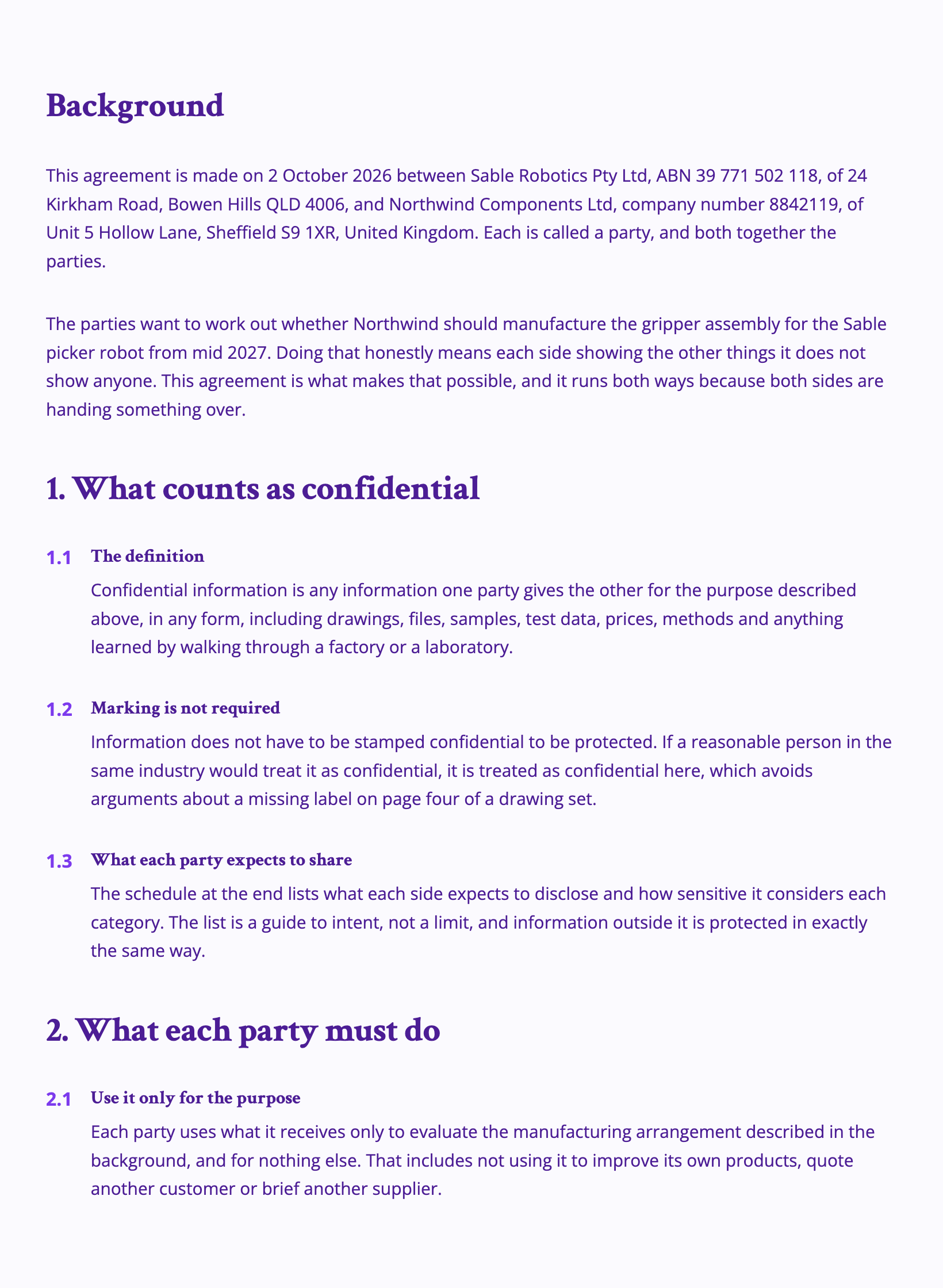 Mutual NDAA robotics company and a British parts maker want to look inside each other before agreeing to anything. Both sides are handing over trade secrets, which is the only real reason to make an NDA mutual.
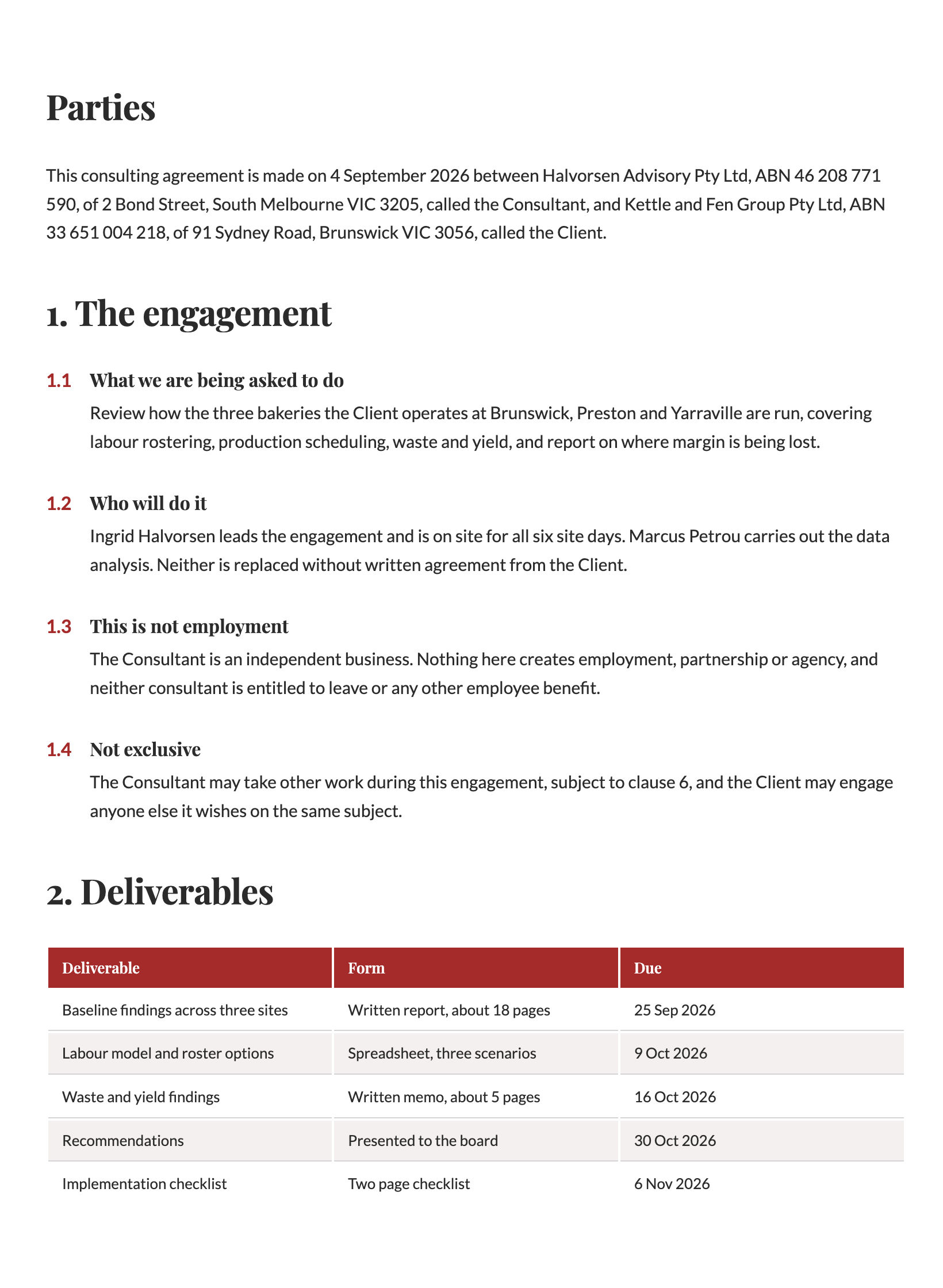 Consulting agreementAn advisory firm reviews three bakeries over seven weeks. What makes this agreement useful is not the fee clause but the two clauses that say what the advice is not.
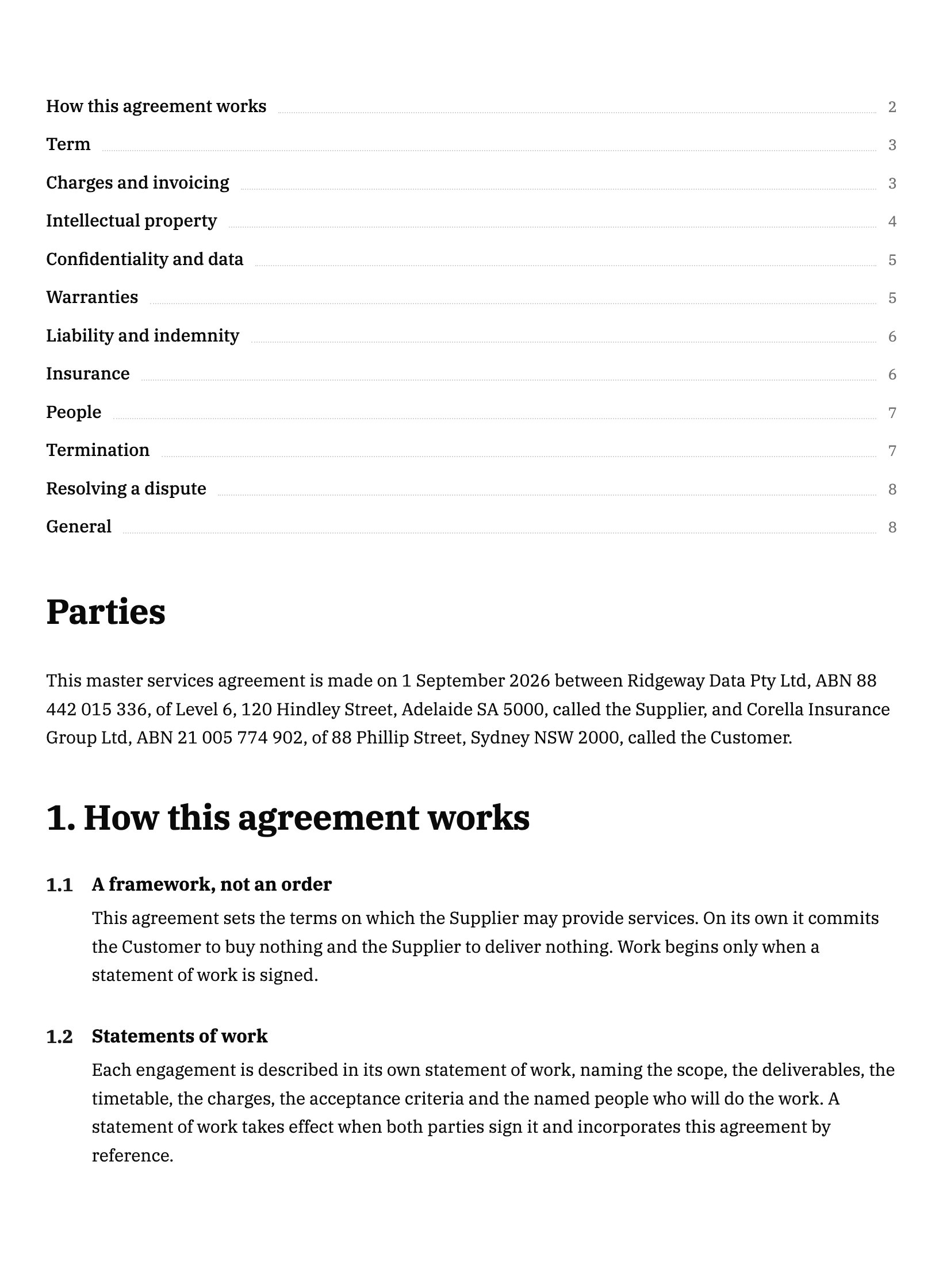 Master services agreementA data consultancy and an insurer sign this once and then buy work under it for three years. It is the rare contract whose whole purpose is to make the next twenty contracts short.
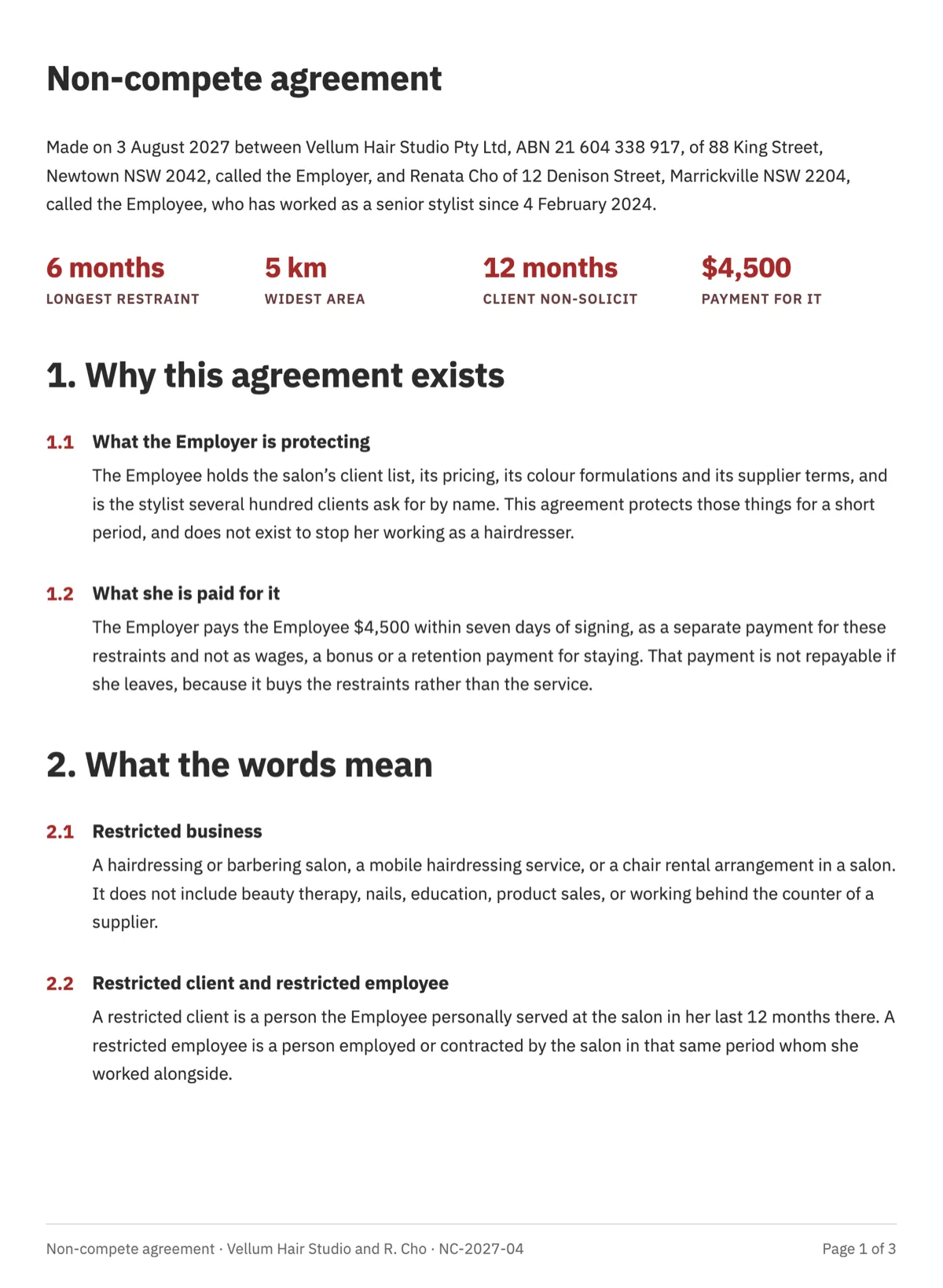 Non-compete agreement template with cascading restraint clausesAn Australian non-compete lives or dies on how it is drafted, because a court will not rewrite one that reaches too far. This one restrains a senior stylist from a competing salon using three separate covenants of falling reach, from 5 kilometres for six months down to 1 kilometre for three, and pays $4,500 for them.
Questions people ask
Which clauses usually survive termination?
Confidentiality, intellectual property, indemnities, the limitation of liability, payment for work already delivered, dispute resolution and governing law appear in nearly every survival list. Some contracts add non solicitation, audit rights and record keeping. The test worth applying is simple: would the obligation be useless if it stopped the day the contract ended.
How long should confidentiality survive?
Three to five years from the end of the agreement is the common commercial range for ordinary business information, with trade secrets carved out to run for as long as they remain secret. United Kingdom government guidance on non disclosure agreements describes a similar range and notes that some categories can justify indefinite protection.
Does a survival clause need a list?
Not strictly, but a list is far easier to check. Wording that says anything intended by its nature to continue does continue works, and it survives renumbering, but it leaves the question open until somebody argues about it. Most negotiated contracts use a named list followed by that catch all sentence, which gives both certainty and flexibility.
Should the liability cap survive?
Yes, and suppliers should insist on it. Indemnities and warranties that survive without a surviving cap are effectively uncapped, because the ceiling that limited them has expired. Making the limitation of liability clause survive for as long as any obligation it limits is the clean way to express this in one line.
What are accrued rights?
They are rights and obligations that already existed on the day the agreement ended, such as an unpaid invoice for delivered work or a claim for a breach that happened during the term. A survival clause should confirm that termination does not affect them, otherwise a party may argue that ending the contract also ended the claim.
Does survival differ if the contract is terminated for cause?
The list should not change. A survival clause that applies however the agreement ends avoids any argument that a particular exit route left some obligations behind. What can change is the damages position, because a party that terminated for cause keeps its claim for the breach, which the survival clause preserves rather than creates.
Put the clause in a finished document
The button opens the document generator with a starting description already filled in. Change it to match your own agreement before you run it.
Create a document with OneCraftRelated clauses
- Consequences of termination clauseThe consequences of termination clause says what each party must do once a contract ends. Sample wording, an exit checklist, accrued rights and final invoices.
- Confidentiality clauseA confidentiality clause inside a wider contract, not a standalone NDA. Sample consulting wording, mutual and one way variants, the tail period and exceptions.
- Return of confidential information clauseA return of confidential information clause says what is given back or destroyed at the end. Sample wording, backup carve outs and the destruction certificate.
For everything the document generator can do, see the document maker.
Step by step in the builder: Create a document with AI, then Document builder components.
Written and checked by the OneCraft team. Last checked .