Contract clause
Termination for insolvency clause
A termination for insolvency clause gives one party the right to end the contract when the other becomes insolvent or enters a formal insolvency process. It also usually allows the solvent party to stop supplying, take back goods, and call in security before an administrator takes control of the business.
This is the clause most likely to say one thing and do another in Australia, because a statutory stay has limited when it can be used since July 2018. Knowing which processes it still bites on is the difference between a clean exit and a void notice.
Indunil Asanka · Co-founder
4 min read · Published
Sample clause
a supply agreement between Ironbark Interiors and Marlow Books, a fictional bookseller in Perth
1. Insolvency Event. An Insolvency Event occurs in relation to a party if it is wound up or resolves to be wound up, an administrator or liquidator is appointed to it, a controller is appointed over the whole or substantially the whole of its property, it enters a compromise or arrangement with its creditors, or it fails to comply with a statutory demand that has not been set aside. 2. Termination. A party may end this agreement immediately by written notice if an Insolvency Event occurs in relation to the other party, to the extent permitted by law. 3. Suspension. Whether or not this agreement is ended, the Supplier may suspend delivery, and may require payment in advance for any further Goods, if an Insolvency Event occurs in relation to the Customer. 4. Retention of Title. Title in Goods supplied but not paid for does not pass to the Customer, and the Supplier may enter the Customer's premises during business hours to recover them, subject to the rights of any administrator or controller.
Sample wording, not legal advice.
Variants
Broad trigger list
The solvent party wants every signal of financial distress captured, not only the formal appointments.
An Insolvency Event occurs if a party is wound up, resolves to be wound up, has an administrator, liquidator, receiver or controller appointed, enters any arrangement or compromise with creditors, is presumed insolvent under section 459C of the Corporations Act 2001, ceases or threatens to cease carrying on business, or has a judgment against it that remains unsatisfied for 20 business days. A party may end this agreement immediately by written notice on the occurrence of an Insolvency Event in relation to the other party, to the extent permitted by law.
Narrow trigger, limited to liquidation
The other party will not accept a right triggered by events short of terminal insolvency, particularly where administration may lead to a rescue.
A party may end this agreement immediately by written notice if the other party is placed into liquidation, or resolves to be wound up other than for the purpose of a solvent reconstruction. No other event relating to the financial position of a party gives rise to a right to end this agreement, although the Supplier may require payment in advance for further deliveries if an invoice remains unpaid for more than 30 days after its due date.
Rights that survive the stay
An Australian contract drafted after the 2018 reforms, where the useful protections are self help rather than termination.
If an Insolvency Event occurs in relation to the Customer, the Supplier may, to the extent permitted by law, suspend further supply, require payment in advance or security for further supply, refuse to release Goods held on the Customer's behalf, set off amounts owed under this agreement against amounts payable by the Supplier, and enforce any security interest it holds. These rights are additional to the Supplier's right to end this agreement and may be exercised whether or not that right is available.
What to negotiate
How wide the trigger list should be
Solvent parties want early signals included, such as failing to comply with a statutory demand or ceasing to carry on business. The other side argues that a wide list turns a temporary cash flow problem into a termination right that lenders and auditors then worry about. Most contracts land on formal appointments plus statutory presumptions of insolvency, and leave out vague tests such as inability to pay debts generally.
Suspension and payment in advance
Since termination may be stayed, the practical protections are the ones that keep working. Suppliers ask for an express right to suspend supply, to require advance payment, and to withhold goods held on the customer's behalf. Customers accept these more readily than a termination right, because they do not end the relationship, and an administrator can restore supply by paying as it goes.
Security and retention of title
A retention of title clause and a registered security interest do more for a supplier than any termination right, because they affect what can be recovered from the estate. Customers accept retention of title as standard in goods contracts. What gets negotiated is the right of entry to recover the goods, which is usually limited to business hours and made subject to the rights of any appointed administrator or controller.
The risk of leaving it out
Without the clause the solvent party has no contractual right to stop performing when the other side fails, and may be required to keep supplying on credit into an insolvency. It also loses the express suspension, advance payment and retention of title protections that in practice matter more than the termination right itself once an administrator is appointed.
The Australian ipso facto stay
Reforms made by the Treasury Laws Amendment (2017 Enterprise Incentives No. 2) Act 2017 introduced a stay into Chapter 5 of the Corporations Act 2001 that took effect on 1 July 2018. Broadly, a right to terminate or amend a contract that arises only because the other party has entered voluntary administration, has a scheme of arrangement proposed to avoid an insolvent winding up, or has a managing controller appointed over the whole or substantially the whole of its property, cannot be enforced during the stay period. The stay applies to contracts entered into on or after 1 July 2018, it does not apply to liquidation, and regulations and ministerial declarations exclude certain contracts and rights from it. The practical consequence is that a clause triggered by administration may sit unusable at exactly the moment it was written for.
What still works when termination does not
The stay is aimed at rights that arise only because of the insolvency process. It does not rescue a counterparty that has also failed to pay, so a termination right triggered by non payment usually remains available, provided the non payment is real and documented separately from the appointment. Rights that are not terminations often keep working too, which is why post reform drafting leans on suspension of supply, payment in advance, withholding delivery, set off and security enforcement. A supplier with a registered security interest and a retention of title clause is in a materially better position than one holding only an elegant termination right.
Where it sits in a generated document
The document generator writes an agreement as numbered content, so the definition of an insolvency event usually appears with the other definitions and the termination right sits in the termination clause that refers to it. The generated text is written from the description it is given and it never prints citations, so any statutory reference in a draft has to be checked against the legislation before the document is used. Asking for suspension and retention of title alongside the termination right produces them as separate numbered provisions.
Documents that carry this clause
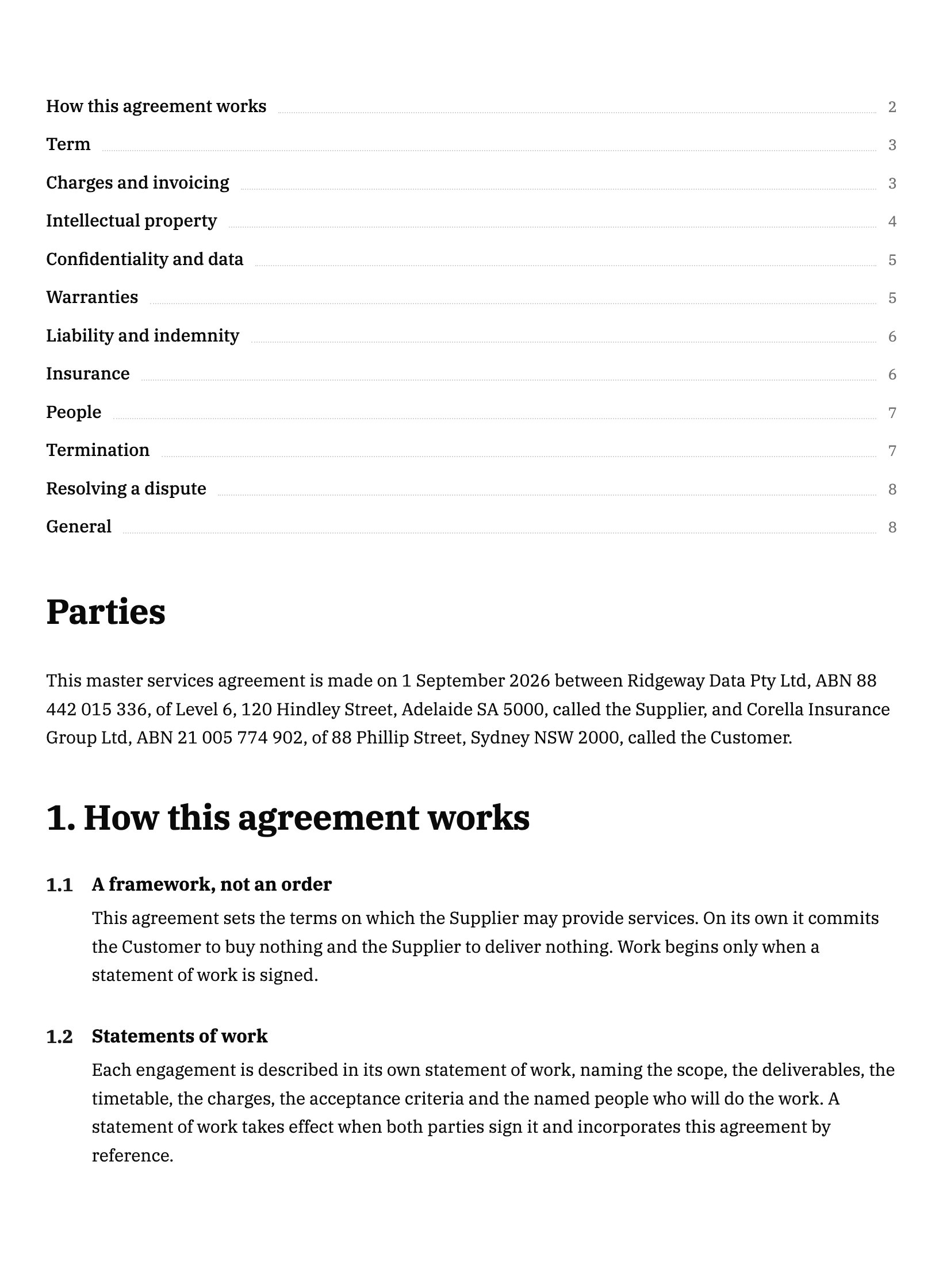 Master services agreementA data consultancy and an insurer sign this once and then buy work under it for three years. It is the rare contract whose whole purpose is to make the next twenty contracts short.
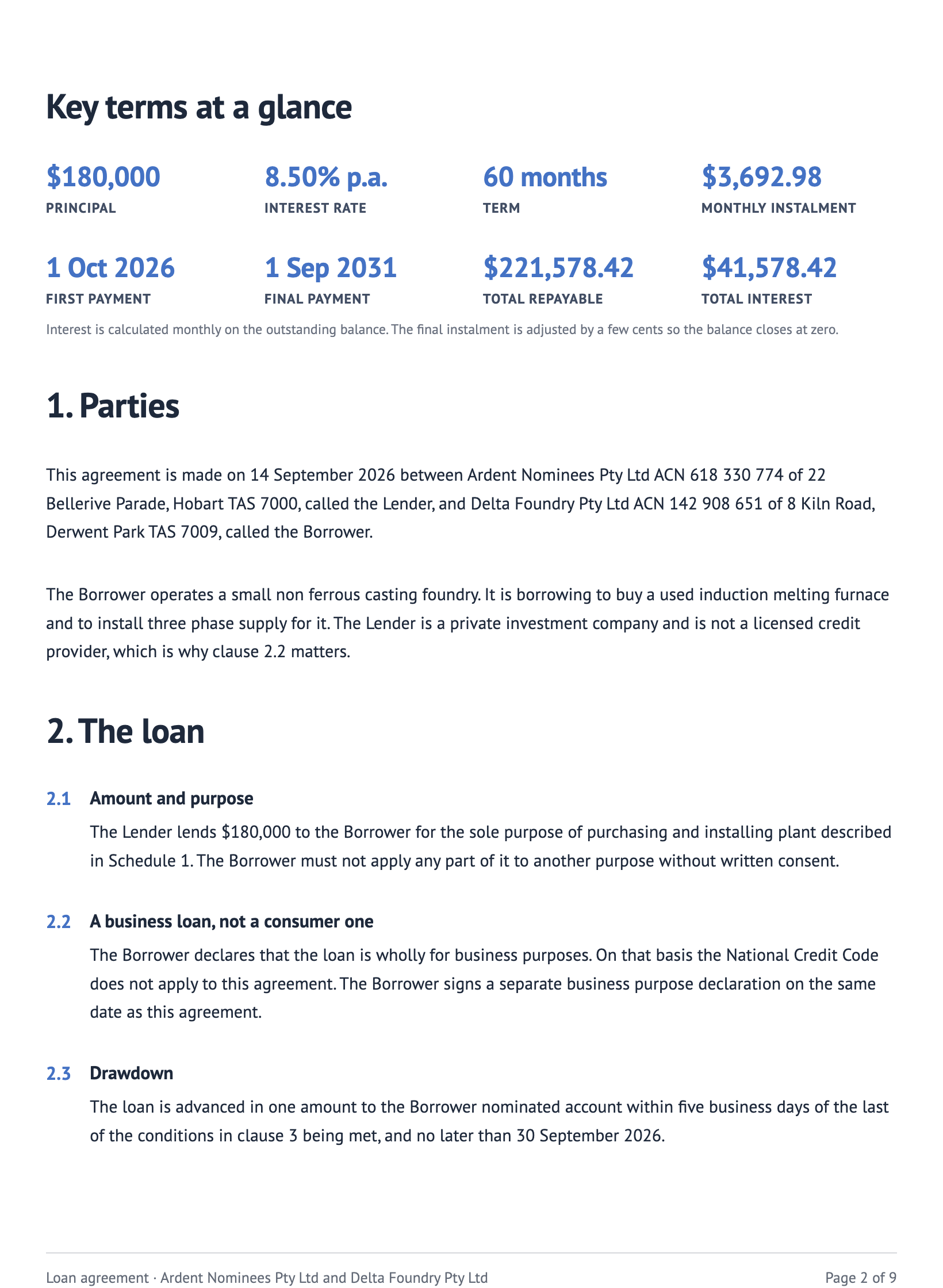 Loan agreement templateA Tasmanian foundry is borrowing $180,000 from a private investment company to buy a used induction furnace. The lender is not a bank, so everything a bank would take for granted has to be written down: what has to happen before the money moves, what is registered over what, and how long the borrower gets to fix a default.
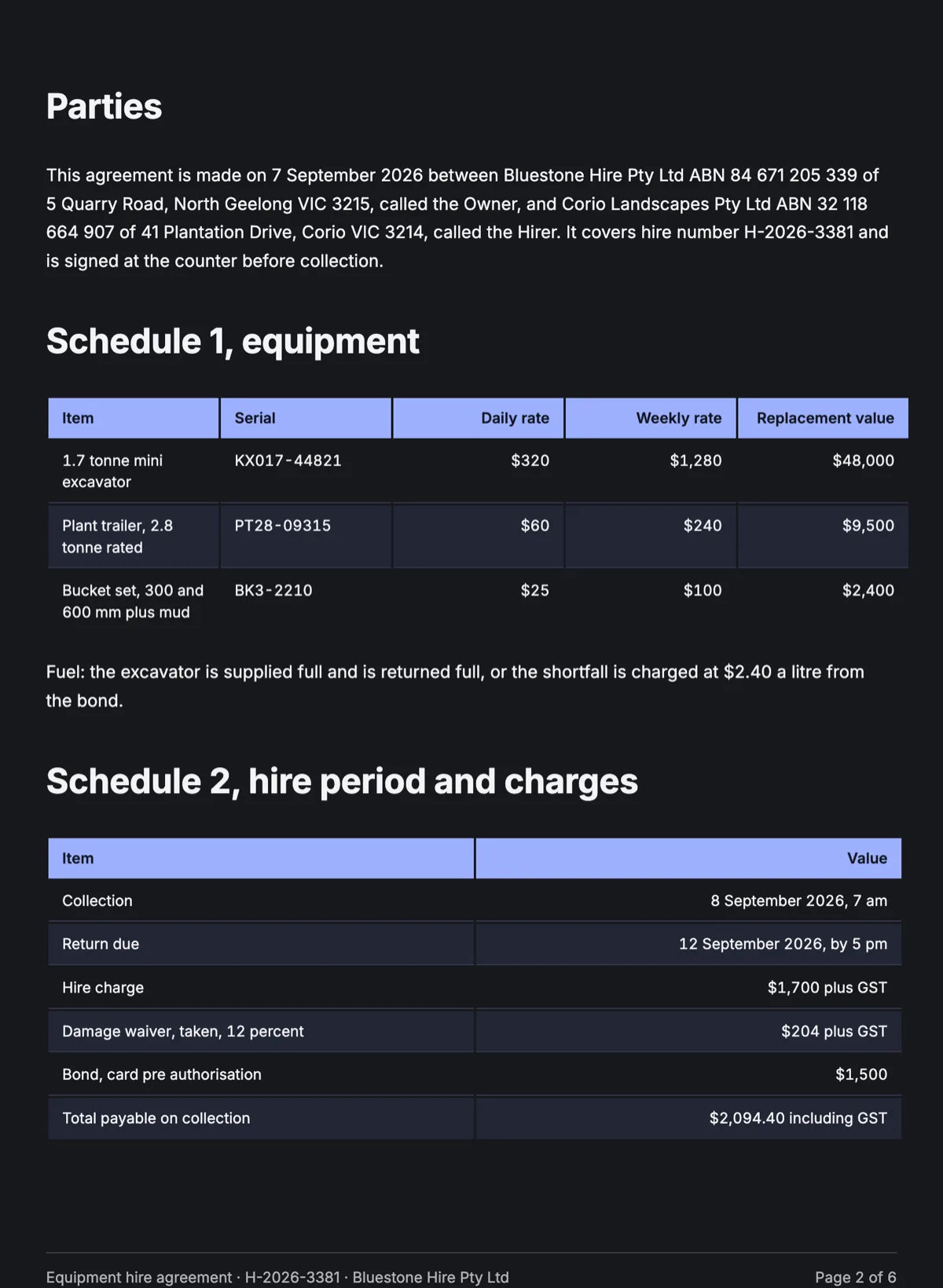 Equipment hire agreement template with the rates in a scheduleA hire agreement is a price list, an insurance decision and a return date, and the argument is always about the day it came back. This one puts the equipment and rates in a schedule, makes the damage waiver a choice with its price, and defines late return in hours so there is nothing to interpret.
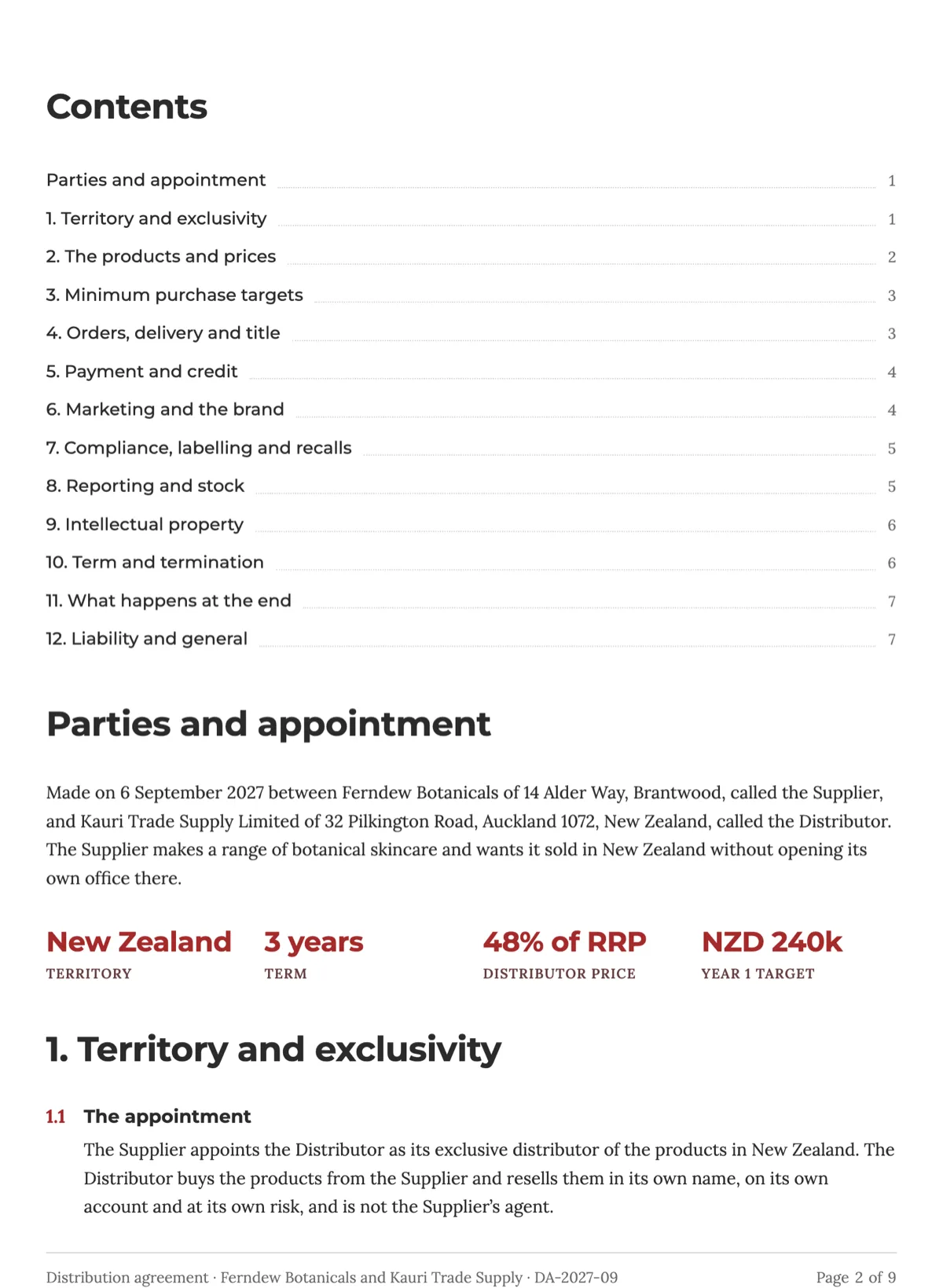 Distribution agreement template with territory and targetsAn exclusive distribution agreement is a trade: a territory in exchange for volume. This one appoints a New Zealand distributor for a skincare range at 48 per cent of recommended retail, with purchase targets rising from NZD 240,000 to NZD 420,000 across three years, and exclusivity that converts to non exclusive if a target is missed by more than 15 per cent.
Questions people ask
What is an ipso facto clause?
It is a contract term that gives one party a right to terminate or change the contract simply because the other has entered an insolvency process, regardless of whether anything else has gone wrong. Australian law has stayed the enforcement of many such rights since 1 July 2018, so the clause can be valid on paper and unusable in the moment it was drafted for.
Does the stay apply to liquidation?
No. The stay introduced by the 2017 reforms is aimed at processes where a business might be saved, principally voluntary administration, schemes of arrangement proposed to avoid an insolvent winding up, and the appointment of a managing controller. Liquidation sits outside it, so a termination right triggered by a winding up generally remains available.
Does the stay apply to contracts signed before July 2018?
It applies to contracts entered into on or after 1 July 2018. Older agreements are not covered, which means two contracts with the same wording can behave differently depending on when they were signed. Renewing or materially varying an old contract is worth checking for this reason before relying on an insolvency termination right.
Can a supplier stop supplying instead of terminating?
Usually yes, if the contract says so. Rights to suspend supply, to require payment in advance, to withhold goods held for the customer and to enforce security are the practical protections that keep working, and they are the ones post reform drafting concentrates on. They also leave room for an administrator to keep trading by paying as it goes.
Is retention of title worth including?
For goods contracts it is often worth more than the termination right. It keeps title with the supplier until payment, and when it is backed by a registered security interest it affects what the supplier can recover from the estate rather than just what it can stop doing. Registration timing matters, so the clause alone is not the whole answer.
How should the trigger list be drafted?
Name the formal appointments, add the statutory presumption of insolvency from an unsatisfied statutory demand, and avoid vague tests that turn a short cash flow problem into a termination event. Express the termination right as applying to the extent permitted by law, so the clause does not purport to do something the stay prevents.
Put the clause in a finished document
The button opens the document generator with a starting description already filled in. Change it to match your own agreement before you run it.
Create a document with OneCraftRelated clauses
- Termination for cause clauseA termination for cause clause ends a contract for serious breach. Sample wording, what counts as material, cure periods and immediate termination events.
- Consequences of termination clauseThe consequences of termination clause says what each party must do once a contract ends. Sample wording, an exit checklist, accrued rights and final invoices.
- Transition assistance clauseA transition assistance clause sets the help an outgoing supplier must give at exit. Sample wording, free and paid variants, data formats and what to negotiate.
For everything the document generator can do, see the document maker.
Step by step in the builder: Create a document with AI, then Document builder components.
Written and checked by the OneCraft team. Last checked .