Contract clause
Transition assistance clause
A transition assistance clause obliges an outgoing supplier to help move a service to the customer or to a replacement supplier. It covers data export, documentation, knowledge transfer and cooperation during a stated period, and says who pays for that work.
The value of this clause is entirely in whether it exists before the relationship goes wrong. Nobody negotiates generous exit help on the day they receive a termination notice.
Nuwan Madhusanka · Co-founder
4 min read · Published
Sample clause
a managed services agreement between Copperleaf Technology and Fernhill Consulting, a fictional advisory firm in Adelaide
1. Transition Period. For 90 days after a notice of termination or expiry is given, the Supplier must provide the Transition Services described in this clause, whether or not the Customer is in breach of this agreement. 2. Transition Services. The Transition Services are: 2.1 export of Customer Data in the formats listed in Schedule 4, delivered within 15 business days of a written request; 2.2 delivery of current system documentation, configuration records and runbooks; 2.3 up to 60 hours of knowledge transfer sessions with the Customer or its replacement supplier; and 2.4 reasonable cooperation with the replacement supplier, including answering written questions within 5 business days. 3. Charges. The first 20 hours of Transition Services are included in the Fees. Hours beyond that are charged at the rates in Schedule 1, and the Customer must pay them within 30 days of invoice. 4. Continuation of Services. If the Customer asks, the Supplier must continue the Services during the Transition Period at the Fees then applying.
Sample wording, not legal advice.
Variants
Included for a set period
The customer has bargaining power and wants exit help treated as part of what it has already paid for.
For 60 days after a notice of termination or expiry, the Supplier must provide transition assistance at no additional charge, including export of Customer Data in the agreed formats, delivery of current documentation, and up to 40 hours of knowledge transfer. The Supplier must provide this assistance whether the agreement ends for convenience, for cause or by expiry, and may not make it conditional on payment of any disputed amount.
Capped hours then charged at rate
The common commercial middle, where a reasonable allowance is included and real projects are paid for.
The Supplier must provide up to 20 hours of transition assistance at no additional charge during the Transition Period. Assistance beyond 20 hours is charged at the professional services rates in Schedule 1, capped at 120 hours in total unless the parties agree otherwise in writing. The Supplier must give the Customer a written estimate before exceeding the included hours, and must not begin chargeable work until the Customer approves the estimate.
Paid at rate from the first hour
Smaller suppliers who cannot absorb an exit project, and customers who prefer a lower ongoing fee.
All transition assistance is chargeable at the rates in Schedule 1 from the first hour, and the Supplier must provide it on reasonable notice during the Transition Period. The Supplier may require payment in advance for estimated hours, but must not withhold Customer Data or documentation that the Customer has already paid for, and must deliver the standard data export described in Schedule 4 at no charge regardless of any dispute.
What to negotiate
Whether it applies when the customer is at fault
Suppliers want to withhold exit help from a customer that has not paid or has breached. Customers argue that an exit clause which disappears in the only circumstances where it is needed is not a clause at all. The usual settlement is that the standard data export and documentation are always provided, while chargeable assistance can be made conditional on payment of undisputed amounts.
The formats the data comes back in
A data export nobody can load is not an export. Customers ask for named formats listed in a schedule, with a sample provided during the term so the format can be tested while the relationship is working. Suppliers resist open ended obligations to build new exports, and the common landing point is standard formats specified up front plus bespoke work charged at rate.
How many hours are included
Suppliers want a small included allowance because exit work competes with paying projects. Customers want enough to complete a genuine handover. Twenty to forty included hours with a further capped block at standard rates suits most mid sized services. Naming an overall cap protects the supplier from an unlimited obligation and gives the customer a number to plan against.
Cooperation with the replacement supplier
Outgoing suppliers are rarely enthusiastic about helping a competitor. Customers ask for a written question and answer process with a response deadline, which is specific enough to enforce. Suppliers ask that questions come through the customer rather than direct from the competitor, and that confidentiality obligations continue to apply to anything shared during the handover.
The risk of leaving it out
Without the clause the outgoing supplier has no obligation to help beyond returning what is plainly the customer's property, and every part of the handover becomes a negotiation conducted under time pressure. Customers in that position often pay a premium for cooperation, extend a contract they wanted to leave, or start the new arrangement without documentation.
The clause only works if it is specific
A general obligation to provide reasonable assistance on exit sounds fair and settles nothing. Reasonable means one thing to a customer that has just terminated and another to a supplier that has lost the account. The clauses that work name the period, the tasks, the formats and the hours. A transition period of 60 to 90 days from the notice date, a list of tasks in a schedule, data formats that have been tested during the term, a stated number of included hours and a rate for the rest. Each of those is easy to write while the relationship is healthy, and impossible to agree afterwards.
Exit help and the reason for leaving
The hardest negotiation in this clause is whether it applies when the customer terminated for its own convenience, or when it is the party in breach. A supplier that has been terminated at short notice and is owed money has little appetite for a knowledge transfer project. The practical split most contracts reach is to separate the two kinds of help. Handing back data and documentation that the customer has already paid for happens regardless, because withholding it is close to holding property hostage. Chargeable assistance, such as knowledge transfer sessions and support for a replacement supplier, can reasonably be made conditional on payment of undisputed invoices.
Where it sits in a generated document
The document generator writes an agreement as numbered content, so transition assistance usually appears as its own numbered clause near the termination provisions, with the task list as sub clauses and the data formats in a schedule. The generated text is written from the description it is given and it never prints citations, so any hour count or format list in a draft has to be checked before the document is used. Naming the included hours and the charging rate in the description produces both as separate provisions.
Documents that carry this clause
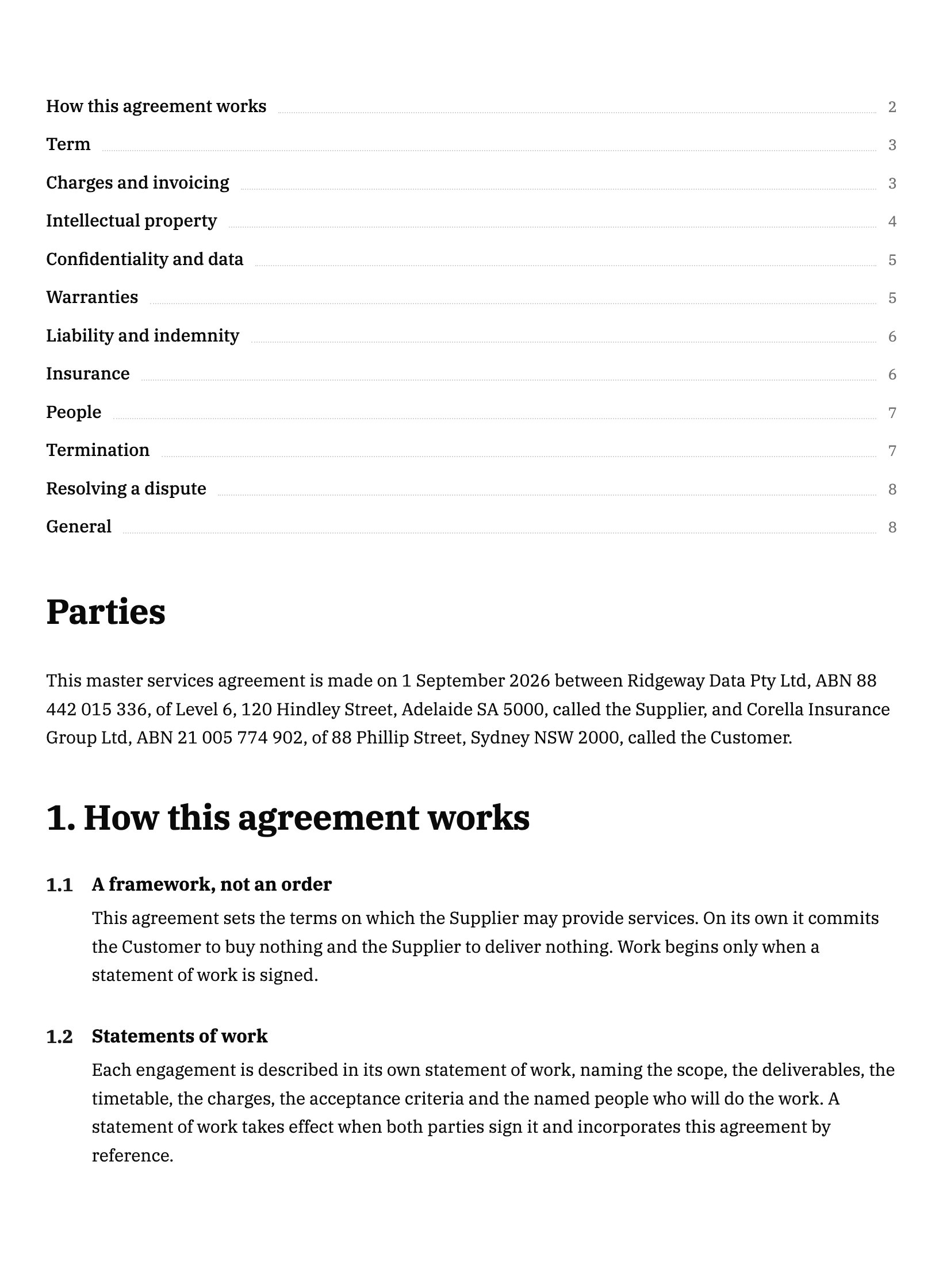 Master services agreementA data consultancy and an insurer sign this once and then buy work under it for three years. It is the rare contract whose whole purpose is to make the next twenty contracts short.
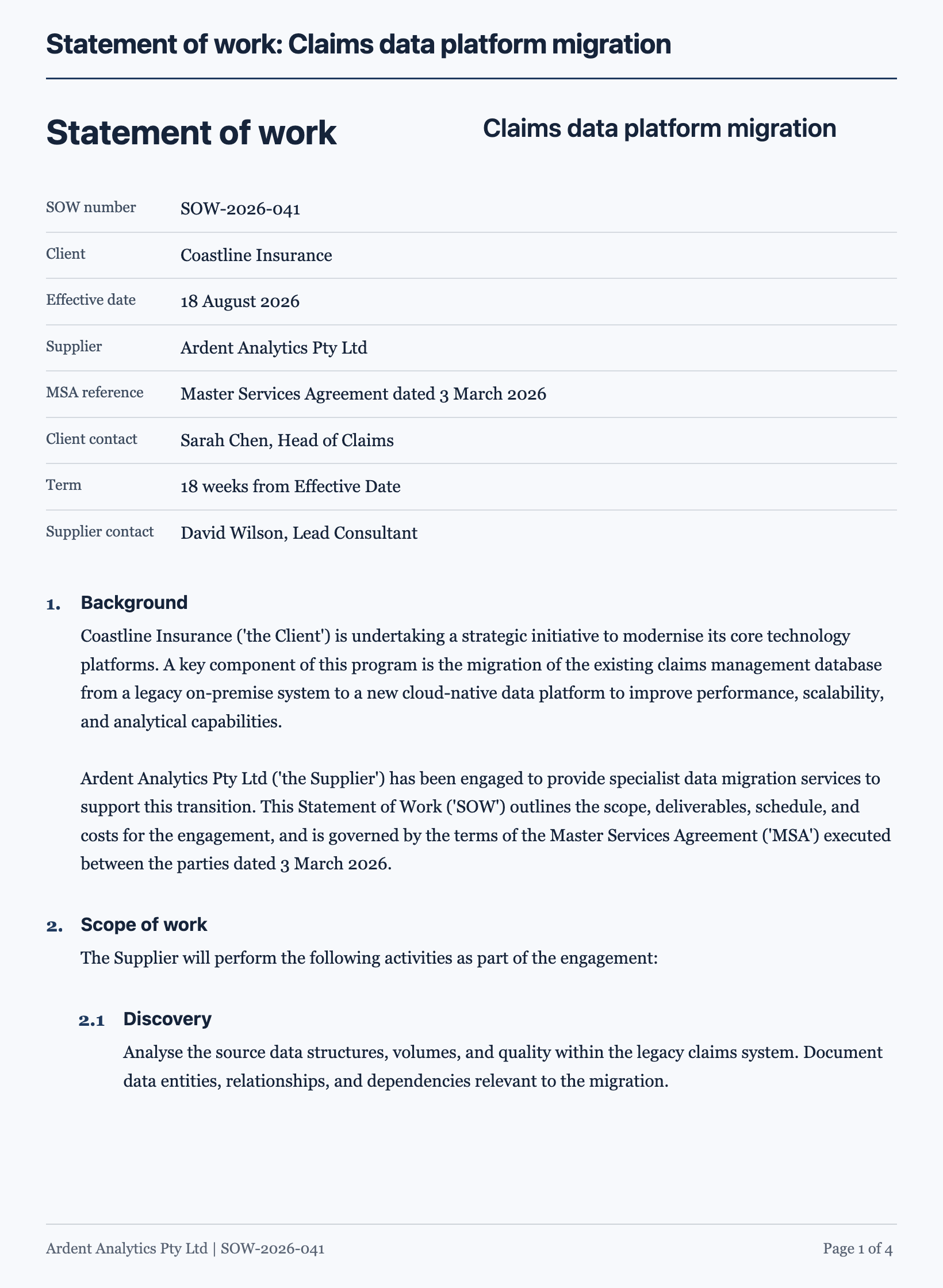 Statement of work template under a master agreementArdent Analytics migrates Coastline Insurance’s claims database to a cloud platform over 18 weeks under SOW-2026-041, governed by a master services agreement dated 3 March 2026. The work is time and materials with four roles priced by the day and a $412,000 estimate before GST, five dated deliverables, ten business days to accept each one, and five assumptions written down before anyone starts.
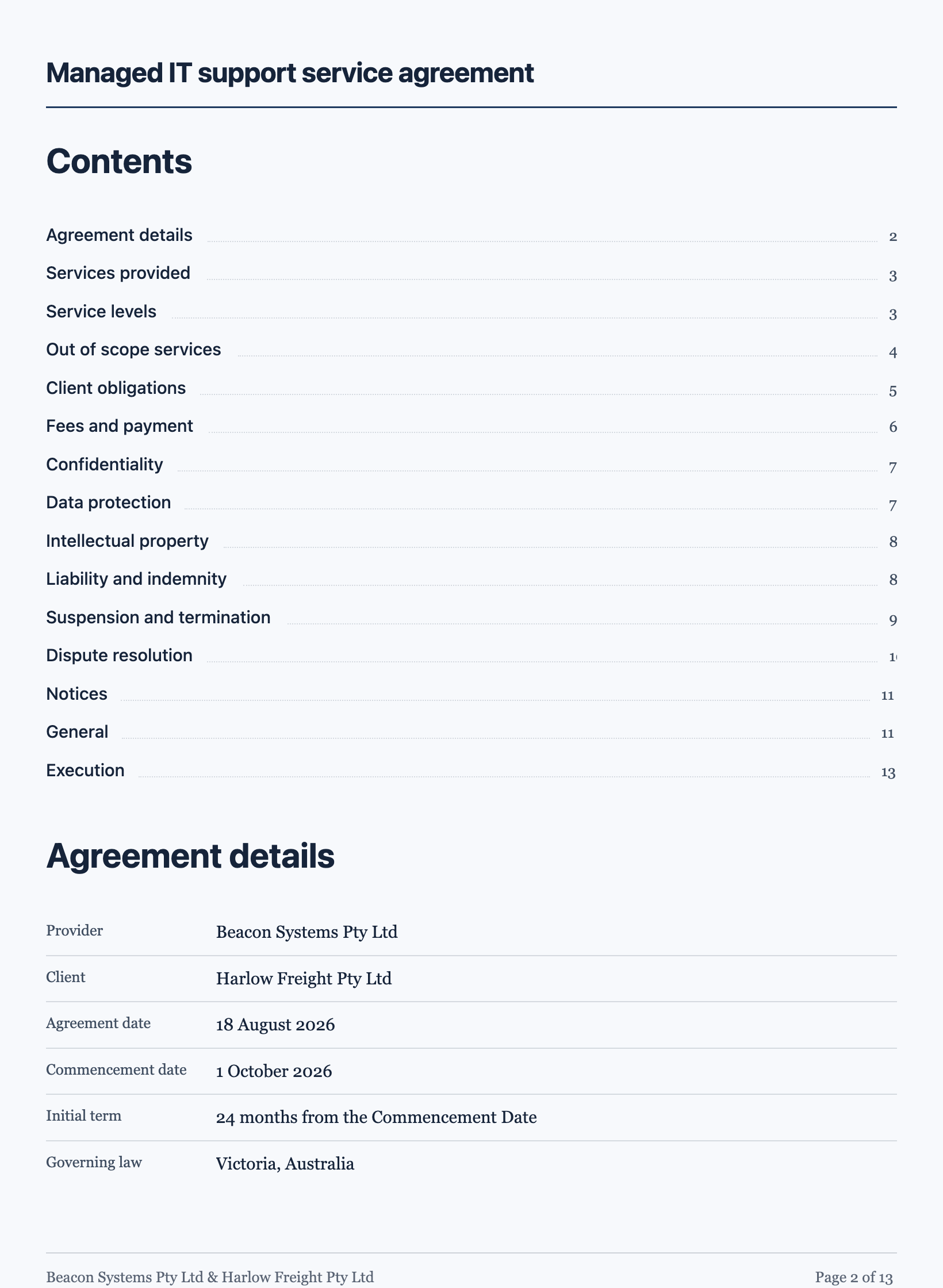 Service agreementBeacon Systems supports Harlow Freight’s IT for an initial 24 months from 1 October 2026 at $8,400 a month plus GST, with 40 hours included and $220 an hour beyond them. Twelve numbered clauses cover the services, a four level severity table, client duties, fees with a CPI adjustment, confidentiality, privacy, IP, a liability cap, termination and a three step dispute ladder.
Questions people ask
What is transition assistance in a contract?
It is the help an outgoing supplier must give when an agreement ends, so the service can move to the customer or to a replacement. It usually covers exporting data in agreed formats, handing over documentation and configuration records, running knowledge transfer sessions, and answering questions from the incoming supplier for a set period.
How long should the transition period be?
Sixty to ninety days from the notice date is the common range for a managed service, and longer where the service is complex or regulated. The period should start when notice is given rather than when the agreement ends, so the handover runs in parallel with the notice period instead of beginning on the day everything stops.
Should transition assistance be free?
Part of it usually is. Returning the customer's own data and documentation is normally included, because charging for it looks like holding property back. Knowledge transfer and support for a replacement supplier are real project work and are commonly charged at standard rates, often with a block of included hours before the meter starts.
Does it apply if the customer breached the contract?
That is the point most heavily negotiated. The workable answer is to split the obligation: data and documentation the customer has already paid for are handed over regardless, while chargeable assistance can be made conditional on payment of undisputed amounts. A clause that disappears entirely on breach gives the customer nothing when it matters.
What data formats should be specified?
Formats the customer can actually load, named in a schedule rather than described as standard or common. The strongest version asks the supplier to provide a sample export during the term so the format can be tested while both sides are cooperating. Bespoke formats requested at exit are usually treated as chargeable work.
Can the customer ask the supplier to keep running the service?
Many contracts allow it, at the fees then applying, for the length of the transition period or a stated extension. It is a useful right where a migration slips, and suppliers usually accept it with a cap on how long the extension can run and a requirement that undisputed invoices are paid during it.
Put the clause in a finished document
The button opens the document generator with a starting description already filled in. Change it to match your own agreement before you run it.
Create a document with OneCraftRelated clauses
- Consequences of termination clauseThe consequences of termination clause says what each party must do once a contract ends. Sample wording, an exit checklist, accrued rights and final invoices.
- Termination for convenience clauseA termination for convenience clause lets a party end a contract on notice with no breach. Sample retainer wording, mutual and one sided versions, exit costs.
- Survival clauseA survival clause names the obligations that keep running after a contract ends. Sample wording, which clauses survive, time limits and what to negotiate.
For everything the document generator can do, see the document maker.
Step by step in the builder: Create a document with AI, then Document builder components.
Written and checked by the OneCraft team. Last checked .