Contract clause
Cure period clause
A cure period clause gives a party who has breached the contract a set time to put it right before the other side can terminate. It converts a breach into a deadline, so an agreement does not end over something that could have been fixed in a fortnight.
One fixed period for every kind of failure is the usual drafting, and it is almost always wrong. A confidentiality leak cannot be cured in ten days, and a missing report does not need ten days.
Nuwan Madhusanka · Co-founder
4 min read · Published
Sample clause
a web maintenance agreement between Kestrel Digital and Saltbush Brewing, a fictional craft brewery in Ballarat
1. Notice to Remedy. If a party believes the other has breached this agreement, it may give that party a written notice describing the breach, the clause breached, and what must be done to remedy it. 2. Cure Periods. The party who receives a notice under clause 1 must remedy the breach within: 2.1 5 business days, for a failure to pay an undisputed invoice; 2.2 10 business days, for a failure to meet a Service Level in Schedule 2; and 2.3 20 business days, for any other breach capable of remedy. 3. No Cure Period. No cure period applies to a breach of clause 9 (Confidentiality), a breach of clause 12 (Work Health and Safety), or a breach that by its nature cannot be remedied, and the party not in breach may end this agreement immediately by written notice. 4. Repeat Breaches. If a party remedies the same breach twice in any rolling six month period, the other party may end this agreement on a third occurrence without giving a further cure period.
Sample wording, not legal advice.
Variants
Single fixed period
Short agreements where one number for everything is simpler than a table and the risks are broadly similar.
If a party breaches this agreement and the breach is capable of being remedied, the other party may give written notice specifying the breach and requiring it to be remedied within 20 business days. If the breach is not remedied within that period, the party who gave the notice may end this agreement immediately by a further written notice. If the breach is not capable of being remedied, the party not in breach may end this agreement immediately by written notice.
Tiered by the kind of breach
Service contracts where payment, performance and safety failures deserve very different response times.
A breach capable of remedy must be remedied within the period that applies to it: 5 business days for payment of an undisputed invoice, 10 business days for a Service Level failure, and 20 business days for any other breach. No period applies to a breach of the confidentiality, safety or anti bribery clauses, or to any breach that by its nature cannot be remedied. A party who remedies a breach within the applicable period remains liable for any loss the breach caused before it was remedied.
Cure plan rather than a cure deadline
Complex failures where a genuine fix takes longer than any sensible notice period, such as a systems migration.
Where a breach cannot reasonably be remedied within 20 business days, the party in breach may within that period deliver a written remediation plan setting out the steps it will take, the resources it will apply and the date by which the breach will be remedied. If the other party accepts the plan, acting reasonably, the cure period is extended to the date in the plan. If the plan is not delivered, is not accepted, or is not met, the other party may end this agreement immediately by written notice.
What to negotiate
One period or several
A single period is simpler to draft and harder to live with. Customers want a short window for payment and performance failures; suppliers want a longer one where a fix depends on a third party. The compromise most contracts reach is a short default with two or three named exceptions, which fits on half a page and removes the argument about whether ten days was reasonable.
Which breaches get no cure period at all
Confidentiality, safety and anti bribery failures are the usual list, because the harm has already happened by the time the notice arrives. Suppliers push to keep the list short, since an immediate termination right removes their chance to respond. The settlement is a closed list stated in the clause, rather than an open reference to serious breaches that nobody can apply with confidence.
What happens on a repeat
A party can breach, cure, and repeat indefinitely without ever triggering termination. Customers ask for a repeat rule, commonly allowing termination on a third occurrence of the same breach within six months. Suppliers ask that the rule apply to the same breach rather than any breach, and that a remediation plan be available first. Both limits usually survive.
Whether curing wipes out the loss
Remedying a breach stops the termination right; it does not reverse the damage the breach already caused. Contracts that do not say so invite an argument that a cured breach is treated as if it never happened. A single sentence confirming that a party remains liable for loss suffered before the remedy settles the point before it becomes a dispute.
The risk of leaving it out
Without a cure period, every breach that gives a right to terminate can be acted on the same day, which makes the relationship fragile and the termination right easy to abuse. It also removes the notice step, so the party at fault may first learn of the problem from a termination letter rather than from a request to fix something.
The notice is half of the clause
A cure period only works if the party in breach knows exactly what to fix and by when. A notice that says the supplier is in material breach of the agreement, with no more detail, starts a clock that nobody can meet and is often ineffective. Good drafting requires the notice to identify the clause breached, the facts relied on and the remedy sought, and to be delivered in the way the notices clause prescribes. Stating the deadline as a date rather than a number of days removes the second most common argument, which is whether the period ran in business days or calendar days and when it started.
Breaches that cannot be cured
Some failures cannot be undone. Confidential information that has been published stays published; a safety incident has already occurred; a deadline that mattered has passed. A cure period for these is not a protection, it is a delay. That is why most contracts pair the cure regime with a short closed list of breaches that allow immediate termination, plus a general sentence covering any breach that by its nature cannot be remedied. The general sentence matters because no list anticipates everything, and without it a party may be forced to give twenty days to fix something that cannot be fixed.
Where it sits in a generated document
The document generator writes an agreement as numbered content, so a cure regime usually appears as a numbered clause with each period as its own sub clause, close to the termination clause that depends on it. The generated text is written from the description it is given and it never prints citations, so any period or cross reference in a draft has to be checked before the document is used. Describing the tiers in the prompt produces them as separate sub clauses rather than as one sentence with three numbers in it.
Documents that carry this clause
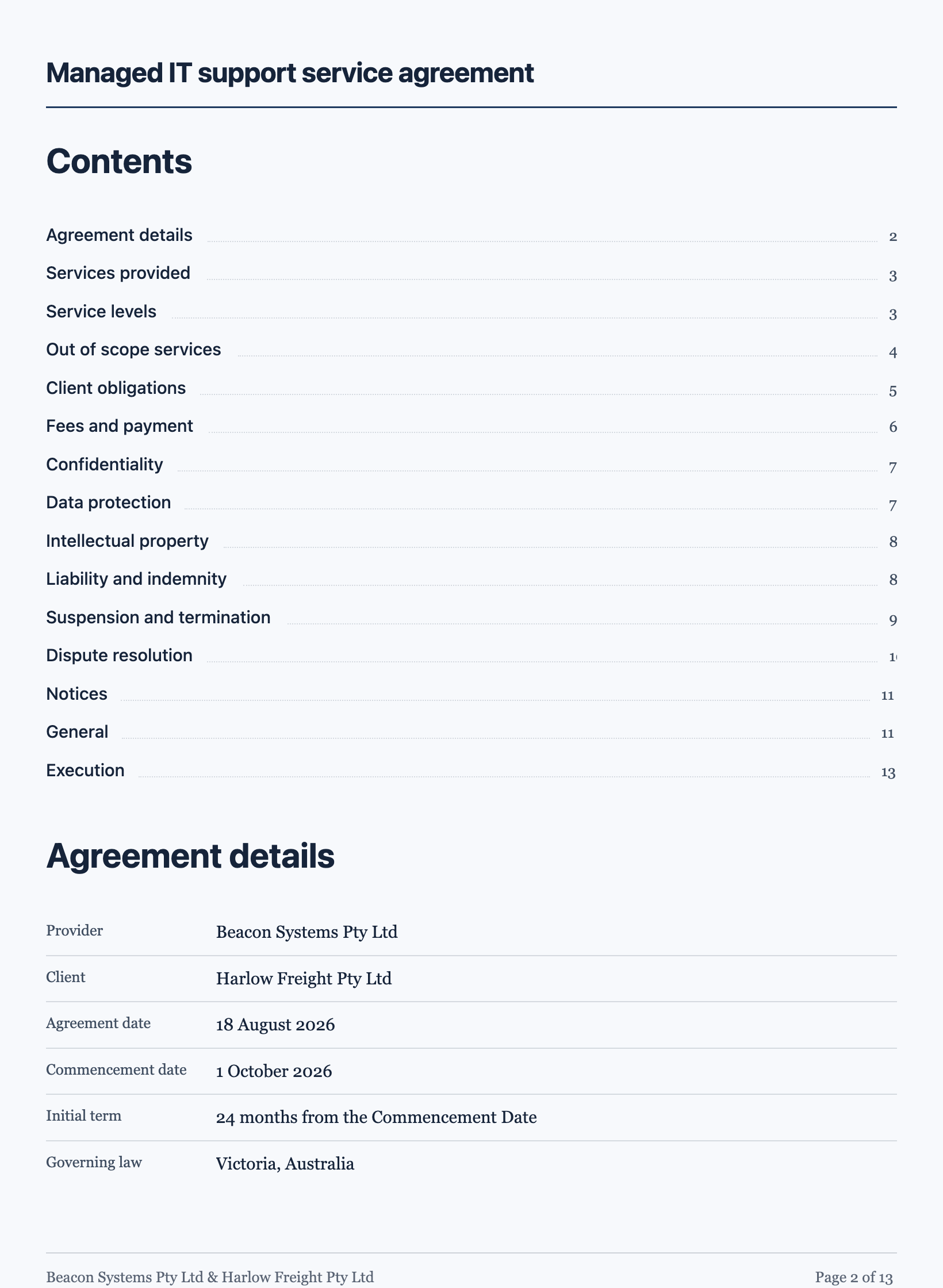 Service agreementBeacon Systems supports Harlow Freight’s IT for an initial 24 months from 1 October 2026 at $8,400 a month plus GST, with 40 hours included and $220 an hour beyond them. Twelve numbered clauses cover the services, a four level severity table, client duties, fees with a CPI adjustment, confidentiality, privacy, IP, a liability cap, termination and a three step dispute ladder.
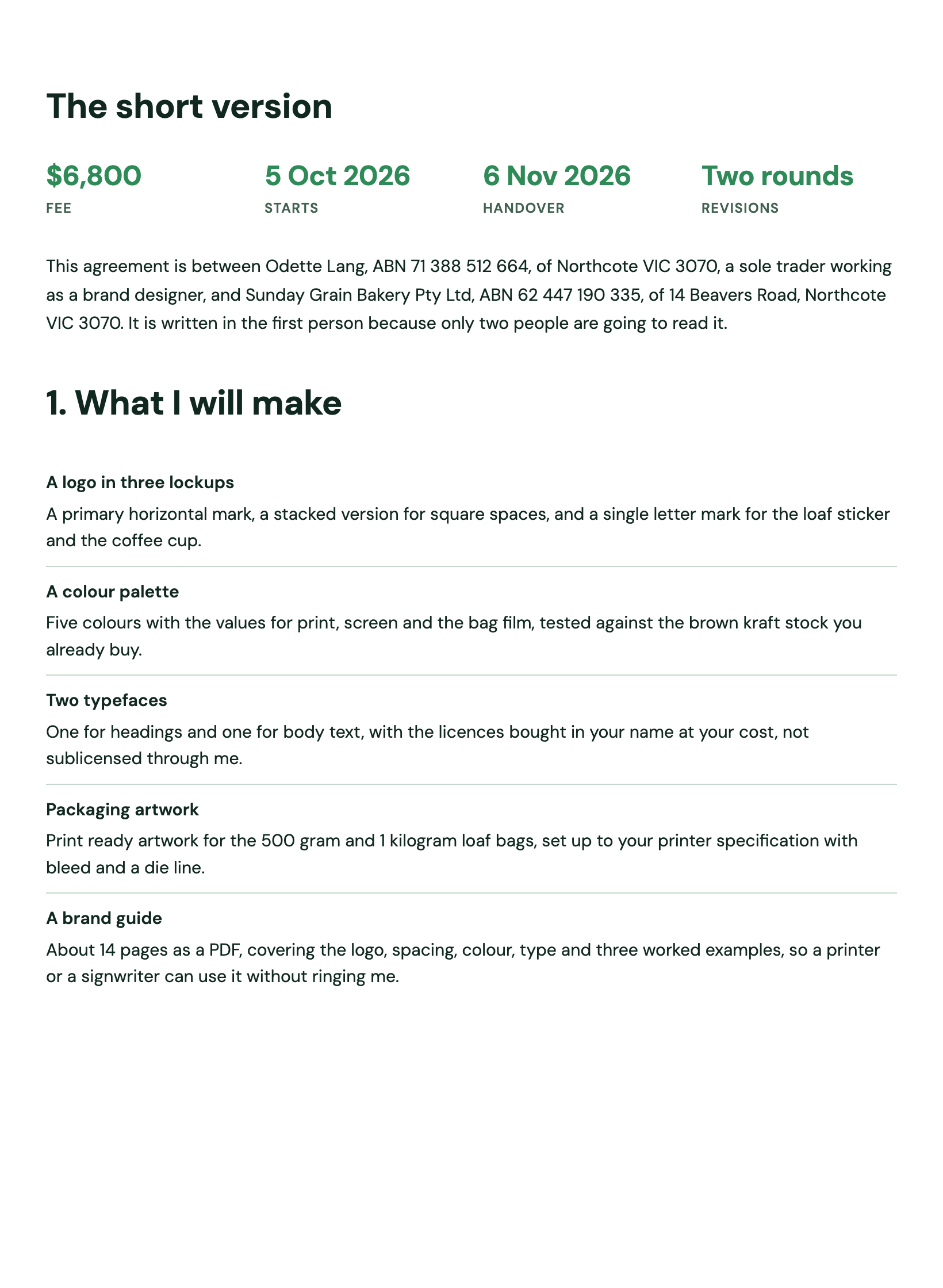 Freelance contractA brand designer and a bakery owner agree five weeks of work in language they can both read. It covers everything a longer contract would, and it never once says party of the first part.
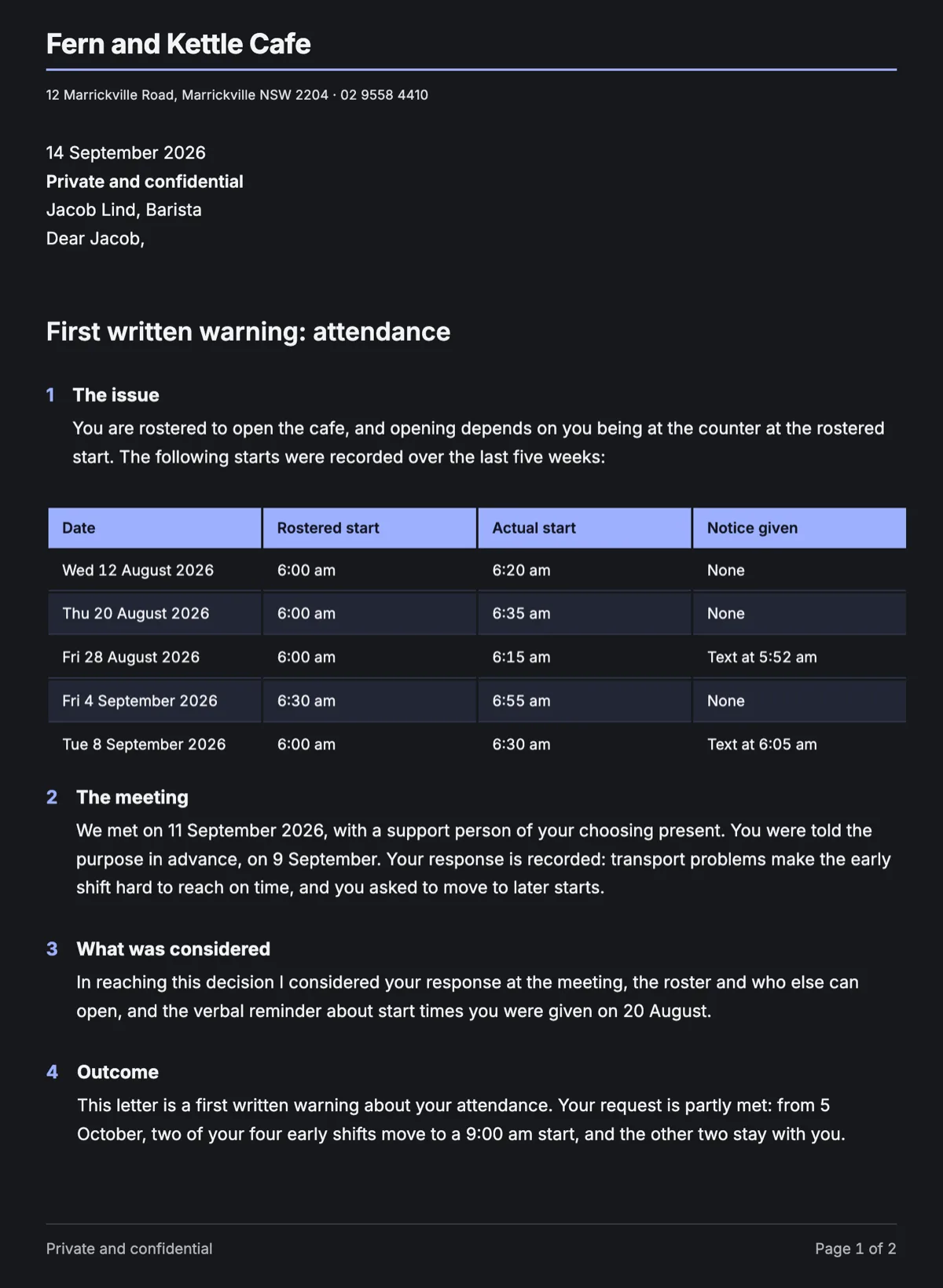 Written warning letter template that records the process, not just the problemA warning letter is evidence that a fair process happened, and most fail because they record the problem and skip the meeting, the response and the review date. This one records all four, states the consequence in one sentence, and ends with an acknowledgement the employee can sign without admitting anything.
Questions people ask
What is a cure period in a contract?
It is the time a party gets to fix a breach after receiving written notice of it, before the other side can end the agreement. The period turns a breach into a deadline, which keeps a contract alive over failures that can be put right and gives both sides a documented record of what went wrong and when.
How long should a cure period be?
Twenty business days is a common default for general breaches, with shorter periods for payment and performance failures where a fix is quick. The right length depends on what a genuine fix requires. A period that is too short invites a dispute about reasonableness, and one that is too long leaves the other party exposed while nothing improves.
Do all breaches get a cure period?
No. Most contracts exclude confidentiality, safety and anti bribery breaches, along with any breach that by its nature cannot be remedied. The harm in those cases has already occurred, so a waiting period protects nobody. Keeping that list closed and short is usually what the party at risk of termination negotiates for.
What if a breach takes longer than the cure period to fix?
A remediation plan mechanism handles it. The party in breach delivers a written plan inside the original period, setting out the steps and a completion date, and the cure period extends to that date if the plan is accepted. Without such a mechanism, a genuine but slow fix can still result in a valid termination.
Does fixing the breach remove liability for it?
Not unless the contract says so. A remedy stops the termination right, but the loss caused before the fix remains claimable. Contracts that are silent invite an argument that a cured breach is treated as never having happened, so many drafts add one sentence confirming that liability for earlier loss survives the remedy.
Can the same breach be cured over and over?
Only where the contract has no repeat breach rule. The standard answer is a clause allowing termination on a third occurrence of the same breach within a rolling six month period, without a further cure period. That stops a pattern of fix and repeat from keeping a failing arrangement permanently alive.
Put the clause in a finished document
The button opens the document generator with a starting description already filled in. Change it to match your own agreement before you run it.
Create a document with OneCraftRelated clauses
- Termination for cause clauseA termination for cause clause ends a contract for serious breach. Sample wording, what counts as material, cure periods and immediate termination events.
- Termination notice clauseA termination notice clause says how notice must be given for it to count. Sample wording, delivery methods, deemed receipt rules and who is allowed to sign.
- Term clause in a contractA term clause in a contract says when it starts, how long it runs and how it ends. Sample managed services wording, fixed, rolling and completion variants.
For everything the document generator can do, see the document maker.
Step by step in the builder: Create a document with AI, then Document builder components.
Written and checked by the OneCraft team. Last checked .