Contract clause
Term clause in a contract
A term clause fixes when a contract starts, how long it runs, and what happens when that period ends. It is the clause every other date counts back from, including notice periods, renewal deadlines and the moment obligations stop binding either side.
Most disputes about a term clause are not about its length. They are about the day it started, because a start date tied to an event nobody recorded turns every later deadline into guesswork.
Indunil Asanka · Co-founder
4 min read · Published
Sample clause
a managed services agreement between Copperleaf Technology and Harbourline Joinery, a fictional cabinet maker in Newcastle
1. Term. This agreement begins on the Commencement Date and continues for 24 months, unless ended earlier under clause 11. 1.1 The Commencement Date is the first business day after the Supplier notifies the Customer in writing that the Managed Environment has passed the acceptance tests in Schedule 2. 1.2 If the Commencement Date has not occurred by 30 September 2027, either party may end this agreement by written notice, and neither party owes the other anything except for Services already delivered. 2. Expiry. At the end of the Term this agreement expires without further notice, and the clauses listed in clause 14 continue to apply. 3. Interim Services. Any Services delivered between the date this agreement is signed and the Commencement Date are governed by this agreement as if the Term had already begun, and are invoiced at the rates in Schedule 1.
Sample wording, not legal advice.
Variants
Fixed term with a hard expiry
A defined project or a budget cycle, where both sides want the relationship to end unless something new is signed.
This agreement begins on 1 July 2027 and ends on 30 June 2029, unless ended earlier under clause 11. It does not renew automatically. If the parties wish to continue beyond the expiry date they must sign a new agreement or a written extension, and any Services delivered after expiry without such a document are supplied on the terms of this agreement at the rates then published by the Supplier.
Initial term then rolling month to month
Ongoing services where neither side wants a cliff edge, but the customer will not commit past the first year.
This agreement begins on the Commencement Date and continues for an initial term of 12 months. At the end of the initial term it continues month to month until either party ends it by giving 30 days written notice, which may be given at any time after the ninth month. The rates in Schedule 1 are fixed for the initial term and may be adjusted once in any rolling 12 month period on 60 days written notice.
Term ending on completion
A project contract where the finish line is a deliverable rather than a date on the calendar.
This agreement begins on the date it is signed by both parties and continues until the Supplier has delivered every Deliverable listed in Schedule 2 and the Customer has accepted them under clause 6, or until it is ended earlier under clause 11. If the final Deliverable has not been accepted within 18 months of the start date, either party may end this agreement on 20 business days written notice, and the Customer must pay for work completed to that date.
What to negotiate
What actually triggers the start date
Suppliers want the clock running from signing, because their costs begin then. Customers want it running from go live, so they do not pay for a system they cannot use. The common settlement is a start date tied to a recorded event, such as written notice that acceptance testing passed, plus a longstop date after which either side can walk away if that event has not happened.
Whether work before the start date is covered
Work often begins while the contract is still with the lawyers, which leaves early deliverables governed by nothing. Suppliers want that period covered so the liability cap and the payment terms apply to it. Customers usually agree, since the alternative is an uninsured gap. A short interim services clause stating that earlier work is treated as within the term settles it in one sentence.
Length against price certainty
A longer term buys a better rate and costs flexibility. Customers ask for a short term with an option to extend; suppliers offer a discount for committing to two or three years. The landing point is usually an initial term at the discounted rate with a capped increase for any extension, so the customer knows what a longer commitment is worth before it makes one.
The risk of leaving it out
With no term clause the agreement runs for whatever period a court later infers from the conduct of the parties, and either side can argue it was free to walk away at any time. Notice periods, renewal deadlines, survival and price review dates all hang off the term, so leaving it out leaves several other clauses with nothing to measure from.
Start dates that depend on something happening
A conditional start date is usually the right answer and the most common source of trouble. If the term begins on go live, acceptance or the grant of a licence, the contract has to say who declares that the event happened, in what form, and by when. Written notice from one party to the other is the simplest mechanism and leaves a record in the file. The second half is a longstop: a date by which the trigger must occur, after which either party can walk away without penalty. Without it, one side can be held to an agreement that has not started and cannot be ended, sometimes for years.
Fixed, rolling and completion based terms
A fixed term ends on a stated date and suits budget cycles and defined projects. A rolling term runs until somebody gives notice, and suits services that are expected to continue, though it needs a clear notice period or it becomes a contract nobody can exit cleanly. A completion based term ends when the last deliverable is accepted, which matches how project work actually behaves but needs an acceptance mechanism and a longstop date so it cannot run forever. Most commercial agreements use a hybrid: an initial fixed period that protects the pricing, followed by a rolling period on notice.
Where it sits in a generated document
The document generator writes an agreement as numbered content, so the term normally appears as clause 1 or 2 with its start date and expiry as sub clauses, which is where a reader expects to find it. The generated text is written from the description it is given and it never prints citations, so any date or figure in a draft has to be checked against the deal before the document is used. Naming the trigger for the start date in the prompt is worth doing, because a description that only says twelve months produces a term with no trigger at all.
Documents that carry this clause
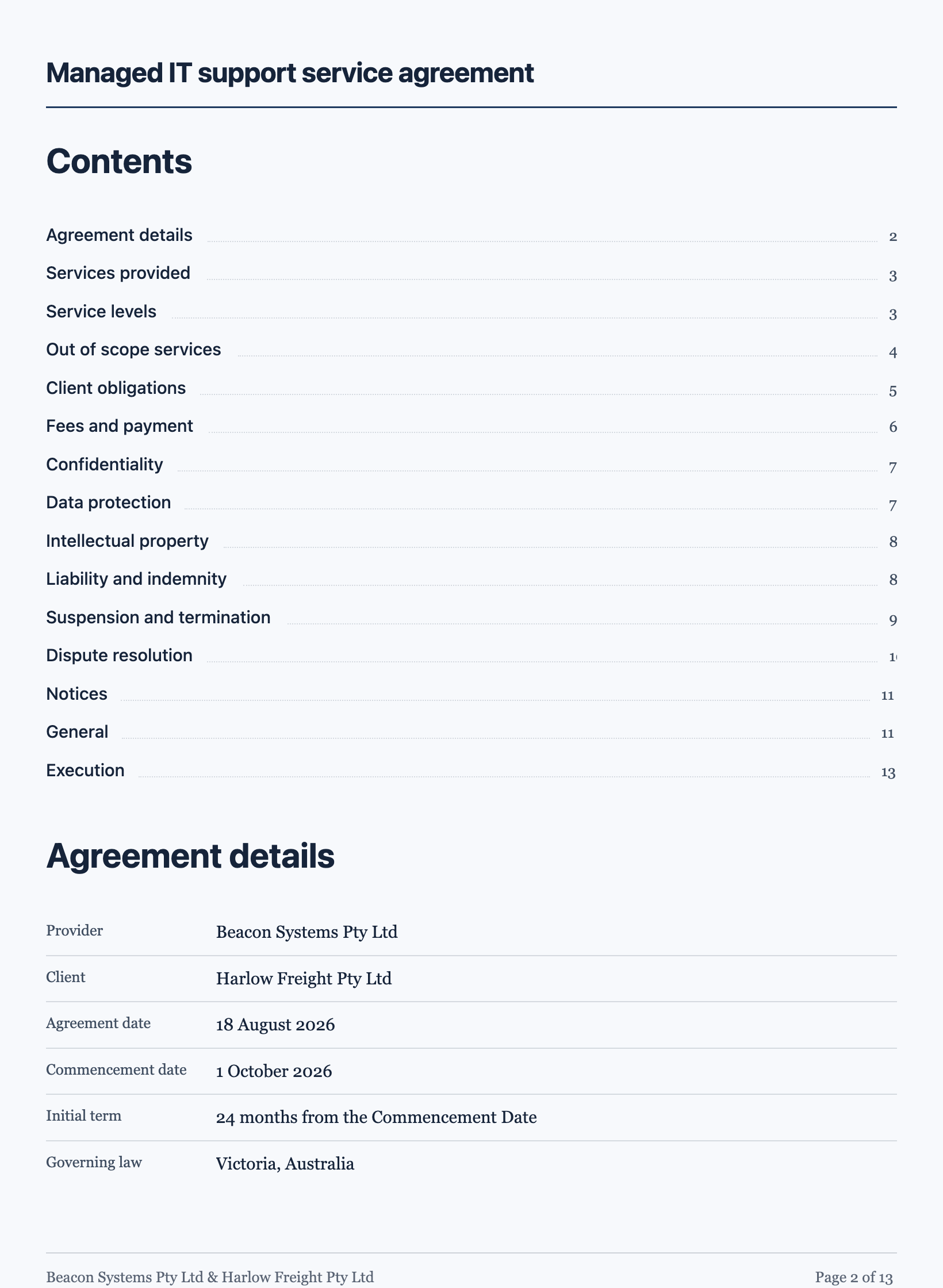 Service agreementBeacon Systems supports Harlow Freight’s IT for an initial 24 months from 1 October 2026 at $8,400 a month plus GST, with 40 hours included and $220 an hour beyond them. Twelve numbered clauses cover the services, a four level severity table, client duties, fees with a CPI adjustment, confidentiality, privacy, IP, a liability cap, termination and a three step dispute ladder.
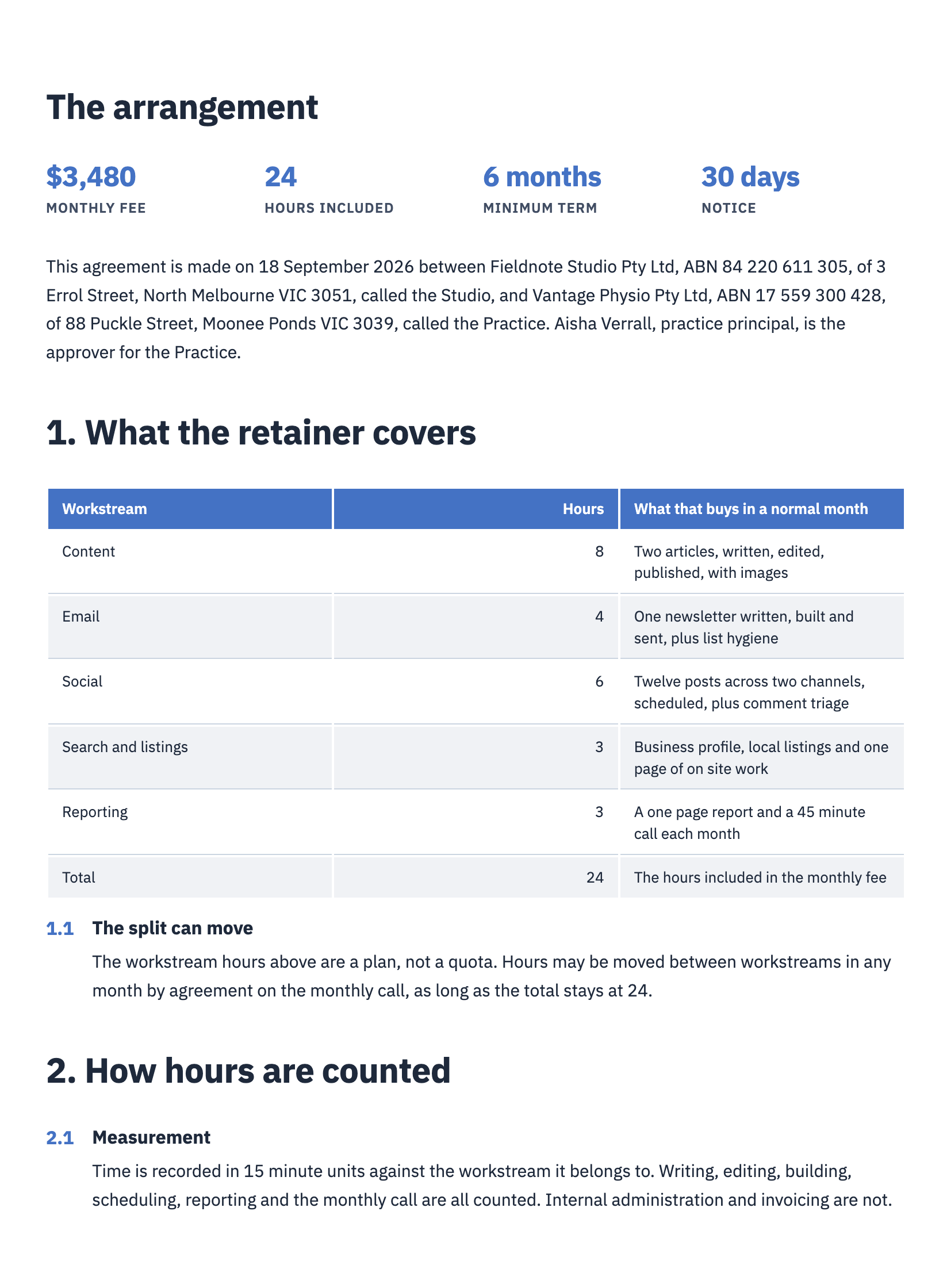 Monthly retainer agreementA studio sells a physio practice twenty four hours a month. Almost every clause exists to answer one question that ordinary contracts duck: what happens to the hours nobody used.
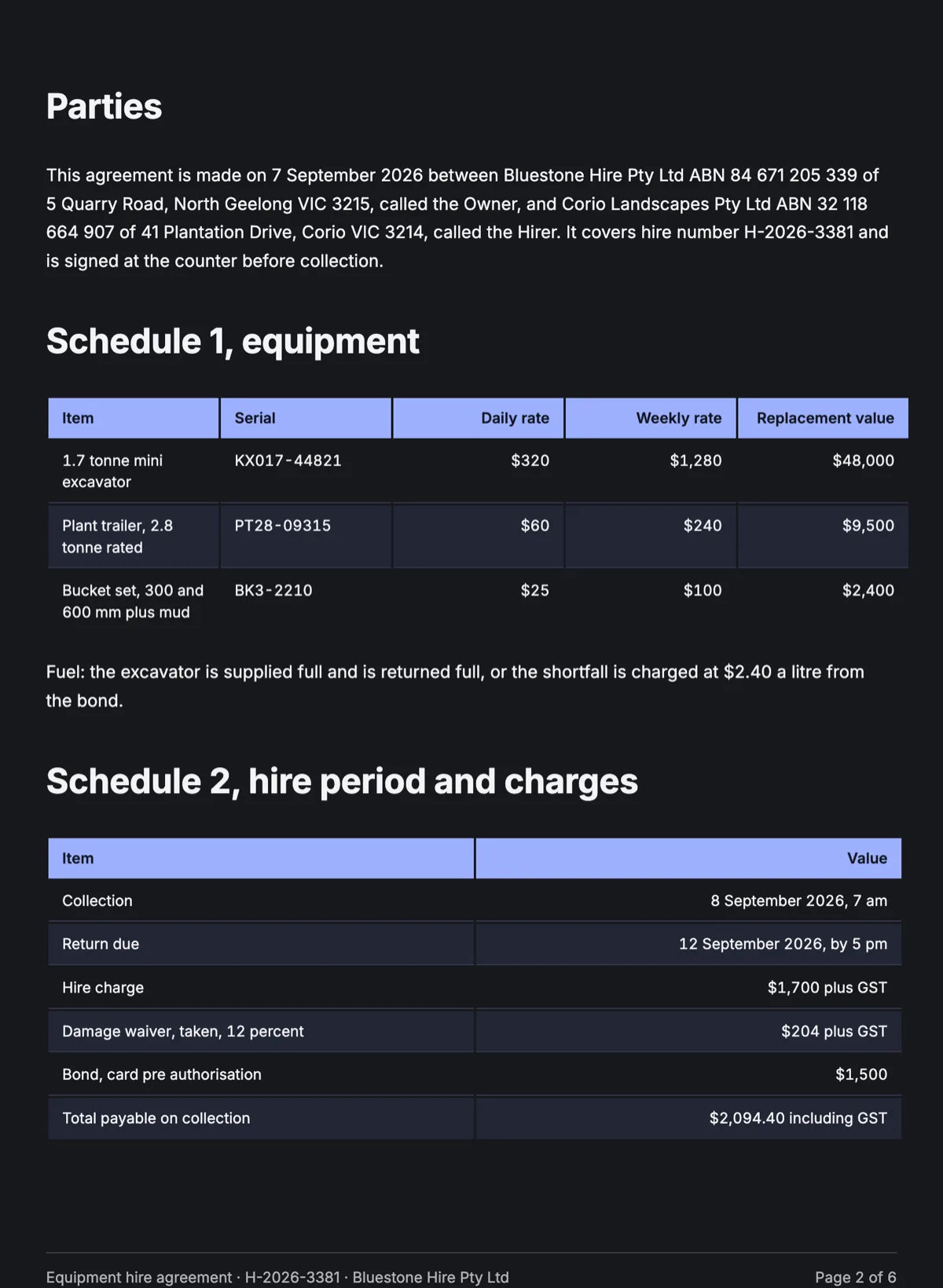 Equipment hire agreement template with the rates in a scheduleA hire agreement is a price list, an insurance decision and a return date, and the argument is always about the day it came back. This one puts the equipment and rates in a schedule, makes the damage waiver a choice with its price, and defines late return in hours so there is nothing to interpret.
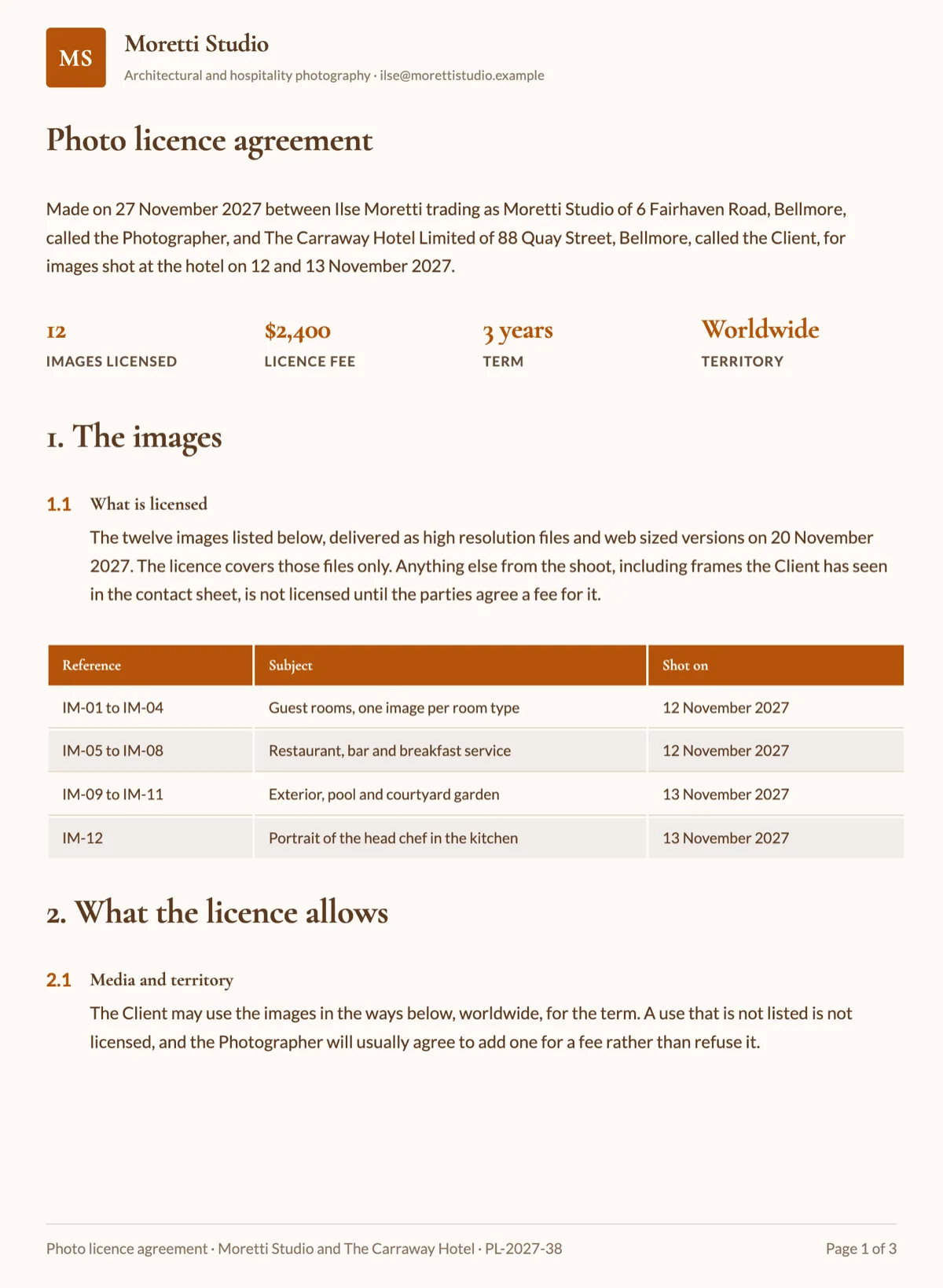 Photo licence agreement covering media, territory and durationA photo licence says which images, for which uses, for how long. Everything else is detail. This one licenses twelve hotel images to the hotel that commissioned them for three years worldwide at $2,400, with a table that marks paid advertising as an extra and resale as not available at any price.
Questions people ask
What is the difference between the term and the termination clause?
The term clause says how long the agreement is meant to run in the ordinary course. The termination clause says how either party can end it before that. Reading them together tells you the two ways the relationship can finish, and the survival clause then says which obligations keep going after either ending.
Can a contract start before it is signed?
Parties often agree that the term began on an earlier date, which is usually done to cover work already delivered. The wording has to be deliberate, naming the date and saying that earlier work is treated as supplied under the agreement. Backdating the signature itself is a different thing and should be avoided, because it misrepresents when the document was made.
How long should a commercial term be?
Long enough to justify the setup cost and short enough that the customer can leave if the service slips. Twelve months is the common default for services, with two or three years where the supplier is investing up front. Longer terms are normally paired with a price review mechanism and a termination for convenience right so neither side is trapped.
What happens when a fixed term expires?
In the ordinary case the agreement simply ends, and the clauses in the survival list keep running. If the parties keep trading afterwards without signing anything, the terms may be implied into that continued relationship, which is untidy. A clause saying what applies to services delivered after expiry avoids the argument entirely.
Does the term need a longstop date?
It does whenever the start date depends on an event rather than a calendar date. Without a longstop, a party can be bound to an agreement that never starts and cannot be exited. A short clause letting either side walk away if the trigger has not happened by a named date costs nothing and closes that gap.
Can the term be extended without a new contract?
Yes, if the contract says how. The usual mechanisms are an option to extend exercisable by written notice before a deadline, or an automatic rollover unless notice is given. Both should state what happens to the price on extension, since an extension at an unstated rate is where most of the later disagreement comes from.
Put the clause in a finished document
The button opens the document generator with a starting description already filled in. Change it to match your own agreement before you run it.
Create a document with OneCraftRelated clauses
- Auto renewal clauseAn auto renewal clause rolls a contract over unless someone opts out in time. Sample wording, fairer versions, and the Australian unfair contract terms risk.
- Termination notice clauseA termination notice clause says how notice must be given for it to count. Sample wording, delivery methods, deemed receipt rules and who is allowed to sign.
- Survival clauseA survival clause names the obligations that keep running after a contract ends. Sample wording, which clauses survive, time limits and what to negotiate.
For everything the document generator can do, see the document maker.
Step by step in the builder: Create a document with AI, then Document builder components.
Written and checked by the OneCraft team. Last checked .