Contract clause
Auto renewal clause
An auto renewal clause rolls a contract into a further term unless one party gives notice before a deadline. It saves both sides from renegotiating every year, and it is the clause most often challenged as unfair when the opt out window is short and no reminder is sent.
The clause itself is ordinary commercial practice. What draws regulator attention is the combination of a long renewal term, a narrow window to say no, and a customer who was never told the window had opened.
Nuwan Madhusanka · Co-founder
4 min read · Published
Sample clause
a subscription agreement between Copperleaf Technology and Fernhill Consulting, a fictional advisory firm in Adelaide
1. Renewal. At the end of the Initial Term this agreement renews for successive periods of 12 months, unless either party gives written notice of non renewal at least 30 days before the end of the then current term. 1.1 The Supplier must send the Customer a renewal notice between 90 and 60 days before the end of each term, stating the renewal date, the last day for giving notice of non renewal, and the fees that will apply if the agreement renews. 1.2 If the Supplier does not send the notice required by clause 1.1, the Customer may end the renewed term at any time in its first 60 days on 14 days written notice, and the Supplier must refund fees for the unused part of that period. 2. Fees on Renewal. Fees for a renewal term may increase by no more than the annual movement in the All Groups Consumer Price Index for the eight capital cities, plus 2 per cent.
Sample wording, not legal advice.
Variants
Renewal with a price cap and a reminder
Business to business subscriptions where the customer will accept a rollover but not an open ended price rise.
This agreement renews for successive 12 month terms unless either party gives 30 days written notice before the end of the then current term. The Supplier must give the Customer written notice of the renewal date and the renewal fees at least 60 days before each renewal. Fees on renewal must not increase by more than 5 per cent above the fees for the term then ending, and any larger increase takes effect only if the Customer agrees to it in writing before the renewal date.
Renewal into a month to month term
The fairest common form, because the customer keeps the service running but is never locked into a second long term.
At the end of the Initial Term this agreement continues on a month to month basis at the fees then applying, until either party ends it by giving 30 days written notice. Neither party needs to give notice before the end of the Initial Term to move to the month to month arrangement. The Supplier may adjust the monthly fee once in any 12 month period by giving 60 days written notice, and the Customer may end the agreement before the new fee takes effect.
No automatic renewal
Government and larger corporate buyers, whose procurement rules often forbid a rollover that nobody actively approved.
This agreement ends on the last day of the Term and does not renew automatically. The Supplier must notify the Customer at least 90 days before the end of the Term that the agreement is about to expire. If the parties wish to continue, they must sign a written extension before the expiry date, stating the new term and the fees for it. Services delivered after expiry without a signed extension are supplied month to month and either party may stop them on 14 days notice.
What to negotiate
The length of the opt out window
Suppliers ask for 60 or 90 days so they can plan capacity. Customers ask for 30 days or less, because a long window means deciding on next year before this year has been assessed. The usual landing point is 30 days for a 12 month renewal, paired with an obligation on the supplier to send a reminder before the window opens, which removes most of the unfairness argument.
What the price can do on renewal
An uncapped renewal price is the part customers push back on hardest, since the alternative to accepting it is an unplanned migration. Suppliers want room to move with their own costs. Most negotiations land on an index linked cap, or a fixed percentage ceiling, with anything above it requiring the customer to agree in writing before the renewal date.
Whether a missed reminder has a consequence
A reminder obligation with no remedy attached is only a courtesy. Customers ask that a missed reminder give them a right to exit the renewed term early, with a refund for the unused part. Suppliers accept a short window for that right rather than an open ended one. A 30 to 60 day exit right is common and keeps the obligation real.
The risk of leaving it out
Without a renewal clause a fixed term agreement simply ends, and any work that continues afterwards sits on terms nobody has agreed. Suppliers lose the revenue certainty they priced for, and customers can find themselves receiving a service with no liability cap, no service levels and no agreed rate, because the document that carried all three has expired.
Where an auto renewal becomes unfair
The unfair contract terms regime in the Australian Consumer Law, which sits in Schedule 2 of the Competition and Consumer Act 2010, applies to standard form consumer and small business contracts. The Australian Competition and Consumer Commission names automatic rollover terms as a category it examines, particularly where one party can renew without the other's active agreement. Since the 2023 changes, a term found unfair can attract a penalty rather than simply being void, which has changed how carefully these clauses are drafted. The features that attract attention are consistent: a long renewal term, a short window to opt out, no reminder, and a price that can move without a ceiling.
Reminder notices and the opt out window
The single change that makes a renewal clause defensible is a reminder sent before the window opens, stating the renewal date, the last day to say no, and the fees that will apply. It turns a silent rollover into an informed choice, and it costs the supplier one automated message. Pairing the reminder with a consequence matters too. If the supplier does not send it, the customer should be able to leave the renewed term early with a refund for the unused portion. Without a consequence the obligation is decorative, and a regulator reading the clause will treat it that way.
Where it sits in a generated document
The document generator writes an agreement as numbered content, so a renewal clause usually appears as a sub clause under the term, with the notice period and the renewal price as further sub clauses. The generated text is written from the description it is given and it never prints citations, so a reference to an index or a statutory regime in the draft has to be checked before the document is used. A description that asks for a reminder notice and a price cap produces those as separate numbered provisions rather than a single sentence.
Documents that carry this clause
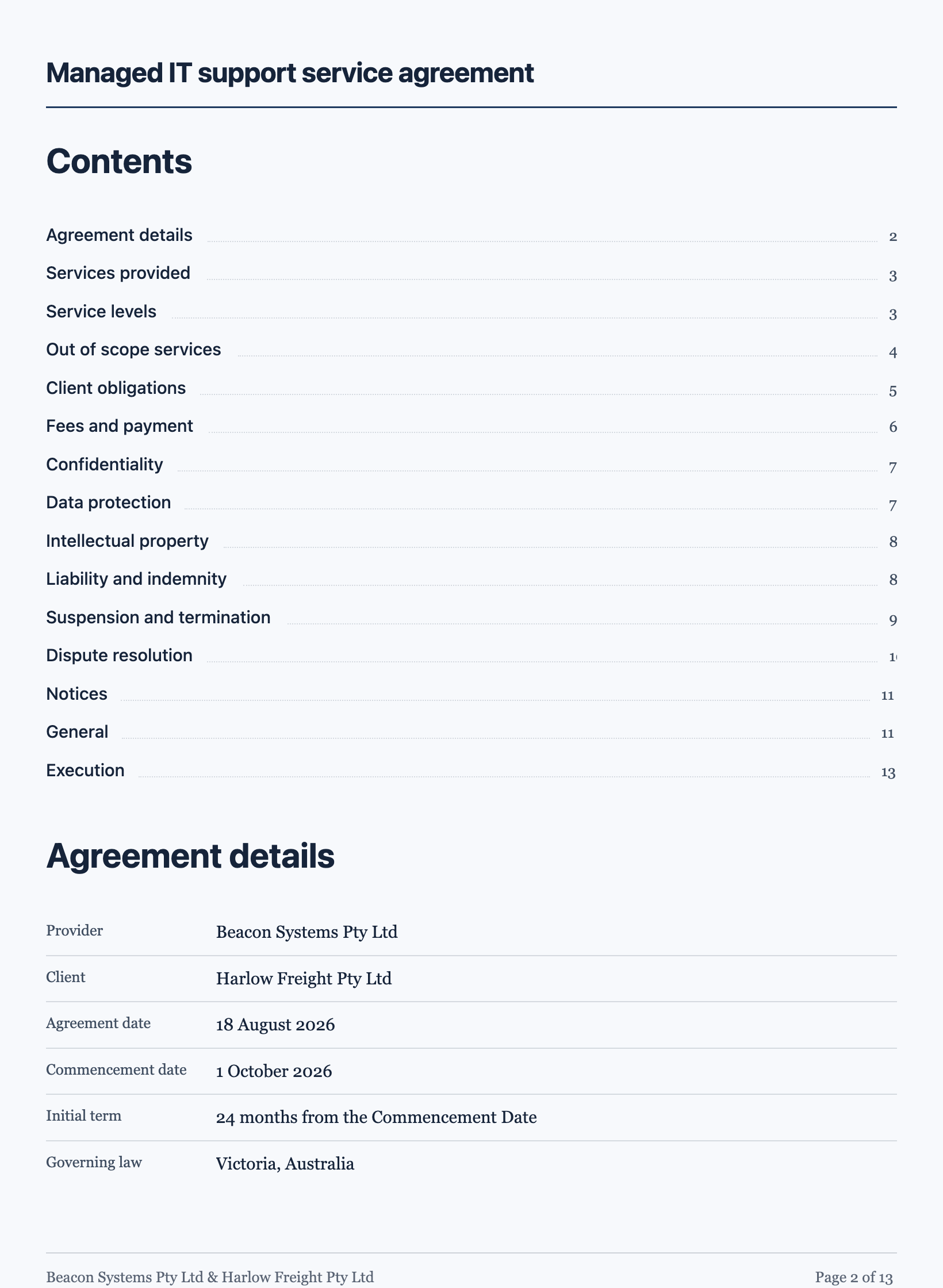 Service agreementBeacon Systems supports Harlow Freight’s IT for an initial 24 months from 1 October 2026 at $8,400 a month plus GST, with 40 hours included and $220 an hour beyond them. Twelve numbered clauses cover the services, a four level severity table, client duties, fees with a CPI adjustment, confidentiality, privacy, IP, a liability cap, termination and a three step dispute ladder.
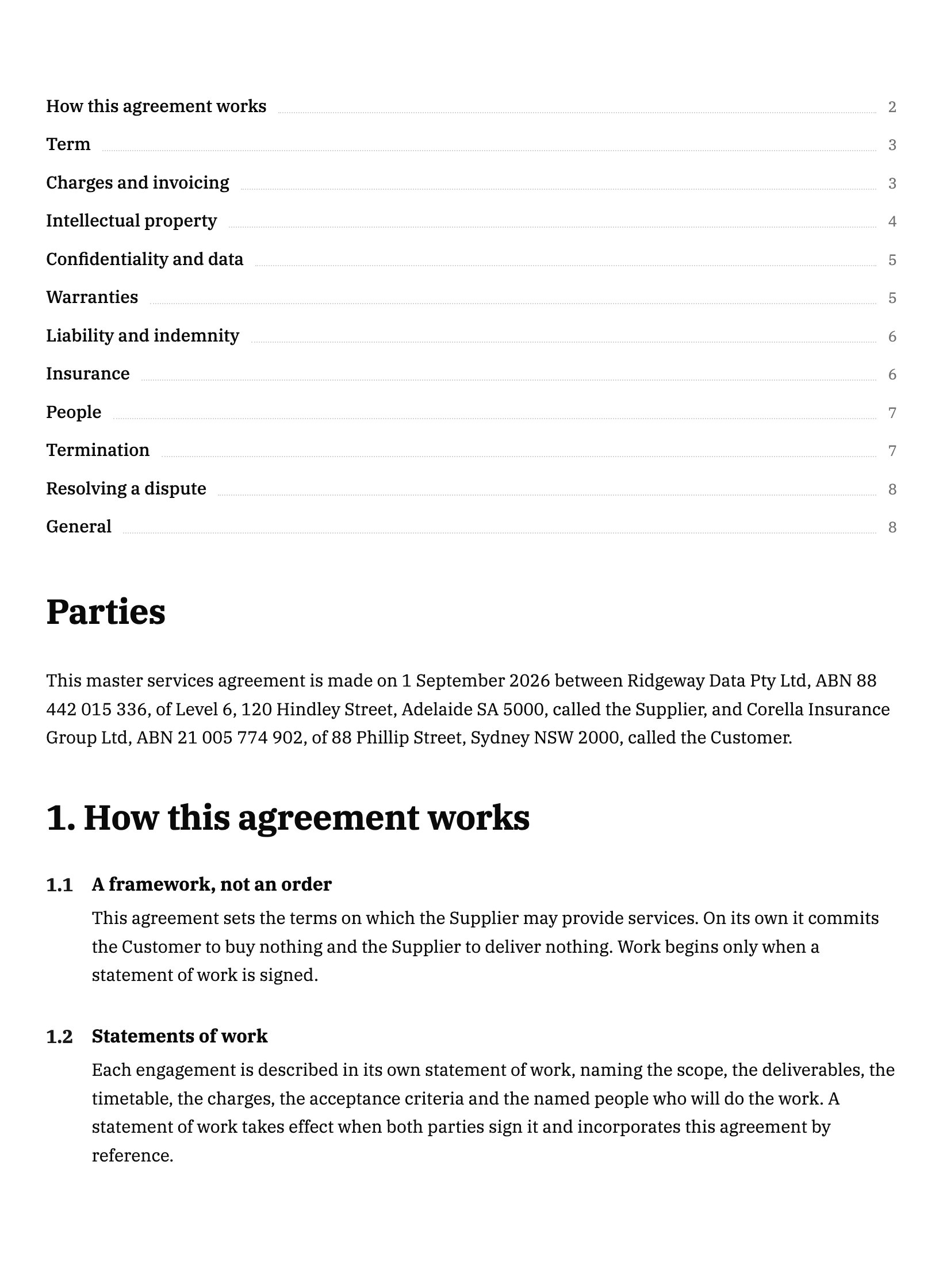 Master services agreementA data consultancy and an insurer sign this once and then buy work under it for three years. It is the rare contract whose whole purpose is to make the next twenty contracts short.
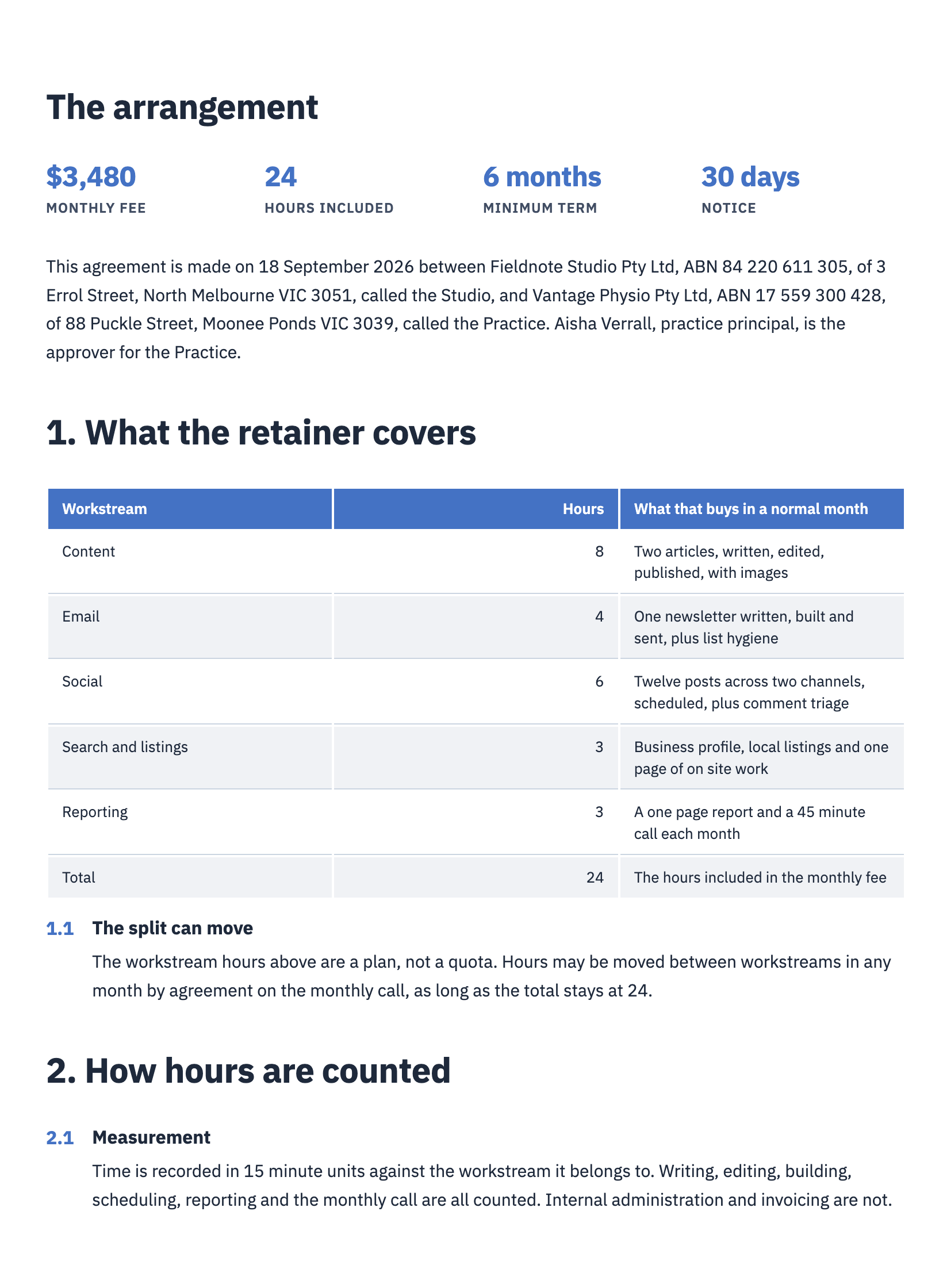 Monthly retainer agreementA studio sells a physio practice twenty four hours a month. Almost every clause exists to answer one question that ordinary contracts duck: what happens to the hours nobody used.
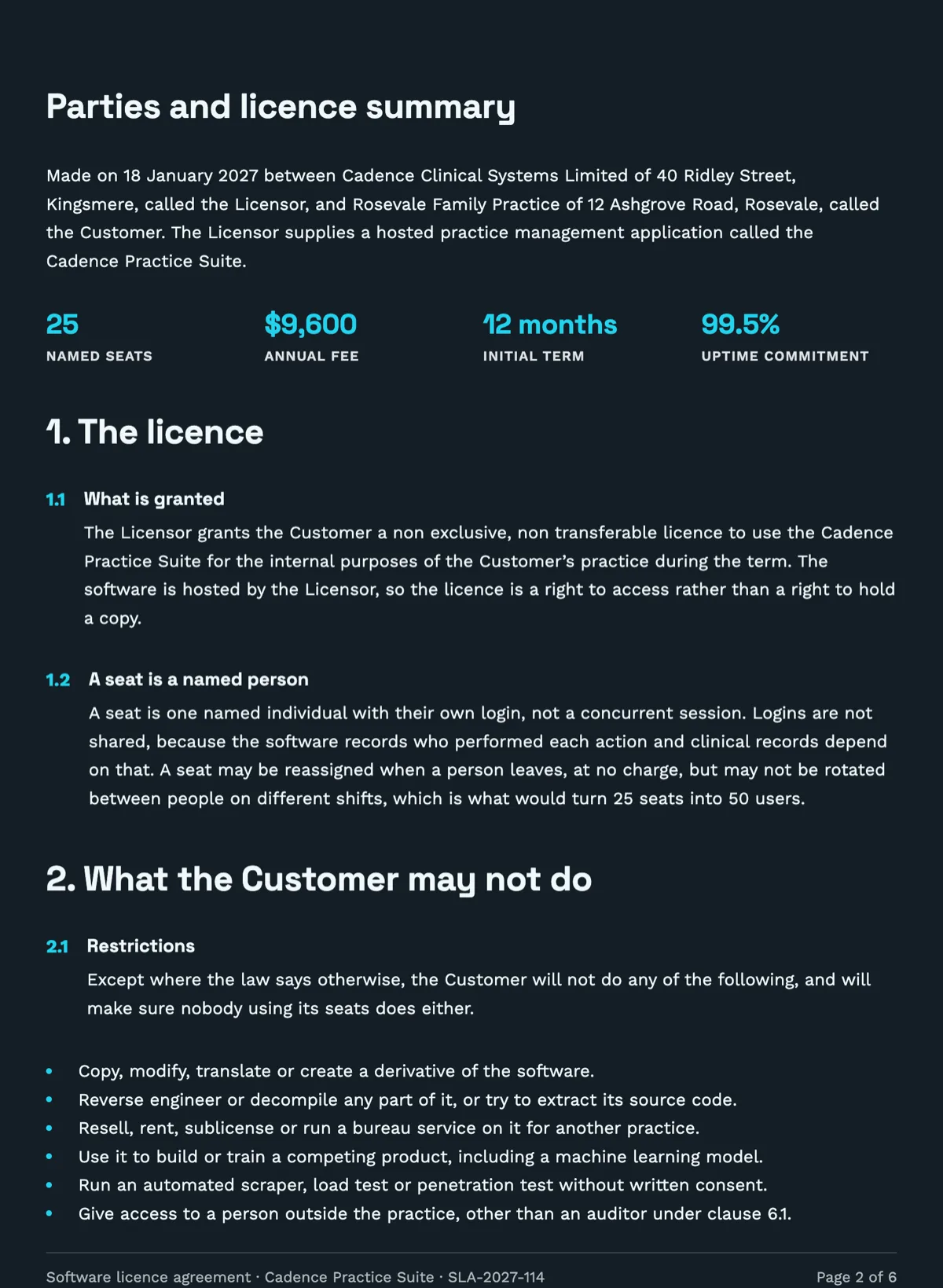 Software licence agreement template with seats, term and supportA software licence agreement has to answer three questions before anything else: what a seat is, what happens when the software is down, and who gets the data at the end. This one licenses a hosted practice management suite to a medical practice for 25 named users at $9,600 a year, with a support table, uptime credits and a 30 day export.
Questions people ask
Are auto renewal clauses legal in Australia?
Yes, and they are common. What can make one unenforceable is the unfair contract terms regime in Schedule 2 of the Competition and Consumer Act 2010, which applies to standard form consumer and small business contracts. A rollover that the other party cannot realistically avoid, with a long term and no reminder, is the shape most likely to be challenged.
How much notice should a customer get before renewal?
There is no single statutory figure for ordinary commercial contracts, but sending the reminder before the opt out window opens is the practical standard. A notice 60 to 90 days out, naming the renewal date, the last day to give notice and the new fees, gives the customer a real choice and removes most of the argument that the term operated by stealth.
Can the price go up on renewal?
It can if the clause says so, and most customers will only accept that with a ceiling. Common ceilings are a fixed percentage, or the movement in a published index plus a small margin. An uncapped renewal price combined with a short opt out window is one of the features regulators look at most closely in standard form contracts.
What is an evergreen clause?
It is another name for an automatic renewal that keeps rolling indefinitely, term after term, until somebody gives notice. The risk is the same as any rollover, magnified by the fact that nobody revisits the deal. Many buyers now replace an evergreen term with a rollover into a month to month arrangement, which keeps the service running without a new lock in.
What happens if the supplier forgets the reminder notice?
That depends entirely on what the clause says. If a missed reminder has no consequence written into it, the renewal still happens. The fix customers ask for is a right to exit the renewed term within its first 30 to 60 days, with a refund for the unused part, which makes the reminder obligation something both sides take seriously.
Does auto renewal apply to small business contracts?
It often does, and small business contracts sit inside the unfair contract terms regime when they are standard form and meet the size thresholds. The Australian Competition and Consumer Commission publishes guidance on which contracts are covered and what kinds of term it treats as problematic, including automatic rollovers and unilateral variation rights.
Put the clause in a finished document
The button opens the document generator with a starting description already filled in. Change it to match your own agreement before you run it.
Create a document with OneCraftRelated clauses
- Term clause in a contractA term clause in a contract says when it starts, how long it runs and how it ends. Sample managed services wording, fixed, rolling and completion variants.
- Early termination fee clauseAn early termination fee clause charges for ending a contract before the term ends. Sample wording, sliding scales, the penalty test and unfair terms limits.
- Termination notice clauseA termination notice clause says how notice must be given for it to count. Sample wording, delivery methods, deemed receipt rules and who is allowed to sign.
- Cooling off period clauseA cooling off period clause gives a party time to cancel after signing. Sample wording, the statutory periods in Australia and the UK, and contractual versions.
For everything the document generator can do, see the document maker.
Step by step in the builder: Create a document with AI, then Document builder components.
Written and checked by the OneCraft team. Last checked .