Contract clause
Cooling off period clause
A cooling off clause gives a party a short window after signing in which it can cancel without giving a reason and without penalty. Some cooling off rights come from statute and cannot be removed by contract, and others are offered voluntarily to make a sale easier to accept.
Two different things travel under the same name. One is a statutory right that exists whether or not the contract mentions it, and the other is a commercial promise the supplier chose to make.
Nuwan Madhusanka · Co-founder
4 min read · Published
Sample clause
a home services agreement between Northgate Cleaning and a residential customer signed at the customer's home, both fictional
1. Cooling Off Period. The Customer may cancel this agreement by written notice given to the Supplier at any time before the end of the fifth business day after the day on which the Customer signs it. 1.1 A notice under clause 1 may be given by email to the address in Item 2 of the Schedule, by post, or by handing it to the Supplier's representative. 2. Effect of Cancellation. If the Customer cancels under clause 1, this agreement is at an end, the Supplier must refund every amount the Customer has paid within 10 business days, and neither party owes the other anything further. 3. Services During the Period. The Supplier must not begin the Services, and must not accept payment, before the end of the Cooling Off Period unless the Customer asks in writing for the Services to start earlier. 4. Statutory Rights. Clause 1 is in addition to any right the Customer has under the Australian Consumer Law to terminate an unsolicited consumer agreement, and does not limit that right.
Sample wording, not legal advice.
Variants
Contractual cooling off, offered voluntarily
A business to business or online sale where no statutory right applies, and the supplier wants to remove hesitation at signing.
The Customer may cancel this agreement, without giving a reason, by written notice received by the Supplier before the end of the tenth business day after the date of signing. On cancellation the Supplier must refund all amounts paid within 10 business days and must delete any personal information collected for the purpose of performing the agreement, other than records it is required by law to keep. The Supplier may charge for any Services the Customer expressly asked it to begin during the period.
Statutory right restated
An agreement negotiated at the customer's home or by telephone, where an unsolicited consumer agreement right applies by law.
This agreement is an unsolicited consumer agreement. The Customer may terminate it during the termination period that applies under the Australian Consumer Law by giving the Supplier oral or written notice that the Customer terminates the agreement. The Supplier must not supply the Services, and must not accept or require any payment, during that period. Nothing in this agreement limits the Customer's statutory rights, and if any term of this agreement is inconsistent with them, the statutory rights prevail.
Cooling off with an express early start
Services the customer wants done urgently, where waiting out the period would defeat the point of the booking.
The Customer may cancel this agreement by written notice before the end of the fifth business day after signing. If the Customer asks in writing for the Services to begin before that day ends, the Customer may still cancel, but must pay for Services actually performed up to the time the cancellation notice is received, at the rates in Schedule 1. The Supplier must refund the balance of any amount paid within 10 business days and must not charge a cancellation fee.
What to negotiate
Whether a statutory right already applies
This is the first question and it is not negotiable once answered. Unsolicited consumer agreements, certain property contracts and several financial products carry statutory cooling off rights that a contract cannot remove. Drafting a shorter contractual period over the top of a longer statutory one creates a document that misstates the customer's rights, which is a worse outcome than saying nothing.
How the cancellation must be communicated
Suppliers want written notice to a named address so the date is recorded. Customers want the method to be easy, because a right that is hard to exercise is worth less. The workable form is a nominated email address plus post, with the notice effective on receipt. Where a statutory right applies, the statutory method governs and the contract cannot narrow it.
Whether work can start during the period
Suppliers of urgent services want to begin immediately; the point of the period is that the customer has not committed yet. The usual compromise is that work starts only on a written request from the customer, and if the customer then cancels it pays for what was actually performed rather than a cancellation fee. Statutory regimes often restrict this more tightly.
Refund timing
A cooling off right with a slow refund is only half a right. Ten business days is a common and workable deadline, and stating it in the clause avoids the argument entirely. Suppliers sometimes ask for longer where payment came through a third party processor, which is reasonable if the longer period is stated rather than left open.
The risk of leaving it out
Where a statutory cooling off right applies, leaving it out of the document does not remove it, but it does leave customers unaware of a right they hold and leaves the supplier looking as though it concealed one. Where no statutory right applies, omitting a voluntary period simply means cancellations are handled case by case, which is slower and inconsistent.
Statutory periods in Australia and overseas
In Australia the clearest example sits in the Australian Consumer Law, Schedule 2 of the Competition and Consumer Act 2010, which gives a consumer a termination period for an unsolicited consumer agreement, the category covering door to door and telephone sales. The Act also restricts supply and payment during that period. Residential property purchases carry their own cooling off periods, set separately by each state and territory and administered by its fair trading or consumer affairs regulator, so the length and the forfeit differ depending on where the property is. In the United Kingdom the Consumer Contracts (Information, Cancellation and Additional Charges) Regulations 2013 give a 14 day cancellation right for most distance and off premises consumer contracts. None of these rights depends on the contract mentioning them.
Contractual cooling off is a sales tool
Where no statutory right applies, a voluntary period does a different job: it lowers the cost of saying yes. A ten day window on a business to business subscription removes the pressure from a signing decision and rarely produces many cancellations, because the customer who was going to change their mind usually does so in the first week regardless. The drafting points are the same either way. Say when the period starts, since signing and delivery are different dates. Say how notice is given. Say what happens to money already paid and by when. Say whether work can begin during the period and what is payable if it does.
Where it sits in a generated document
The document generator writes an agreement as numbered content, so a cooling off right usually appears early, near the term, with the cancellation method and the refund deadline as sub clauses. The generated text is written from the description it is given and it never prints citations, so any statutory period named in a draft has to be checked against the legislation and the relevant state regulator before the document is used. Describing the notice method and the refund deadline produces both rather than a bare right to cancel.
Documents that carry this clause
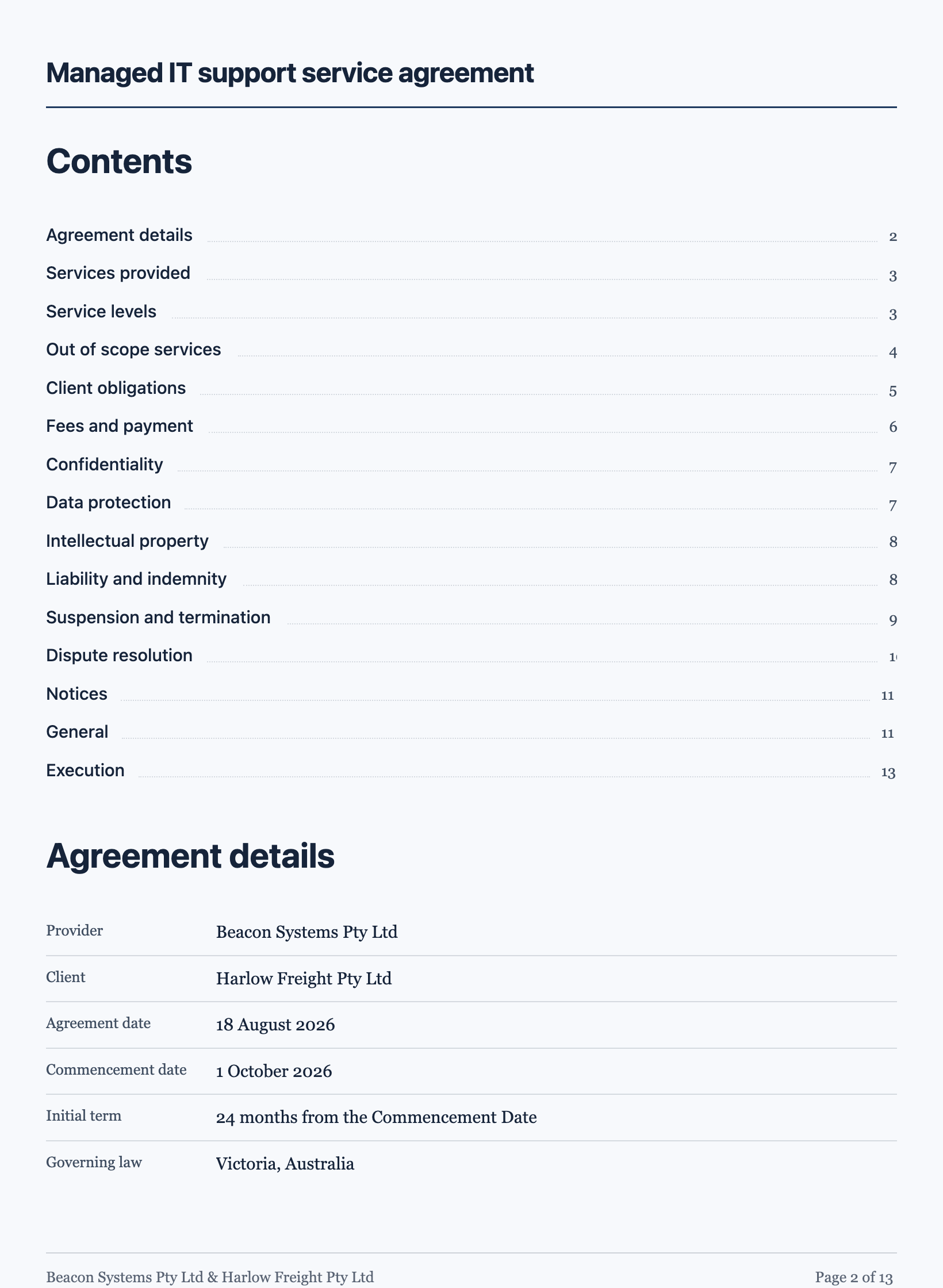 Service agreementBeacon Systems supports Harlow Freight’s IT for an initial 24 months from 1 October 2026 at $8,400 a month plus GST, with 40 hours included and $220 an hour beyond them. Twelve numbered clauses cover the services, a four level severity table, client duties, fees with a CPI adjustment, confidentiality, privacy, IP, a liability cap, termination and a three step dispute ladder.
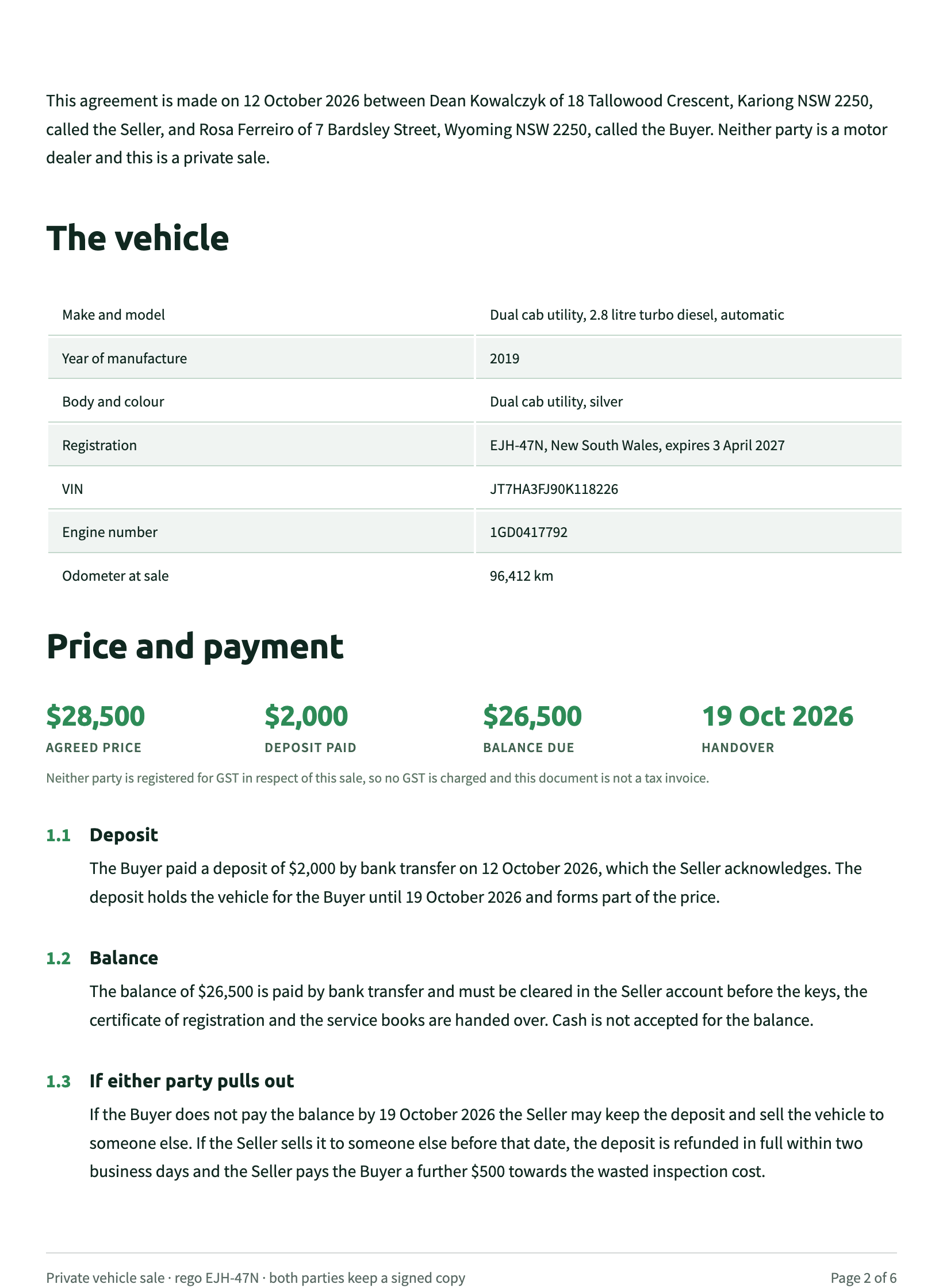 Vehicle sale agreement templateA dual cab ute is changing hands between two people on the Central Coast for $28,500. No dealer, so no statutory warranty and no guarantee of clear title. What the buyer gets instead is five written warranties, a register certificate number, and a mechanic's report obtained before the balance moves.
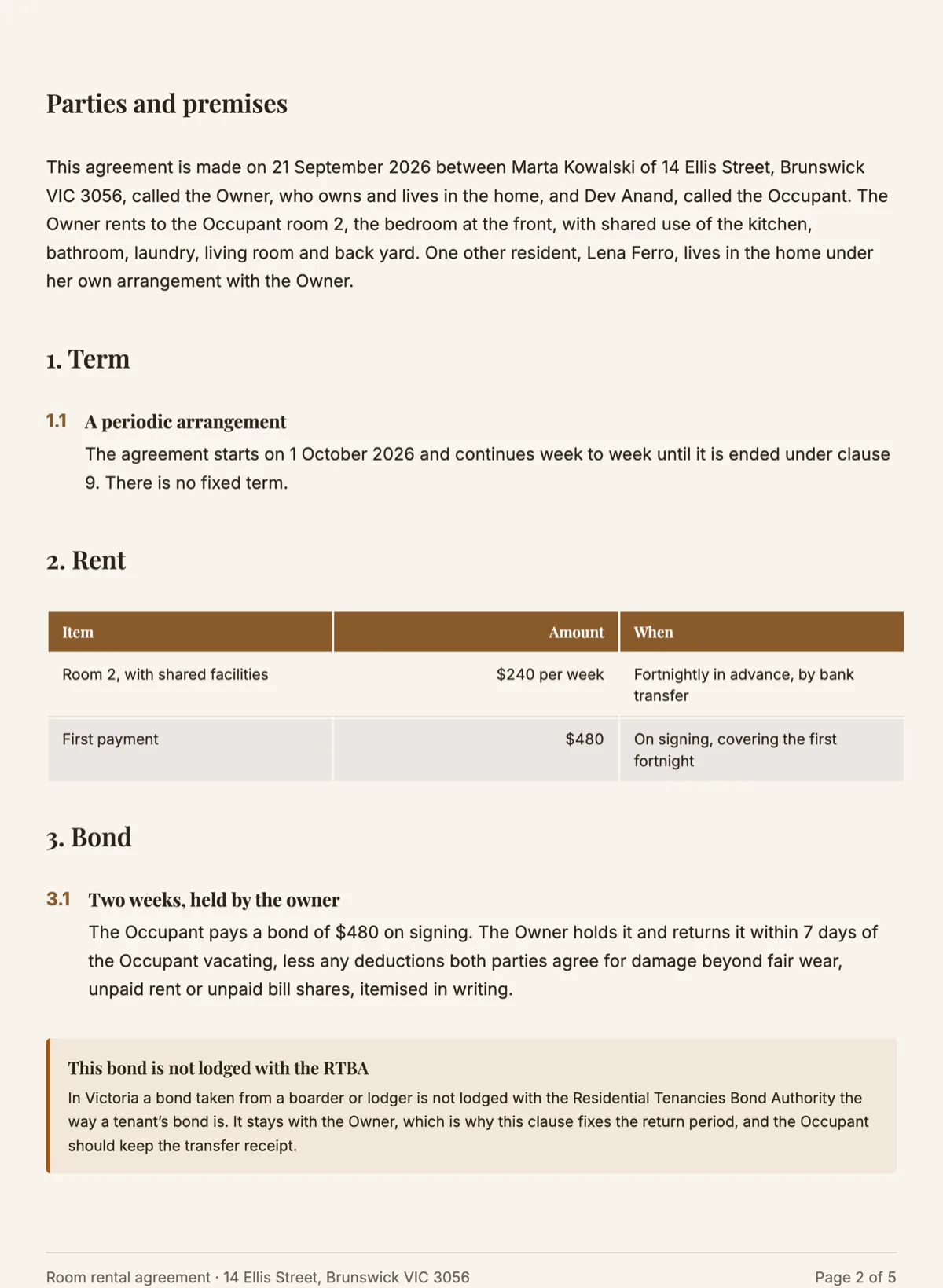 Room rental agreement template for one room in a shared homeRenting a room is not the same as renting a house, and most templates copy a residential lease and hope. This one is written for one room with shared kitchen and bathroom, prices the bills split, lists the rules that matter, and says plainly that the occupant is a boarder or lodger and what that changes.
Questions people ask
Is there a general cooling off period for contracts in Australia?
No. There is no universal right to change your mind after signing. Cooling off rights attach to particular kinds of transaction, including unsolicited consumer agreements under the Australian Consumer Law, residential property purchases under each state's own rules, and several financial products. Outside those categories, a cooling off period exists only if the contract gives one.
How long is the cooling off period for door to door sales?
Unsolicited consumer agreements, which include door to door and telephone sales, carry a termination period set by the Australian Consumer Law in Schedule 2 of the Competition and Consumer Act 2010. The same rules restrict supplying goods or services and taking payment during that period, so a supplier that starts work immediately may be in breach.
Can a contract remove a statutory cooling off right?
No. A statutory right applies regardless of what the document says, and a term that purports to exclude it has no effect to that extent. Restating the right in the contract is fine and often helpful, but the restatement should be accurate, because a shorter period written into a document misleads the customer about what they actually have.
Does cooling off apply to business to business contracts?
Statutory cooling off rights are generally aimed at consumers, so most business to business agreements carry none. Suppliers sometimes offer one voluntarily, particularly for subscriptions bought online, because it makes signing easier. Where it is voluntary, the contract decides the length, the notice method and what happens to money already paid.
What happens to money paid during a cooling off period?
It should be refunded in full when the right is exercised, and the clause should state a deadline. Ten business days is common and workable. Where the customer expressly asked for work to start during the period, most drafts allow a charge for the work actually performed, but not a separate cancellation fee on top of it.
How long is the cancellation period in the United Kingdom?
The Consumer Contracts (Information, Cancellation and Additional Charges) Regulations 2013 give consumers 14 days to cancel most distance and off premises contracts, running from delivery for goods and from the day after the contract for services. Different rules apply to certain categories, including bespoke goods and digital content the consumer has begun to download.
Put the clause in a finished document
The button opens the document generator with a starting description already filled in. Change it to match your own agreement before you run it.
Create a document with OneCraftRelated clauses
- Auto renewal clauseAn auto renewal clause rolls a contract over unless someone opts out in time. Sample wording, fairer versions, and the Australian unfair contract terms risk.
- Early termination fee clauseAn early termination fee clause charges for ending a contract before the term ends. Sample wording, sliding scales, the penalty test and unfair terms limits.
- Term clause in a contractA term clause in a contract says when it starts, how long it runs and how it ends. Sample managed services wording, fixed, rolling and completion variants.
For everything the document generator can do, see the document maker.
Step by step in the builder: Create a document with AI, then Document builder components.
Written and checked by the OneCraft team. Last checked .