Contract clause
Early termination fee clause
An early termination fee clause makes one party pay a stated amount for ending the agreement before the term is up. It is meant to recover costs the other party committed on the strength of the full term, such as equipment, setup work or a discount already given.
A fee that recovers what the supplier actually lost is ordinary commercial drafting. A fee equal to every remaining month is the version that gets tested against the penalty doctrine and the unfair contract terms rules.
Indunil Asanka · Co-founder
4 min read · Published
Sample clause
a 24 month gym membership agreement between Granite Loft Climbing and a member, on standard terms, both fictional
1. Early Termination. The Member may end this agreement before the end of the Minimum Term by giving 14 days written notice and paying the Early Termination Fee. 1.1 The Early Termination Fee is one month of the then current monthly fee, plus the unamortised balance of the joining fee calculated on a straight line basis over the Minimum Term. 1.2 The Early Termination Fee is not payable if the Member ends this agreement because of a serious illness or injury certified by a medical practitioner, because the Member has moved more than 25 kilometres from the Premises, or because Granite Loft Climbing has breached this agreement. 2. Refunds. Any fee paid for a period after the effective date of termination must be refunded within 10 business days. 3. No Other Charge. Granite Loft Climbing may not charge any other amount for ending this agreement early, including an administration or processing fee.
Sample wording, not legal advice.
Variants
Sliding scale by time remaining
Equipment and connection contracts where the supplier's unrecovered cost genuinely falls as the term runs.
If the Customer ends this agreement before the end of the Minimum Term, the Customer must pay an Early Termination Fee equal to the unrecovered balance of the Setup Cost shown in Item 3 of the Schedule, reduced by one twenty fourth for each complete month of the Minimum Term that has passed. No Early Termination Fee is payable in the final three months of the Minimum Term. The Supplier must give the Customer a written calculation of the fee within 10 business days of the termination notice.
Discount clawback rather than a fee
Contracts priced at a discount for a longer commitment, where the honest charge is the discount given back.
The Fees in Schedule 1 reflect a 15 per cent discount granted in consideration of the Customer committing to a 36 month term. If the Customer ends this agreement before the end of that term other than for cause, the Customer must pay the difference between the discounted Fees actually paid and the standard Fees that would have applied without the discount, for the period up to the effective date of termination only. No other early termination charge applies.
No fee after a minimum period
Consumer facing and small business contracts, where a fee that runs to the last day of the term is difficult to defend.
The Customer may end this agreement at any time on 30 days written notice. If notice is given during the first 12 months, the Customer must pay an Early Termination Fee equal to two months of the then current monthly fee. If notice is given after the first 12 months, no Early Termination Fee is payable. Any amount prepaid for a period after the effective date of termination must be refunded within 10 business days.
What to negotiate
What the fee is actually recovering
A fee tied to a real cost is defensible and a round number is not. Suppliers should be able to point to the equipment, the setup labour or the discount the fee recovers. Customers ask for the calculation to be written into the clause or a schedule. Doing that once at drafting is far cheaper than explaining the number to a regulator or a tribunal later.
Whether the fee reduces over time
An unrecovered cost falls as the term runs, so a fee that stays the same in month twenty three as it was in month one looks like a punishment rather than a recovery. Customers ask for a sliding scale or a straight line amortisation. Suppliers accept it readily where the underlying cost really is being recovered month by month.
The exceptions that should apply
Most consumer facing contracts carve out termination for the supplier's breach, and many add hardship grounds such as serious illness, relocation or loss of income. Suppliers want the grounds evidenced, usually by a certificate or a document. Agreeing the evidence at drafting avoids the situation where a customer in genuine difficulty is arguing about proof.
Whether other charges can be added
An administration fee stacked on top of a termination fee is the kind of detail that attracts attention, because it is rarely tied to any real cost. Customers ask for a sentence saying the stated fee is the only charge for ending early. Suppliers who have priced the fee properly lose nothing by agreeing, and the clause reads better for it.
The risk of leaving it out
Without the clause a supplier that has bought equipment or discounted its price for a long commitment has no contractual way to recover that outlay when the customer leaves early. It has to prove its loss as damages instead, which is slower, uncertain, and often ends below what a properly drafted and properly explained fee would have delivered.
The penalty test applies to exit fees
A sum payable on ending a contract early is measured the same way as any other agreed sum. It is enforceable while it protects a legitimate interest of the party charging it, and it becomes an unenforceable penalty when it is out of all proportion to that interest. The High Court set out that approach in Paciocco v Australia and New Zealand Banking Group Ltd in 2016, following Andrews v Australia and New Zealand Banking Group Ltd in 2012, which confirmed the doctrine is not limited to sums payable on breach. That second point matters here, because an early termination fee is usually payable on the exercise of a right rather than on a breach at all. A fee built from a recorded cost survives that test far more comfortably than a round figure.
Unfair contract terms and consumer contracts
For standard form consumer and small business contracts, the unfair contract terms regime in Schedule 2 of the Competition and Consumer Act 2010 adds a second test. A term can be unfair where it causes a significant imbalance, is not reasonably necessary to protect a legitimate interest, and would cause detriment if relied on. The Australian Competition and Consumer Commission publishes guidance on the kinds of term it examines, and exit fees that bear no relation to the supplier's actual loss appear in that territory. Since the 2023 changes a term found unfair can attract a penalty rather than simply being declared void, which has changed how these fees are set.
Where it sits in a generated document
The document generator writes an agreement as numbered content, so an early termination fee usually appears as a sub clause under the termination right it applies to, with the calculation and the exceptions as further sub clauses. The generated text is written from the description it is given and it never prints citations, so any figure or formula in a draft has to be checked before the document is used. Describing how the fee is calculated, rather than naming a bare amount, produces a clause a reader can follow.
Documents that carry this clause
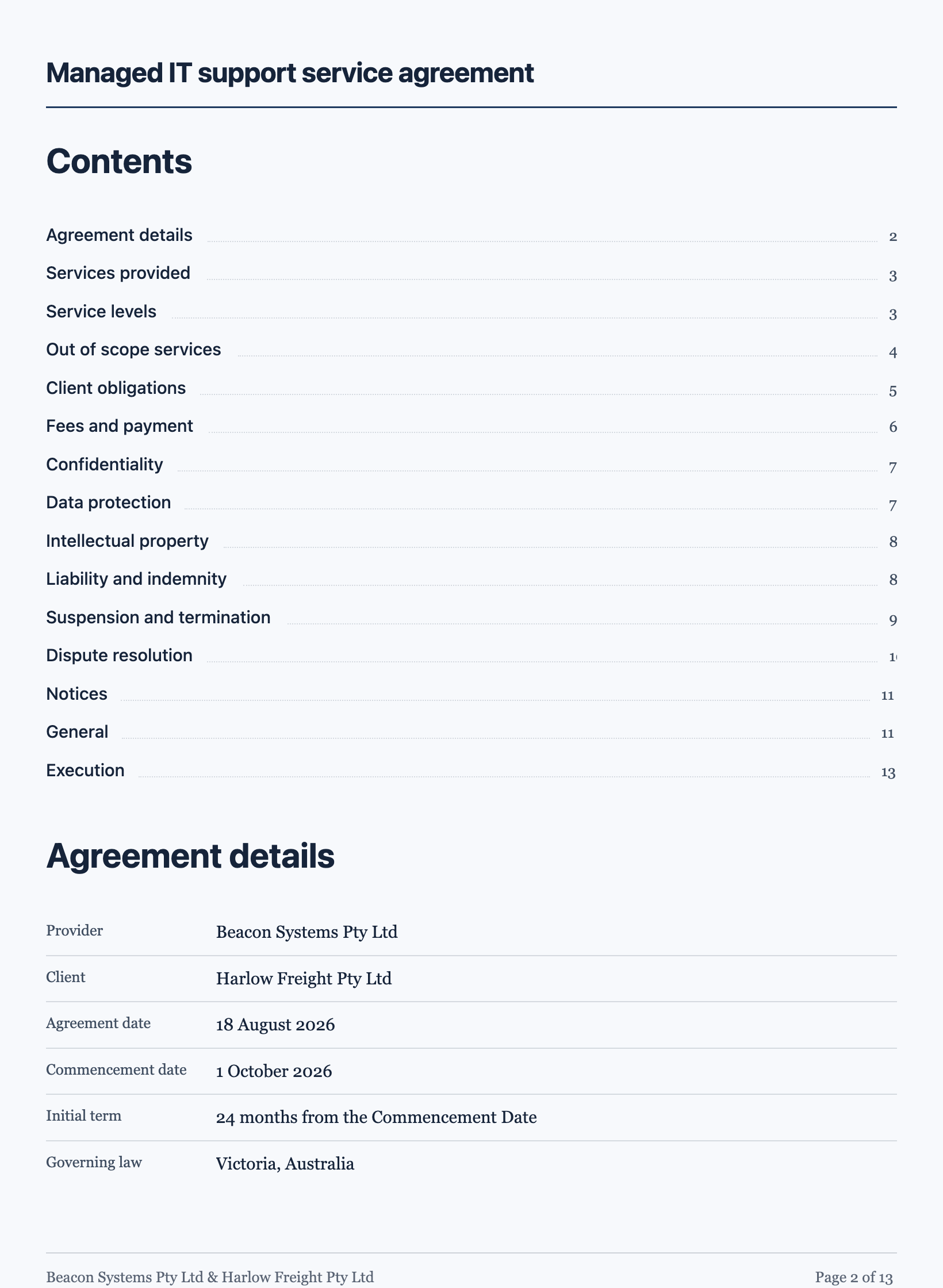 Service agreementBeacon Systems supports Harlow Freight’s IT for an initial 24 months from 1 October 2026 at $8,400 a month plus GST, with 40 hours included and $220 an hour beyond them. Twelve numbered clauses cover the services, a four level severity table, client duties, fees with a CPI adjustment, confidentiality, privacy, IP, a liability cap, termination and a three step dispute ladder.
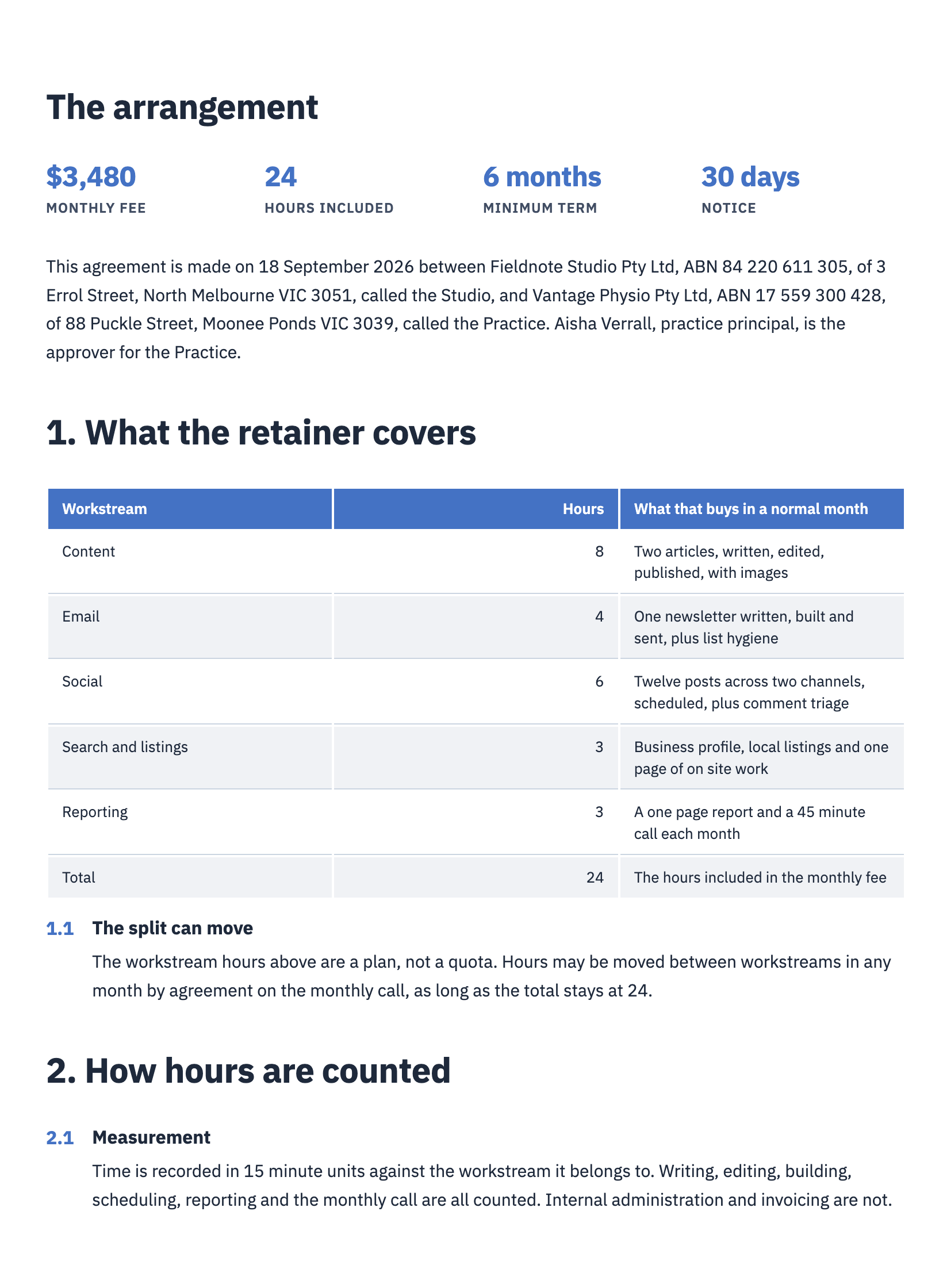 Monthly retainer agreementA studio sells a physio practice twenty four hours a month. Almost every clause exists to answer one question that ordinary contracts duck: what happens to the hours nobody used.
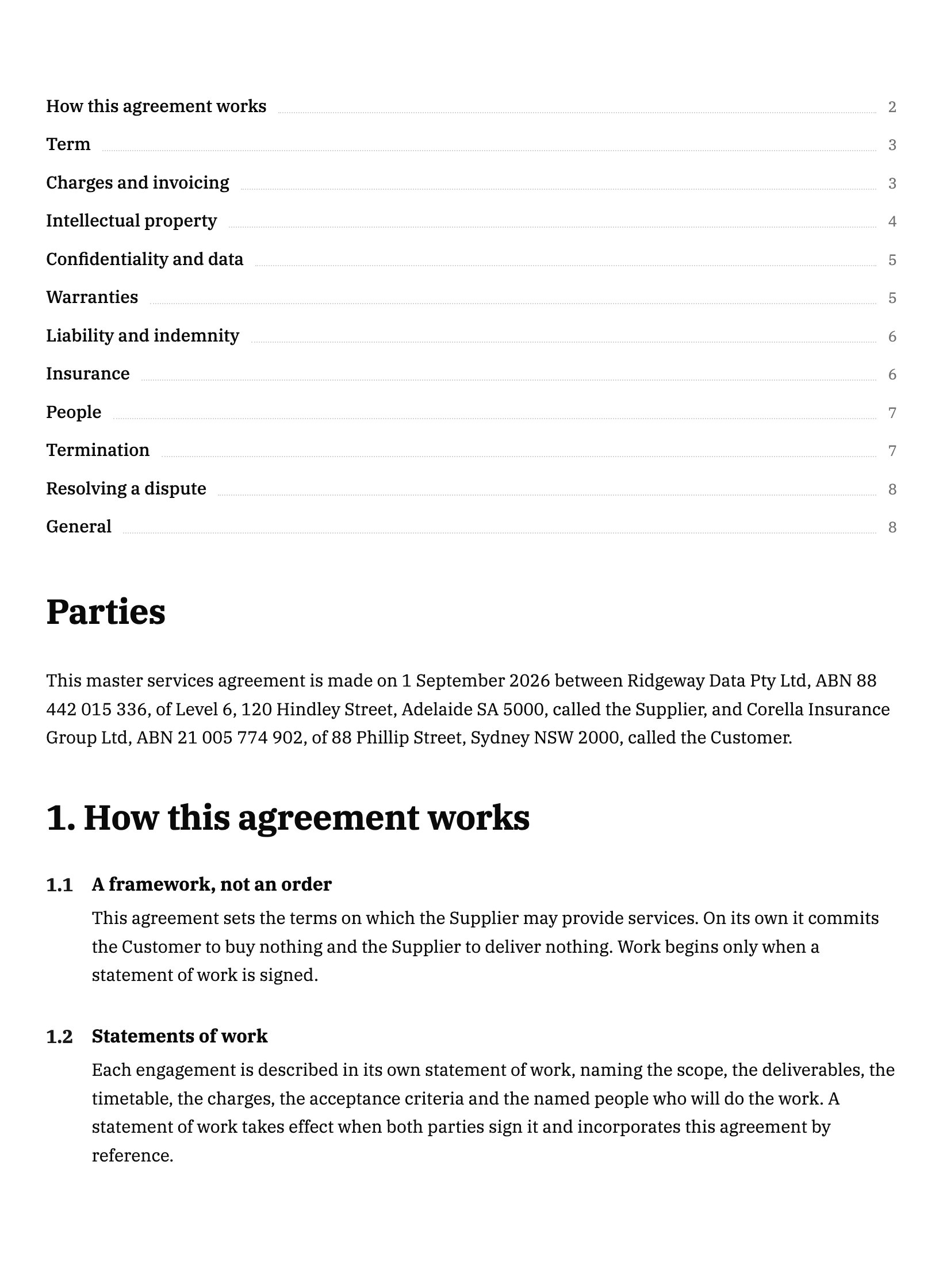 Master services agreementA data consultancy and an insurer sign this once and then buy work under it for three years. It is the rare contract whose whole purpose is to make the next twenty contracts short.
Questions people ask
Are early termination fees enforceable in Australia?
They can be. A fee that recovers a genuine cost the supplier committed for the full term is ordinary commercial drafting. A fee out of all proportion to that interest risks being an unenforceable penalty, and in a standard form consumer or small business contract it may also be examined under the unfair contract terms regime.
How should an early termination fee be calculated?
From a real cost, written down. Common bases are the unamortised balance of setup or equipment costs, the discount given in exchange for the longer term, or a short fixed number of months that reflects the notice the supplier would otherwise need. Putting the calculation in the clause makes the fee much easier to defend.
Is charging all remaining months lawful?
It is the version most likely to be challenged. Charging the entire balance of the term gives the supplier the full benefit of a contract it is no longer performing, which is hard to describe as protecting a legitimate interest. Sliding scales and discount clawbacks achieve a similar commercial result with far less risk.
Can a fee be charged when the supplier is at fault?
It should not be, and most drafts say so expressly. Charging a customer for leaving a contract the supplier has breached is close to charging for the supplier's own failure. Carving out termination for cause, along with agreed hardship grounds, is standard practice in consumer facing agreements.
What is the difference between an exit fee and liquidated damages?
Liquidated damages are payable when a party breaches, usually for delay. An exit fee is payable when a party exercises a right to leave early, so no breach is involved. Both are measured against the same proportionality test, which is why the reasoning behind the number matters as much in one as in the other.
Should prepaid fees be refunded on early termination?
Yes, for the period after the effective date, and most well drafted clauses say so. Keeping a prepayment for a service that will not be delivered, on top of an exit fee, is the combination that draws attention. A short refund deadline, commonly 10 business days, makes the obligation concrete.
Put the clause in a finished document
The button opens the document generator with a starting description already filled in. Change it to match your own agreement before you run it.
Create a document with OneCraftRelated clauses
- Auto renewal clauseAn auto renewal clause rolls a contract over unless someone opts out in time. Sample wording, fairer versions, and the Australian unfair contract terms risk.
- Cooling off period clauseA cooling off period clause gives a party time to cancel after signing. Sample wording, the statutory periods in Australia and the UK, and contractual versions.
- Termination for convenience clauseA termination for convenience clause lets a party end a contract on notice with no breach. Sample retainer wording, mutual and one sided versions, exit costs.
For everything the document generator can do, see the document maker.
Step by step in the builder: Create a document with AI, then Document builder components.
Written and checked by the OneCraft team. Last checked .