Contract clause
Liquidated damages clause
A liquidated damages clause fixes in advance the sum payable for a named breach, most often late completion, so neither side has to prove what the delay actually cost. It gives the customer a certain remedy and gives the supplier a known ceiling on what running late will cost it.
A delay claim without this clause turns into an argument about lost trading, months after the job has finished and the evidence has gone cold. A rate agreed at signing replaces that argument with arithmetic, as long as the rate can survive the penalty test.
Indunil Asanka · Co-founder
4 min read · Published
Sample clause
a shop fit out contract between Ironbark Interiors and Marlow Books, a fictional bookseller opening in a Perth arcade
1. Date for Practical Completion. The Contractor must reach Practical Completion of the Works by 14 May 2027, as extended under clause 9. 2. Liquidated Damages. If Practical Completion is not reached by the Date for Practical Completion, the Contractor must pay the Principal liquidated damages of $1,200 for each day, or part of a day, from that date until Practical Completion is reached. 2.1 The parties agree that $1,200 a day is a genuine pre estimate of the loss the Principal will suffer through delayed trading, being rent, staff standing time and the cost of holding deferred stock. 2.2 The total payable under clause 2 is capped at 10 per cent of the Contract Sum. 2.3 Liquidated damages are the Principal's only remedy for delay in reaching Practical Completion, and do not limit any remedy for defective work. 3. Set Off. The Principal may deduct liquidated damages from any amount otherwise payable to the Contractor, after giving written notice of the amount and how it was calculated.
Sample wording, not legal advice.
Variants
Daily rate with a cap
The standard construction form, where each day of delay costs the same and the running total is limited.
If the Contractor does not reach Practical Completion by the Date for Practical Completion, the Contractor must pay the Principal $1,200 for each day until Practical Completion is reached, to a maximum of 10 per cent of the Contract Sum. Once that maximum is reached the Principal may, by written notice, either continue with the Works or terminate under clause 12, and liquidated damages stop accruing from the date of the notice.
Per event rather than per day
Service contracts where the failure is a missed report or a missed milestone rather than a delay that keeps running.
If the Supplier fails to deliver a Monthly Report by the fifth business day of the following month, the Supplier must credit the Customer $800 for each report missed, applied against the next invoice. A credit is payable once for each missed report regardless of how late the report is, and the total credited in any twelve month period must not exceed 15 per cent of the fees payable for that period.
Sole remedy, with carve outs
The supplier wants certainty that delay cannot be claimed twice, once at the agreed rate and again as general damages.
Liquidated damages under clause 2 are the Principal's only remedy at law or in equity for delay in reaching Practical Completion. This clause does not limit the Principal's rights in respect of defective work, a breach of the confidentiality obligations, a breach of the work health and safety obligations, or the Contractor's fraud. If clause 2 is found to be unenforceable, the Principal may claim damages for delay at general law, subject to the liability cap in clause 14.
What to negotiate
The rate and the evidence behind it
The customer proposes a number that reflects what the delay really costs it, such as rent, wages and lost trading. The supplier pushes the number down and asks to see the working. The usual landing point is a rate built from a short written calculation kept with the contract file, because a figure that can be explained later is far harder to attack as a penalty than a round number nobody can source.
The cap and what happens when it is reached
Suppliers want an overall cap, commonly between 5 and 15 per cent of the contract sum, so exposure is knowable. Customers accept a cap but ask for a termination right once it is exhausted, otherwise the supplier has no incentive to finish. The common settlement is a cap plus a right to terminate for cause on notice once the cap is reached, with damages stopping at that point.
Extensions of time
The supplier will not accept a delay rate without a workable extension of time regime, because a customer that causes delay and then charges for it will usually find the clause unenforceable. Customers try to keep the grounds narrow. Most contracts settle on a list of qualifying causes, a short notice period for claiming, and a named person who decides, with a mechanism if that person does not respond.
Whether it is the only remedy
Suppliers want liquidated damages stated as the sole remedy for delay, so the same lateness cannot be charged twice. Customers want carve outs for defects, safety and confidentiality, which are separate failures rather than delay. A sole remedy clause usually survives in that narrowed form, together with a fallback allowing general damages if the fixed rate is later held unenforceable.
The risk of leaving it out
With no clause the customer has to prove what the delay actually cost, item by item, long after the job finished, which is slow and often ends at a lower figure than the parties would have agreed at the start. The supplier loses the other half of the bargain, because its delay exposure becomes whatever the customer can establish, with no ceiling on it.
The penalty test in Australia
A fixed sum is enforceable while it protects a legitimate interest of the party imposing it, and becomes an unenforceable penalty when it is out of all proportion to that interest. The High Court set out that approach in Paciocco v Australia and New Zealand Banking Group Ltd in 2016, following Andrews v Australia and New Zealand Banking Group Ltd in 2012, which confirmed the doctrine is not confined to sums payable on breach. The practical consequence is simple enough. A rate worked out from real costs, written down at the time and kept on file, is defensible even if the loss turns out lower on the day. A round number nobody can explain is the one that gets challenged.
Extensions of time keep the clause alive
A customer that causes part of the delay and still charges the full daily rate is asking a court to let it profit from its own act. Where the contract has no workable mechanism to extend the date for events the customer caused, the date can fall away entirely and the fixed rate goes with it, leaving the customer to prove ordinary damages. That is why the extension of time clause and the liquidated damages clause are drafted as a pair. The list of qualifying causes, the notice period for claiming one, and the person who decides the claim all matter more to the enforceability of the rate than the rate itself does.
Where it sits in a generated document
The document generator writes an agreement as numbered content, so a delay rate arrives as a numbered clause with its cap and its set off right as sub clauses under it, next to the completion date it depends on. The generated text is written from the description it is given and it never prints citations, so a figure or a statutory reference in a draft has to be checked before the document is used. Asking for the cap and the sole remedy wording in the description is more reliable than editing them in later, because the built in chat changes the text of a component rather than adding new clauses around it.
Documents that carry this clause
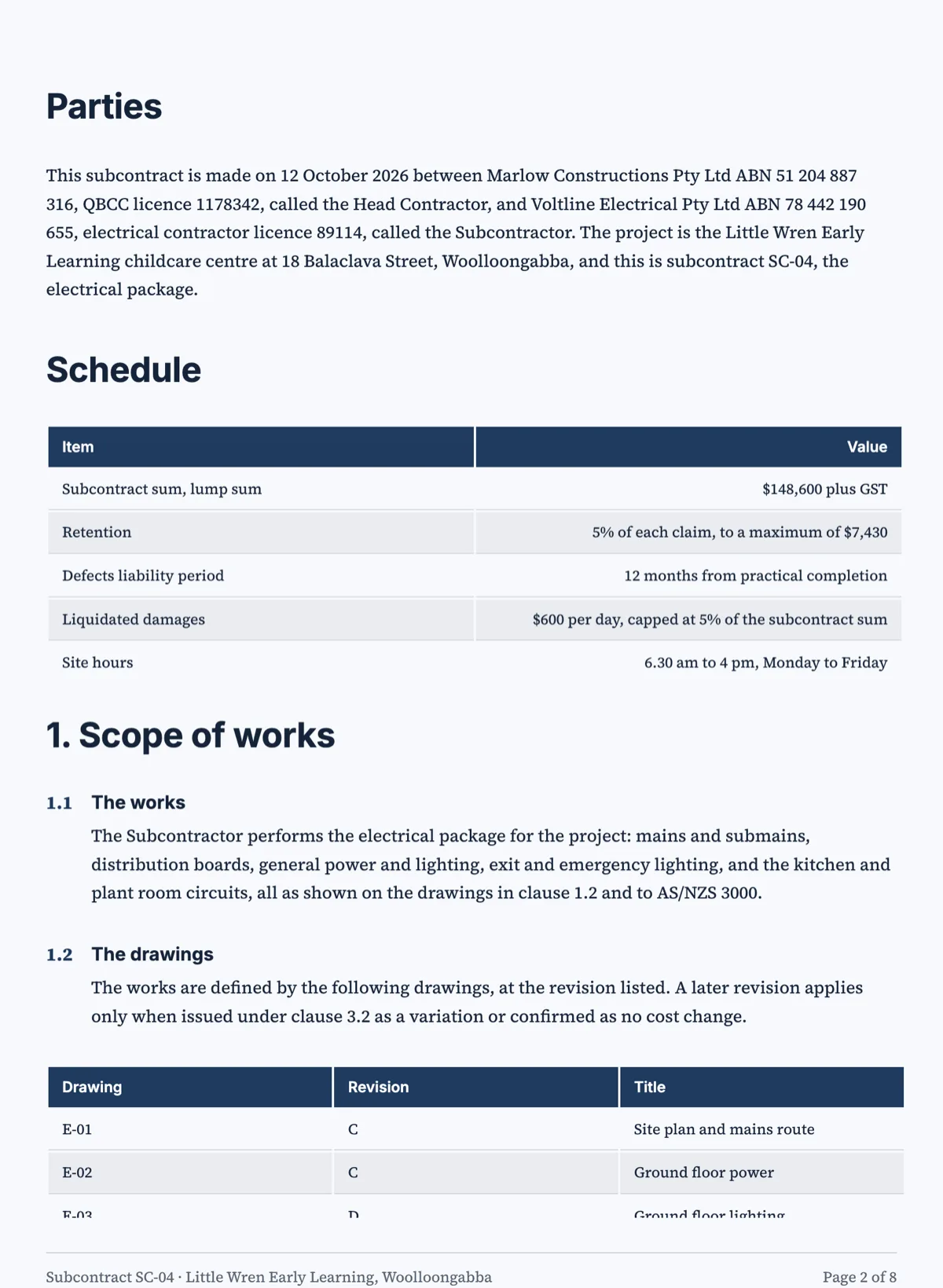 Subcontractor agreement template that flows the head contract downA subcontract exists to pass the head contract's obligations down one level and move the money back up on time. This one names the scope by drawing, sets the progress claim dates against the security of payment rules, holds retention and states the insurances, so the trade knows exactly when it is paid and for what.
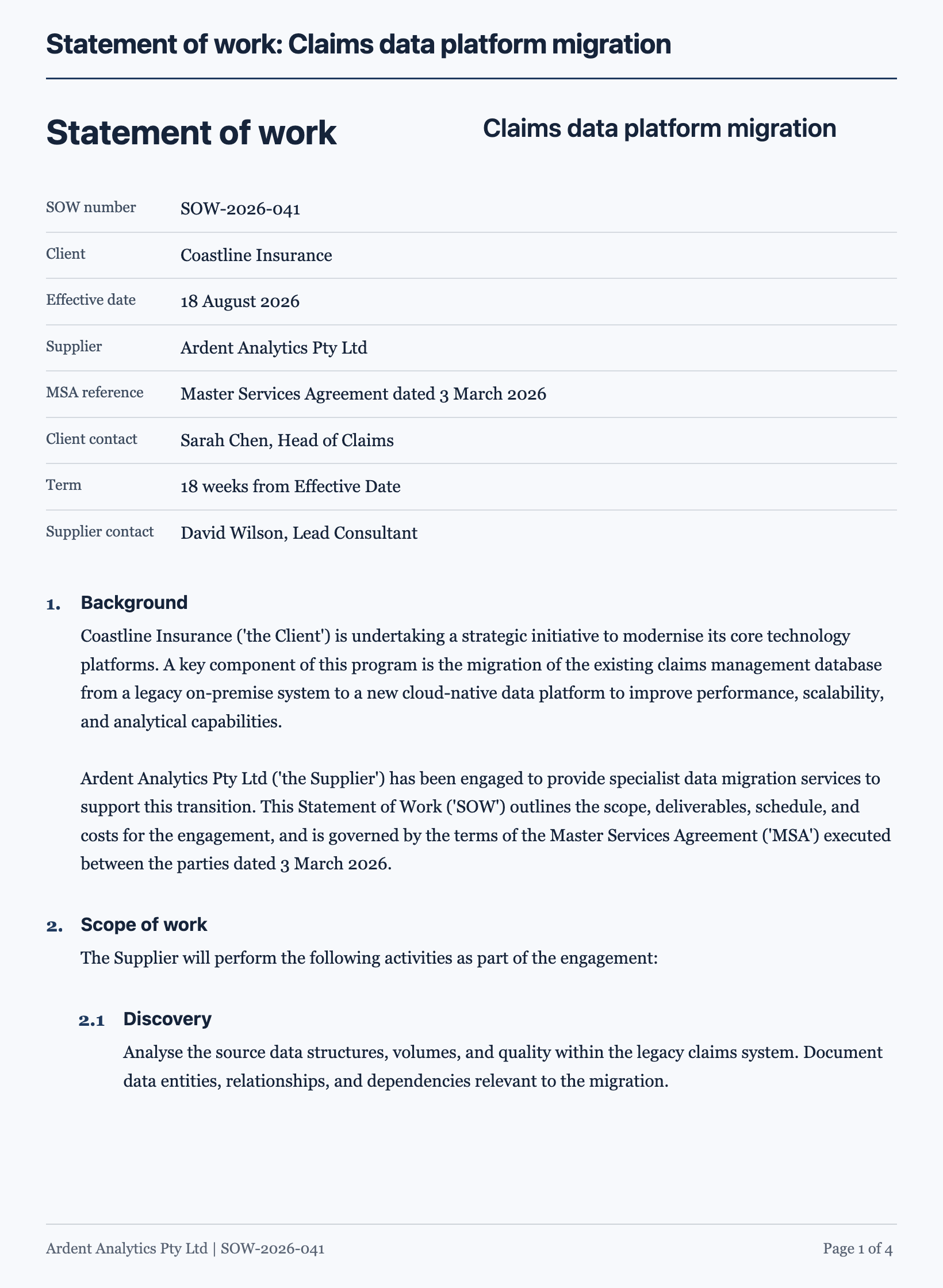 Statement of work template under a master agreementArdent Analytics migrates Coastline Insurance’s claims database to a cloud platform over 18 weeks under SOW-2026-041, governed by a master services agreement dated 3 March 2026. The work is time and materials with four roles priced by the day and a $412,000 estimate before GST, five dated deliverables, ten business days to accept each one, and five assumptions written down before anyone starts.
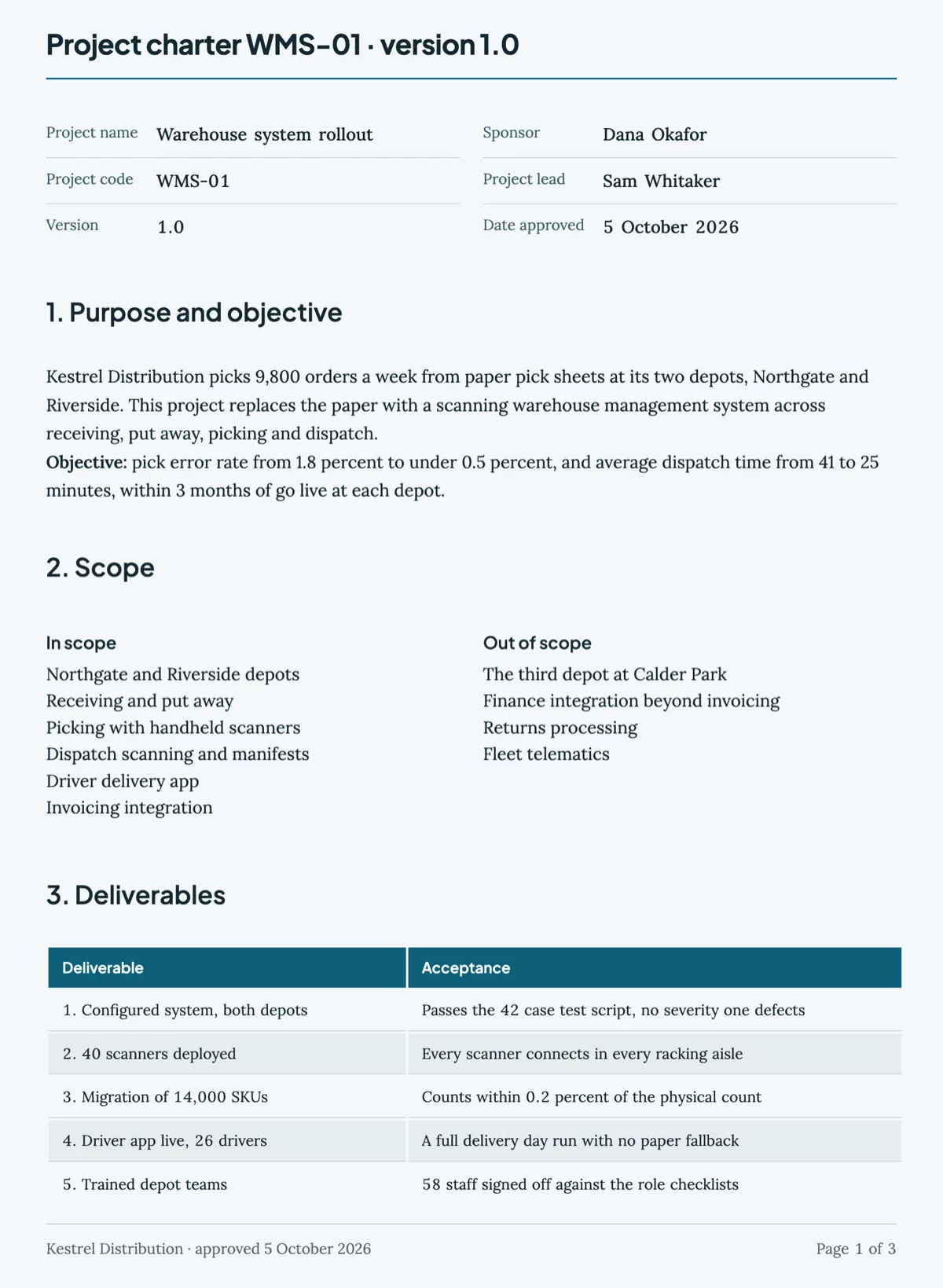 Project charter template with the scope in and out on one pageA charter exists so that a project starts with a sponsor's signature on a page that says what it is and is not. This one fits a system rollout on three pages: a measurable objective, scope in and out as two lists side by side, the team with their authority, a $341,000 budget, five milestones on a timeline and the five risks worth naming on day one.
Questions people ask
What is the difference between liquidated damages and a penalty?
Liquidated damages are a sum agreed in advance that protects a real interest of the party charging it. A penalty is a sum so far above that interest that it works as punishment for breaking the contract rather than as compensation. Penalties are not enforceable, so the rate and the reasoning behind it are what decide which side of the line a clause falls.
Does a liquidated damages rate have to match the actual loss?
No. The point of fixing the rate in advance is that nobody proves the loss afterwards, so a gap between the rate and the eventual loss does not by itself invalidate the clause. What matters is whether the sum was out of all proportion to the interest being protected when the contract was made, judged on what the parties knew then.
Can liquidated damages be deducted from an invoice?
Only if the contract says so. A set off right is usually written into the same clause or into a separate set off clause, together with a requirement to give written notice of the amount and the calculation. Without that right the customer has to pay the invoice and then pursue the damages separately, which is a much weaker position.
Is there usually a cap on liquidated damages?
Most commercial contracts cap the total between 5 and 15 per cent of the contract sum. A cap gives the supplier a knowable exposure and makes the rate easier to defend. Customers normally ask for a termination right once the cap is reached, since a supplier that has hit its ceiling has no further financial reason to finish quickly.
Do liquidated damages apply if the customer caused the delay?
Not for that part of the delay. A contract with a proper extension of time regime moves the completion date for causes the customer is responsible for, and the rate then runs from the new date. Where no such mechanism exists, the whole fixed date can fall away and the customer is left proving ordinary damages instead.
Can a service contract use liquidated damages?
Yes, and it often works better as a credit per missed event rather than a daily rate. A missed monthly report, a breached response time or a failed availability target each suit a per event figure applied against the next invoice. The same proportionality test applies, so the credit should reflect what the failure costs the customer.
Put the clause in a finished document
The button opens the document generator with a starting description already filled in. Change it to match your own agreement before you run it.
Create a document with OneCraftRelated clauses
- Limitation of liability clause: putting a ceiling on exposureA limitation of liability clause puts a ceiling on what one party can recover. Australian sample wording, three variants, the carve outs and the UK test.
- Hold harmless clauseA hold harmless clause promises not to hold the other side responsible for a named risk. Sample wording, how it differs from an indemnity, what to negotiate.
- Waiver of subrogation clauseA waiver of subrogation clause stops an insurer suing the other party after it pays a claim. Sample lease wording, mutual and one way versions, insurer consent.
- Termination for cause clauseA termination for cause clause ends a contract for serious breach. Sample wording, what counts as material, cure periods and immediate termination events.
For everything the document generator can do, see the document maker.
Step by step in the builder: Create a document with AI, then Document builder components.
Written and checked by the OneCraft team. Last checked .