Contract clause
Limitation of liability clause: putting a ceiling on exposure
A limitation of liability clause sets the most one party can be made to pay the other under the contract. It normally works in three layers: liability that cannot lawfully be limited is preserved, certain categories of loss are excluded, and what remains is capped at a stated figure or formula.
A liability clause is read backwards in a dispute, starting at the carve outs. A cap with four exceptions is not really a cap, and a cap with none is rarely enforceable.
Indunil Asanka · Co-founder
4 min read · Published
Sample clause
a software subscription agreement between Bluegum Software and a national veterinary group paying roughly one hundred and twenty thousand dollars a year
15. Limitation of liability 15.1 Nothing in this Agreement limits or excludes a liability that cannot lawfully be limited or excluded, including liability for death or personal injury caused by negligence, for fraud, and under the consumer guarantees in the Australian Consumer Law to the extent they apply. 15.2 Subject to clause 15.1, neither party is liable to the other for loss of profit, loss of revenue, loss of anticipated savings, loss of goodwill or loss or corruption of data, however arising. 15.3 Subject to clauses 15.1 and 15.2, the total aggregate liability of each party under or in connection with this Agreement, whether in contract, tort, under statute or otherwise, is limited to the Fees paid and payable by the Customer in the twelve (12) months immediately before the first event giving rise to the liability. 15.4 Clause 15.3 does not limit the Customer's obligation to pay the Fees. 15.5 A party's liability is reduced to the extent the loss was caused by the other party's act, omission or failure to mitigate.
Sample wording, not legal advice.
Variants
Cap at fees paid
The parties want a figure that scales with the size of the relationship and needs no negotiation each year.
The total aggregate liability of the Supplier under or in connection with this Agreement is limited to the total Fees paid by the Customer under this Agreement in the twelve (12) months before the first event giving rise to the liability. Where the Agreement has run for less than twelve months, the cap is the Fees paid annualised over twelve months. This limit applies to all claims in aggregate and not to each claim separately.
Cap at the insured amount
The customer wants the cap to line up with cover that actually exists rather than with a contract value.
The Supplier's total aggregate liability under this Agreement is limited to five million dollars ($5,000,000), being the limit of indemnity under the professional indemnity policy the Supplier must maintain under clause 16. The Supplier must notify the Customer if that cover lapses or is reduced, and must not reduce the limit of indemnity below that amount during the Term or for three (3) years afterwards.
United Kingdom wording with a reasonableness note
The contract is governed by English law, where a limitation in written standard terms is tested for reasonableness.
Nothing in this Agreement excludes or limits liability for death or personal injury caused by negligence, for fraud or fraudulent misrepresentation, or for any other liability that cannot lawfully be limited. Subject to that, the Supplier's total liability is limited to the Charges paid in the twelve months before the claim. The parties record that they have negotiated this limit, that the Charges were set on the basis of it, and that they consider it reasonable for the purposes of the Unfair Contract Terms Act 1977.
What to negotiate
The carve outs
Customers ask for exceptions covering fraud, wilful misconduct, breach of confidentiality, infringement indemnities and personal injury. Each one removes a category from the cap. Suppliers concede fraud and personal injury readily, argue hard about confidentiality, and usually accept an uncapped infringement indemnity only with its own separate sub limit.
Aggregate or per claim
An aggregate cap for the whole term is worth far less to a customer than the same figure applied to each claim. Suppliers insist on aggregate. Customers who cannot win per claim wording often settle for a higher aggregate number or a cap that resets in each contract year, which is a middle position both sides can price.
Whether the cap is mutual
A one sided cap protecting only the supplier is common in standard terms and increasingly resisted. Making the cap mutual costs the supplier little, since the customer's main obligation is to pay fees and that obligation is carved out of the cap anyway. It also makes the clause easier to defend as balanced.
The risk of leaving it out
With no limitation clause, liability is whatever the general law allows, which for a breach causing a business interruption can be many times the contract value. Suppliers price on the assumption that a cap exists, so a contract without one is usually mispriced. Customers gain the theoretical right to recover more from a supplier who may not be able to pay it.
What cannot be limited
Australian law puts several categories beyond reach. Liability for death or personal injury caused by negligence is one. The consumer guarantees in the Australian Consumer Law are another, and they apply to many business acquisitions as well as to consumers. For supplies other than of a kind ordinarily acquired for personal use, the legislation does allow liability for breach of certain guarantees to be limited to specified remedies such as resupply or the cost of resupply, which is why that narrower wording appears in well drafted clauses. A clause that simply excludes all statutory liability is overreaching and invites a court to read it down.
Common mistakes
The cap is stated at the fees paid but nothing says over what period, so a five year contract has a five year cap. The exclusion of consequential loss and the cap are merged into one sentence, so failing one takes out the other. The clause protects the supplier only, in a standard form small business contract. And the carve outs swallow the cap, leaving four categories uncapped and a clause that no longer limits anything material.
Where it sits in a generated document
The liability clause sits in the risk section, after the warranties it qualifies and beside the indemnity it interacts with. A generated subscription agreement builds that section as separate numbered clauses so each layer can be read on its own, which matters because a court asked to sever an unenforceable part needs the parts to be separable. The preserved liability sub clause is written first so it plainly governs the ones beneath it.
Documents that carry this clause
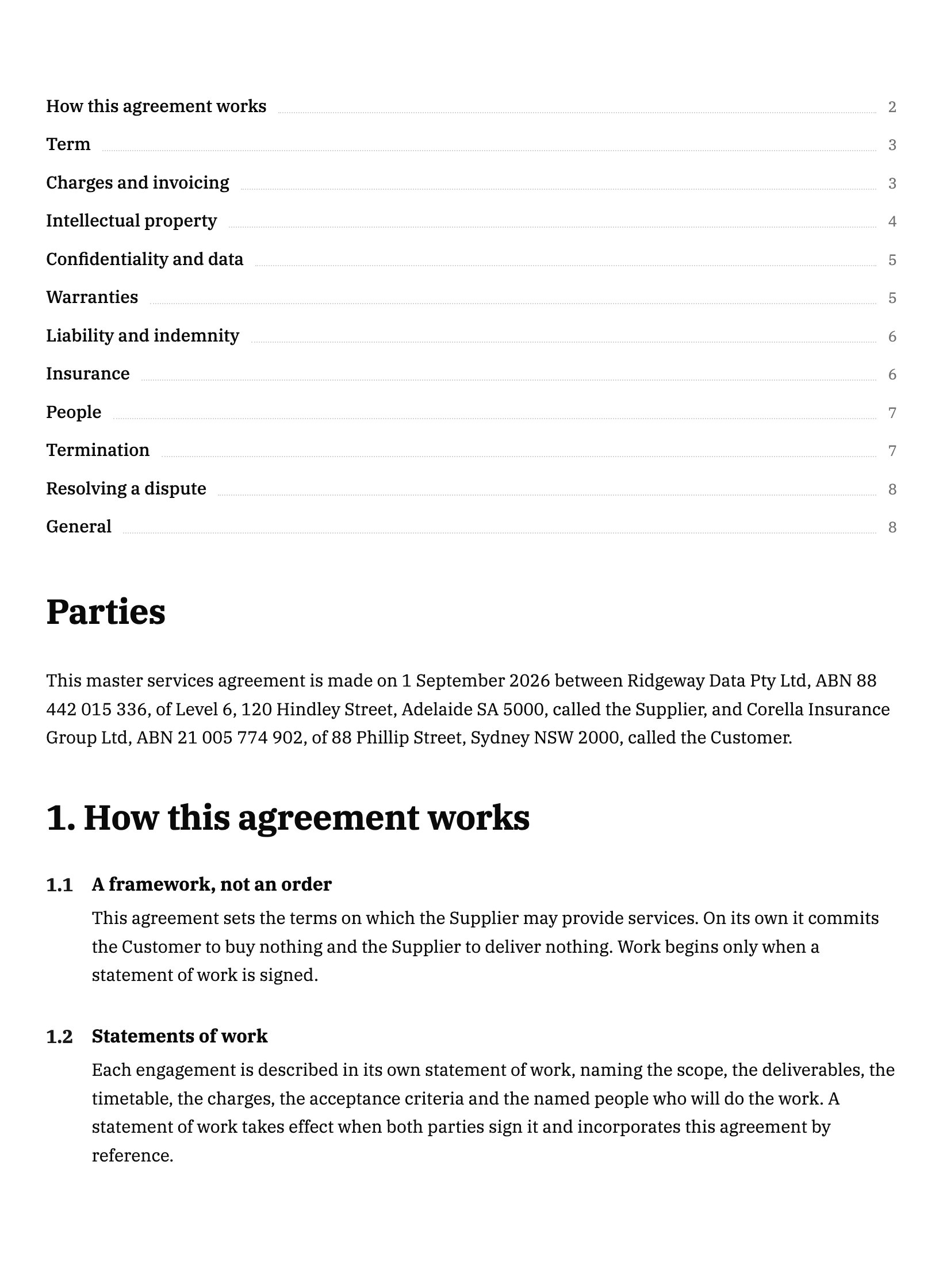 Master services agreementA data consultancy and an insurer sign this once and then buy work under it for three years. It is the rare contract whose whole purpose is to make the next twenty contracts short.
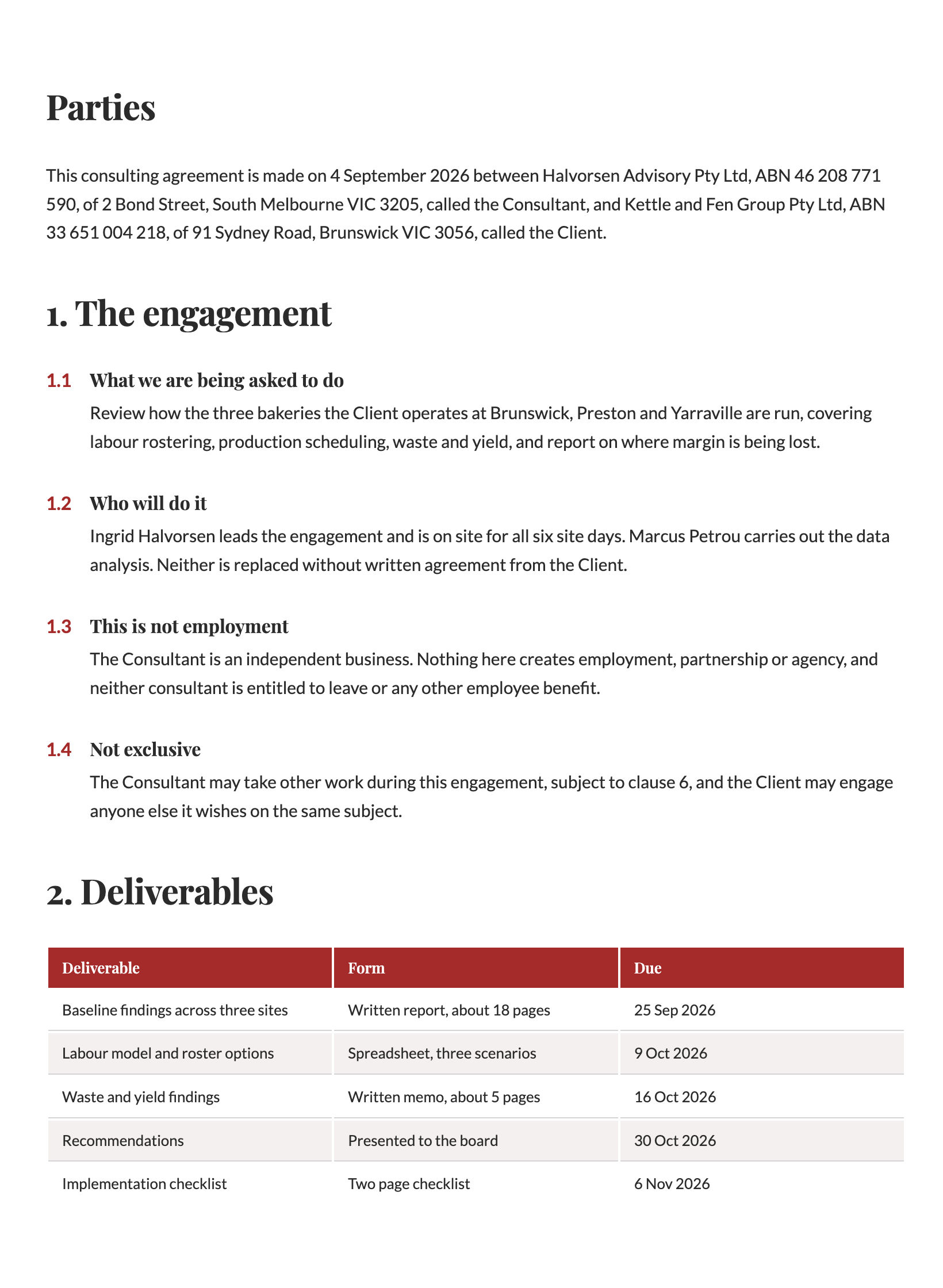 Consulting agreementAn advisory firm reviews three bakeries over seven weeks. What makes this agreement useful is not the fee clause but the two clauses that say what the advice is not.
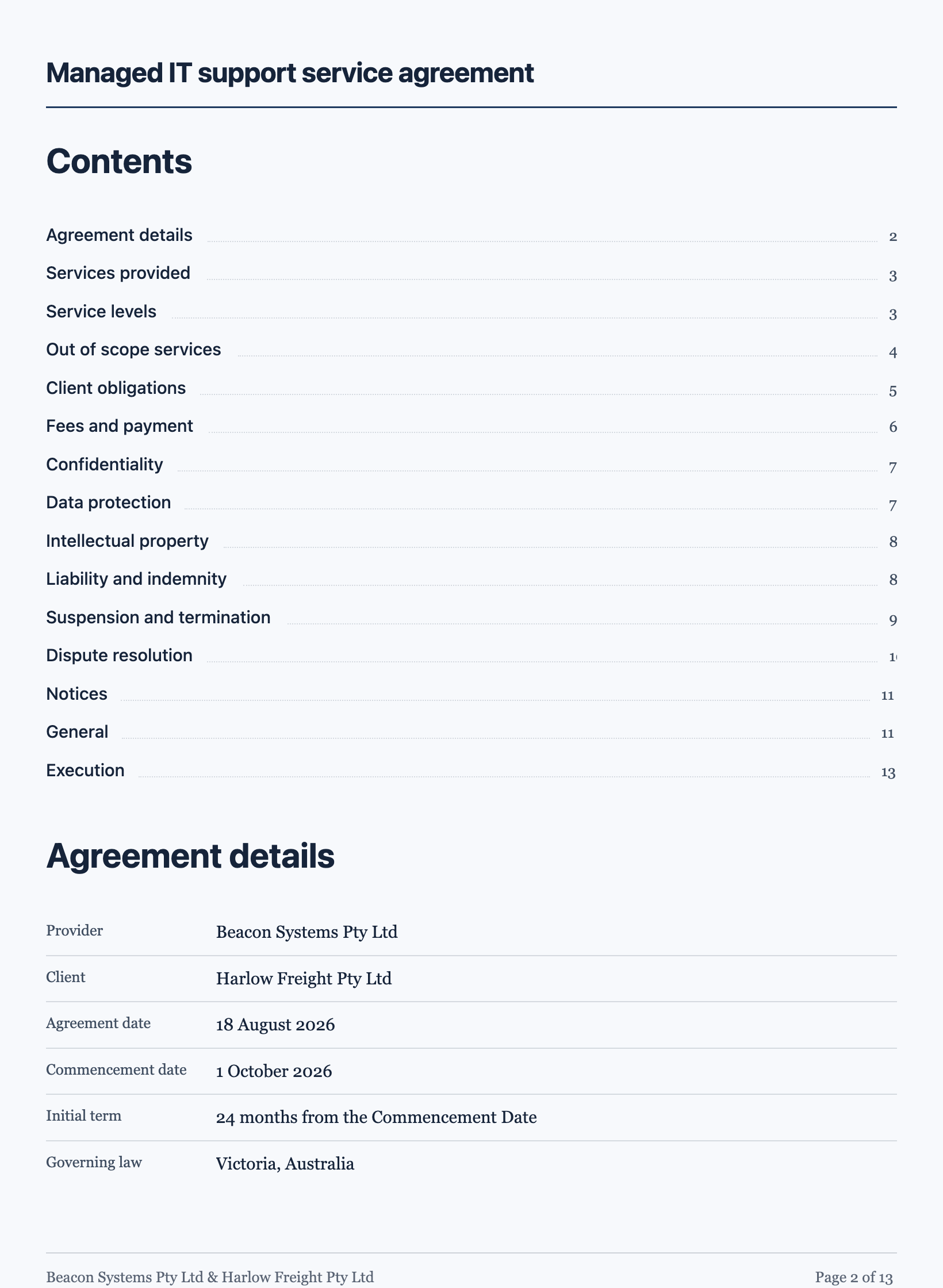 Service agreementBeacon Systems supports Harlow Freight’s IT for an initial 24 months from 1 October 2026 at $8,400 a month plus GST, with 40 hours included and $220 an hour beyond them. Twelve numbered clauses cover the services, a four level severity table, client duties, fees with a CPI adjustment, confidentiality, privacy, IP, a liability cap, termination and a three step dispute ladder.
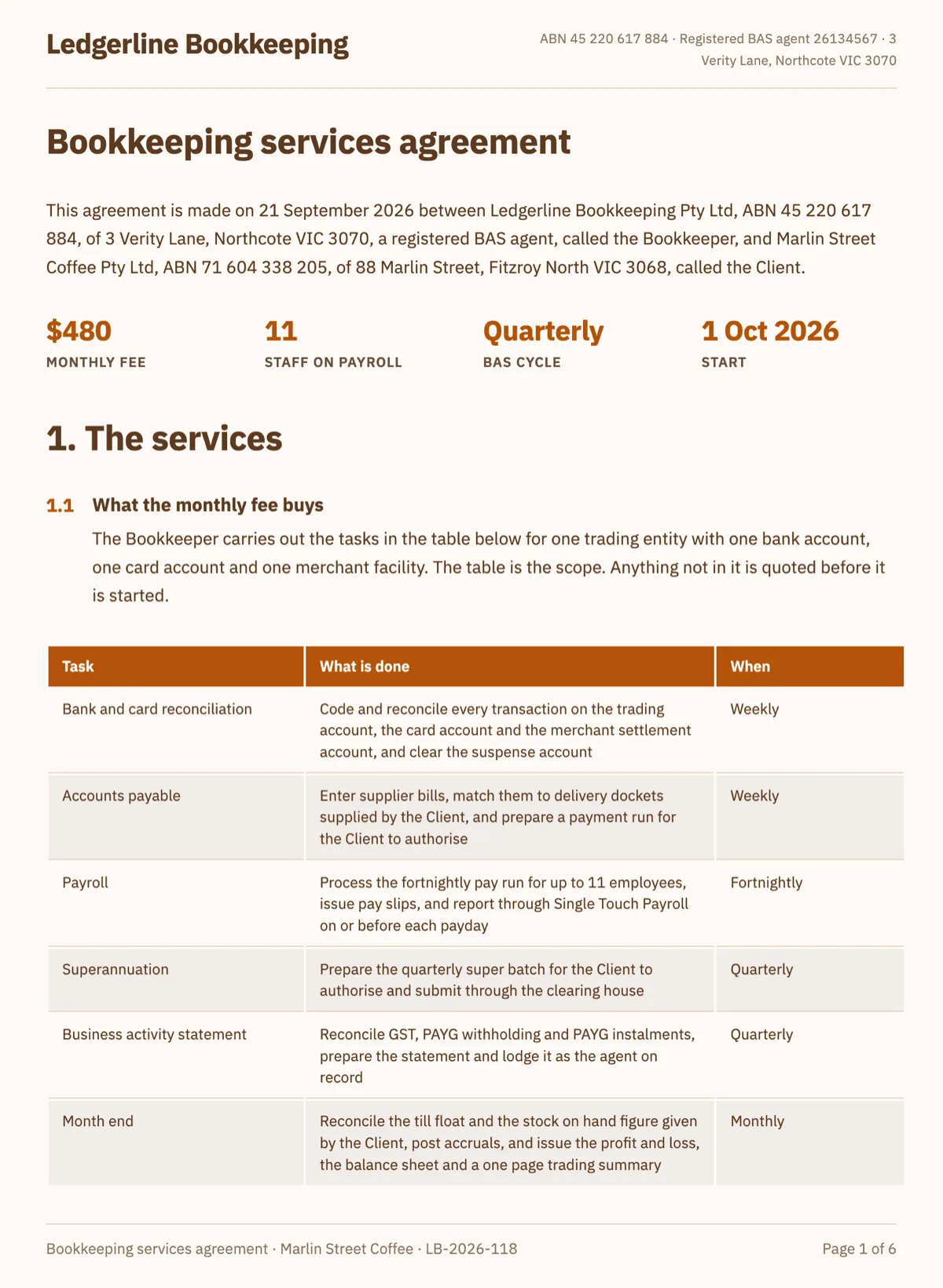 Bookkeeping services agreement with a monthly scope tableBookkeeping goes wrong when nobody wrote down which tasks are monthly, which are weekly, and who has to hand over what before a statement can be lodged. This agreement settles all three in a scope table and a lodgement calendar, then prices the whole year so the cafe can see what it is committing to.
Questions people ask
Is a limitation of liability clause enforceable in Australia?
Generally yes between commercial parties where the wording is clear. The limits are that liability for death or personal injury caused by negligence and liability under the consumer guarantees cannot simply be excluded, and that in a standard form small business contract a one sided cap can be examined as an unfair term. Clear, mutual and layered drafting holds up best.
What is a normal liability cap?
Twelve months of fees is the most common formula in services and software contracts, sometimes expressed as the greater of an annual fee figure and a stated dollar amount. Where the work carries a risk out of proportion to its price, such as a small design fee on a large build, the cap is often set against insurance instead.
Should the cap be per claim or aggregate?
Suppliers insist on aggregate for the whole term, since a per claim cap has no real ceiling. Customers who need more usually negotiate a higher aggregate figure or a cap that resets each contract year. Whichever is chosen, say it explicitly, because a cap that does not state which it is will be argued both ways.
Can a liability clause exclude liability under the Australian Consumer Law?
No, and a clause that appears to do so is a problem rather than a protection. For supplies not ordinarily acquired for personal use, liability for breach of certain guarantees can be limited to remedies such as resupply or paying the cost of resupply. That narrower wording is lawful. A blanket exclusion is not.
Do the carve outs need a separate cap?
Often, yes. Leaving an infringement indemnity entirely uncapped is a large open exposure for a supplier, and refusing any carve out is unacceptable to the customer. A separate higher sub limit for the carved out categories, such as three times the general cap, is a common and workable middle position.
Why does the clause preserve liability it cannot exclude?
Because a clause that overreaches invites a court to read the whole thing down, and because it makes the rest of the drafting honest. Putting the preserved liabilities first also creates a clean structure, so if one later layer is unenforceable the others still stand on their own numbering.
Put the clause in a finished document
The button opens the document generator with a starting description already filled in. Change it to match your own agreement before you run it.
Create a document with OneCraftRelated clauses
- Liability cap clause: how the number is setA liability cap clause fixes the number inside a limitation clause. Sample wording, the common cap formulas compared, per claim and tiered variants.
- Consequential loss clause: excluding indirect and flow on lossA consequential loss clause removes indirect losses such as lost profit from a claim. Australian sample wording, three variants and the naming problem.
- Indemnity clause: promising to cover someone else's lossAn indemnity clause is a promise to cover the other party's loss from a named event. Australian sample wording, three variants and what each side negotiates.
For everything the document generator can do, see the document maker.
Step by step in the builder: Create a document with AI, then Every document component and when to use it.
Written and checked by the OneCraft team. Last checked .