Contract clause
Consequential loss clause: excluding indirect and flow on loss
A consequential loss clause removes whole categories of loss from what one party can claim, typically lost profit, lost production, lost savings and damage to reputation. It does not cap an amount, it deletes a type of claim, which is why the list of named categories matters far more than the label on the clause.
The word consequential has no settled meaning in Australian contract law, and that is the whole problem with the clause. Two parties can sign it believing different things were excluded.
Nuwan Madhusanka · Co-founder
4 min read · Published
Sample clause
a six month dry hire of screening equipment between Palladine Plant Hire and a quarry operator running two shifts a day
14. Excluded loss 14.1 Neither party is liable to the other for any Excluded Loss, however it arises, whether in contract, in tort including negligence, under statute or otherwise. 14.2 Excluded Loss means loss of profit, loss of revenue, loss of production, loss of use, loss of a contract or opportunity, loss of anticipated savings, loss of goodwill or reputation, and any loss described as indirect or consequential. 14.3 Clause 14.1 does not apply to the Hirer's obligation to pay the Hire Charges, to an amount payable under clause 13, or to a liability that cannot lawfully be excluded. 14.4 The parties agree that loss of production by the Hirer arising from a breakdown of the Equipment is Excluded Loss, whether or not it would otherwise be treated as a direct loss. 14.5 If any part of clause 14.2 is unenforceable, the remaining parts continue to apply.
Sample wording, not legal advice.
Variants
Named heads of loss with no label
Both parties want certainty and are willing to negotiate category by category.
Neither party is liable for loss of profit, loss of revenue, loss of production, loss of anticipated savings, loss of goodwill, loss of business opportunity or the cost of obtaining replacement goods or services from a third party. The parties agree that this clause operates by reference to the categories listed and that no general description such as indirect loss or consequential loss is to be used to widen or narrow it.
Exclusion with named exceptions
One category of flow on loss is the very thing the customer is buying protection against.
The Supplier is not liable for loss of profit, loss of revenue, loss of anticipated savings or loss of goodwill, except that the Supplier remains liable for the Customer's reasonable cost of procuring replacement services from a third party for up to three (3) months following a termination for the Supplier's material breach, and for regulatory fines imposed on the Customer as a direct result of the Supplier's failure to meet the Security Requirements in Schedule 4.
Mutual, with the payment obligation preserved
The parties want the exclusion balanced and are alert to the risk that it swallows the price.
Neither party is liable to the other for any indirect or consequential loss, or for loss of profit, revenue, production, savings or goodwill, whether arising in contract, tort or under statute. This clause does not affect either party's obligation to pay an amount that has fallen due under this Agreement, any amount payable under an indemnity in clause 13, or any liability for death, personal injury or fraud, each of which is recoverable in full.
What to negotiate
Naming the categories
Australian courts have declined to treat consequential loss as a term of art with a fixed meaning, so an exclusion that relies on the label alone invites an argument about what it caught. Listing the heads of loss is the fix. Both sides benefit, because certainty is worth more than a broad word either could later regret.
Whether lost production is direct
For a hirer of plant, lost production is the main loss and it is often a direct consequence of a breakdown. Suppliers therefore name it expressly rather than relying on the word indirect. Customers who cannot resist the exclusion usually negotiate a service credit or a rebate of hire charges instead, which gives a bounded remedy.
What the exclusion must not touch
An exclusion drafted too widely can swallow the price itself, since unpaid fees are a loss of revenue. Carving out the payment obligation, the indemnities and any liability that cannot lawfully be excluded is standard, and its absence is one of the clearest signs a clause was copied rather than drafted.
The risk of leaving it out
Without an exclusion, recoverable loss is whatever the general law allows, which includes loss the parties should have contemplated when contracting. For a supplier whose equipment or software sits inside a customer's production line, that can be many multiples of the contract price. Suppliers who rely on a cap alone are exposed to a claim that fits inside the cap and still exceeds their margin.
The naming problem in Australian law
Older cases treated consequential loss as matching the second limb of the remoteness rule, meaning loss that was not the natural result of the breach. Later Australian decisions took a wider and less predictable view, holding that the phrase should be read in its ordinary commercial sense in the contract where it appears. The practical consequence is that nobody can tell you what your clause excludes without reading the rest of your contract. Drafters responded by abandoning the label and listing the heads of loss, then adding a statement that the listed categories govern regardless of whether a loss would otherwise be called direct.
Common mistakes
The clause excludes indirect loss and nothing more, leaving the argument wide open. It excludes loss of revenue without carving out the fees, so in theory unpaid invoices are unrecoverable. It sits inside the same sentence as the cap, so an unenforceable exclusion takes the cap down with it. And it is one sided in a standard form contract with a small business, which is exactly the drafting the unfair terms regime examines.
Where it sits in a generated document
Excluded loss sits between the warranties and the cap, because it narrows what can be claimed before any figure is applied. A generated hire agreement puts the definition of excluded loss in its own numbered sub clause rather than in a definitions schedule, so a reader arguing about a breakdown finds the list in the same place as the exclusion. Nothing in the generated document cites a case for it.
Documents that carry this clause
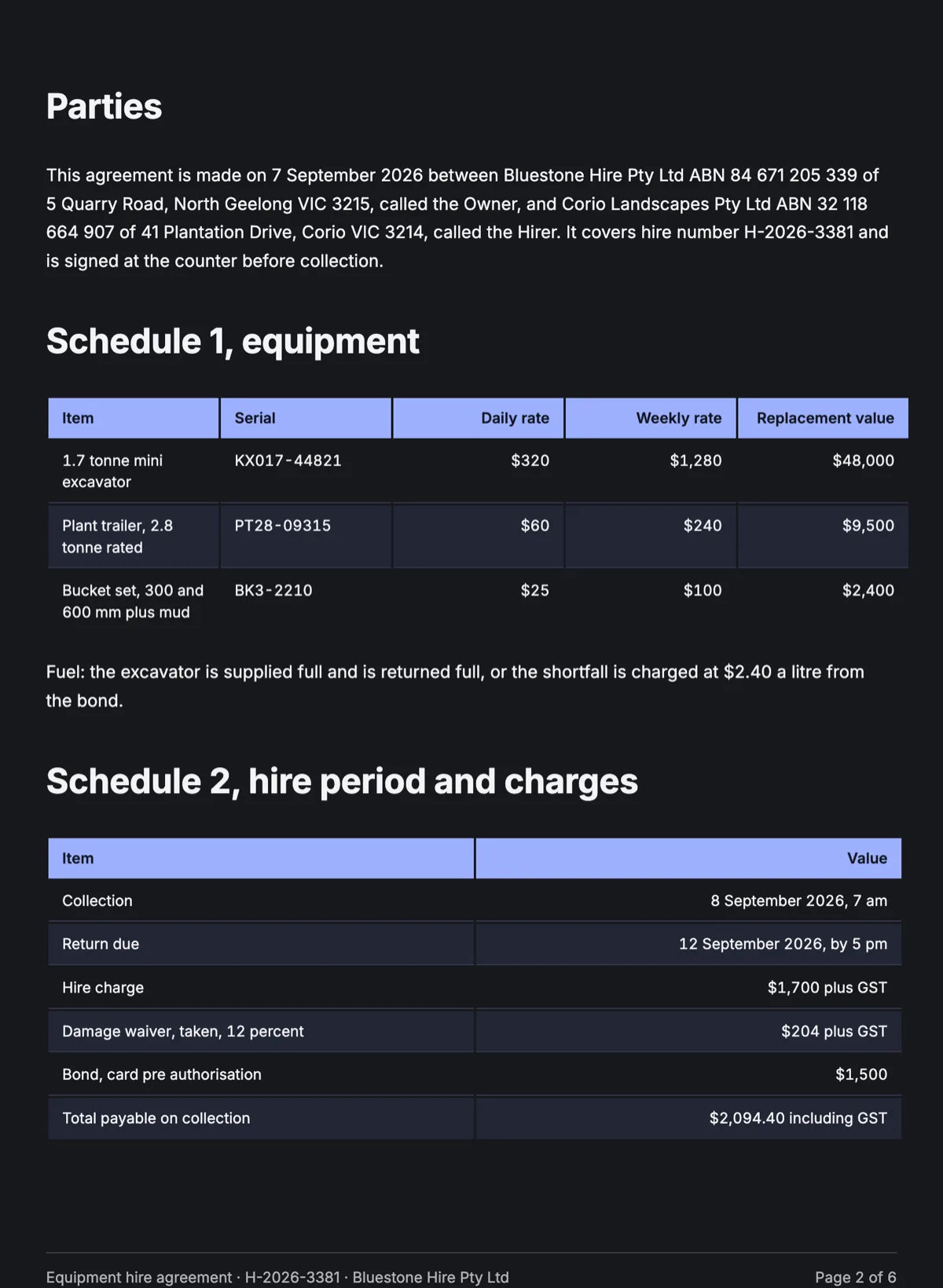 Equipment hire agreement template with the rates in a scheduleA hire agreement is a price list, an insurance decision and a return date, and the argument is always about the day it came back. This one puts the equipment and rates in a schedule, makes the damage waiver a choice with its price, and defines late return in hours so there is nothing to interpret.
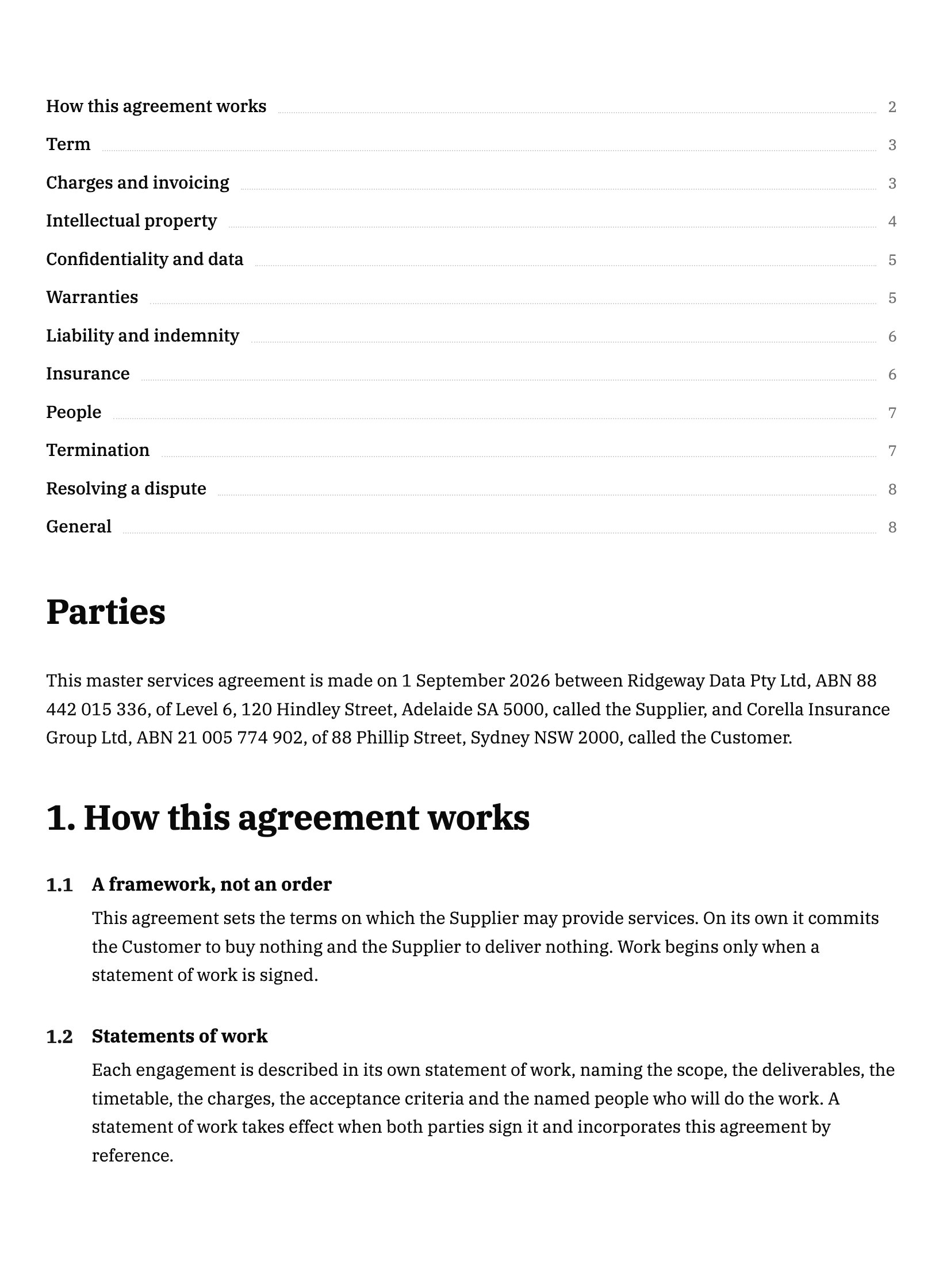 Master services agreementA data consultancy and an insurer sign this once and then buy work under it for three years. It is the rare contract whose whole purpose is to make the next twenty contracts short.
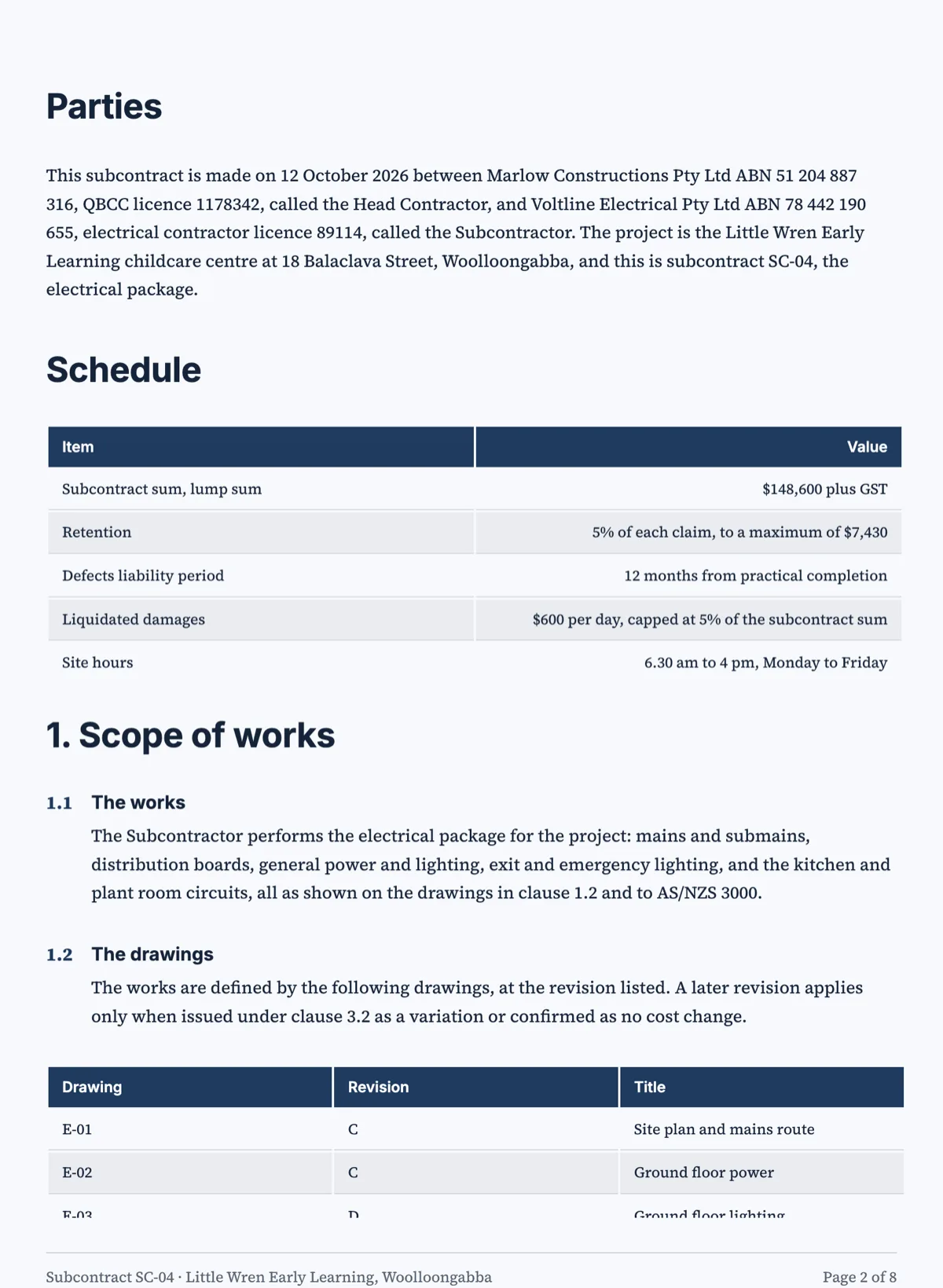 Subcontractor agreement template that flows the head contract downA subcontract exists to pass the head contract's obligations down one level and move the money back up on time. This one names the scope by drawing, sets the progress claim dates against the security of payment rules, holds retention and states the insurances, so the trade knows exactly when it is paid and for what.
Questions people ask
What does consequential loss mean in an Australian contract?
There is no fixed definition. Australian courts have moved away from tying the phrase to a technical remoteness test and read it in the commercial context of the particular contract, which means the same words can produce different outcomes. That uncertainty is the reason modern drafting lists named categories of loss instead of relying on the phrase.
Is loss of profit always consequential?
No. Where profit is the obvious and immediate result of the breach, such as a hirer who cannot run a production line because the hired plant failed, it can be a direct loss. That is why suppliers name loss of profit and loss of production expressly rather than assuming the word indirect covers them.
Should the clause be mutual?
Usually, because the supplier rarely suffers flow on loss anyway, so symmetry costs it little and makes the clause easier to defend as balanced. The one thing to preserve on both sides is the obligation to pay amounts that have fallen due, since an unqualified exclusion of lost revenue can be read against the price itself.
Can consequential loss be excluded under United States law?
For a sale of goods, the Uniform Commercial Code permits consequential damages to be limited or excluded unless the limitation is unconscionable, and it treats limiting consequential damages for personal injury in consumer goods as prima facie unconscionable. State law varies, so a clause written for one state should be checked before it is used in another.
What should never be inside the exclusion?
The obligation to pay amounts already due, indemnities the parties negotiated separately, and any liability that cannot lawfully be excluded such as death or personal injury caused by negligence. Leaving those inside the exclusion produces a clause that either overreaches or accidentally removes the supplier's own right to be paid.
How does the exclusion interact with the cap?
The exclusion deletes categories of loss and the cap limits what remains, so they operate in sequence and should be numbered separately. Drafting them as one sentence is a common error, because if the exclusion is read down or severed the cap can fall with it, leaving liability neither excluded nor limited.
Put the clause in a finished document
The button opens the document generator with a starting description already filled in. Change it to match your own agreement before you run it.
Create a document with OneCraftRelated clauses
- Limitation of liability clause: putting a ceiling on exposureA limitation of liability clause puts a ceiling on what one party can recover. Australian sample wording, three variants, the carve outs and the UK test.
- Liability cap clause: how the number is setA liability cap clause fixes the number inside a limitation clause. Sample wording, the common cap formulas compared, per claim and tiered variants.
- Disclaimer of warranties clause: what can and cannot be excludedA disclaimer of warranties clause removes implied warranties as far as the law allows. Australian sample wording with the consumer guarantees carve out.
For everything the document generator can do, see the document maker.
Step by step in the builder: Create a document with AI, then Every document component and when to use it.
Written and checked by the OneCraft team. Last checked .