Contract clause
Liability cap clause: how the number is set
A liability cap clause is the number inside a limitation of liability provision. It fixes the maximum recoverable amount and the method for calculating it, says whether that maximum applies once or to each claim, and states the period the calculation looks at when the figure is tied to fees.
Two contracts can both cap liability at twelve months of fees and produce figures ten times apart, because of which twelve months they count. The formula is the clause, not the phrase.
Indunil Asanka · Co-founder
4 min read · Published
Sample clause
a two year data migration project between Aldmoor Systems and a fictional national freight broker, priced at three hundred thousand dollars in year one and eighty thousand in year two
16. Cap on liability 16.1 Subject to clauses 15.1 and 15.2, the total aggregate liability of Aldmoor Systems under or in connection with this Agreement is limited to the greater of two hundred and fifty thousand dollars ($250,000) and the Fees paid and payable in the twelve (12) months immediately before the first event giving rise to the liability. 16.2 The cap in clause 16.1 applies to all claims in aggregate across the whole Term, and not separately to each claim. 16.3 Where a series of related events gives rise to more than one claim, those claims are treated as one claim arising on the date of the first of those events. 16.4 Amounts payable under the indemnity in clause 13.2 are subject to a separate cap of seven hundred and fifty thousand dollars ($750,000) and do not count toward the cap in clause 16.1. 16.5 The cap in clause 16.1 is not reduced by any amount Aldmoor Systems recovers under an insurance policy.
Sample wording, not legal advice.
Variants
Per claim cap
The customer will not accept one ceiling for a multi year relationship with several independent workstreams.
The Supplier's liability for each claim is limited to the Charges paid in the twelve months before the event giving rise to that claim. Claims arising from the same or a series of related events are treated as one claim. The Supplier's liability across all claims in any contract year must not exceed three times that amount. The Customer acknowledges that the Charges were calculated on the basis of the limits in this clause.
Tiered by breach type
Some breaches carry far greater exposure than others and one figure suits neither party.
The Supplier's total aggregate liability is limited to the Fees paid in the preceding twelve months, except that liability arising from a breach of the Security Requirements in Schedule 4 is limited to two million dollars ($2,000,000), and liability arising from a breach of the confidentiality obligations in clause 12 is limited to five hundred thousand dollars ($500,000). Each tier applies in aggregate to its own category and the tiers do not combine to increase the general limit.
Cap that resets each contract year
The relationship is long and the customer will not accept a single ceiling spread across several years.
The Supplier's aggregate liability in respect of events occurring in any Contract Year is limited to the Fees paid in that Contract Year. A separate limit applies to each Contract Year and an unused limit does not carry forward. Where a single event spans two Contract Years, the claim is treated as arising in the year in which the event began. Contract Year means each twelve month period from the Commencement Date.
What to negotiate
Which twelve months
Fees paid in the twelve months before the event, fees paid in the first contract year, and fees payable over the whole term are three very different numbers on the same project. Suppliers prefer the twelve months before the event, because a late year breach on a tapering project produces a small cap. Customers push for the highest annual figure.
A floor as well as a formula
A small engagement can produce a cap so low it is not worth suing over, which is bad for the customer and often bad for the supplier's credibility in procurement. Adding a dollar floor, with the cap set at the greater of the two, gives the clause a minimum.
Alignment with insurance
A cap far above the supplier's insurance limit gives the customer a number nobody can pay. Customers who check the certificate of currency often accept a cap set at the policy limit, on condition the cover is maintained. Suppliers should never let the cap sit below their own deductible.
The risk of leaving it out
A limitation clause with no cap only excludes categories of loss, so direct loss remains recoverable in full. On a project where a data error can stop a customer invoicing, direct loss alone can exceed the contract value many times over. Without a number, the supplier's exposure is bounded only by what the customer can prove.
The common cap formulas compared
Five shapes cover most contracts. Fees paid in the twelve months before the event is the default in services and software, and it falls as a project tapers. Total fees payable over the term produces the largest figure and suits short fixed price work. A stated dollar amount is simplest and ages badly across a long term. The greater of a dollar floor and an annual fee figure is the compromise most negotiations reach. A cap set at the limit of the supplier's insurance suits engagements where the risk is out of proportion to the price, such as a small design fee on a large construction project.
Common mistakes
The formula says fees paid without naming a period, so a five year contract has a five year cap. Aggregate and per claim are never distinguished, so both readings are available. Related events are not aggregated, letting a customer split one failure into twenty claims. A carved out indemnity has no sub limit, so the clause caps the small exposures and leaves the large one open. And the cap is set without anyone reading the insurance schedule.
Where it sits in a generated document
A cap is a sub clause of the liability provision rather than a clause of its own, and it has to be numbered so the carve outs can point at it. A generated statement of work keeps the figure in the clause and repeats it nowhere else, which prevents the schedule and the clause drifting apart. Any tiered sub limits are generated as a table in the same document so the categories line up against their figures.
Documents that carry this clause
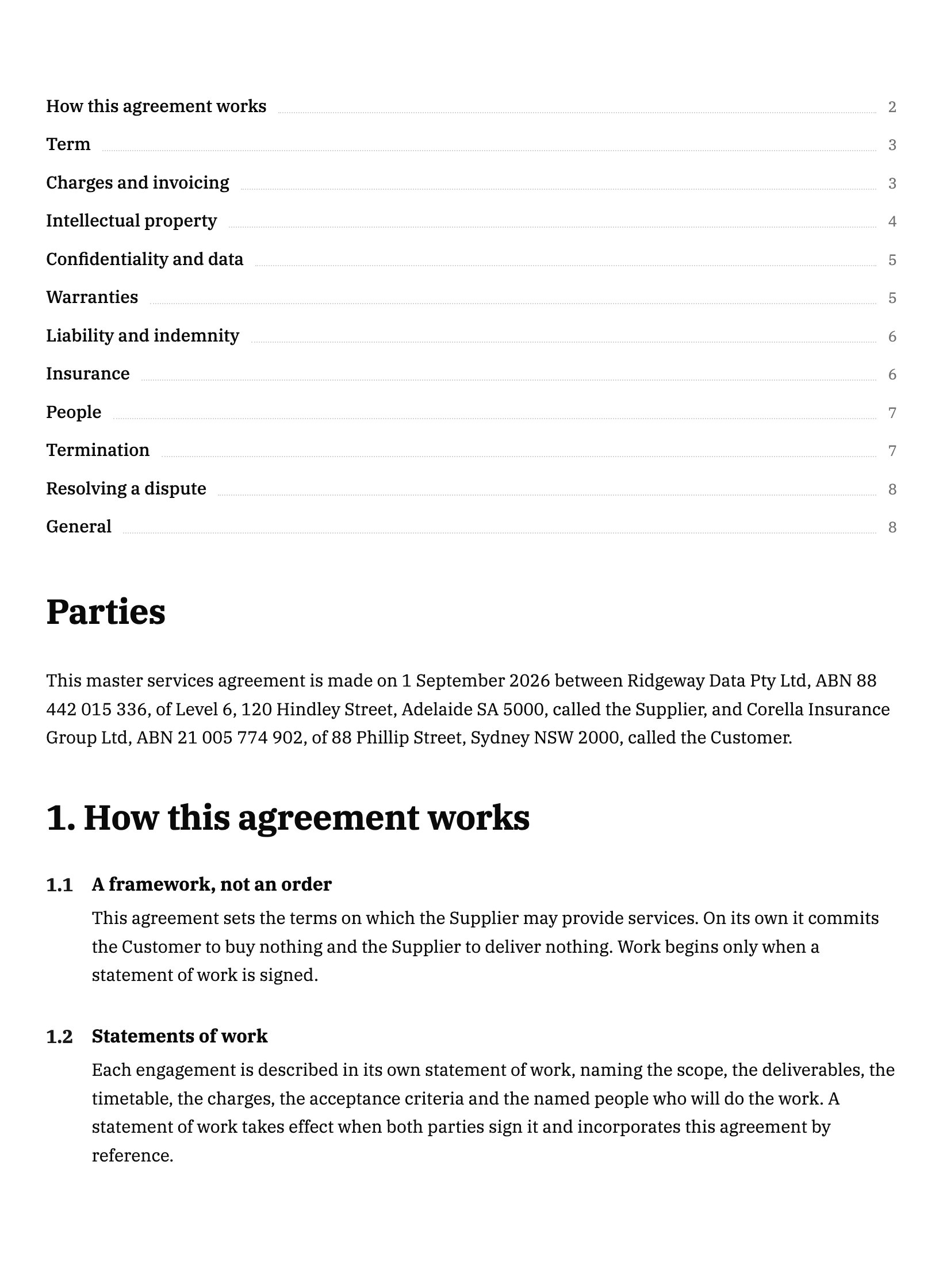 Master services agreementA data consultancy and an insurer sign this once and then buy work under it for three years. It is the rare contract whose whole purpose is to make the next twenty contracts short.
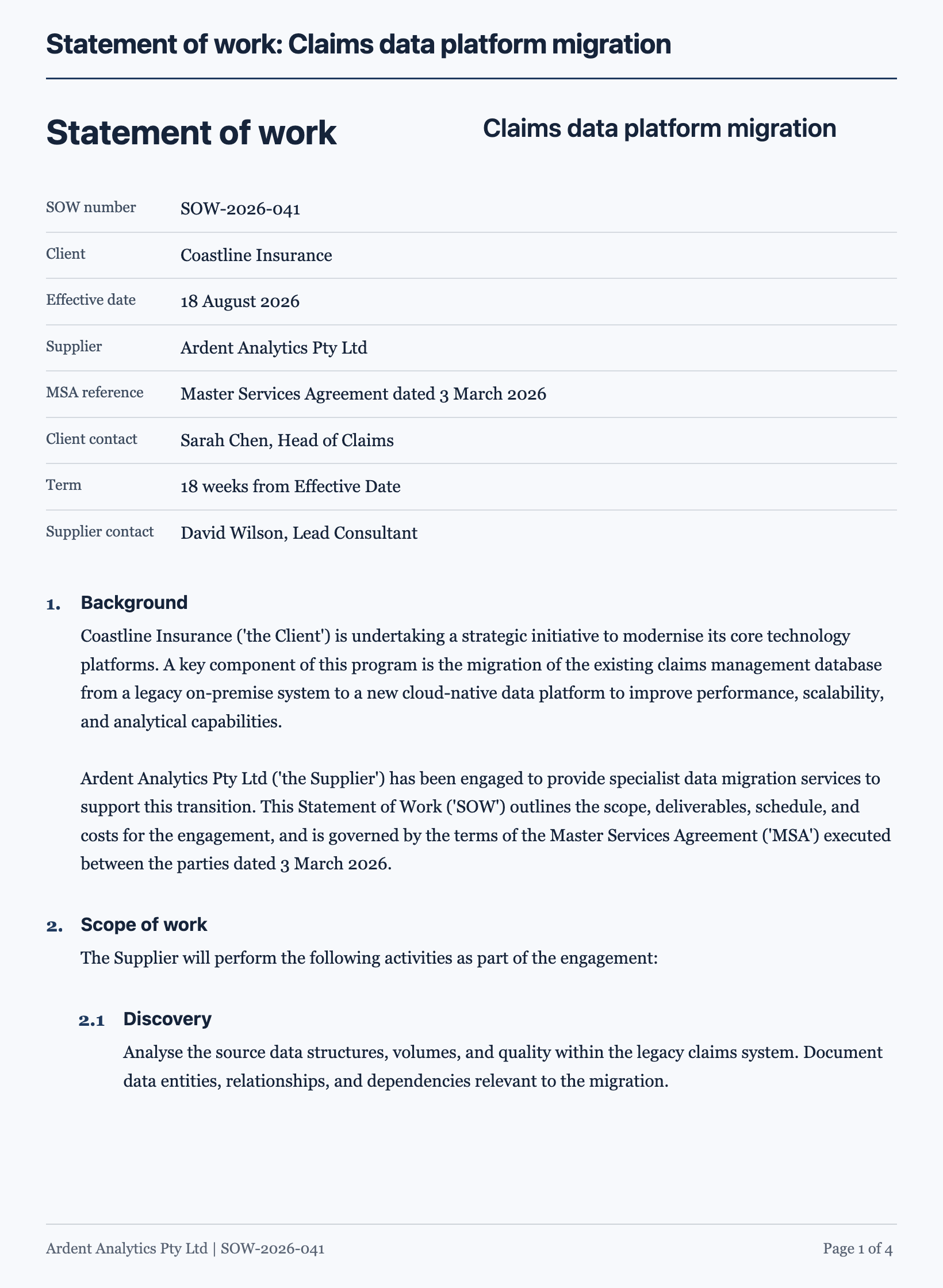 Statement of work template under a master agreementArdent Analytics migrates Coastline Insurance’s claims database to a cloud platform over 18 weeks under SOW-2026-041, governed by a master services agreement dated 3 March 2026. The work is time and materials with four roles priced by the day and a $412,000 estimate before GST, five dated deliverables, ten business days to accept each one, and five assumptions written down before anyone starts.
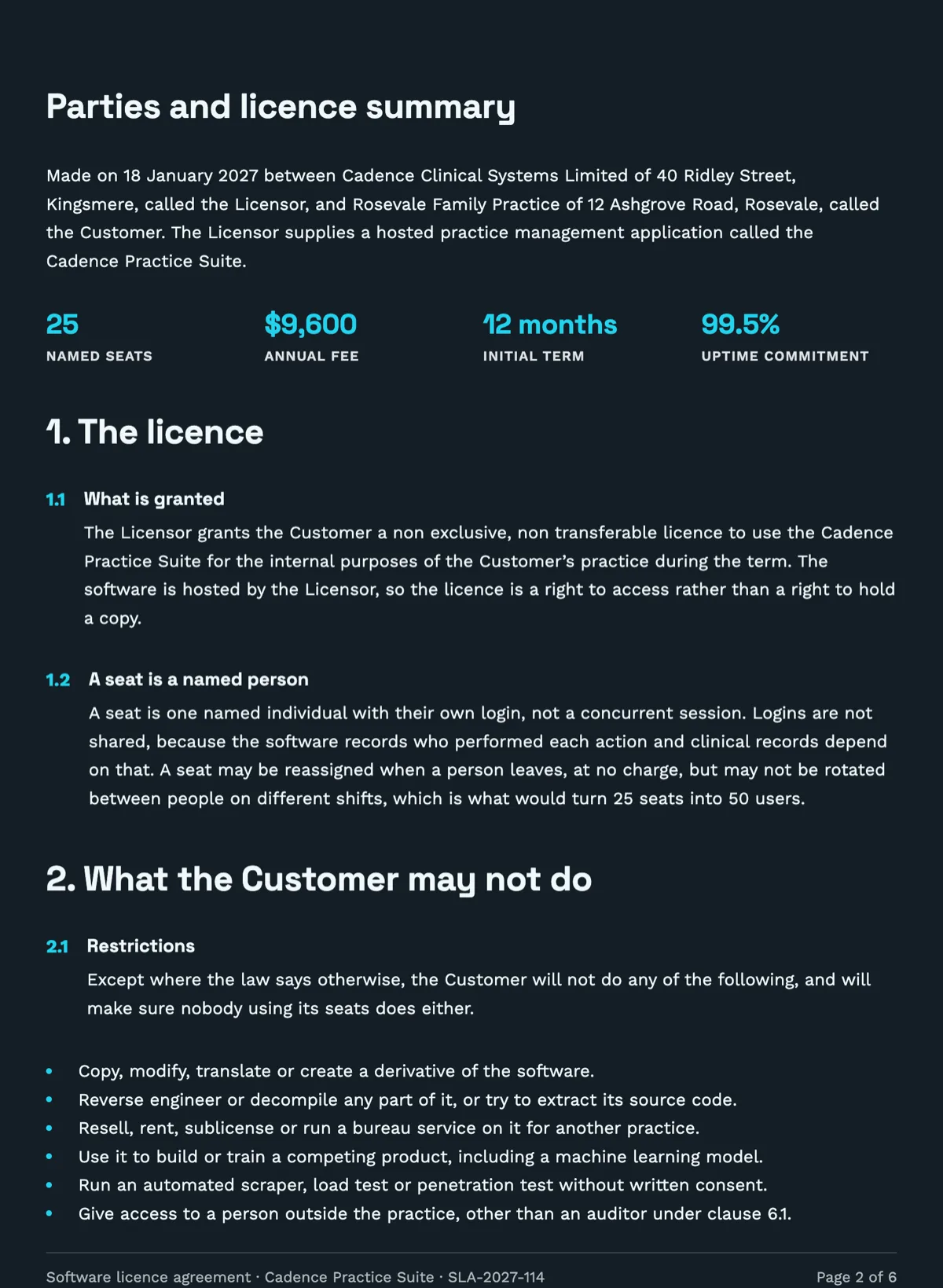 Software licence agreement template with seats, term and supportA software licence agreement has to answer three questions before anything else: what a seat is, what happens when the software is down, and who gets the data at the end. This one licenses a hosted practice management suite to a medical practice for 25 named users at $9,600 a year, with a support table, uptime credits and a 30 day export.
Questions people ask
How is a liability cap usually calculated?
Most commonly as the fees paid in the twelve months before the event giving rise to the claim. Other shapes are total fees payable over the term, a fixed dollar amount, the greater of a dollar floor and an annual fee figure, or the limit of the supplier's insurance. The shape matters more than the headline phrase.
Should a cap have a minimum dollar amount?
On a small engagement, yes. A cap of a few thousand dollars gives the customer no practical remedy, which tends to become an obstacle in procurement rather than a protection for the supplier. Setting the cap at the greater of a stated floor and the fee formula solves it without exposing the supplier on a large contract.
What happens when several claims arise from one failure?
Without an aggregation rule, a customer can characterise one failure as many claims and reach the cap several times. A clause treating claims from the same or a series of related events as one claim, arising on the date of the first event, closes that gap. It is a short sentence and it is often missing.
Should the cap match the supplier's insurance?
Aligning them is sensible where the risk is large relative to the price, and it gives the customer a number that can actually be paid. If the cap is set at the policy limit, the contract should also require the cover to be maintained at that limit during the term and for a stated period afterwards, since the cap is worth nothing once the policy lapses.
Does a cap apply to the customer as well?
Only if it is drafted mutually, and many caps are not. A mutual cap costs the supplier little because the customer's main obligation is to pay, and the fee obligation is normally carved out of the cap anyway. It also removes the most common objection when a small business reviews standard terms.
Can a cap be reduced by insurance recoveries?
Some drafting tries this, providing that any insurance payout counts toward the cap. Customers resist it strongly, since it converts cover the supplier bought into a reduction of the customer's remedy. Stating expressly that the cap is not reduced by an insurance recovery removes the argument before it starts.
Put the clause in a finished document
The button opens the document generator with a starting description already filled in. Change it to match your own agreement before you run it.
Create a document with OneCraftRelated clauses
- Limitation of liability clause: putting a ceiling on exposureA limitation of liability clause puts a ceiling on what one party can recover. Australian sample wording, three variants, the carve outs and the UK test.
- Consequential loss clause: excluding indirect and flow on lossA consequential loss clause removes indirect losses such as lost profit from a claim. Australian sample wording, three variants and the naming problem.
- Insurance clause: which policies, what amounts, what proofAn insurance clause sets the policies a contractor must hold, the amounts and the proof. Australian sample wording, typical cover levels and three variants.
For everything the document generator can do, see the document maker.
Step by step in the builder: Create a document with AI, then Every document component and when to use it.
Written and checked by the OneCraft team. Last checked .