Contract clause
Insurance clause: which policies, what amounts, what proof
An insurance clause requires a party to hold named policies at stated limits for a stated period, and to prove it. It exists so that the indemnities and liabilities elsewhere in the contract are backed by money, rather than by the balance sheet of a business that may not survive the claim.
An indemnity from a business with no cover is a promise, not a remedy. The insurance clause turns the risk section of a contract into something collectible.
Indunil Asanka · Co-founder
4 min read · Published
Sample clause
a grounds maintenance contract between Ironbark Landscapes and the managing agent of a fictional retirement village with public walkways
16. Insurance 16.1 Ironbark Landscapes must hold, for the Term and for three (3) years after it ends, a public and products liability policy with a limit of indemnity of not less than twenty million dollars ($20,000,000) for any one occurrence. 16.2 Ironbark Landscapes must hold workers compensation insurance as required by the law of each State in which its personnel perform the Services, and must hold a motor vehicle policy covering third party property damage for each vehicle it brings onto the Site. 16.3 Each policy must be issued by an insurer authorised to carry on insurance business in Australia. 16.4 Ironbark Landscapes must provide a certificate of currency for each policy before starting the Services, within five (5) business days of a written request, and within five (5) business days of each renewal. 16.5 Ironbark Landscapes must notify the Principal within five (5) business days if a policy is cancelled, lapses, or its limit of indemnity is reduced. 16.6 Holding a policy required by this clause does not limit Ironbark Landscapes' liability under this Agreement.
Sample wording, not legal advice.
Variants
Principal named as an interested party
The principal wants the benefit of the contractor's cover rather than only the contractor's promise.
The Contractor must ensure that the public liability policy notes the Principal as an interested party for its vicarious liability arising from the acts or omissions of the Contractor, and must provide evidence of that notation with each certificate of currency. The Contractor must not make a change to the policy that reduces the Principal's position under it without the Principal's written consent. This obligation does not make the Principal liable for any premium.
Professional indemnity for advisers
The party is giving advice or a design rather than performing physical work, so the exposure is an error rather than an accident.
The Consultant must hold professional indemnity insurance with a limit of indemnity of not less than five million dollars ($5,000,000) for each claim, for the Term and for seven (7) years after the Services are completed. The Consultant must notify the Client if the policy moves to a different insurer or if the retroactive date changes, and must not allow a gap in cover for work performed under this Agreement.
Waiver of subrogation
Parties working alongside each other do not want their insurers suing one another over the same incident.
Each party must ensure that its property and liability policies contain a waiver of the insurer's rights of subrogation against the other party and that other party's personnel, to the extent of the risks each party has assumed under this Agreement. Each party must provide evidence of that waiver on request. Neither party may claim against the other for a loss covered by a policy that contains such a waiver.
What to negotiate
The limit of indemnity
Principals name a figure that reflects the worst plausible incident on their site, not the contract value. Contractors resist limits above what their broker can place at a sensible premium. Twenty million dollars on a site with public access, and ten million on a low risk site, is where most land.
The tail after completion
A claim can surface years after the work. Principals ask for cover to be maintained for three to seven years after completion, longer for design work. Contractors point out that claims made policies respond to the year of the claim, which is why the tail obligation matters more than the limit.
Proof and ongoing notification
A certificate before the work starts proves very little twelve months later. The usual answer requires a certificate on request and on each renewal, plus prompt notice if a policy lapses or its limit is reduced. Principals who ask only once often rely on cover that expired.
The risk of leaving it out
Without an insurance clause the principal has indemnities and warranties that depend entirely on the other party's ability to pay. A public liability claim after an injury on site can exceed a small contractor's whole net worth, in which case the injured person and the principal look to whoever else is standing nearby. The clause is cheap to include and impossible to add after the incident.
Typical cover types and amounts
Five policies cover most contracting. Public and products liability sits at ten to twenty million dollars for any one occurrence, and higher on sites with public access or high value neighbouring property. Workers compensation is compulsory in each state for employers and is set by the relevant state scheme rather than negotiated. Motor vehicle third party property cover applies to any vehicle brought on site. Professional indemnity, usually one to ten million dollars per claim, applies where advice or design is supplied. Contract works or plant cover applies where the work in progress or the equipment itself is at risk. The Australian Prudential Regulation Authority publishes which insurers are authorised, which is the check behind the authorised insurer requirement.
Common mistakes
The clause names a policy type that does not respond to the actual risk, such as public liability for a pure advisory engagement. It requires a certificate before commencement and never again. It sets a limit per year rather than per occurrence, which can be exhausted by an earlier unrelated claim. And it states that holding the policy limits liability, which quietly converts an insurance obligation into a cap the principal never intended to grant.
Where it sits in a generated document
Insurance follows the indemnity and the liability cap, because its amounts should be set with those clauses in view. A generated contractor agreement puts each policy in its own numbered sub clause, so a certificate request can name the exact requirement, and the cover amounts are written as document content. Where the parties want a summary, the same builder produces the cover schedule as a table in the same document.
Documents that carry this clause
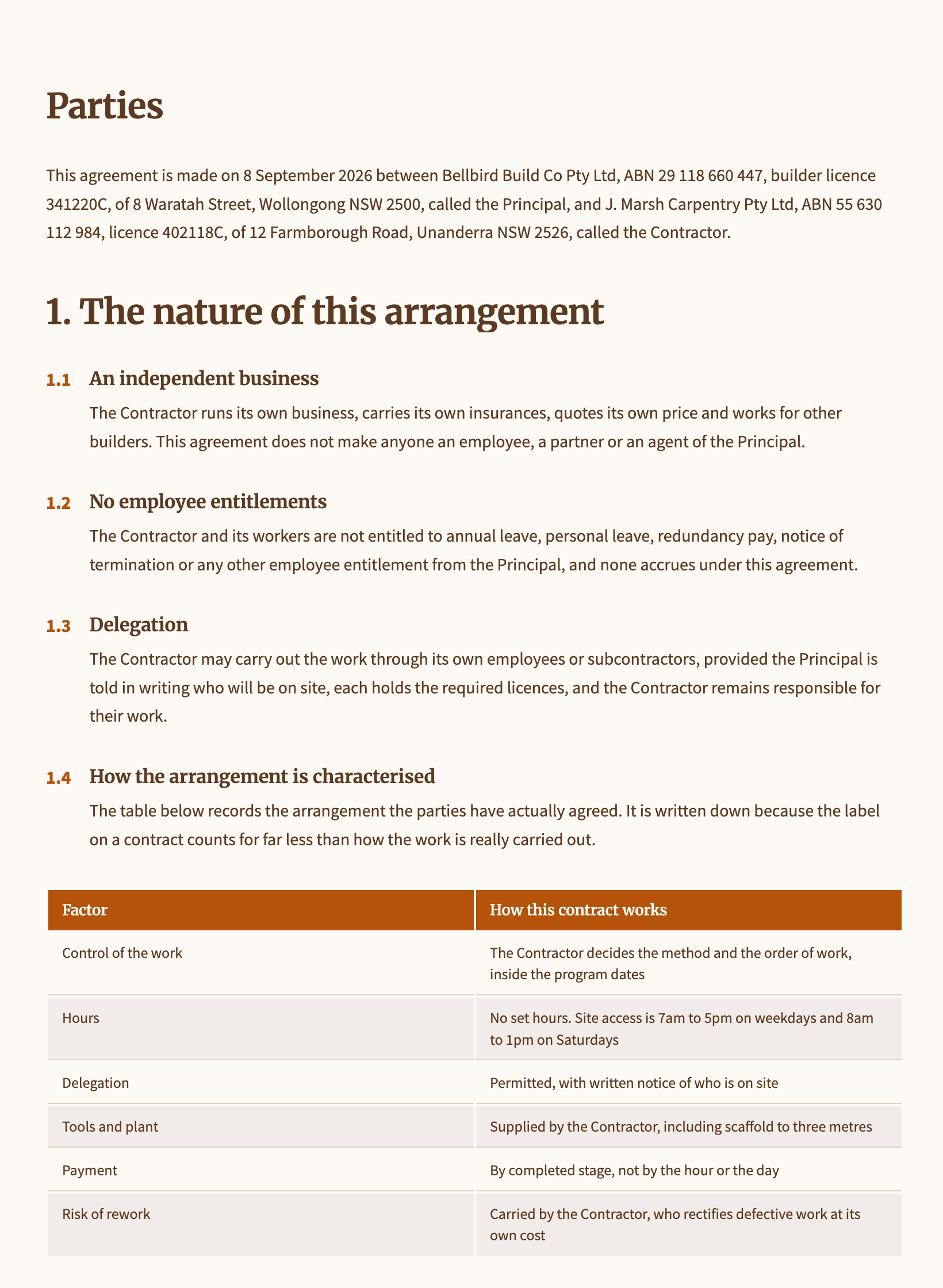 Independent contractor agreementA builder engages a carpentry business for one house. The interesting clause is not the price, it is the table that writes down who controls the work, because that is what decides whether this is a contract at all.
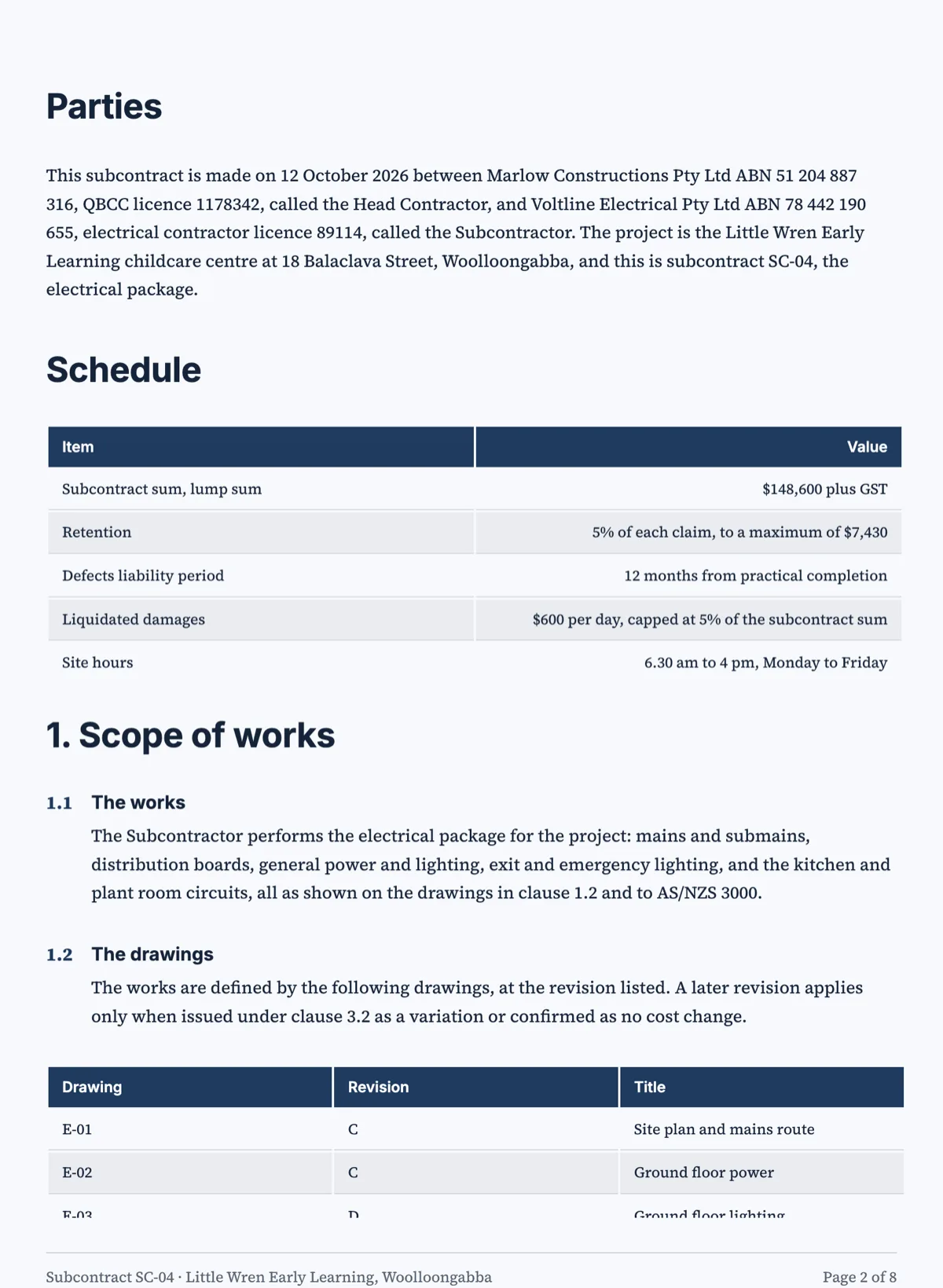 Subcontractor agreement template that flows the head contract downA subcontract exists to pass the head contract's obligations down one level and move the money back up on time. This one names the scope by drawing, sets the progress claim dates against the security of payment rules, holds retention and states the insurances, so the trade knows exactly when it is paid and for what.
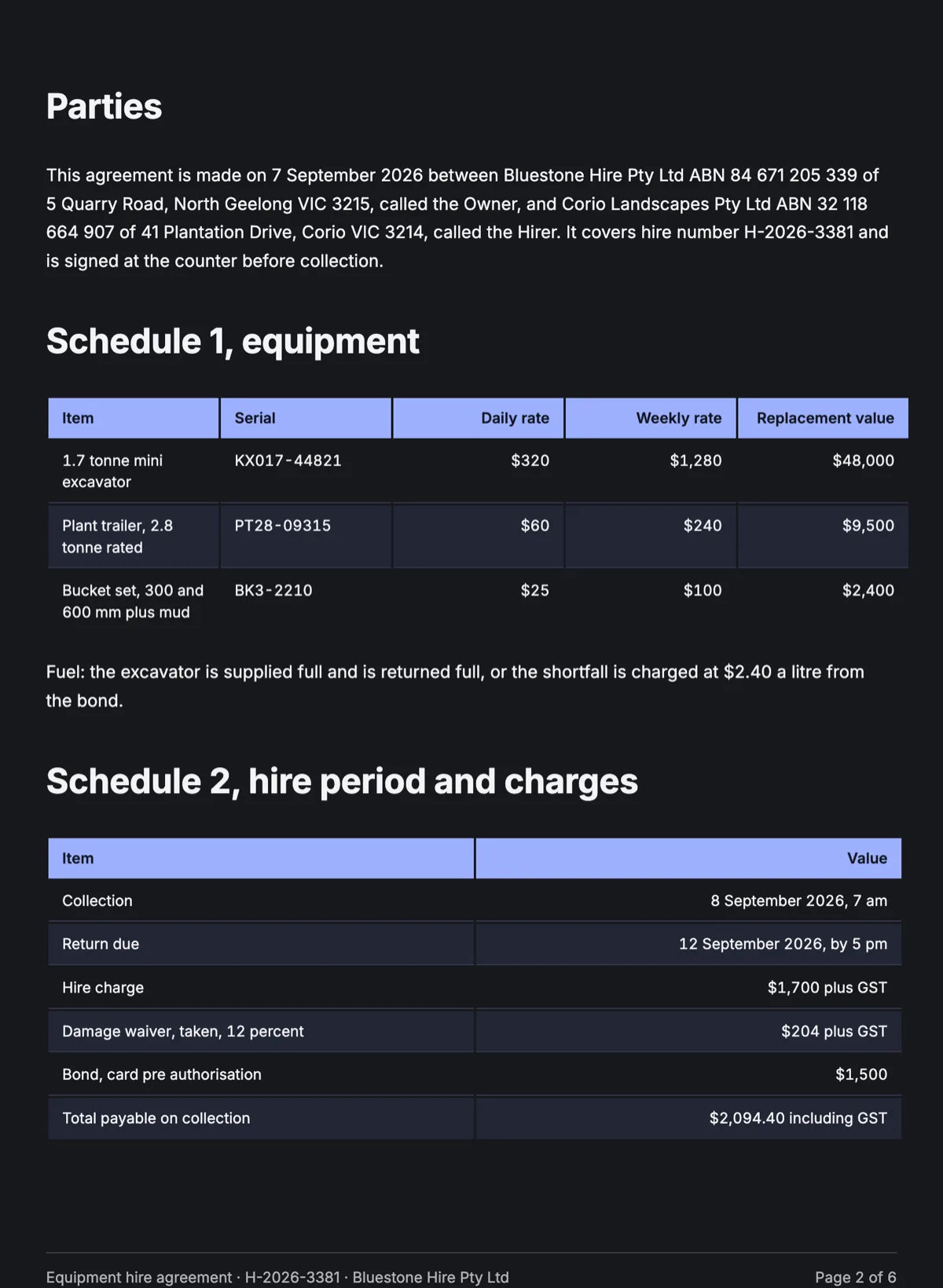 Equipment hire agreement template with the rates in a scheduleA hire agreement is a price list, an insurance decision and a return date, and the argument is always about the day it came back. This one puts the equipment and rates in a schedule, makes the damage waiver a choice with its price, and defines late return in hours so there is nothing to interpret.
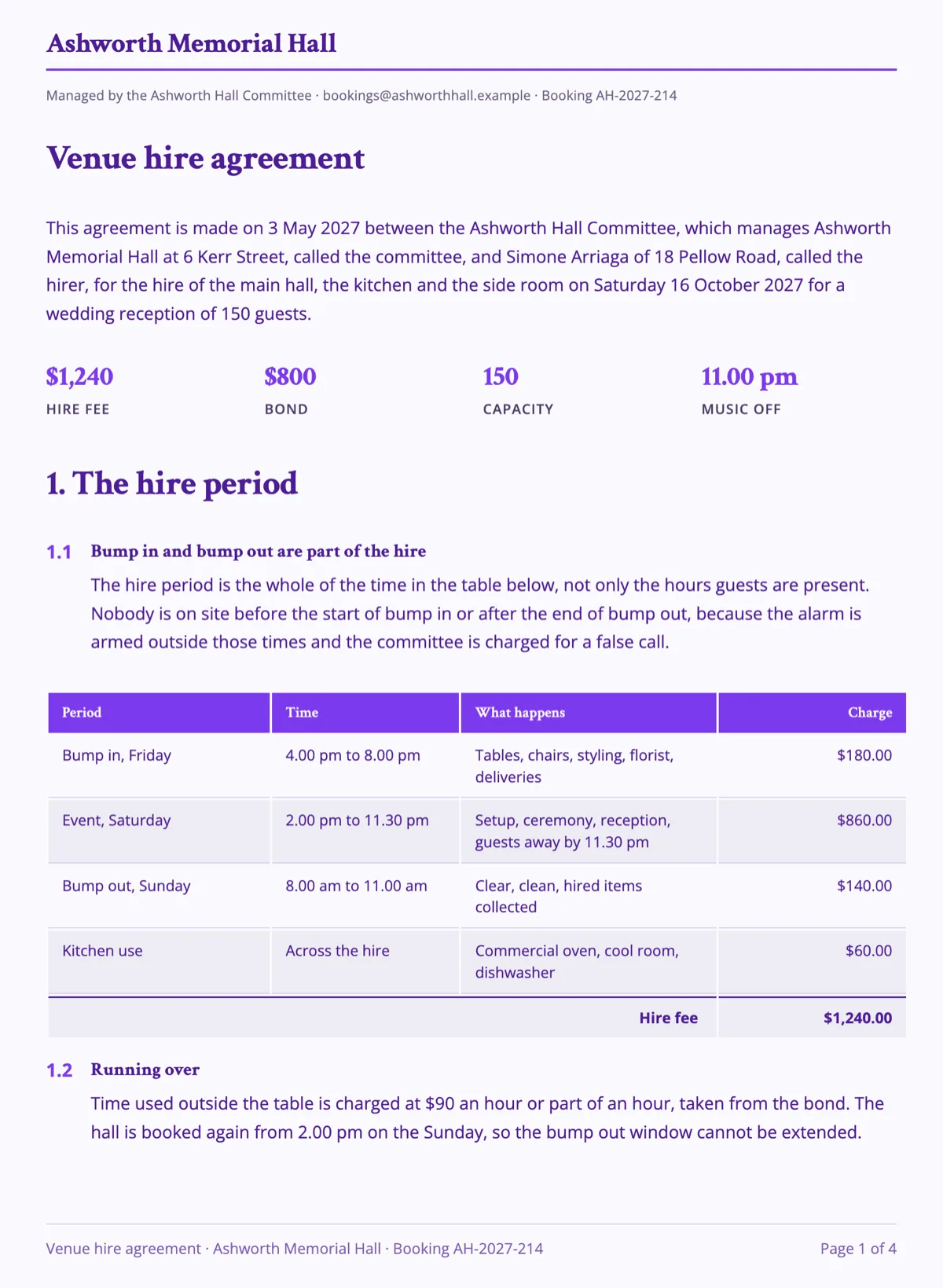 Venue hire agreement template with bump in, noise and a bondHall hire disputes are almost always about time and noise: the hirer thought the hire started when guests arrived, and the committee thought music stopped at eleven. This agreement prices bump in, the event and bump out as three separate periods, and ties the curfew to the planning permit rather than to a preference.
Questions people ask
How much public liability cover should a contract require?
Ten to twenty million dollars for any one occurrence is the common range, with twenty million typical where members of the public are present or neighbouring property is valuable. The figure should reflect the worst plausible incident rather than the contract price, since a small maintenance contract can produce a very large injury claim.
What is a certificate of currency?
A short document from the insurer or broker confirming that a policy exists, who it covers, the limit of indemnity and the period of cover. It is evidence rather than the policy itself, so it will not show every exclusion. Requiring one on each renewal is what stops a contract running for years on cover that expired.
Does the contractor's insurance limit its liability?
Not unless the contract says so, and it should say the opposite. A clause stating that holding the required policy does not limit liability keeps the insurance obligation separate from the liability cap. Without it, a contractor can argue that the agreed cover was the agreed ceiling, which is rarely what the principal intended.
How long should cover continue after the work finishes?
Three years is common for physical work and seven years for design or advice, because a defect or an error can surface long after completion. Liability policies are usually written on a claims made basis, so cover has to exist in the year the claim is made, not the year the work was done. That is why the tail obligation matters.
What is a waiver of subrogation?
A policy term under which the insurer gives up its right to recover from a named other party after paying a claim. Parties working side by side use it so their insurers do not end up suing each other over one incident. The waiver has to be in the policy, so the contract requires evidence of it rather than just promising it.
Is workers compensation negotiable in the clause?
The cover itself is not, since each Australian state requires employers to hold it under its own scheme. What the clause does is confirm the obligation, require evidence, and make clear it applies in every state where personnel work. That last point matters for contractors whose crews cross a border during the job.
Put the clause in a finished document
The button opens the document generator with a starting description already filled in. Change it to match your own agreement before you run it.
Create a document with OneCraftRelated clauses
- Indemnity clause: promising to cover someone else's lossAn indemnity clause is a promise to cover the other party's loss from a named event. Australian sample wording, three variants and what each side negotiates.
- Proportionate liability clause: paying only your shareA proportionate liability clause decides whether a wrongdoer pays only its share. Australian sample wording, the state by state position on contracting out.
- Liability cap clause: how the number is setA liability cap clause fixes the number inside a limitation clause. Sample wording, the common cap formulas compared, per claim and tiered variants.
- Mutual indemnity clause: both sides cover the same risksA mutual indemnity clause has each party cover the other for the same heads of loss. Sample wording for a co marketing deal, three variants and when it fits.
For everything the document generator can do, see the document maker.
Step by step in the builder: Create a document with AI, then Send a document for signature.
Written and checked by the OneCraft team. Last checked .