Contract clause
Mutual indemnity clause: both sides cover the same risks
A mutual indemnity clause gives each party the same promise against the other, covering the same described events. It suits relationships where both sides bring people, property or content into a shared activity, and where neither is buying protection from the other so much as agreeing who answers for what.
Symmetry is not fairness by itself. Two parties with very different exposures can sign identical wording and end up with a clause that only ever runs one way.
Nuwan Madhusanka · Co-founder
4 min read · Published
Sample clause
a six month co marketing arrangement between Ferro Strength and Lumen Pilates, two independent studios sharing a joint membership offer and each promoting it to its own list
9. Mutual indemnity 9.1 Each party (the Indemnifying Party) indemnifies the other party (the Indemnified Party) against any loss, damage, cost or expense the Indemnified Party incurs arising from a third party claim that content or materials the Indemnifying Party supplied for the Campaign infringe that third party's intellectual property rights. 9.2 Each party indemnifies the other against a third party claim for personal injury or property damage caused by an act or omission of that party or its personnel at a Campaign event. 9.3 An indemnity under this clause is reduced proportionately to the extent the loss was caused by the Indemnified Party. 9.4 The Indemnified Party must notify the Indemnifying Party of a claim within ten (10) business days of becoming aware of it, must not admit liability or settle without written consent, and must give reasonable assistance with the defence. 9.5 Each party's total liability under this clause is limited to two hundred thousand dollars ($200,000) in aggregate over the Term.
Sample wording, not legal advice.
Variants
Symmetrical with a single shared cap
Both parties bring similar exposure and want the clause to be genuinely even on its face and in effect.
Each party indemnifies the other against third party claims arising from that party's own content, personnel or premises. Each party's aggregate liability under this clause is limited to the same amount, being the Indemnity Cap in the Details Schedule. Neither party may recover under this clause for loss of profit, loss of revenue or loss of goodwill. This clause survives termination for the period stated in clause 14 and is the sole remedy for a claim of the kind it covers.
Symmetrical with different caps
The parties are very different in size and one of them cannot carry the same number as the other.
Each party gives the indemnity in clause 9.1 on the same terms, except that the aggregate liability of the Smaller Party under this clause is limited to five hundred thousand dollars ($500,000) and the aggregate liability of the Larger Party is limited to two million dollars ($2,000,000). The parties acknowledge that the difference reflects the relative scale of each party's activities and the insurance each maintains, and is not an assessment of fault.
Knock for knock
Personnel and equipment from both parties work side by side, and allocating fault after an incident would be slow and expensive.
Each party is responsible for, and indemnifies the other against, injury to or death of its own personnel and loss of or damage to its own property, regardless of how the injury, loss or damage is caused and regardless of any negligence or breach by the other party. Each party must maintain insurance covering the risks it assumes under this clause and must ensure its insurers waive rights of subrogation against the other party.
What to negotiate
Whether symmetry is real
Identical wording produces an unequal clause when only one party supplies content, or only one party hosts events. The useful test is to read each limb and ask which party will actually trigger it. Where the answer is always the same party, the fix is different heads for each side rather than the same sentence twice.
Matching caps to capacity
A small business promising the same figure as a large one is promising something it cannot pay, which helps nobody. Different caps for each side, explained in the clause as reflecting scale and insurance rather than fault, are more honest and are usually accepted once the reason is written down.
Knock for knock and its limits
Knock for knock is efficient because it removes the fault inquiry entirely, and it only works where both parties carry insurance for what they have assumed. Without matching cover and a waiver of subrogation, the clause simply moves an uninsured loss to whichever party had the accident.
The risk of leaving it out
Without a mutual indemnity in a shared activity, a third party claim lands wherever the claimant chooses to point, and the two parties then argue about contribution while the claim runs. In a joint campaign or a shared event that argument usually costs more than the claim itself, and it damages the relationship the arrangement was built to create.
When mutual wording is the right shape
Mutual indemnities suit arrangements where both parties contribute the same kinds of things: content in a co marketing campaign, staff and equipment at a shared site, data in a joint research project. They suit a supply relationship far less well, because a customer buying a service is not bringing an equivalent exposure and a mutual clause there is usually a negotiating gesture rather than a real allocation. The question to ask is whether each party can name a plausible event under which it would pay. If only one can, the clause is one way wearing a mutual label.
Common mistakes
The same words are used for both parties when only one supplies the content that could infringe. Caps are equal in a relationship that is not. Notice and defence mechanics appear only once, drafted from the perspective of a single indemnified party, so the reciprocal direction has no process. And the interaction with insurance is left out, which matters most in a knock for knock clause where the whole structure assumes cover exists.
Where it sits in a generated document
In a collaboration agreement the mutual indemnity sits after the obligations of each party, so the reader already knows what each side is bringing. A generated memorandum or partnership document numbers the clause and gives each limb its own sub number, which is what lets a later notice quote the right one. Each party in the signature block becomes one signer, with a name, an email and a position in the signing order.
Documents that carry this clause
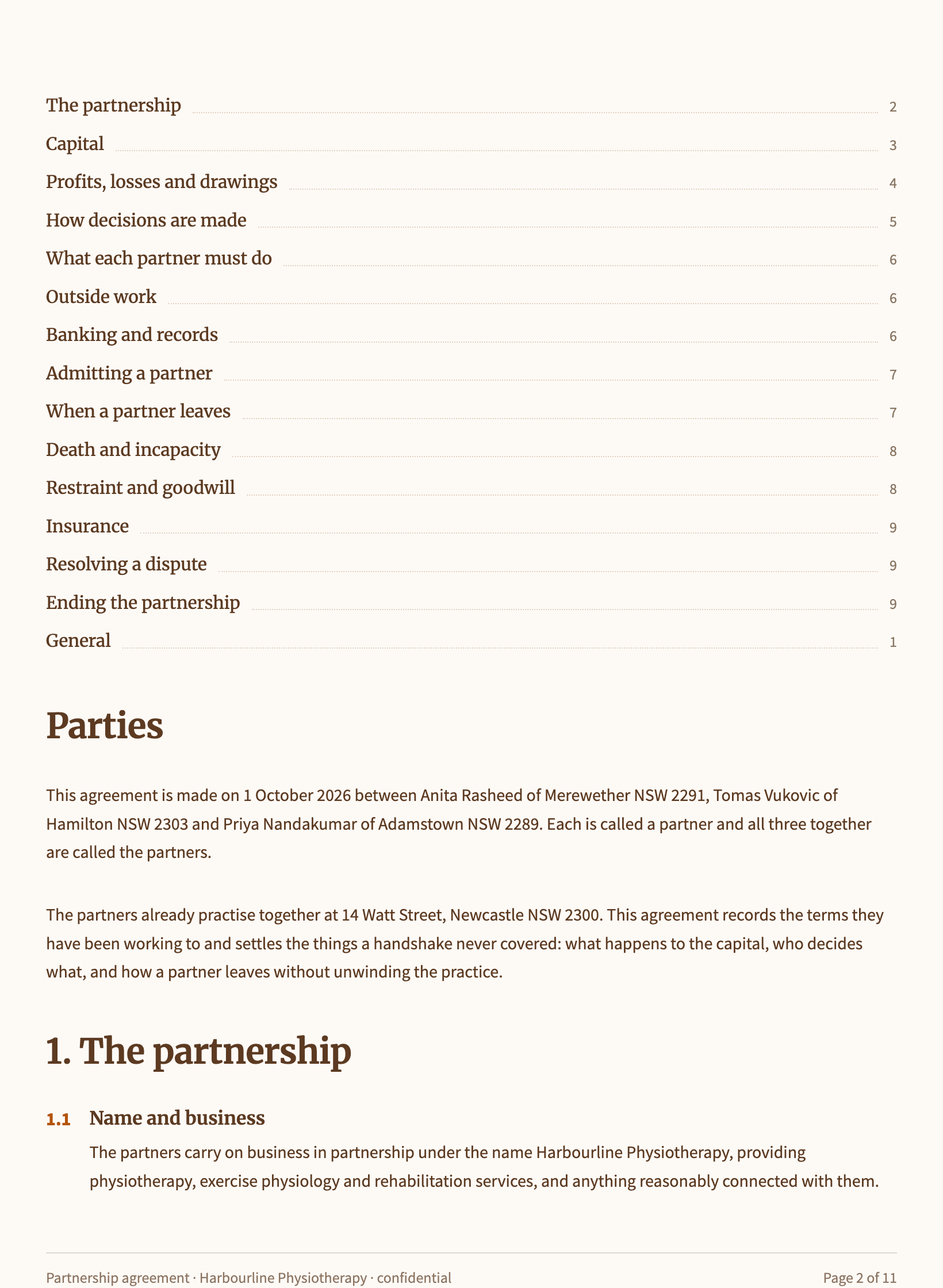 Partnership agreement templateThree physiotherapists have run one Newcastle practice together since 2024 without anything in writing. This agreement records what the handshake never covered: uneven capital sitting beside uneven hours, the six decisions no partner can make alone, and what a leaving partner is owed.
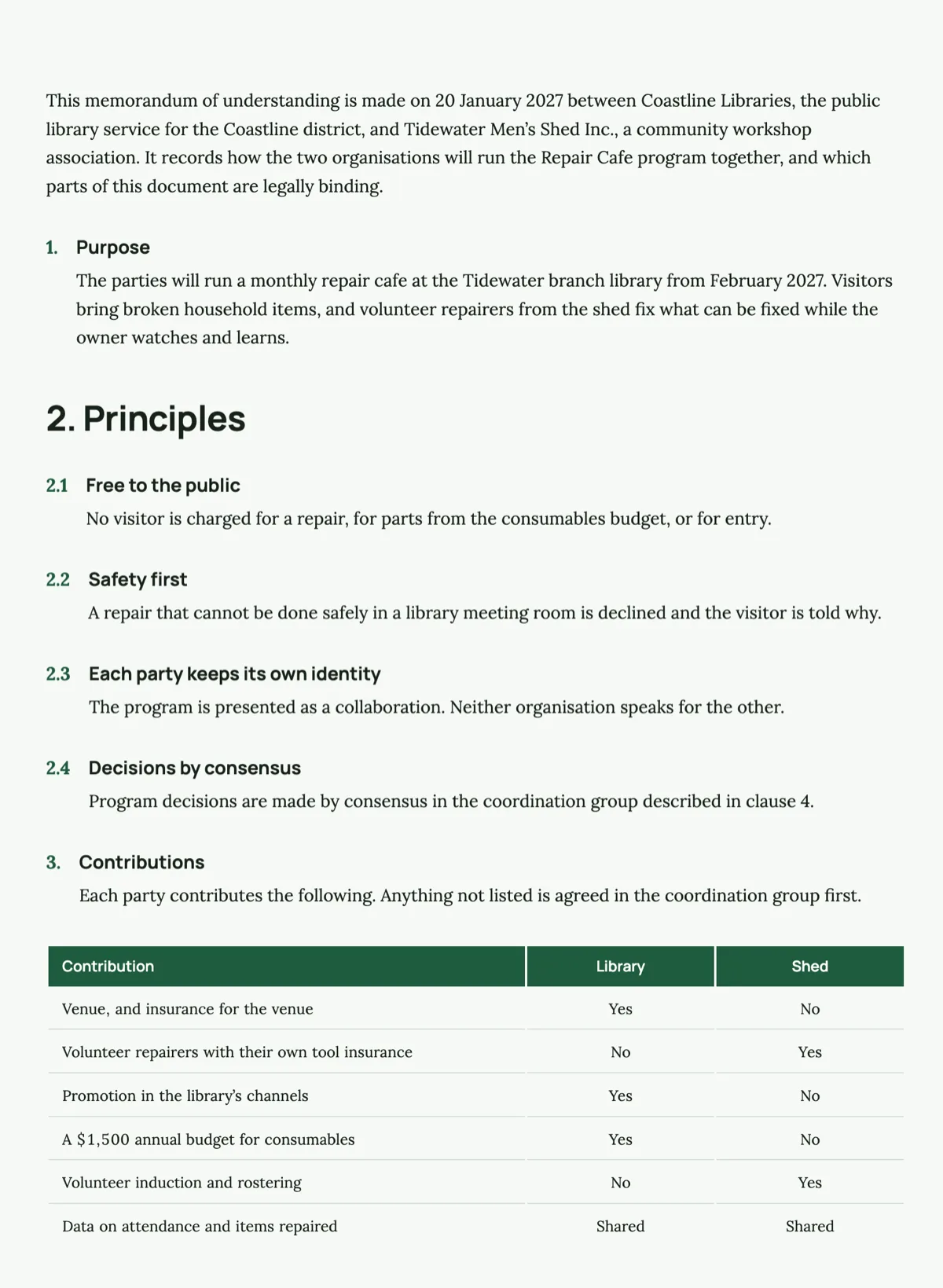 Memorandum of understanding template that says which clauses bindAn MOU is useful because it is not a contract, and dangerous when nobody says which parts are. This one records a collaboration between a library service and a men's shed in plain words, puts each side's contribution in a table, and marks the three clauses that legally bind, where a letter of intent or a mutual NDA would bind by design.
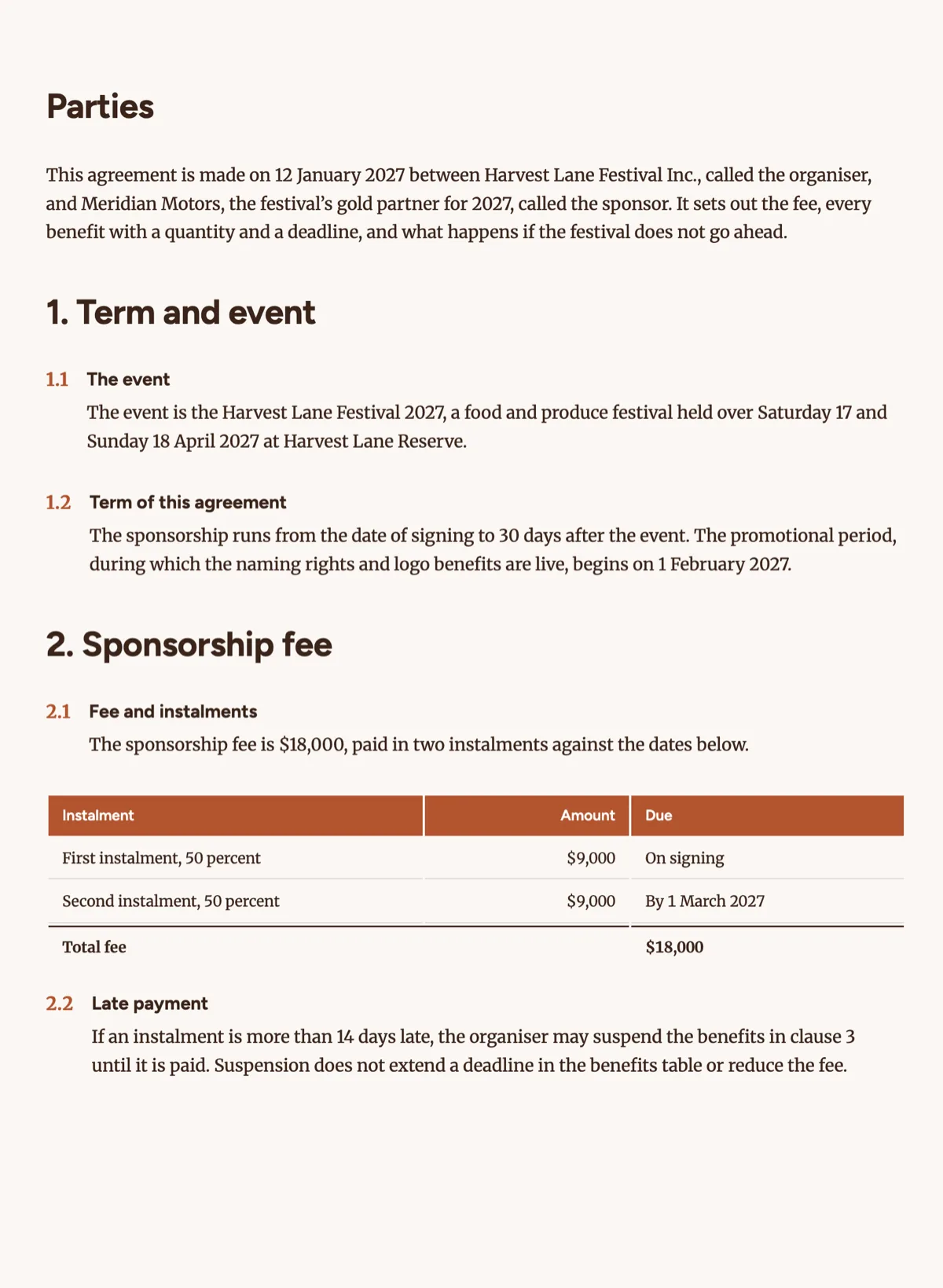 Sponsorship agreement template that lists every benefit with a numberSponsorship falls apart in the delivery, when nobody can find the email that said how many banners and which stage. This agreement is the benefits list as a table with quantities and dates, the $18,000 fee in instalments tied to those dates, and the two clauses sponsors care about most: exclusivity, and what happens if the event does not go ahead.
Questions people ask
When is a mutual indemnity appropriate?
Where both parties bring the same kind of exposure to a shared activity, such as content in a joint campaign, staff at a shared site, or data in a collaboration. In an ordinary supply relationship it is usually the wrong shape, because the customer has no equivalent risk to indemnify against and the mutuality is cosmetic.
Should both sides have the same cap?
Only if both sides can carry it. A small studio promising the same figure as a national chain is promising something it cannot pay, which gives the larger party false comfort. Different caps, with a sentence in the clause explaining that the difference reflects scale and insurance rather than fault, is the more workable arrangement.
What is a knock for knock indemnity?
Each party takes responsibility for injury to its own people and damage to its own property, whatever the cause and regardless of the other party's negligence. It is common where crews work side by side, because it removes the fault inquiry entirely. It only functions where both parties carry insurance for the risks they have taken on.
Does a mutual indemnity need notice and defence terms?
Yes, and in both directions, which is where drafting often slips. A clause written from the perspective of one indemnified party leaves the reciprocal direction with no process at all. Draft the mechanics using the defined terms Indemnifying Party and Indemnified Party so the same steps apply whichever way the claim runs.
Should a mutual indemnity be capped at all?
In a collaboration between two ordinary businesses, usually yes, because neither side is being paid to carry unlimited exposure. Third party infringement and personal injury are the categories most often left outside the cap, and where they are, both parties should hold insurance that responds to them.
Does a waiver of subrogation belong in the same clause?
It belongs in the insurance clause, but a knock for knock indemnity depends on it, so the two have to be read together. Without the waiver, one party's insurer can pay its own insured and then sue the other party for the same loss, which undoes the allocation the indemnity just made.
Put the clause in a finished document
The button opens the document generator with a starting description already filled in. Change it to match your own agreement before you run it.
Create a document with OneCraftRelated clauses
- Indemnity clause: promising to cover someone else's lossAn indemnity clause is a promise to cover the other party's loss from a named event. Australian sample wording, three variants and what each side negotiates.
- Insurance clause: which policies, what amounts, what proofAn insurance clause sets the policies a contractor must hold, the amounts and the proof. Australian sample wording, typical cover levels and three variants.
- Release clause: giving up claims for goodA release clause gives up claims one party has against another. Australian sample wording for a building settlement and the unknown claims problem.
For everything the document generator can do, see the document maker.
Step by step in the builder: Create a document with AI, then Send a document for signature.
Written and checked by the OneCraft team. Last checked .