Contract clause
Indemnity clause: promising to cover someone else's loss
An indemnity clause is a promise by one party to cover a loss the other party suffers from a named event. It shifts a risk rather than capping one, so the amount is whatever the event costs, and the promise usually survives the end of the contract and sits outside the liability cap unless the drafting says otherwise.
An indemnity is the one clause in a commercial contract with no natural ceiling. Reading it properly means reading the trigger, because everything after the trigger is arithmetic.
Nuwan Madhusanka · Co-founder
4 min read · Published
Sample clause
a venue hire agreement between Ridgeway Events, which runs corporate functions, and the operator of a heritage hall that Ridgeway brings its own contractors into
13. Indemnity 13.1 Ridgeway Events indemnifies the Operator against any loss, damage, cost or expense the Operator incurs arising from damage to the Venue or to the Operator's property caused by an act or omission of Ridgeway Events, its personnel or its Contractors during the Hire Period. 13.2 Ridgeway Events also indemnifies the Operator against any claim brought by a third party for personal injury arising from an activity Ridgeway Events conducts at the Venue. 13.3 The indemnity in clauses 13.1 and 13.2 is reduced proportionately to the extent the loss or claim was caused by an act or omission of the Operator or its personnel. 13.4 The Operator must notify Ridgeway Events in writing within ten (10) business days of becoming aware of a claim to which clause 13.2 applies, and must not settle or admit liability for that claim without Ridgeway Events' written consent. 13.5 Ridgeway Events may conduct the defence of a claim under clause 13.2 at its own cost, and the Operator must give it reasonable assistance.
Sample wording, not legal advice.
Variants
Third party claims only
The customer accepts responsibility for outside claims but will not underwrite the other party's own commercial losses.
The Supplier indemnifies the Customer against any claim brought against the Customer by a third party alleging that the Deliverables infringe that third party's intellectual property rights, and against the reasonable legal costs of defending such a claim. This indemnity does not extend to any loss the Customer itself suffers, including loss of profit, loss of opportunity or the cost of replacing the Deliverables, which is governed by clause 15.
Reduced for the indemnified party's own fault
Neither party will accept an indemnity that pays out even where the claimant caused the problem.
The indemnity in this clause does not apply to the extent that the loss or claim was caused or contributed to by an act or omission of the indemnified party, its personnel or anyone acting on its behalf, or by the indemnified party's failure to comply with this Agreement. Where the loss is partly attributable to the indemnified party, the amount recoverable under this clause is reduced in proportion to that contribution, as agreed between the parties or determined under clause 20.
United States broad form
The contract follows United States drafting practice, where the defend, indemnify and hold harmless triad is standard and state law may restrict it.
Contractor shall defend, indemnify and hold harmless Owner and its officers, employees and agents from and against any and all claims, damages, losses and expenses, including reasonable attorneys' fees, arising out of or resulting from performance of the Work, but only to the extent caused by the negligent acts or omissions of Contractor or anyone for whose acts Contractor may be liable. This obligation shall not be construed to negate any other right or obligation of indemnity.
What to negotiate
The trigger event
An indemnity for loss arising from this agreement is close to unlimited liability under another name. Narrowing the trigger to named events, such as third party infringement claims, personal injury or property damage, is the single most effective amendment. Everything else in the clause is secondary to what sets it off.
Whether the cap applies
Suppliers want indemnities inside the liability cap. Customers want them outside it, because a cap at twelve months of fees is no answer to an infringement claim. The usual landing point leaves personal injury and infringement outside the cap, and brings ordinary contractual indemnities inside it.
Who runs the defence
A party paying for a claim wants to control how it is defended and settled. The indemnified party wants to protect its own name and relationships. Standard wording gives the indemnifier the right to conduct the defence, requires prompt notice, and stops the indemnified party admitting liability or settling alone.
The risk of leaving it out
Without an indemnity each party recovers only what the general law allows, which means proving breach, proving causation and proving loss that is not too remote. That is a much harder path than pointing at a promise to pay. In practice the party that would have been indemnified ends up funding a third party claim caused by the other side's work.
Why an indemnity is not the same as a damages claim
A damages claim requires a breach, and the loss has to be of a kind the law allows for that breach. An indemnity is a primary obligation to pay on the happening of a described event, so the event and the amount are the only questions. That has three practical effects. It can cover loss with no breach at all, it usually avoids arguments about remoteness, and it can be enforced before the indemnified party has actually paid out if the wording is drafted that way. Those differences are why an indemnity is negotiated far harder than the damages it sits beside.
Common mistakes
The trigger is written as any loss arising in connection with this agreement, which no cap can contain. The indemnity is silent about contributory fault, so it pays out even where the beneficiary caused the loss. There is no notice or defence mechanism, so the indemnifier learns about a claim after it has been settled. And the interaction with the liability cap is left unstated, which produces two clauses that each assume the other yields.
Where it sits in a generated document
Indemnity belongs beside the liability clauses, close enough that the reader can see whether the cap reaches it. A generated master agreement numbers the risk section so the indemnity, the cap and the exclusions are separate clauses that can cross reference each other, which is the only way the interaction becomes readable. Where the indemnity survives termination, the survival clause has to list it by number.
Documents that carry this clause
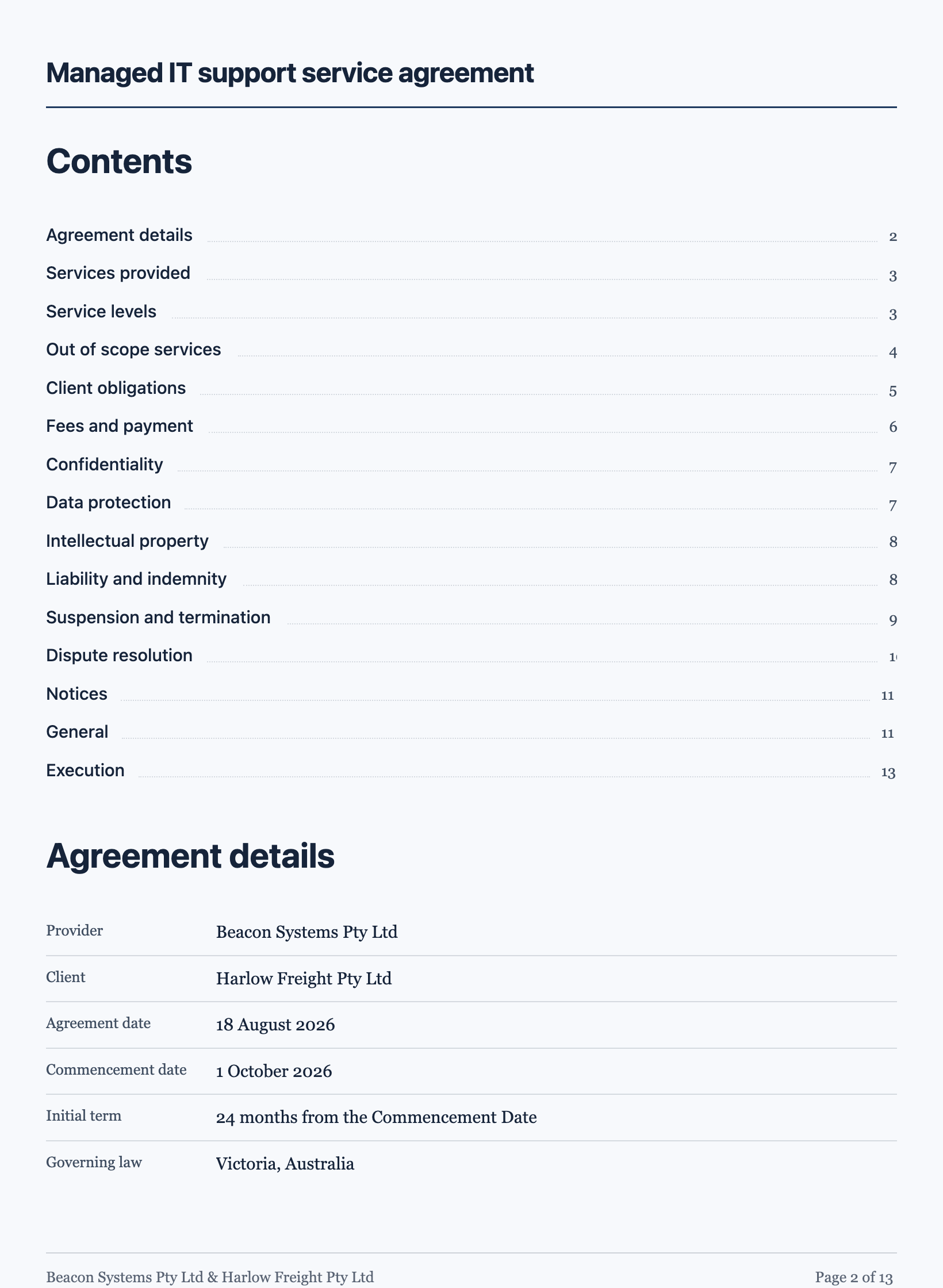 Service agreementBeacon Systems supports Harlow Freight’s IT for an initial 24 months from 1 October 2026 at $8,400 a month plus GST, with 40 hours included and $220 an hour beyond them. Twelve numbered clauses cover the services, a four level severity table, client duties, fees with a CPI adjustment, confidentiality, privacy, IP, a liability cap, termination and a three step dispute ladder.
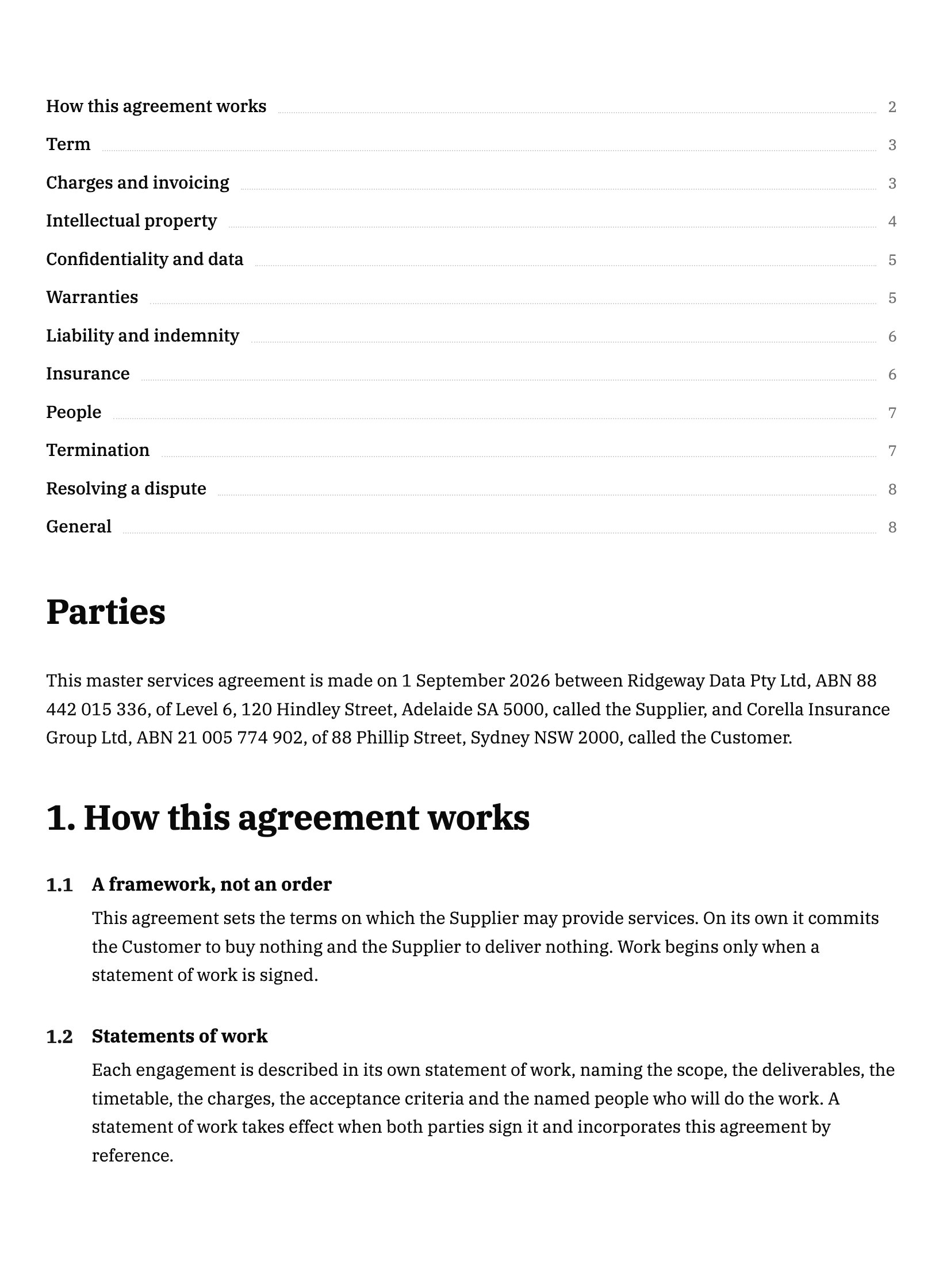 Master services agreementA data consultancy and an insurer sign this once and then buy work under it for three years. It is the rare contract whose whole purpose is to make the next twenty contracts short.
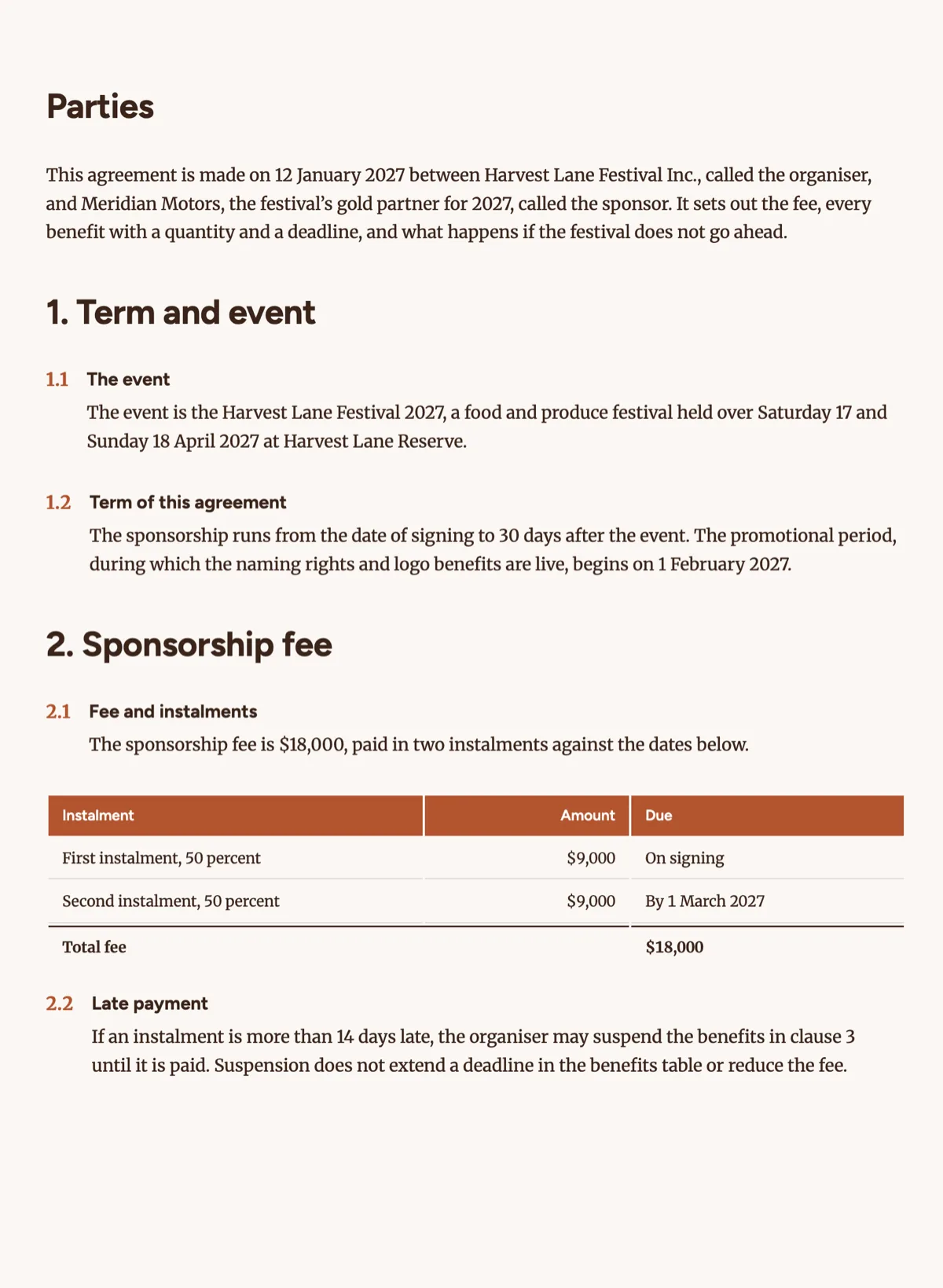 Sponsorship agreement template that lists every benefit with a numberSponsorship falls apart in the delivery, when nobody can find the email that said how many banners and which stage. This agreement is the benefits list as a table with quantities and dates, the $18,000 fee in instalments tied to those dates, and the two clauses sponsors care about most: exclusivity, and what happens if the event does not go ahead.
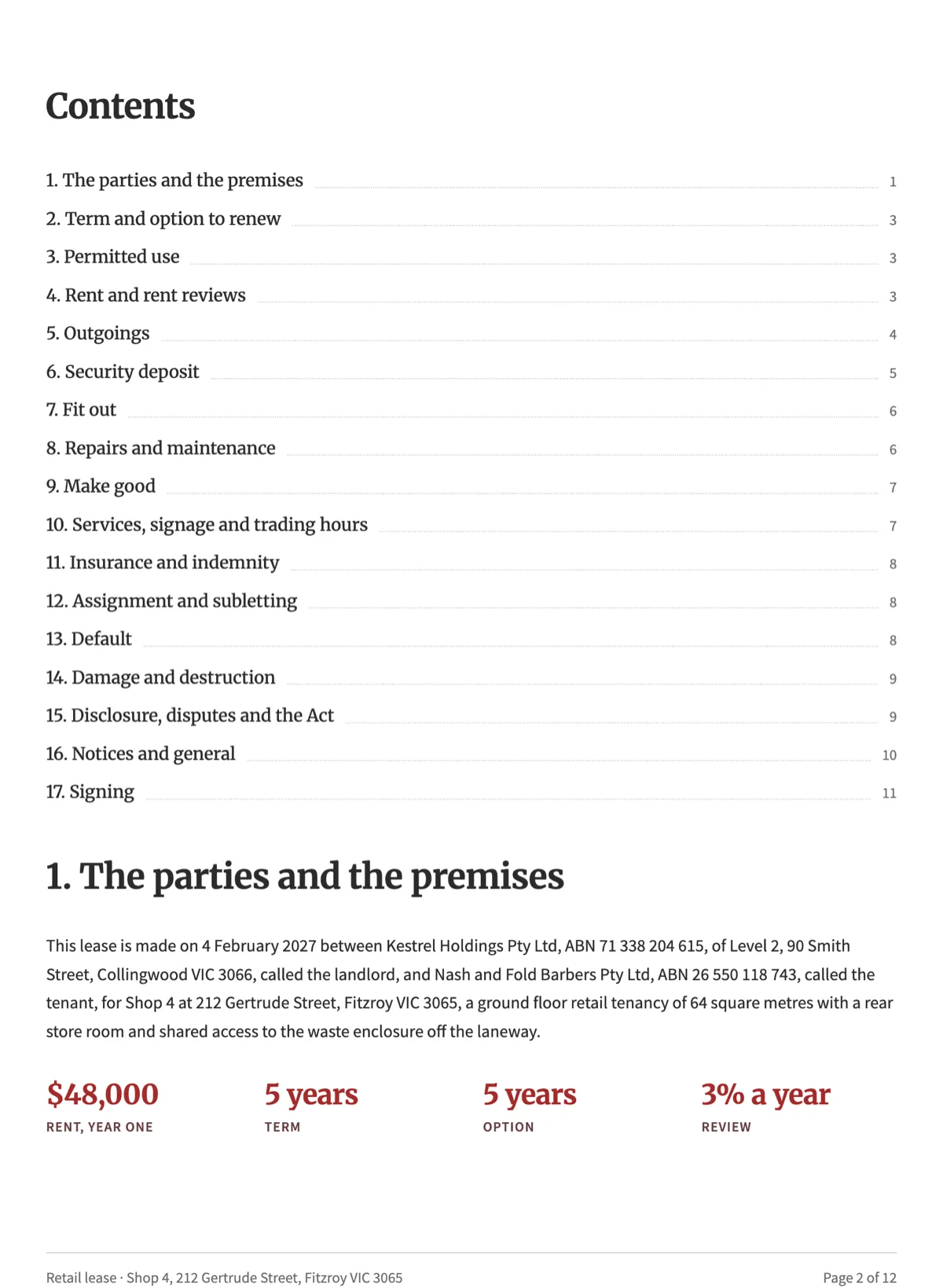 Commercial lease agreement template with outgoings and fit out termsA retail lease is decided by three numbers and two clauses: the rent, the review, the outgoings, the fit out contribution and the make good. This 12 page Victorian lease sets all five out in the open, including the outgoings the landlord is not allowed to recover at all.
Questions people ask
What is the difference between an indemnity and a warranty?
A warranty is a promise that something is true, and breaking it gives rise to a damages claim with all the usual requirements of causation and remoteness. An indemnity is a promise to pay on the happening of an event, whether or not anything was breached. That is why an indemnity is the harder clause to give and the more valuable one to hold.
Should an indemnity be capped?
It depends which indemnity. An indemnity for ordinary contractual loss sits comfortably inside a liability cap. An indemnity for third party infringement or personal injury does not, because the exposure has nothing to do with the contract value. The common settlement caps the general indemnities and leaves those two categories outside the cap.
Can an indemnity be claimed before the loss is paid?
Only if the wording allows it. An indemnity drafted against liability can often be enforced once the liability is established, while one drafted against loss suffered generally requires payment first. Suppliers giving an indemnity prefer the second, because it delays the claim and lets them see the real number.
Is an indemnity clause unfair in a small business contract?
A broad indemnity in a standard form small business contract is one of the terms regulators examine, particularly where it is one way and covers loss the other party caused. Narrowing the trigger, adding a proportionate reduction for the beneficiary's own fault, and making it mutual are the changes that move it toward defensible.
Does an indemnity survive the end of the contract?
It should, and only if the survival clause says so. An event that triggers an indemnity may not surface until months after the agreement ends, particularly an infringement claim. Listing the indemnity clause by number in the survival provision is a one line change that decides whether the promise still exists when it is needed.
Who controls the defence of an indemnified claim?
Normally the party paying, since it carries the cost of the outcome. The indemnified party keeps a duty to give prompt written notice, an obligation not to admit liability or settle without consent, and a duty to assist. A clause without those mechanics leaves the indemnifier funding a settlement it had no part in.
Put the clause in a finished document
The button opens the document generator with a starting description already filled in. Change it to match your own agreement before you run it.
Create a document with OneCraftRelated clauses
- Limitation of liability clause: putting a ceiling on exposureA limitation of liability clause puts a ceiling on what one party can recover. Australian sample wording, three variants, the carve outs and the UK test.
- Mutual indemnity clause: both sides cover the same risksA mutual indemnity clause has each party cover the other for the same heads of loss. Sample wording for a co marketing deal, three variants and when it fits.
- Insurance clause: which policies, what amounts, what proofAn insurance clause sets the policies a contractor must hold, the amounts and the proof. Australian sample wording, typical cover levels and three variants.
For everything the document generator can do, see the document maker.
Step by step in the builder: Create a document with AI, then Every document component and when to use it.
Written and checked by the OneCraft team. Last checked .