Contract clause
Release clause: giving up claims for good
A release clause is a promise to give up claims a party has or may have against another, usually in exchange for a payment or a concession. It names who is released, what claims are covered, whether claims nobody knows about yet are included, and what happens if the payment never arrives.
A release is the only clause in most settlements that actually ends anything. Everything else is administration around the two questions of who is released and from what.
Nuwan Madhusanka · Co-founder
4 min read · Published
Sample clause
a settlement between Corradine Builders and a homeowner over a rear deck that moved in its first winter, resolved before either party filed in a tribunal
4. Release 4.1 On receipt of the Settlement Sum, the Owner releases and discharges Corradine Builders, its directors, employees and subcontractors from all claims, demands, actions and proceedings the Owner has or could have had arising out of or in connection with the construction of the Deck, whether known or unknown at the date of this Deed. 4.2 The release in clause 4.1 does not extend to a claim for personal injury, to a claim arising from fraud, or to a claim arising from work Corradine Builders performs after the date of this Deed. 4.3 Corradine Builders releases the Owner from all claims for unpaid amounts relating to the Deck. 4.4 Each party may plead this Deed as a bar to any proceeding brought contrary to clause 4.1 or 4.3. 4.5 If the Settlement Sum is not paid in full within ten (10) business days of the date of this Deed, the releases in this clause do not take effect and each party retains every right it had immediately before signing.
Sample wording, not legal advice.
Variants
Mutual release
Both sides have complaints and both want the matter closed, which is most commercial settlements.
Each party releases and discharges the other party, and that party's related bodies corporate, officers and employees, from all claims arising out of or in connection with the Dispute, whether known or unknown at the date of this Deed. Neither party may commence or continue any proceeding against the other in relation to the Dispute. This release does not affect either party's obligations under this Deed, which remain fully enforceable.
Release excluding unknown claims
The releasing party cannot yet see the full extent of the problem and will not sign away what it has not measured.
The Owner releases the Builder from all claims arising out of the Works that the Owner knows of, or ought reasonably to know of, at the date of this Deed. This release does not extend to a claim arising from a defect that is not reasonably apparent on inspection at that date and which becomes apparent afterwards, and the Owner's rights in relation to such a defect are preserved in full, including any statutory warranty that applies to the Works.
Release conditional on payment
The releasing party is giving up rights in exchange for money it has not yet received.
The release in this Deed is conditional on payment of the Settlement Sum in cleared funds by the Payment Date. Until that payment is made the release has no effect. If payment is not made by the Payment Date, the Claimant may, at its election, enforce this Deed as a debt for the Settlement Sum or treat the Deed as at an end and pursue the original claims, and time does not run against the Claimant during the period between the date of this Deed and the Payment Date.
What to negotiate
Known claims or everything
The paying party wants a release of all claims, known and unknown, arising from the relationship. The releasing party wants it confined to the dispute it has actually assessed. The common middle releases everything arising from a defined subject matter, with carve outs for personal injury, fraud and future conduct.
Who else is released
A release of one company leaves its directors, employees and subcontractors exposed, and they will simply be sued instead. Paying parties therefore extend the release to related entities and personnel. Releasing parties accept that for people who were part of the work and resist a release that covers unrelated group companies.
Whether it bites before payment
A release that takes effect on signing leaves the claimant with a promise and no claim. Making it conditional on payment in cleared funds, with a right to revive the original claims if payment fails, is the version a claimant should insist on and one most paying parties accept without much argument.
The risk of leaving it out
A settlement without a release is a payment, not an ending. The paying party has no defence to the same claim being brought again, and no answer if the other side later sues a director or a subcontractor over the same facts. Deeds of settlement exist to close the subject matter, and the release is the clause that does the closing.
Why a release is usually in a deed
A release given for money is straightforward, because the payment is the consideration. A release given for nothing is harder to enforce as a simple contract, which is why settlements are so often executed as deeds. Signing formalities differ, and in most Australian jurisdictions a deed made by an individual requires the signature to be witnessed, while a company can execute under the Corporations Act. The other practical reason is limitation periods, which for a deed are commonly longer than for a contract, so the promise not to sue has a longer life than the claim it replaced.
Common mistakes
The release covers all claims of any kind ever, which sweeps in personal injury and fraud and may be read down for it. It names only the company, so the same claim is brought against the director the following month. It takes effect on signing rather than on payment. And it leaves the obligations created by the settlement itself inside the release, so the parties have arguably released each other from the deed they just signed.
Where it sits in a generated document
In a deed of settlement the release is the operative clause, sitting after the recitals and the payment obligation and before the confidentiality and costs clauses. A generated deed is built as numbered content, which matters here because the release will be quoted in a plea if anyone sues. Each party in the signature block becomes one signer with a name, an email and a place in the signing order.
Documents that carry this clause
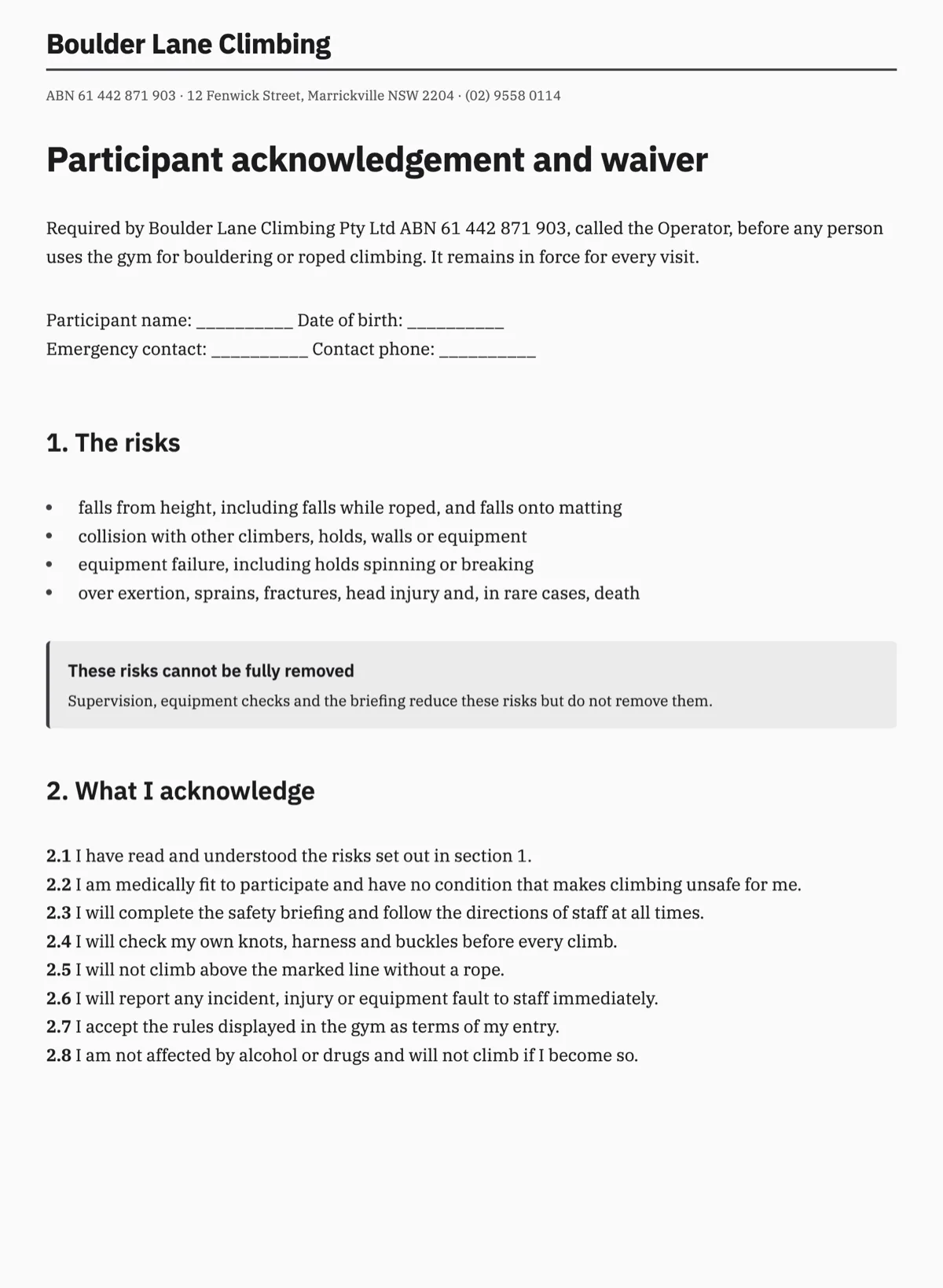 Liability waiver template written for Australian recreational servicesMost waivers in Australia are copies of American forms and exclude things that cannot be excluded, which makes the whole document weaker. This one names the real risks, takes the acknowledgements one by one, and uses the recreational services exclusion the way the consumer law actually permits, with a guardian block for minors.
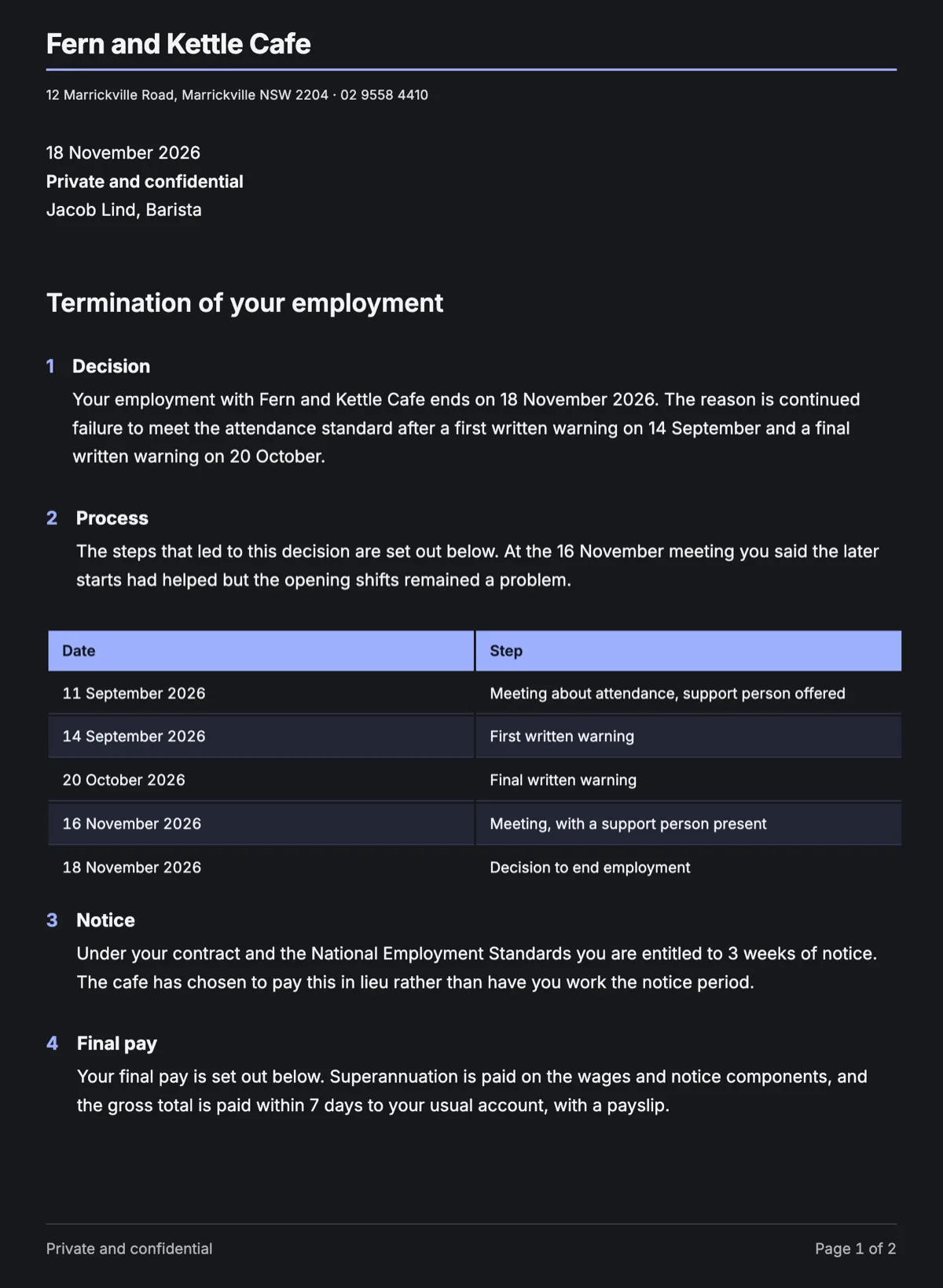 Termination letter template that shows the final payA termination letter is read twice, once by the employee in the meeting and once by a lawyer or a tribunal months later, and both need the same facts. This one states the reason and the process in dates, shows the final pay as a table with each component, and says what happens next, so there is nothing to ask afterwards.
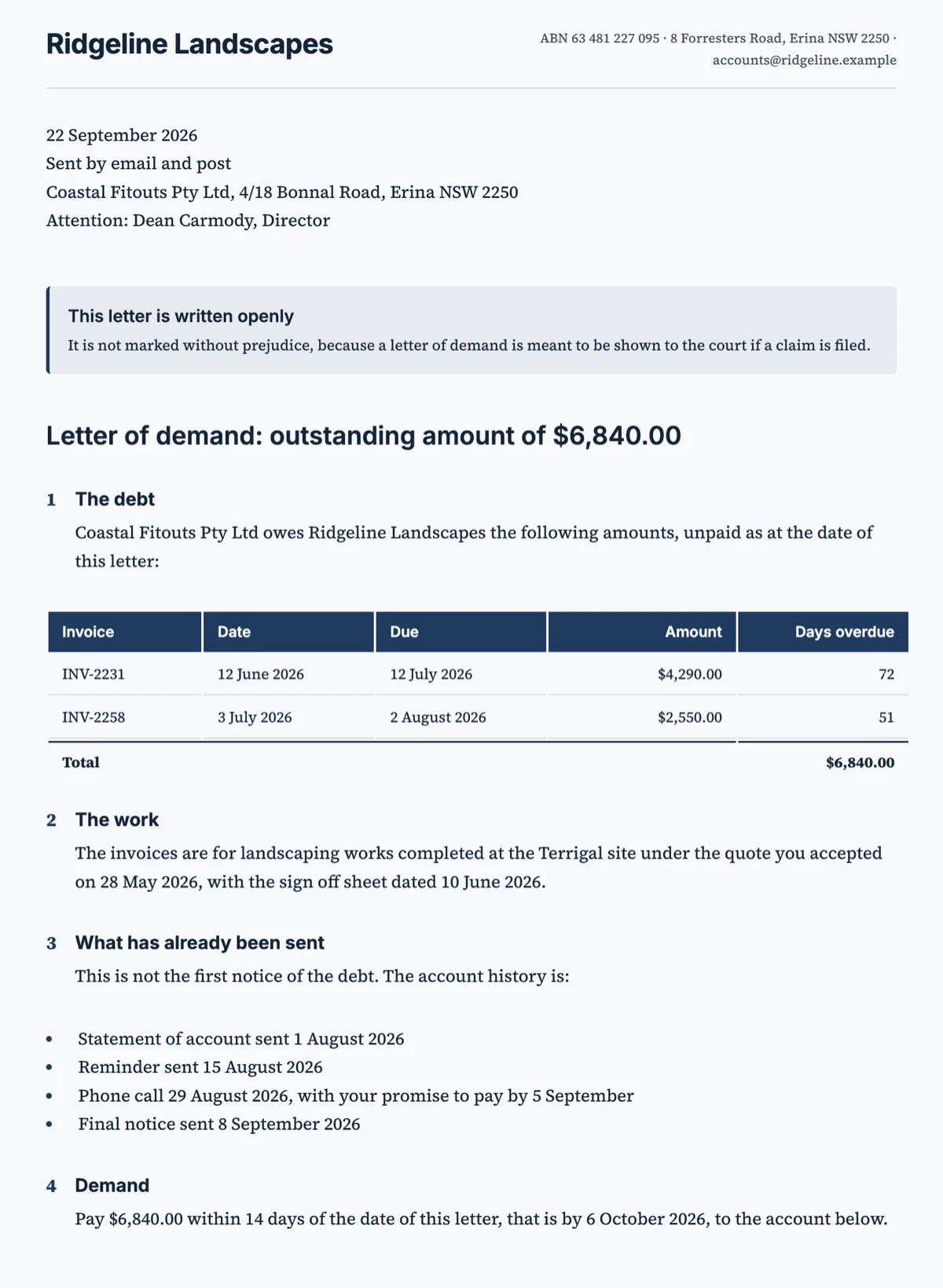 Letter of demand template that can go straight to the tribunalA letter of demand is the last letter that is not a court form, and it works because it is specific: what is owed, for what, since when, and what happens on day fifteen. This one itemises two invoices, lists the reminders already sent, gives fourteen days and names the court and the amounts that will be claimed.
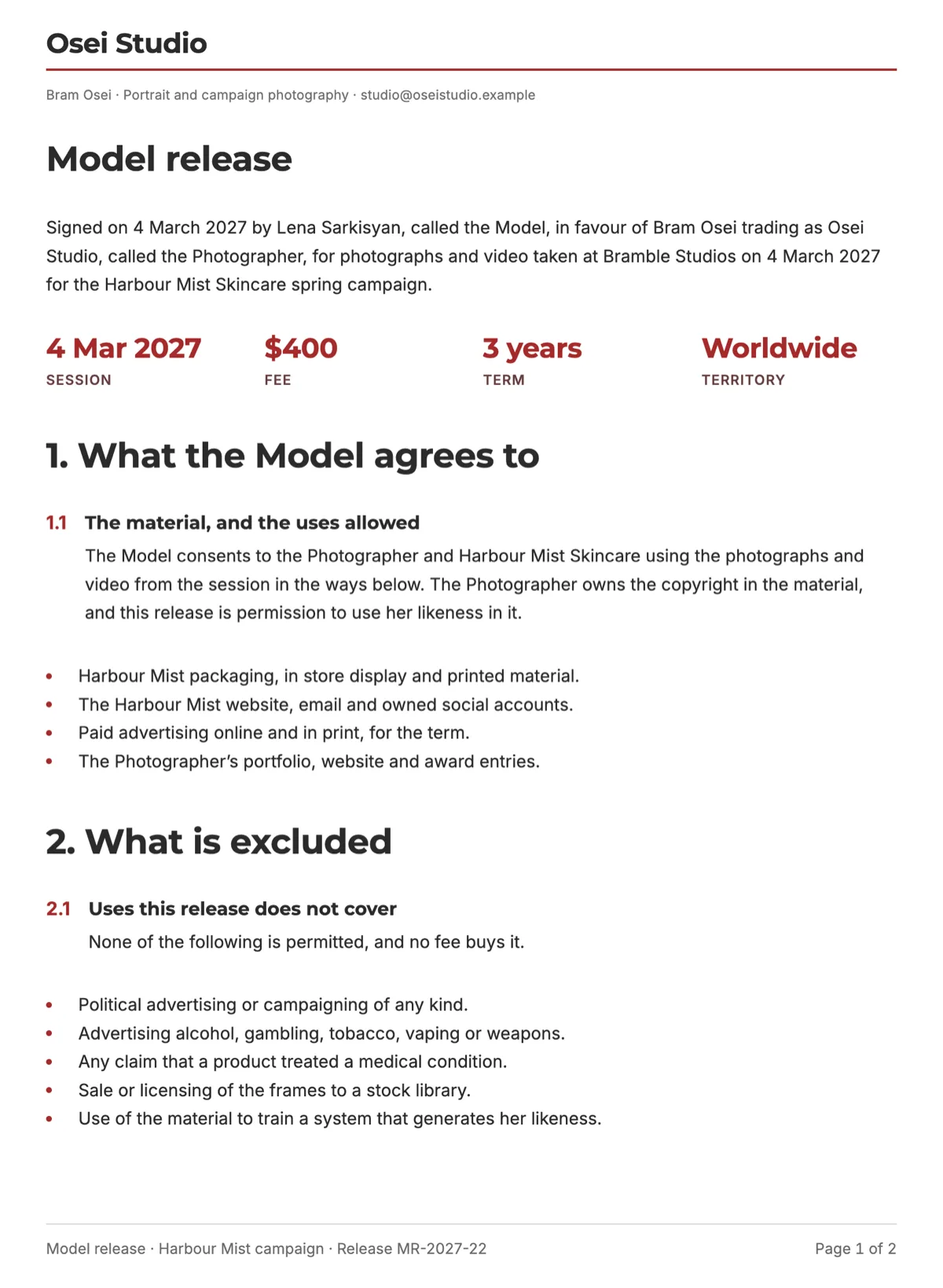 Model release template with uses allowed and uses excludedA model release is only as good as its two lists: what the photographs may be used for, and what they may never be used for. This one covers a skincare campaign shoot, runs for three years worldwide for $400, and rules out political advertising, alcohol and gambling, medical claims, stock libraries and training a system on the model's likeness.
Questions people ask
What is the difference between a release and a waiver?
A release gives up a claim that already exists, usually in a settlement and usually for consideration. A waiver is a party choosing not to enforce a right it holds under a contract, often in one instance, and it can sometimes be withdrawn for the future. A release is intended to be final, which is why it is drafted far more carefully.
Can a release cover claims nobody knows about yet?
It can, if the wording says known or unknown, and paying parties usually insist on that. The releasing party should think hard about it, particularly where a defect may still be hidden. Carve outs for personal injury, fraud and defects that are not reasonably apparent are the usual way to sign a broad release safely.
Does a release need to be in a deed?
Not always, but it is the safer form. Where the release is given in exchange for a payment there is consideration and a contract works. A deed avoids the consideration question entirely, is subject to longer limitation periods in most Australian jurisdictions, and signals that the parties intended the arrangement to be binding and final.
Should employees and subcontractors be released too?
If the paying party wants the matter genuinely closed, yes. A release that names only the company leaves everyone who did the work exposed to the same claim, and a claimant who is unhappy may go after them next. Extend it to the people involved, and resist extending it to unrelated group entities.
What if the settlement money is never paid?
The release should not take effect until payment is received in cleared funds, and the deed should say what happens if it is not. Two options are usual: sue on the deed for the settlement sum as a debt, or treat the deed as at an end and pursue the original claims. Give the claimant the election.
Can a release be set aside?
It is difficult and it does happen, most often where there was fraud, a serious misrepresentation about the facts being settled, or genuine unconscionable conduct in obtaining the signature. Those are narrow grounds. Plain wording, independent advice and an honest exchange of information are what make a release hold.
Put the clause in a finished document
The button opens the document generator with a starting description already filled in. Change it to match your own agreement before you run it.
Create a document with OneCraftRelated clauses
- Indemnity clause: promising to cover someone else's lossAn indemnity clause is a promise to cover the other party's loss from a named event. Australian sample wording, three variants and what each side negotiates.
- Force majeure clause: excusing performance when events interveneA force majeure clause excuses performance during events outside either party's control. Sample wording with a sixty day exit, variants and notice duties.
- Proportionate liability clause: paying only your shareA proportionate liability clause decides whether a wrongdoer pays only its share. Australian sample wording, the state by state position on contracting out.
For everything the document generator can do, see the document maker.
Step by step in the builder: Create a document with AI, then Send a document for signature.
Written and checked by the OneCraft team. Last checked .