Contract clause
Force majeure clause: excusing performance when events intervene
A force majeure clause suspends a party's obligations while a listed event outside its control prevents performance. It defines the qualifying events, requires notice, obliges the affected party to keep trying, and gives one or both parties a way out if the interruption lasts longer than a stated period.
The clause is only as wide as its own list, and the event that stops a business is usually the one the drafter never imagined. What saves a contract is the structure around the list, not the list itself.
Nuwan Madhusanka · Co-founder
4 min read · Published
Sample clause
a catering agreement between Larkspur Catering and a fictional agricultural society for a three day regional show held on a river flat
17. Force majeure 17.1 A party is not liable for a failure to perform an obligation under this Agreement, other than an obligation to pay money, to the extent the failure is caused by a Force Majeure Event. 17.2 Force Majeure Event means flood, fire, storm, war, terrorism, an epidemic or a public health order restricting gatherings, an industrial dispute other than one involving the affected party's own workforce, and a failure of the electricity or water supply to the Site, in each case where the event is beyond the reasonable control of the affected party. 17.3 The affected party must notify the other party within two (2) business days of becoming aware of a Force Majeure Event, describing the event and its expected effect on performance, and must keep the other party informed. 17.4 The affected party must take all reasonable steps to reduce the effect of the event and must resume performance as soon as it is able. 17.5 If a Force Majeure Event prevents performance for more than sixty (60) days, either party may terminate this Agreement by written notice, and neither party is liable except for amounts due for Services already provided.
Sample wording, not legal advice.
Variants
Closed list only
Both parties want certainty about what qualifies and will accept that an unlisted event does not.
A Force Majeure Event means only an event listed in Schedule 5. No other event, including a change in market conditions, an increase in the cost of labour or materials, the unavailability of a subcontractor, or a failure by a party's own supplier, is a Force Majeure Event, whether or not it is beyond the affected party's control. The parties have chosen a closed list so that the operation of this clause can be determined without reference to any general description.
Open definition with named examples
Neither party wants to lose protection against an event nobody has thought of yet.
A Force Majeure Event means any event beyond the reasonable control of the affected party that prevents or materially impedes performance, including but not limited to the events listed in Schedule 5. An event is not a Force Majeure Event merely because it makes performance more expensive or less profitable, nor where the affected party could have avoided or overcome its effect by taking steps a reasonable person in its position would have taken.
Payment obligations expressly preserved
One party is worried the clause could be used to stop paying for work already delivered.
This clause does not excuse or suspend an obligation to pay an amount that has fallen due, and a Force Majeure Event affecting a party's ability to obtain funds or to access a banking service is not a ground for relief under this clause. Where performance is suspended, the Customer remains liable for Services provided before the suspension and for any committed third party cost the Supplier cannot cancel, on production of evidence of that cost.
What to negotiate
Closed list or open definition
A closed list is predictable and certain to miss something. An open definition covers the unforeseen and invites argument about whether an event really was beyond control. Most commercial contracts use an open definition with named examples, plus express statements that cost increases and a party's own supplier failure do not qualify.
Notice and its consequence
Suppliers want a short notice period that does not forfeit relief if missed. Customers want notice to be a condition, so late notice means no excuse. The workable middle requires notice within a few business days and limits relief to the period from when notice was given, which penalises delay without removing protection entirely.
Who carries the costs of the interruption
Relief from performance is not the same as relief from cost. A caterer stood down two days before an event has already bought food. Customers usually accept liability for committed third party costs that cannot be cancelled, on production of evidence, and resist any claim for lost margin.
The risk of leaving it out
Without the clause the affected party must rely on the general law, which sets a high bar. Frustration ends the contract entirely and only where performance has become impossible or radically different, not merely harder or more expensive. Most real interruptions fall short of that, so a party with no clause is left in breach for something it could not control.
Why the general law is not enough
Australian law has no statutory force majeure regime, so relief depends on the words the parties chose. The fallback doctrine is frustration, and it is deliberately narrow: it discharges the contract only where an unforeseen event makes performance impossible or fundamentally different from what was agreed, and it is unavailable where the contract already allocates the risk. Frustration also produces an outcome neither party may want, since the contract ends rather than pausing. A drafted clause lets the parties choose suspension, a period of grace and a controlled exit instead.
Common mistakes
The clause lists acts of God and nothing else, leaving a public health order or a supply chain failure outside it. Notice is required with no consequence for failing to give it, so the requirement is decorative. There is no long stop, so a suspended contract stays alive indefinitely with neither party able to move on. And payment obligations are not carved out, which lets a party stop paying for work already done.
Where it sits in a generated document
Force majeure sits with the general clauses near the end, and it needs to be read with termination, which is usually the clause immediately before it. A generated events contract numbers both so the sixty day exit can point at the termination consequences rather than repeating them. Only the agreement itself defines the qualifying events, and the generated document lists them as content without attributing them to any source.
Documents that carry this clause
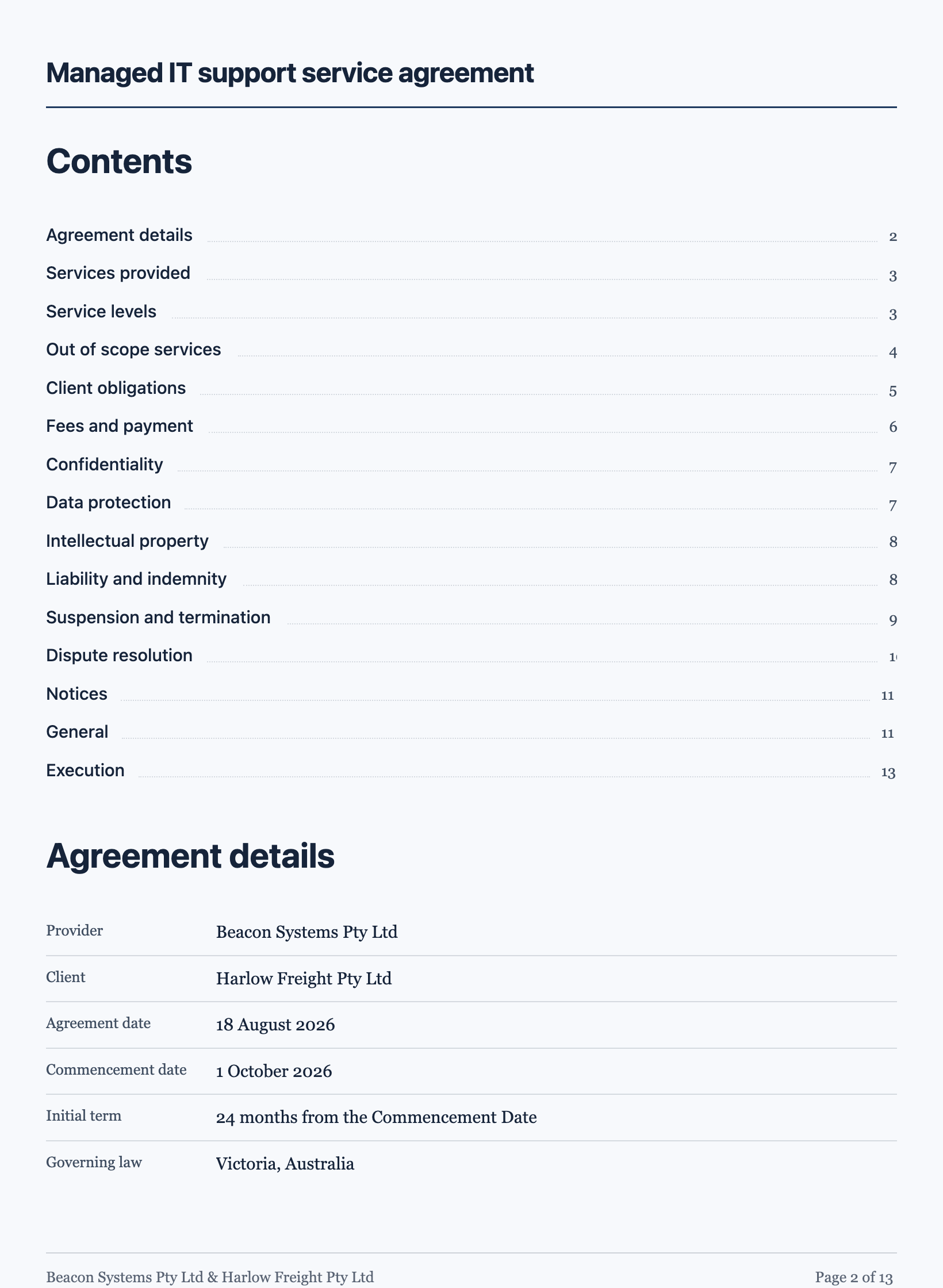 Service agreementBeacon Systems supports Harlow Freight’s IT for an initial 24 months from 1 October 2026 at $8,400 a month plus GST, with 40 hours included and $220 an hour beyond them. Twelve numbered clauses cover the services, a four level severity table, client duties, fees with a CPI adjustment, confidentiality, privacy, IP, a liability cap, termination and a three step dispute ladder.
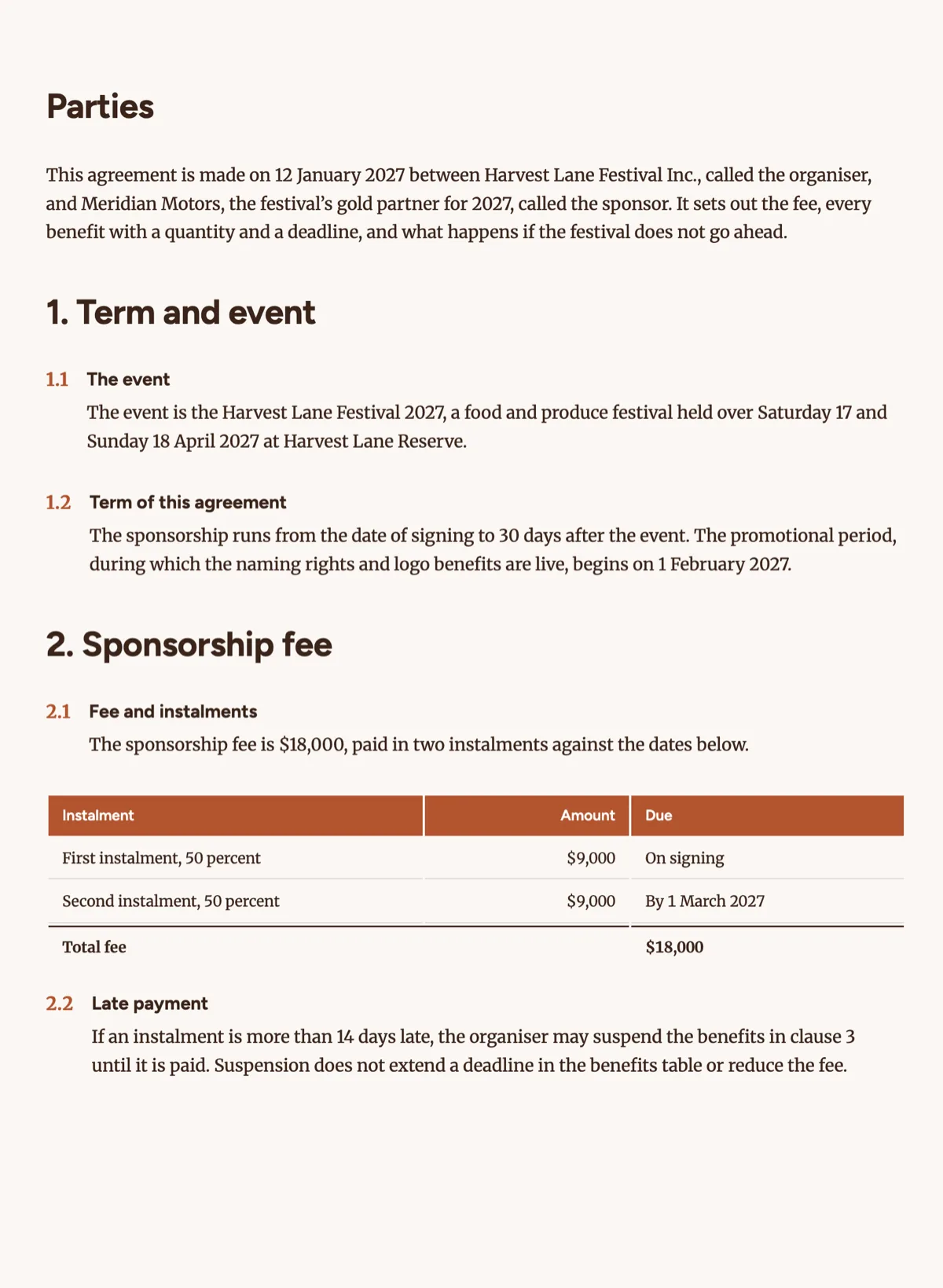 Sponsorship agreement template that lists every benefit with a numberSponsorship falls apart in the delivery, when nobody can find the email that said how many banners and which stage. This agreement is the benefits list as a table with quantities and dates, the $18,000 fee in instalments tied to those dates, and the two clauses sponsors care about most: exclusivity, and what happens if the event does not go ahead.
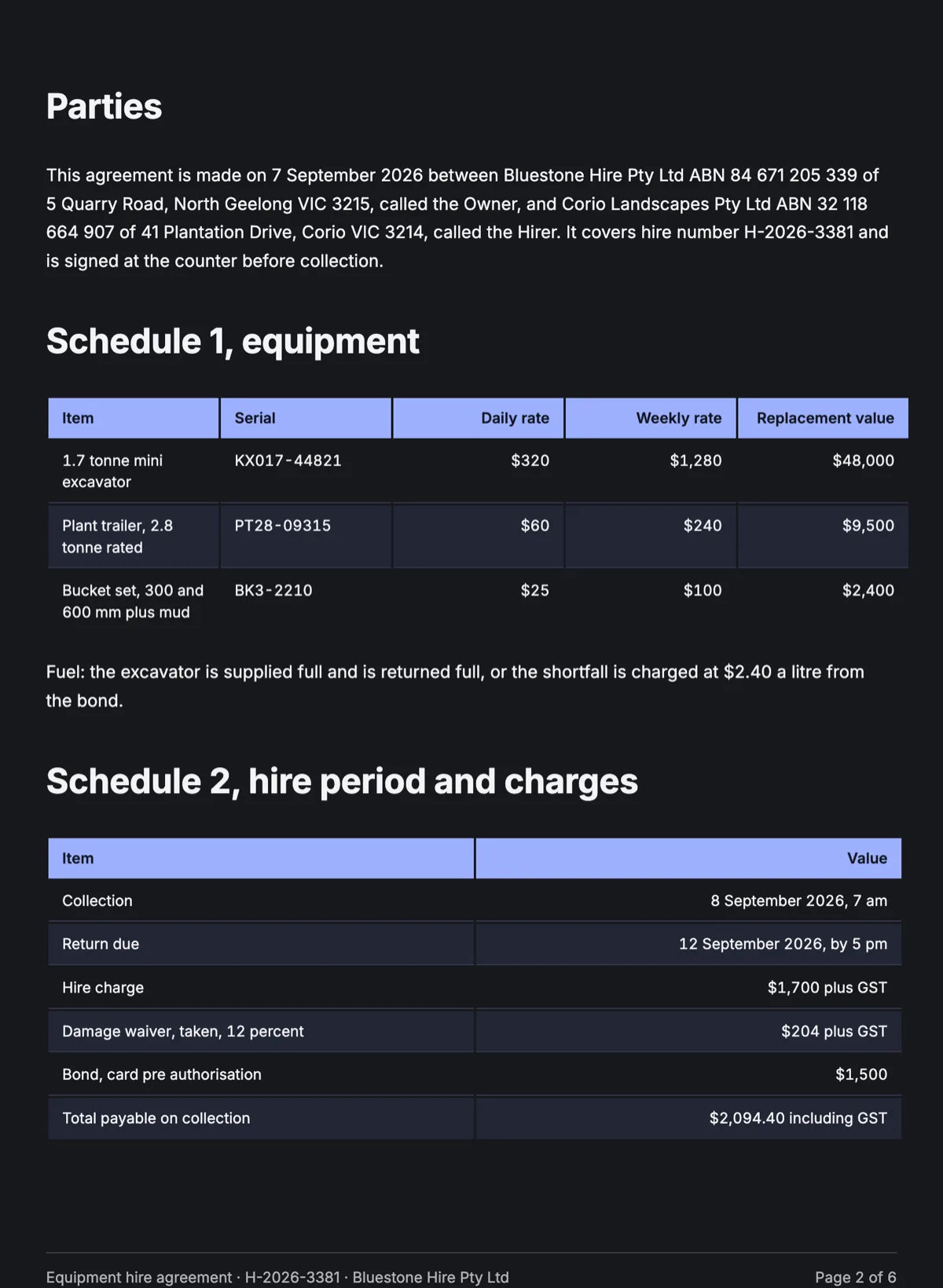 Equipment hire agreement template with the rates in a scheduleA hire agreement is a price list, an insurance decision and a return date, and the argument is always about the day it came back. This one puts the equipment and rates in a schedule, makes the damage waiver a choice with its price, and defines late return in hours so there is nothing to interpret.
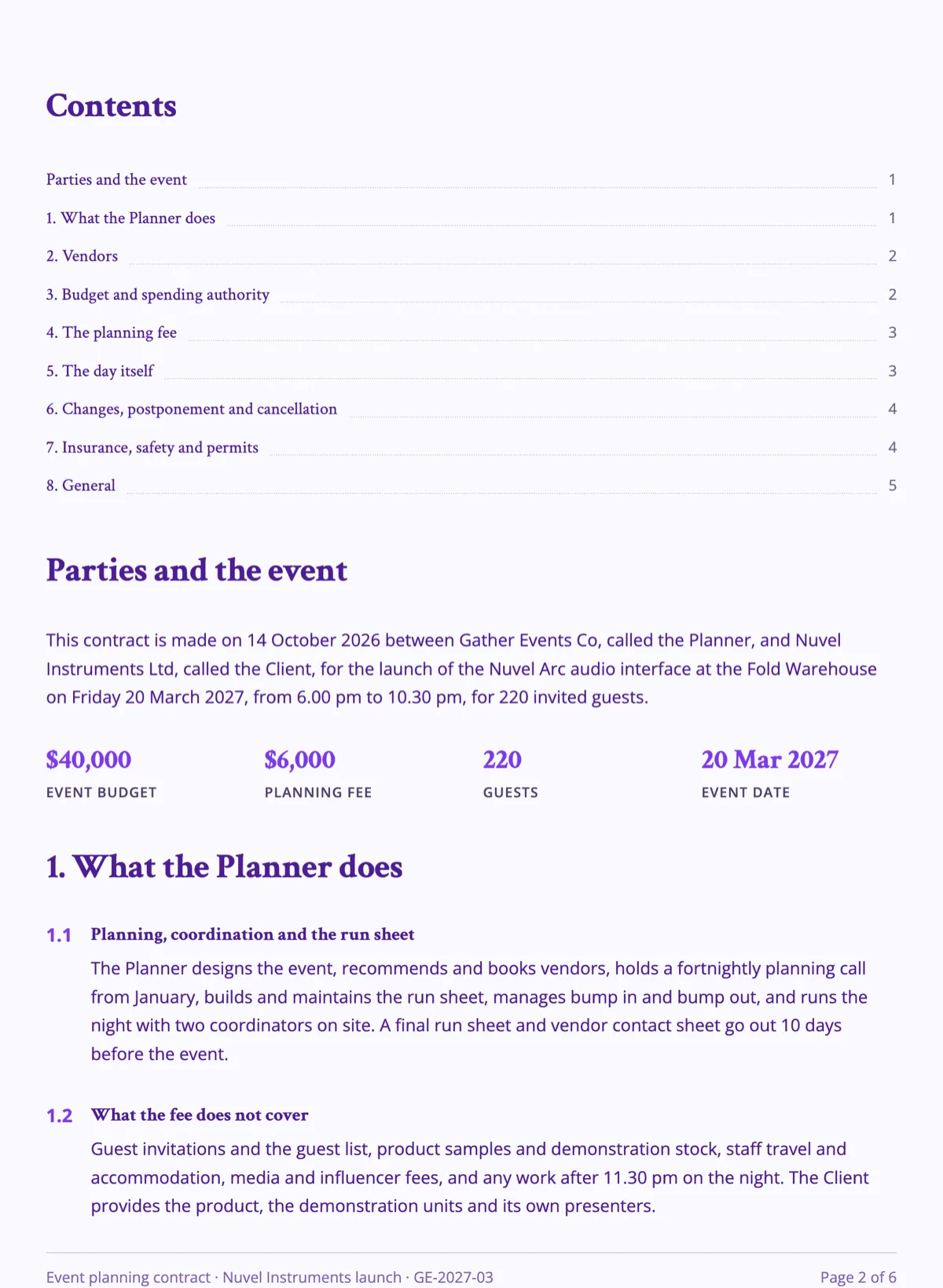 Event planning contract with a vendor table and a spending limitMost event disputes are really one of two arguments: who was actually contracted to the caterer, and who approved the extra $3,000. This contract answers both on the first two pages, with a vendor table that names the contracting party on every line and a spending limit the planner cannot quietly exceed.
Questions people ask
Does force majeure cover a pandemic?
Only if the clause says so, either by naming an epidemic or a public health order, or through an open definition wide enough to catch it. Clauses drafted before 2020 often referred to acts of God and natural disasters without mentioning disease or government restrictions, which left many parties arguing about wording that had never been tested.
Is a cost increase a force majeure event?
Almost never, and well drafted clauses say so expressly. Relief is for events that prevent performance, not events that make it unprofitable. A party worried about input costs needs a price adjustment or cost pass through mechanism instead, which is a pricing clause rather than a risk clause and is negotiated on different terms.
Does the affected party still have to pay?
Payment obligations are normally carved out, and they should be. A party that has received the benefit of work already performed should not be excused from paying for it because a later event stopped the rest. Clauses that omit the carve out let a party treat a disruption as a reason to stop paying invoices already due.
What is the difference between force majeure and frustration?
Force majeure is a contractual allocation of risk that the parties write themselves, and it usually suspends obligations. Frustration is a doctrine of the general law that discharges the contract entirely, and it applies only where performance becomes impossible or radically different. Frustration is also unavailable where the contract has already dealt with the event.
How long should the termination trigger be?
Long enough that an ordinary interruption does not end the contract, short enough that neither party is trapped. Thirty days suits a time critical supply, sixty to ninety days suits a longer relationship. Both parties should hold the right, since a one sided exit lets the unaffected party walk at the worst possible moment.
Must the affected party try to work around the event?
Include an express duty to mitigate and to resume as soon as it can, because without it a party can rely on the clause while making no effort. A mitigation obligation also gives the other side something concrete to point at if the relief is being stretched, which is more useful in practice than arguing about the definition.
Put the clause in a finished document
The button opens the document generator with a starting description already filled in. Change it to match your own agreement before you run it.
Create a document with OneCraftRelated clauses
- Suspension for non payment clause: pausing work, not ending itA suspension for non payment clause lets a supplier pause work on an overdue invoice without terminating. Sample wording, notice periods and three variants.
- Limitation of liability clause: putting a ceiling on exposureA limitation of liability clause puts a ceiling on what one party can recover. Australian sample wording, three variants, the carve outs and the UK test.
- Release clause: giving up claims for goodA release clause gives up claims one party has against another. Australian sample wording for a building settlement and the unknown claims problem.
For everything the document generator can do, see the document maker.
Step by step in the builder: Create a document with AI, then Every document component and when to use it.
Written and checked by the OneCraft team. Last checked .