Contract clause
Suspension for non payment clause: pausing work, not ending it
A suspension for non payment clause lets a supplier stop performing while an invoice is overdue, without ending the contract. It sets how overdue the amount must be, what warning the customer gets, what the supplier may and may not switch off, and what has to happen before work restarts.
Termination is a blunt response to a late invoice, because it ends the revenue as well as the exposure. Suspension keeps the contract alive and puts the pressure where it belongs.
Indunil Asanka · Co-founder
4 min read · Published
Sample clause
a website hosting and support agreement between Copperleaf Hosting and an online homewares retailer that has slipped two invoices behind
10. Suspension for non payment 10.1 If an amount is not paid within ten (10) days after its due date, Copperleaf Hosting may give the Client a written suspension warning identifying the invoice, the amount and the date suspension will take effect. 10.2 The suspension date in a warning must be at least five (5) business days after the warning is given. 10.3 If the amount remains unpaid on the suspension date, Copperleaf Hosting may suspend the Services until the amount and any interest accrued on it are paid in full. 10.4 Copperleaf Hosting must not suspend the Services because of an amount the Client has disputed in writing under clause 5.4 while that dispute is being resolved in good faith. 10.5 During a suspension Copperleaf Hosting must continue to hold the Client Data securely and must, on written request, provide the Client with an export of that data in a usable format within five (5) business days. 10.6 Copperleaf Hosting must restore the Services within one (1) business day of receiving payment, and may charge a restoration fee of two hundred dollars ($200).
Sample wording, not legal advice.
Variants
Immediate suspension on default
The service is expensive to keep running and the supplier cannot carry an unpaid month.
If an amount is not paid by its due date, the Supplier may suspend the Services immediately and without further notice, and must notify the Customer of the suspension on the day it takes effect. The Supplier is not liable for any loss the Customer suffers as a result of a suspension properly made under this clause. The Services resume when the overdue amount is paid in full together with any restoration fee.
Two stage notice
The customer is a larger organisation whose payment delays are usually administrative rather than financial.
The Supplier may suspend the Services only after giving two written notices. The first notice is given no earlier than seven (7) days after the due date and asks for payment within ten (10) business days. The second notice is given only if the amount remains unpaid, states the suspension date, and is sent to both the operational contact and the accounts payable contact named in the Details Schedule. Suspension takes effect no earlier than five (5) business days after the second notice.
Partial suspension only
Switching the whole service off would cause harm out of proportion to the debt, as with a live storefront or a patient record.
The Supplier may suspend only the parts of the Services described as Discretionary Services in Schedule 2, being new development work, priority support and reporting. The Supplier must continue to provide the Core Services, being hosting, security patching and backup, while an amount is overdue, and may recover the cost of doing so as a debt. The Supplier may terminate under clause 14 if the amount remains unpaid for sixty (60) days.
What to negotiate
How much notice before the switch off
Suppliers want the shortest path to leverage. Customers want enough warning to route the payment through an approval chain. Five business days after a written warning, itself given after the invoice is ten days overdue, is a common shape and rarely fought once the warning has to name the invoice.
What stays on during a suspension
Customers focus hard on data access and on anything customer facing. Suppliers who agree to keep backups, security patching and a data export running during a suspension usually win a shorter notice period in exchange, because the clause stops looking like a threat to the customer's own customers.
The restoration fee
A modest fee reflecting real work is accepted. A large one reads as a penalty and invites an argument about the whole clause. Keeping the figure small and stating that it covers restoration work is the version that survives, and it is also the version a customer actually pays without a second dispute.
The risk of leaving it out
Without a suspension right the supplier has two options on an overdue invoice: keep working and keep lending, or terminate for breach and lose the contract. Stopping work with no clause behind it is itself a breach, so a supplier that walks off site to force payment can end up defending a claim instead of pursuing one.
Suspension in construction contracts
In construction the right to suspend is not left entirely to the contract. Security of payment legislation in each state gives a claimant who has an adjudicated or unpaid scheduled amount a statutory route that can include suspending work after notice, on terms the legislation sets. A contractual clause that is narrower does not remove that entitlement, and a clause that purports to bar suspension in circumstances the legislation allows is unlikely to hold. Outside construction there is no equivalent, so the clause is the only source of the right.
Common mistakes
Suspension is allowed for any overdue amount, including one the customer has properly disputed, which turns a query into a shutdown. The clause says nothing about data, so a customer facing an outage also faces losing access to its own records. Restoration is left undefined, so nobody knows how quickly service returns after payment. And suspension and termination are drafted as alternatives without saying that a suspension does not waive the right to terminate later.
Where it sits in a generated document
Suspension normally sits between the payment clauses and the termination clause, since it is the middle remedy between them. A generated services agreement numbers each of those separately, so the suspension clause can refer to the disputed invoice sub clause and to the termination clause by number, and a warning letter can quote the right one without paraphrasing it. The same builder produces the overdue payment notice that carries the warning, and the figures in it are written as document content rather than as fields somebody fills in later.
Documents that carry this clause
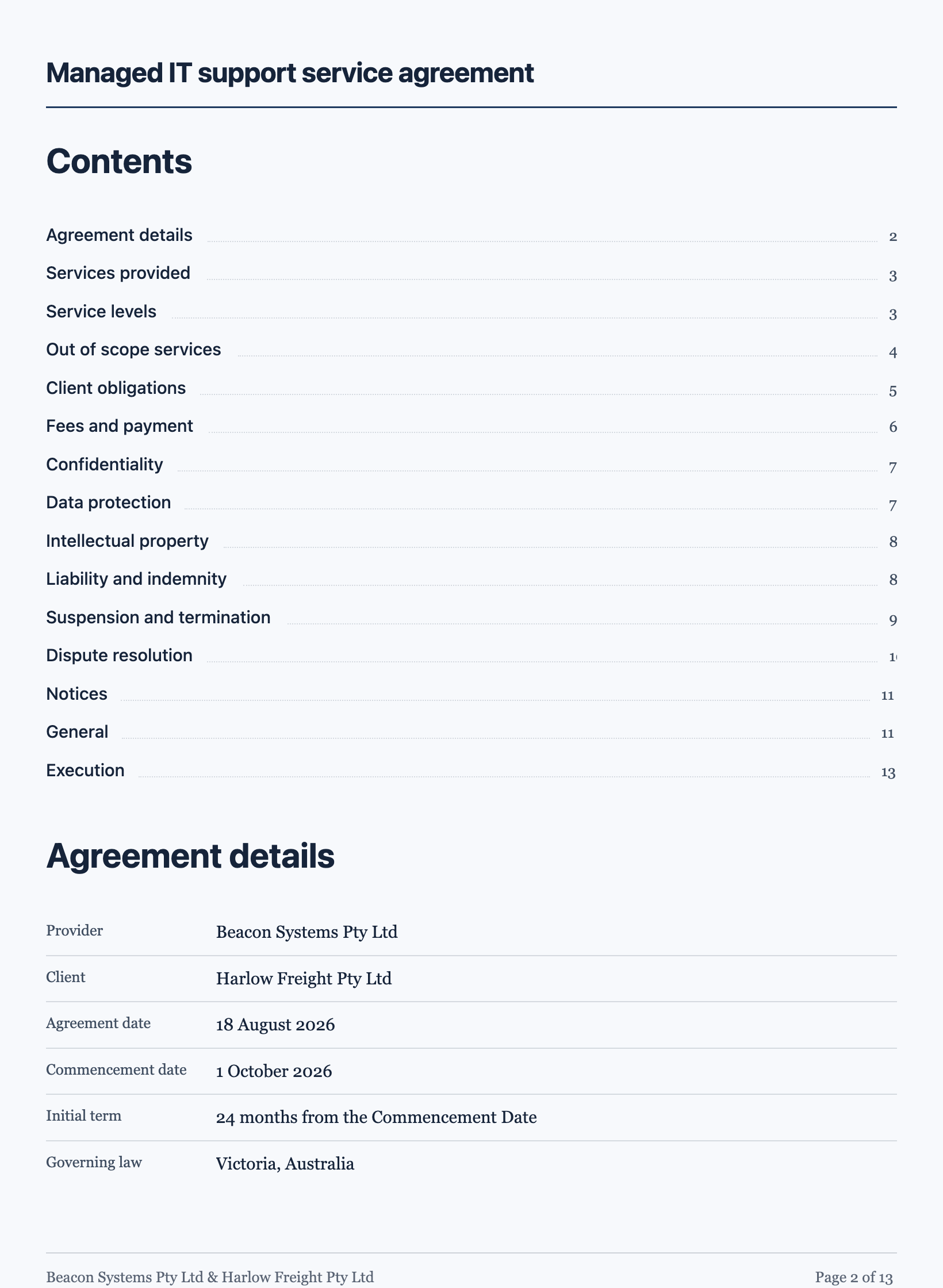 Service agreementBeacon Systems supports Harlow Freight’s IT for an initial 24 months from 1 October 2026 at $8,400 a month plus GST, with 40 hours included and $220 an hour beyond them. Twelve numbered clauses cover the services, a four level severity table, client duties, fees with a CPI adjustment, confidentiality, privacy, IP, a liability cap, termination and a three step dispute ladder.
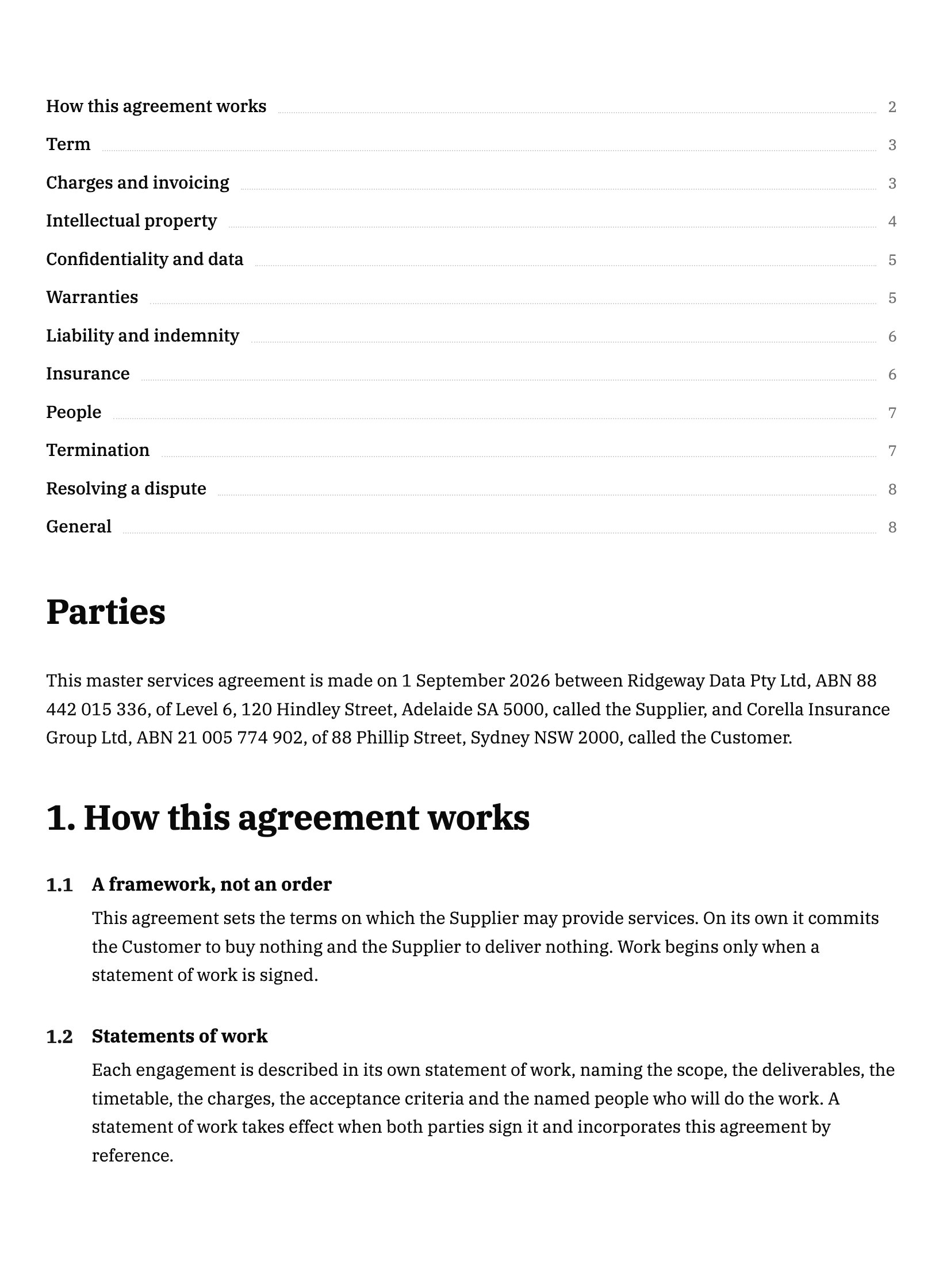 Master services agreementA data consultancy and an insurer sign this once and then buy work under it for three years. It is the rare contract whose whole purpose is to make the next twenty contracts short.
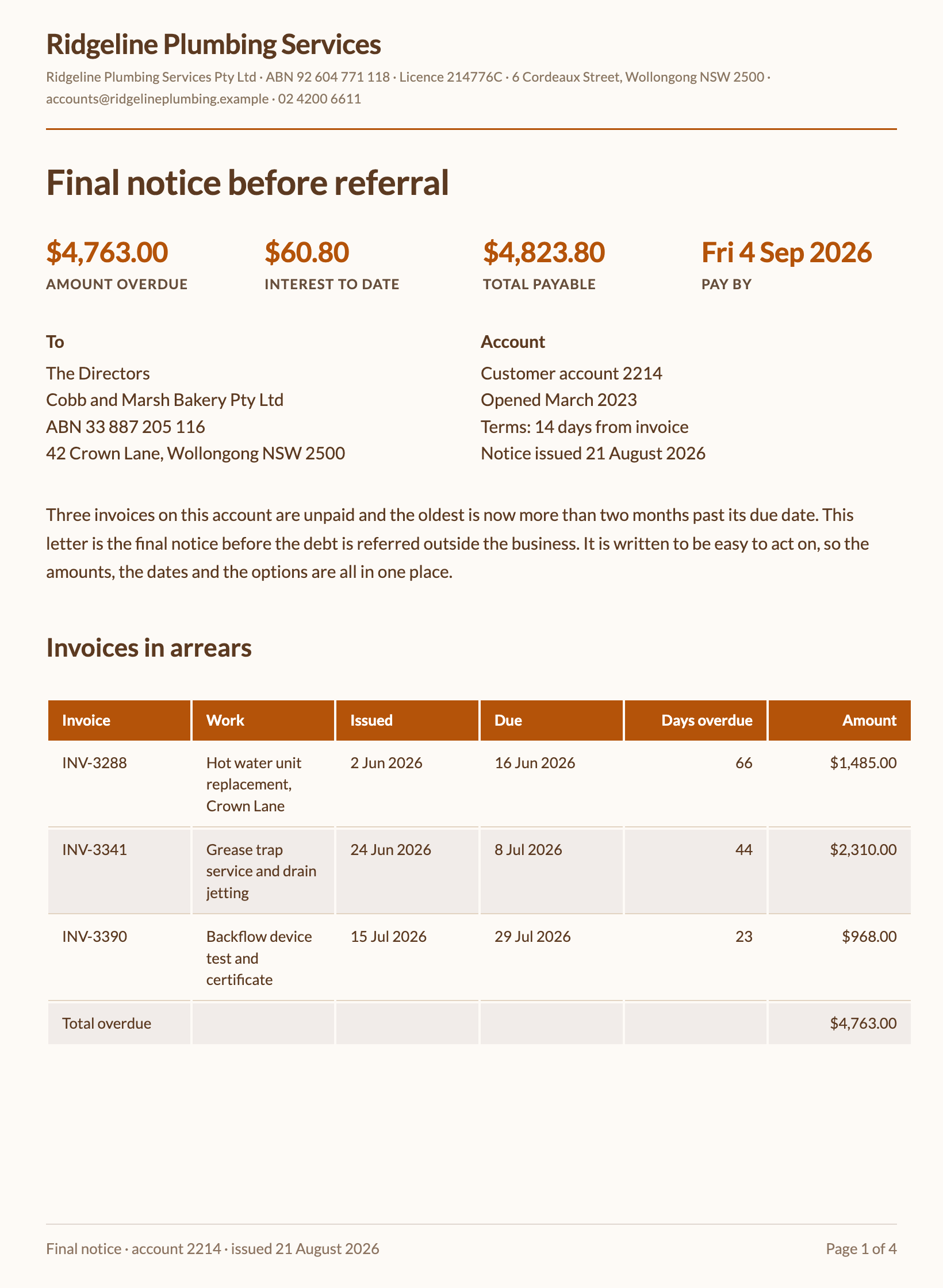 Overdue payment noticeA plumbing business is owed $4,763 across three invoices, the oldest sixty six days past due. This is the last letter before the debt leaves the business, and it is written to be acted on rather than to sound threatening.
Questions people ask
Can a supplier stop work because an invoice is unpaid?
Only if the contract gives that right, or in construction where security of payment legislation provides a statutory route. Stopping work without either is usually a breach, however justified it feels, and it hands the customer a claim. That is why the suspension clause is worth more to a supplier than the interest clause beside it.
How long should the notice period be?
Long enough for a payment to clear an ordinary approval chain, which in practice means five to ten business days after a written warning that names the invoice. A shorter period produces suspensions caused by internal delay rather than by refusal, and those are the ones that damage a relationship the supplier wants to keep.
Can a customer be suspended over a disputed invoice?
It should not be, and a well drafted clause excludes amounts genuinely disputed in writing within a short window. Without the carve out, a customer with a real complaint has to pay first to stay online, which is the shape regulators look at in standard form small business contracts.
Does suspension mean the customer stops paying?
No, and the clause should say so. Charges for the period usually continue to accrue, or the contract states expressly that they are paused, but silence produces a dispute about the suspended weeks on top of the original debt. Whichever position is chosen, write it in the same clause as the suspension right.
Should the supplier keep providing data access during a suspension?
Almost always. Cutting a customer off from its own records escalates a payment issue into a business continuity issue, and an export obligation costs the supplier very little. Customers will trade a shorter notice period for it, which means the concession usually improves the clause for both sides.
Can a supplier suspend and then terminate for the same non payment?
Yes, if the clause preserves that. Say expressly that suspension does not limit or waive the right to terminate, and that time spent suspended counts toward any cure period. Without those words a customer can argue the supplier elected suspension as its remedy and gave up the right to end the contract.
Put the clause in a finished document
The button opens the document generator with a starting description already filled in. Change it to match your own agreement before you run it.
Create a document with OneCraftRelated clauses
- Late payment interest clause: setting a rate that holdsA late payment interest clause sets what accrues on an overdue invoice. Australian sample wording at 8 percent, cash rate linked and UK statutory variants.
- Payment terms clause: when the money is actually dueA payment terms clause fixes when an invoice falls due and how it is paid. Australian sample wording, net 30 and seven day variants, and what to negotiate.
- Set off clause: deducting what the other side owesA set off clause lets one party deduct what the other owes it from what it owes. Australian sample wording, a no set off variant, and the insolvency position.
- Force majeure clause: excusing performance when events interveneA force majeure clause excuses performance during events outside either party's control. Sample wording with a sixty day exit, variants and notice duties.
For everything the document generator can do, see the document maker.
Step by step in the builder: Create a document with AI, then Every document component and when to use it.
Written and checked by the OneCraft team. Last checked .