Contract clause
Late payment interest clause: setting a rate that holds
A late payment interest clause says what a customer owes on top of the invoice once the due date passes. It fixes the rate, the day accrual starts, whether interest compounds, and whether a flat recovery fee applies as well. Its real job is to make paying late cost more than paying on time.
Interest on an overdue invoice is rarely collected in full, and that is not the point of the clause. Its value is that it gives a small supplier something concrete to write in the second reminder.
Indunil Asanka · Co-founder
4 min read · Published
Sample clause
a retainer between Kestrel Digital, a five person agency in Newcastle, and a regional equipment hire company that pays its suppliers slowly
9. Late payment 9.1 If an amount payable under this Agreement is not paid by its due date, the Client must pay interest on the unpaid amount at the rate of eight per cent (8%) per annum. 9.2 Interest accrues daily from the day after the due date until the amount is paid in full, and is calculated on the unpaid amount only. Interest does not compound. 9.3 Interest under clause 9.1 does not accrue on an amount the Client has disputed in writing under clause 5.4 while the dispute is being resolved in good faith, and accrues from the original due date if the dispute is resolved in favour of Kestrel Digital. 9.4 Kestrel Digital may recover its reasonable costs of collecting an overdue amount, including fees charged by a collection agent. 9.5 Interest is payable without the need for a demand and is not a fee for the extension of credit.
Sample wording, not legal advice.
Variants
Flat administration fee instead of interest
Invoices are small and daily interest on a few hundred dollars is not worth the accounting.
If an invoice is not paid within seven (7) days of its due date, the Customer must pay an administration fee of forty dollars ($40) for each reminder the Supplier issues, to a maximum of three reminders per invoice. The fee reflects the Supplier's reasonable cost of following up an overdue account and is payable in addition to the invoiced amount. No interest is charged on an overdue invoice while this clause applies.
Cash rate plus a margin
The term runs for years and neither side wants a fixed number to drift away from the cost of money.
Interest accrues on an overdue amount at the Reserve Bank of Australia cash rate target published on the first business day of the relevant month, plus four per cent (4%) per annum, calculated daily on the unpaid balance. If the cash rate target is not published for a month, the rate last published applies. The rate under this clause never falls below two per cent (2%) per annum.
United Kingdom statutory wording
Both parties act in the course of a business and the contract is governed by English law.
Interest on a late payment accrues under the Late Payment of Commercial Debts (Interest) Act 1998 at the statutory rate of eight per cent (8%) above the Bank of England base rate current on the last day of the period in which the debt became due, together with the fixed sum for the cost of recovering the debt allowed by that Act. The parties do not contract out of that entitlement.
United States wording with a usury saving clause
The customer is in a United States state where an excessive contract rate can be struck down or capped.
Past due amounts bear interest at one and one half per cent (1.5%) per month, or the maximum rate permitted by applicable state law, whichever is lower. If any interest charged is later determined to exceed the maximum lawful rate, the excess is applied to reduce the principal owing and any remaining excess is refunded to Buyer. Nothing in this section is intended to charge interest at a rate above the lawful maximum.
What to negotiate
The rate itself
Suppliers ask for a headline number that stings, often eight to twelve per cent. Customers push it toward the cost of short term borrowing. The common settlement is a benchmark plus a margin, which both sides can defend in three years, rather than a fixed figure chosen because it looked firm on the day.
Grace days before accrual
Customers with a monthly payment run ask for seven grace days so an ordinary cycle never triggers interest. Suppliers accept a short grace period if accrual then runs from the original due date rather than the end of the grace period, which stops the grace days becoming a free extension of the term.
Compounding and recovery costs
Compounding turns a modest rate into a large number over a long default and is usually resisted. Recovery costs are the opposite: customers rarely fight a clause that lets a supplier recover a collection agent fee, because a paying customer never triggers it. Simple interest with recovery costs is the usual landing point.
The risk of leaving it out
With no interest clause, an Australian supplier is left arguing for damages or statutory interest from the date proceedings begin, which is a much later date than the due date and a much harder conversation than pointing at a number in the contract. The practical effect is that slow paying customers are financed at zero per cent, and the supplier's own overdraft covers the gap.
Whether the rate is enforceable
An interest rate that genuinely compensates for late money is a legitimate contractual term. A rate set far above any plausible cost of funds starts to look like a punishment for breach rather than compensation, which is where the penalty doctrine becomes relevant, and in a standard form small business contract it can also be attacked as an unfair term. Two things keep a rate defensible. It is tied to something observable, and it is close to a rate a court would recognise as commercial.
Common mistakes
The rate is stated per month in one clause and per annum in another, so nobody knows which governs. Interest accrues on the whole invoice while part of it is legitimately disputed, which gives the customer a reason to dispute more. The clause charges interest and a flat fee and collection costs for the same delay, stacking three remedies for one breach. And the accrual start date is left as after the due date, which is one day of argument on every invoice.
Where it sits in a generated document
Late payment normally follows the payment clause so the due date it refers to is already defined. In a generated agreement the interest wording arrives as its own numbered clause with sub numbers for the rate, the accrual and the disputed amount carve out, which matters because a reminder letter will quote the number. The AI chat panel can rewrite the text of that clause, and only its text, so a rate change is an edit rather than a rebuild.
Documents that carry this clause
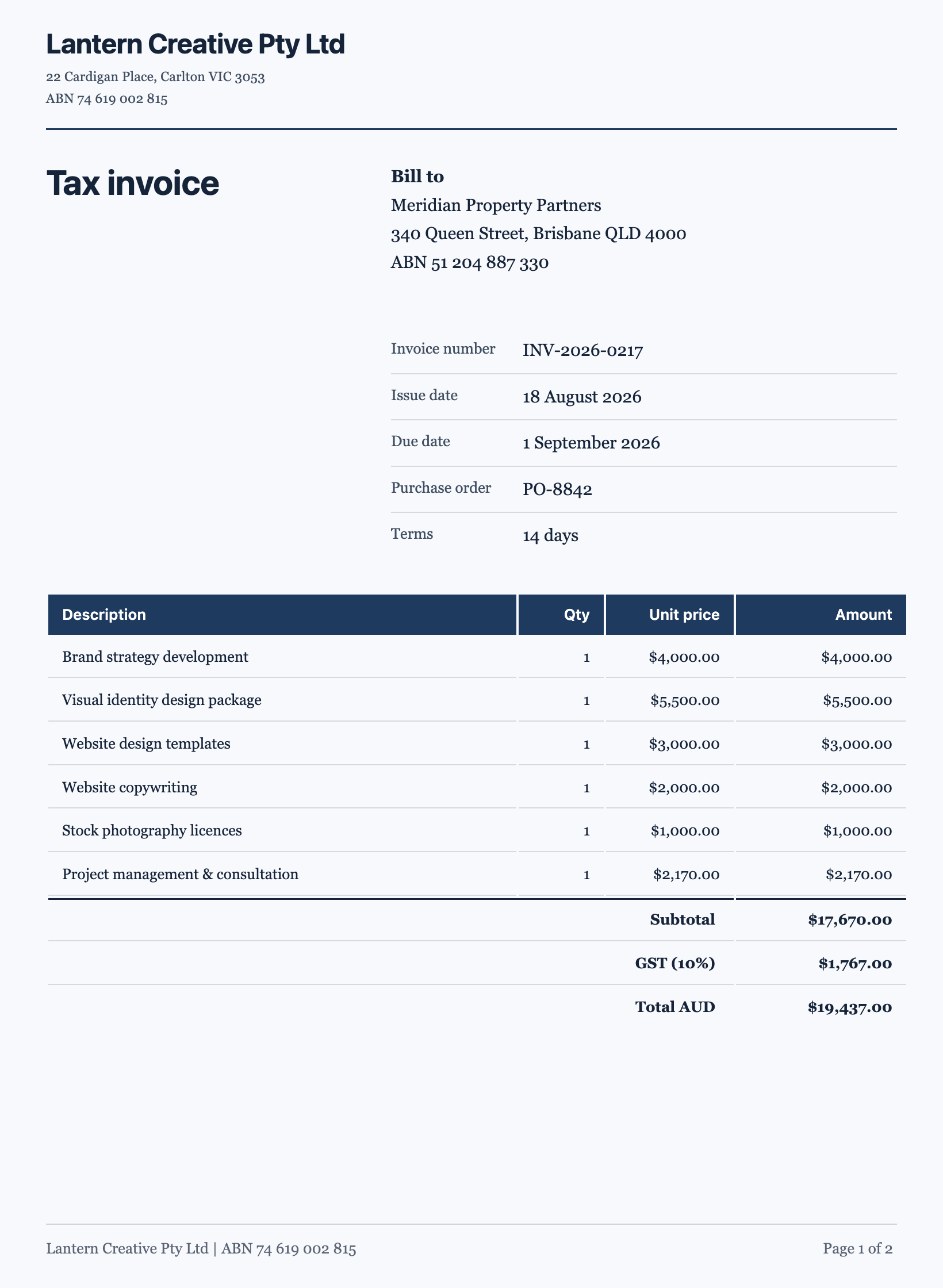 Tax invoice template with GST, terms and a due dateLantern Creative bills Meridian Property Partners $19,437 for six branding and website lines. Both ABNs are printed, the buyer’s purchase order PO-8842 is quoted, and the due date is 14 days after issue. Everything an accounts payable team checks before paying sits in one block above the table, and the bank details sit under it.
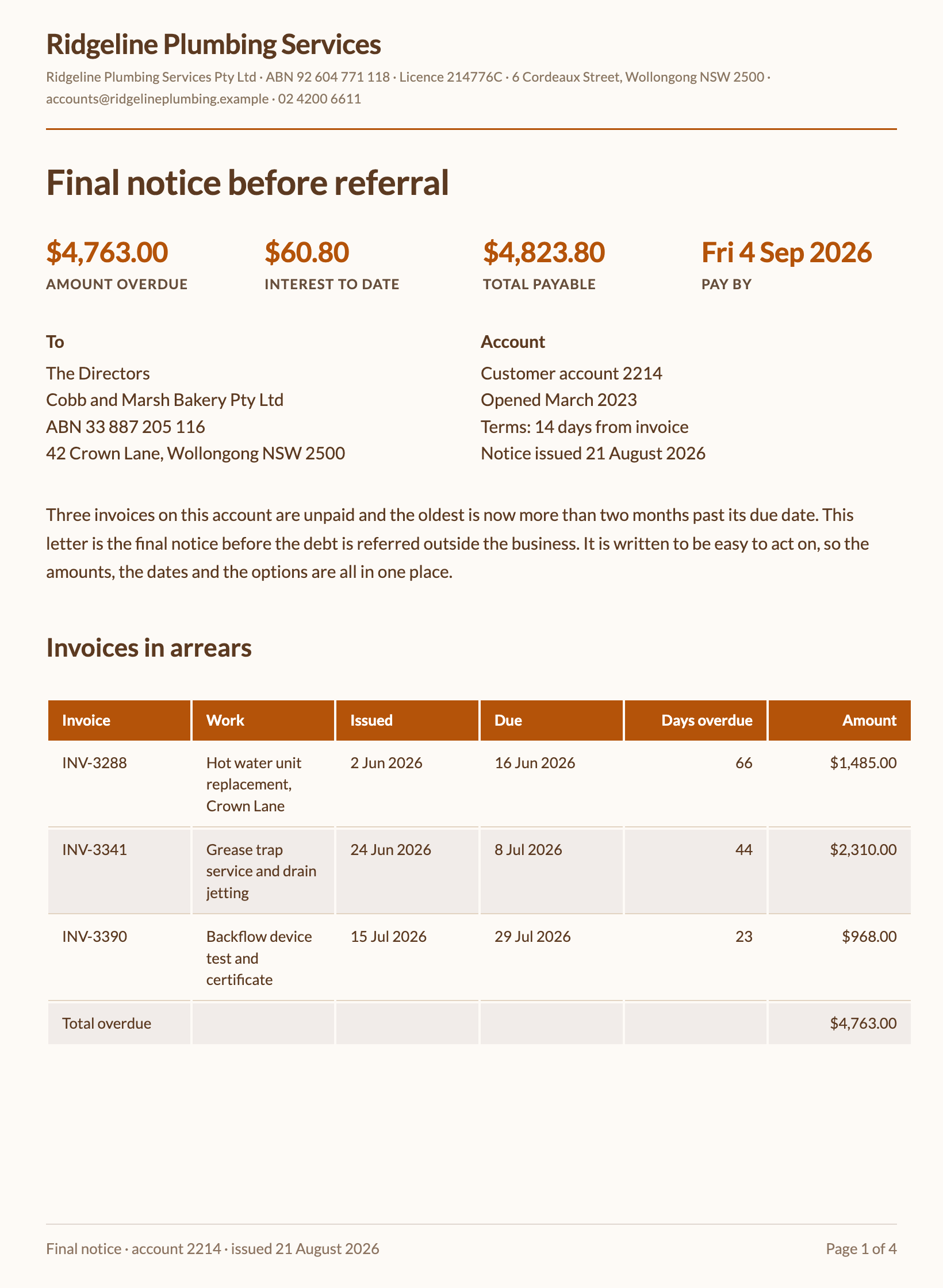 Overdue payment noticeA plumbing business is owed $4,763 across three invoices, the oldest sixty six days past due. This is the last letter before the debt leaves the business, and it is written to be acted on rather than to sound threatening.
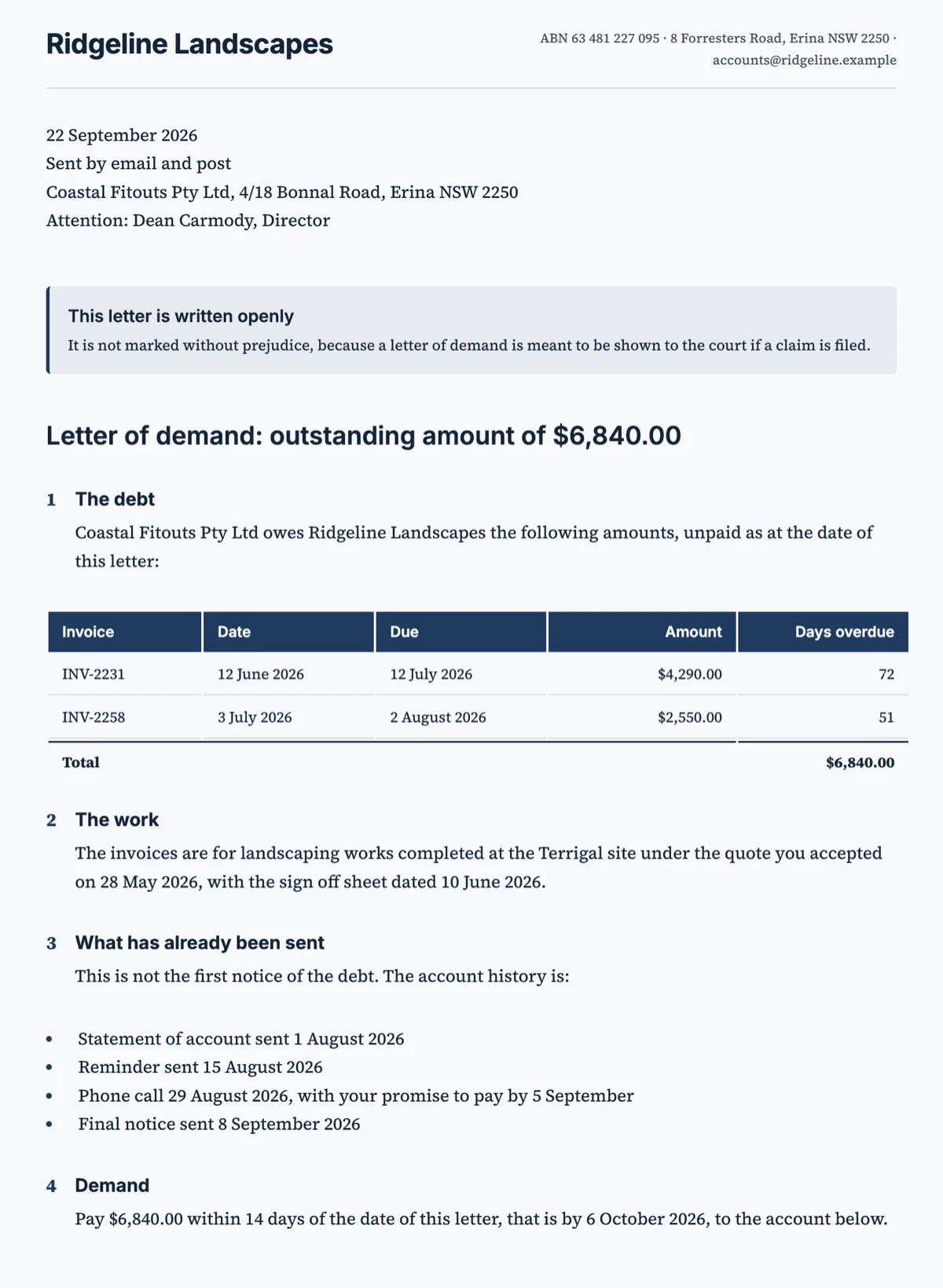 Letter of demand template that can go straight to the tribunalA letter of demand is the last letter that is not a court form, and it works because it is specific: what is owed, for what, since when, and what happens on day fifteen. This one itemises two invoices, lists the reminders already sent, gives fourteen days and names the court and the amounts that will be claimed.
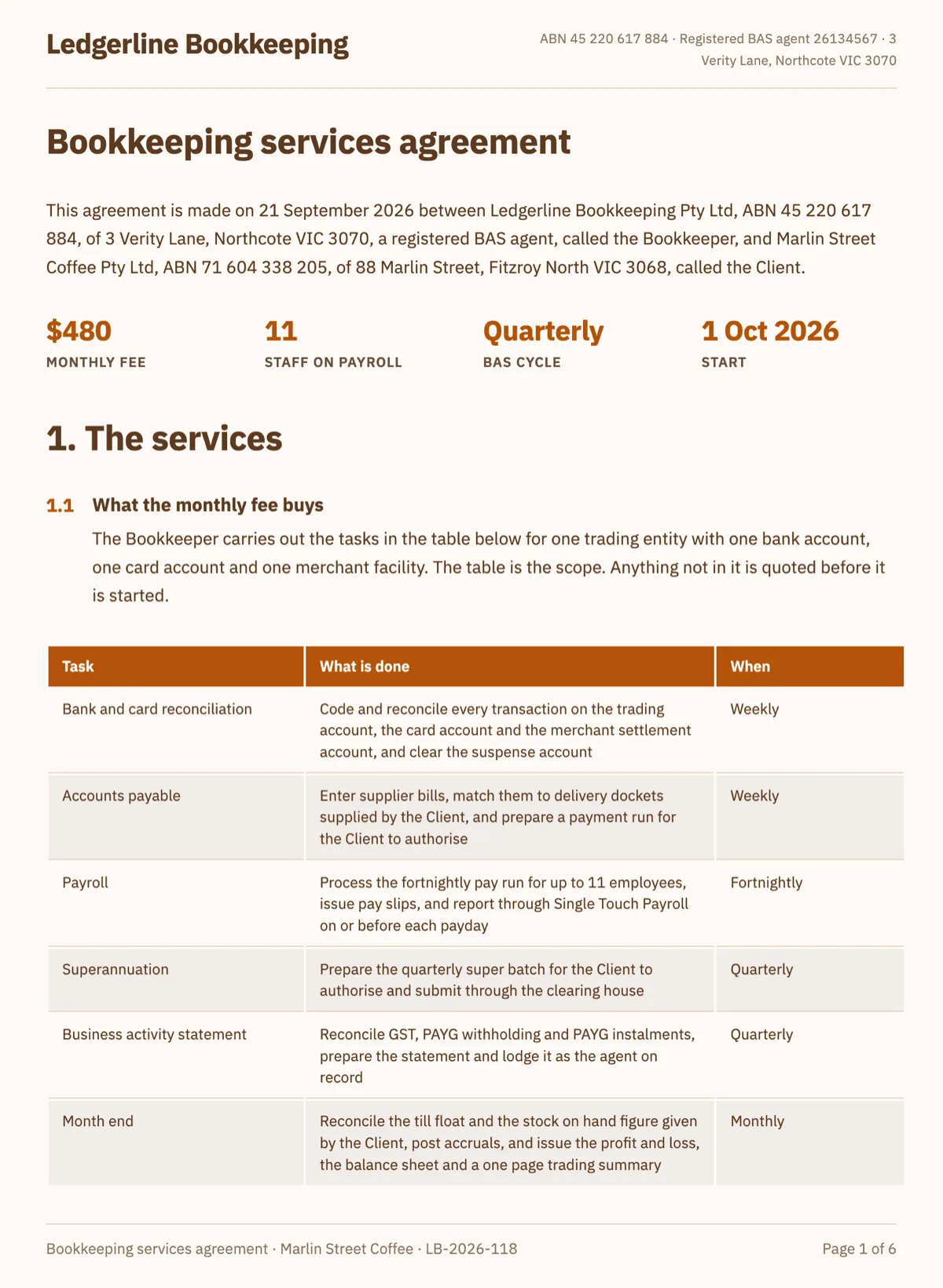 Bookkeeping services agreement with a monthly scope tableBookkeeping goes wrong when nobody wrote down which tasks are monthly, which are weekly, and who has to hand over what before a statement can be lodged. This agreement settles all three in a scope table and a lodgement calendar, then prices the whole year so the cafe can see what it is committing to.
Questions people ask
Is a late payment interest rate of 10 per cent enforceable in Australia?
Usually yes between businesses, because ten per cent a year is close to a commercial cost of funds and reads as compensation rather than punishment. The risk rises with the number. A rate that cannot be explained by any funding cost invites an argument that it is a penalty, and in a standard form small business contract it can also be challenged as unfair.
Can interest be charged without a clause in the contract?
Not as a contractual entitlement. A supplier can claim interest awarded by a court from the start of proceedings, and in some cases damages for the cost of being kept out of its money, but neither runs from the invoice due date. That gap between the due date and the filing date is what the clause is for.
Should interest compound?
Rarely worth the fight. Compounding matters only on long defaults, and by then the supplier is in a recovery process where the principal is the issue. Customers resist it strongly, and a compounding rate is easier to characterise as punitive. Simple daily interest on the unpaid balance is the standard.
Does interest apply to a disputed invoice?
Only if the clause says so, and a fair clause says it does not while the dispute is genuine. The usual compromise is that interest is suspended during a written dispute raised inside a short window, then backdated to the original due date if the dispute fails. That stops a query being used as a free extension.
Can a supplier charge a fee and interest for the same overdue invoice?
It can be drafted, and it is often cut in negotiation because it stacks remedies for one breach. A reminder fee that reflects real administrative cost sits comfortably beside interest. A fee that is really a second interest charge under another name does not, and it weakens the clause that would otherwise hold.
What happens in the United Kingdom if the contract is silent?
For a business to business debt, the Late Payment of Commercial Debts (Interest) Act 1998 supplies interest at eight per cent above the Bank of England base rate plus a fixed recovery sum, so silence is less damaging than in Australia. A contractual rate can replace it only if the substitute remedy is itself substantial.
Put the clause in a finished document
The button opens the document generator with a starting description already filled in. Change it to match your own agreement before you run it.
Create a document with OneCraftRelated clauses
- Payment terms clause: when the money is actually dueA payment terms clause fixes when an invoice falls due and how it is paid. Australian sample wording, net 30 and seven day variants, and what to negotiate.
- Suspension for non payment clause: pausing work, not ending itA suspension for non payment clause lets a supplier pause work on an overdue invoice without terminating. Sample wording, notice periods and three variants.
- Invoicing clause: when invoices go out and what they must showAn invoicing clause says when invoices go out and what they must show to be payable. Australian sample wording, the tax invoice checklist and three variants.
For everything the document generator can do, see the document maker.
Step by step in the builder: Create a document with AI, then Every document component and when to use it.
Written and checked by the OneCraft team. Last checked .