Contract clause
Payment terms clause: when the money is actually due
A payment terms clause fixes when money changes hands. It names the trigger that starts the clock, usually a valid tax invoice, the number of days until the amount falls due, the method of payment, and the account it goes to. Without those four facts an agreed price is only half agreed.
Most invoice disputes are not arguments about the amount, they are arguments about the date. A payment terms clause removes the argument by naming the trigger, the period and the method before any work starts.
Nuwan Madhusanka · Co-founder
4 min read · Published
Sample clause
a shop fit out contract between Harbourline Joinery and Meridian Dental, a two surgery practice refitting its reception in Adelaide
5. Payment 5.1 The Client must pay each amount set out in a valid Tax Invoice within fourteen (14) days of the date on which the Tax Invoice is received. 5.2 A Tax Invoice is valid when it states the Contract Reference, itemises the Works completed in the relevant period, and meets the requirements for a tax invoice under Australian law. 5.3 Payment is made by electronic funds transfer to the account Harbourline Joinery nominates in writing. Payment by cheque is not accepted. 5.4 If the Client disputes part of a Tax Invoice in good faith, the Client must pay the undisputed part by the due date and give written notice of the disputed part within seven (7) days of receipt, setting out the reason for the dispute. 5.5 Payment of a Tax Invoice is not an acknowledgement that the Works to which it relates are complete or free from defects.
Sample wording, not legal advice.
Variants
Thirty days from end of month, pro customer
The customer runs one payment run a month and wants every invoice to land in the same cycle.
The Customer must pay each valid Tax Invoice within thirty (30) days of the end of the calendar month in which the Tax Invoice is received. A Tax Invoice received after the twenty fifth day of a month is treated as received in the following month. The Customer is not required to pay a Tax Invoice that omits a purchase order number, and the payment period for that Tax Invoice starts again when a corrected Tax Invoice is received.
Seven days from issue, pro supplier
A small supplier funds materials out of its own working capital and cannot carry a month of exposure.
The Client must pay each Tax Invoice within seven (7) days of the date the Tax Invoice is issued. Receipt is presumed on the day the Tax Invoice is sent to the email address in the Details Schedule. The payment period is not extended by an internal approval process of the Client, by the absence of a purchase order, or by any query raised after the due date.
United Kingdom wording
The agreement is governed by the law of England and Wales and both parties act in the course of a business.
The Customer shall pay each undisputed invoice within thirty (30) days of receipt. The parties acknowledge that the Late Payment of Commercial Debts (Interest) Act 1998 applies to this Agreement and that nothing in this clause is intended to oust or postpone the statutory right to interest and to a fixed sum for the cost of recovering a late payment. Any contractual remedy for late payment operates in substitution for that statutory right.
United States wording
The buyer is a United States company and the contract is for goods, so state law and the Uniform Commercial Code sit behind the terms.
Buyer shall pay each invoice Net 30 from the invoice date. The parties agree that Net 30 has the meaning given to it by trade usage and the course of dealing between them, and that acceptance of goods does not waive Buyer's right to revoke acceptance for a nonconformity discovered within a reasonable time. Payment is made in United States dollars by ACH transfer to the account stated on the invoice.
What to negotiate
Invoice date or invoice receipt
Suppliers want the clock to start when the invoice is issued. Customers want it to start when a correct invoice reaches accounts payable. The usual landing point is receipt at a named email address, with receipt presumed on the day of sending, so the supplier keeps a fixed date and the customer keeps one delivery point.
What makes an invoice invalid
A customer with a purchase order system will ask that an invoice missing the order number is not payable. Suppliers accept that only if a correction restarts the clock rather than cancelling the debt, and only if the customer must raise the defect within a few days rather than on the due date.
The disputed amount carve out
Without a carve out, one queried line lets a customer hold the whole invoice. The settled position pays the undisputed part on time, requires the reason for the dispute in writing within a short window, and names the person it goes to, so a query never stops the payment cycle.
The risk of leaving it out
With no payment term, Australian courts read in an obligation to pay within a reasonable time, and what is reasonable is argued after the fact from the conduct of the parties and the custom of the trade. That leaves no certain due date, no clean starting point for interest, and a debt that is harder to prove overdue in a recovery claim.
How courts read it
A payment clause is read against the whole bargain rather than on its own. Where the contract fixes a due date, that date governs and the supplier need not prove what was reasonable. Where it does not, a term requiring payment within a reasonable time is implied, and the court looks at the trade, the size of the job and how the parties handled earlier invoices. Standard form wording drafted by one side is read against that side when it is genuinely unclear, which favours short sentences and plain dates.
Common mistakes
Three appear often. The clause says thirty days without saying thirty days from what, so the trigger is guessed. The payment method names a bank account inside the contract, so a change of bank needs a variation, which is also how invoice redirection fraud finds its opening. And payment is made conditional on satisfaction rather than on a stated acceptance test, handing the customer a discretion the supplier cannot price. Naming the trigger, nominating the account in writing, and defining acceptance fixes all three.
Where it sits in a generated document
Payment usually lands as the third or fourth clause, after the parties and the scope, because everything after it refers back to the amount. The document generator classifies an agreement like this one as legal in register and numbered in structure, so payment arrives as clause 5 with its own sub numbers and a later reference to clause 5.4 resolves. Figures are written as content, never as fillable inputs, and no source is cited for them.
Documents that carry this clause
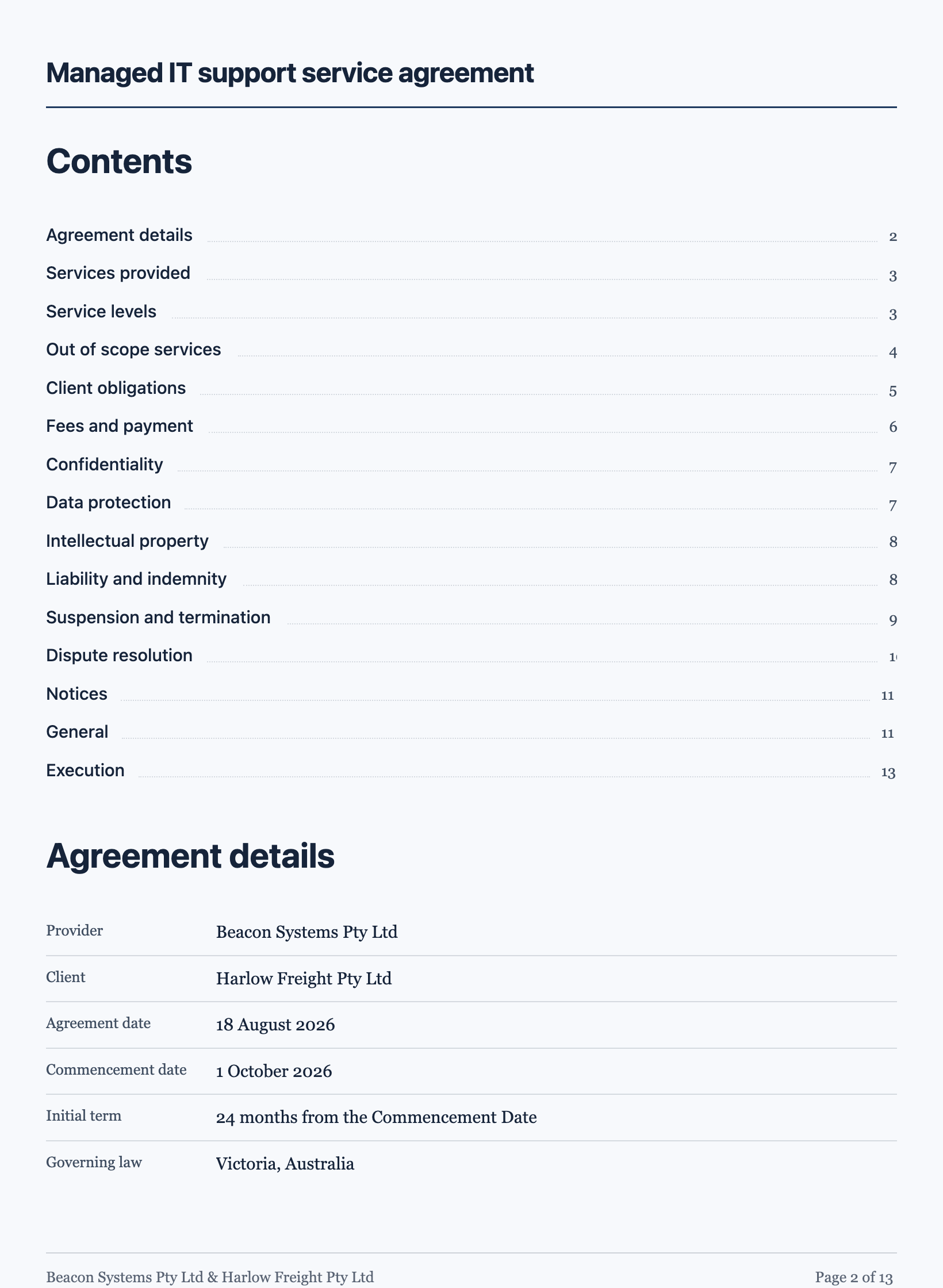 Service agreementBeacon Systems supports Harlow Freight’s IT for an initial 24 months from 1 October 2026 at $8,400 a month plus GST, with 40 hours included and $220 an hour beyond them. Twelve numbered clauses cover the services, a four level severity table, client duties, fees with a CPI adjustment, confidentiality, privacy, IP, a liability cap, termination and a three step dispute ladder.
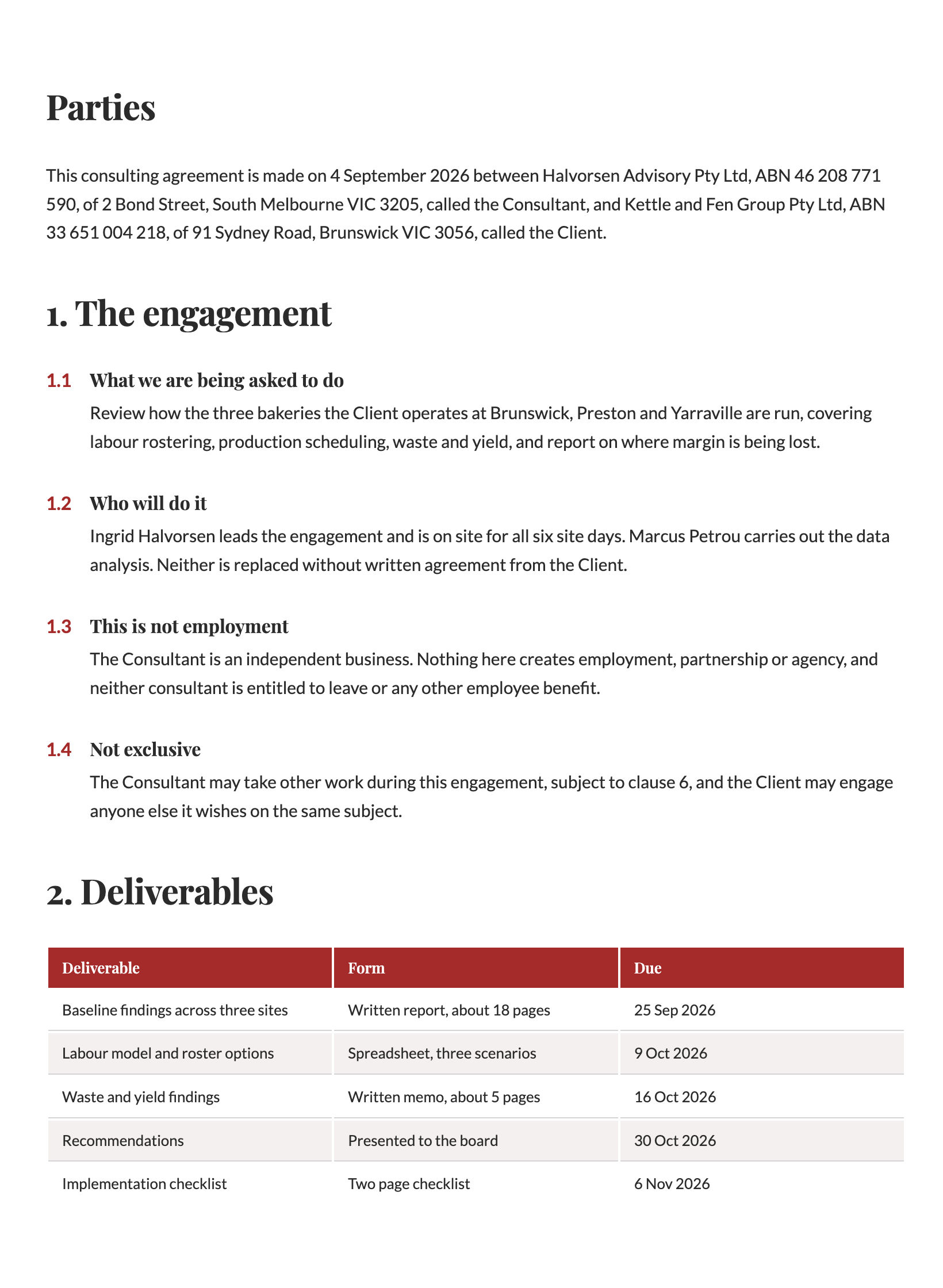 Consulting agreementAn advisory firm reviews three bakeries over seven weeks. What makes this agreement useful is not the fee clause but the two clauses that say what the advice is not.
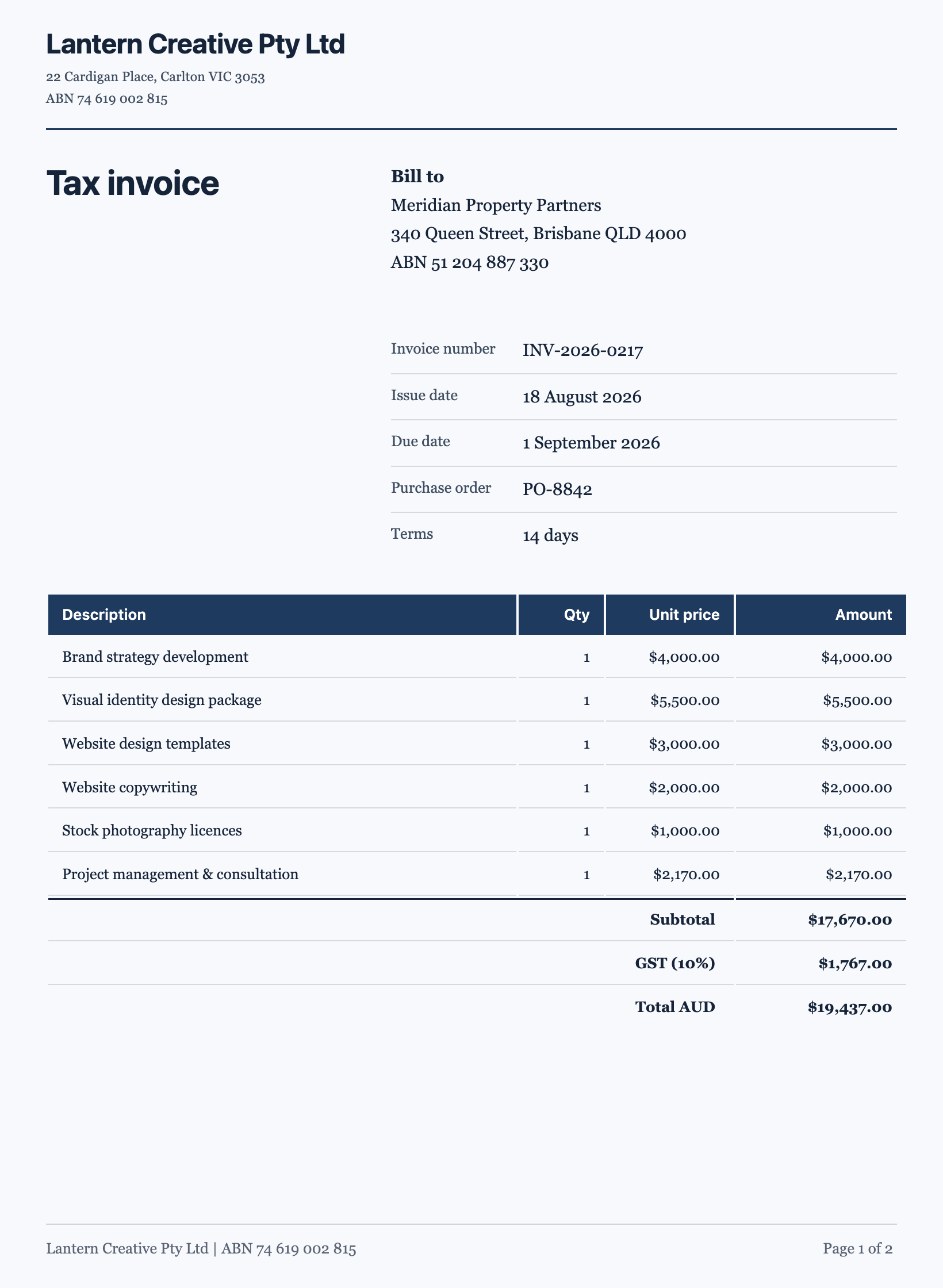 Tax invoice template with GST, terms and a due dateLantern Creative bills Meridian Property Partners $19,437 for six branding and website lines. Both ABNs are printed, the buyer’s purchase order PO-8842 is quoted, and the due date is 14 days after issue. Everything an accounts payable team checks before paying sits in one block above the table, and the bank details sit under it.
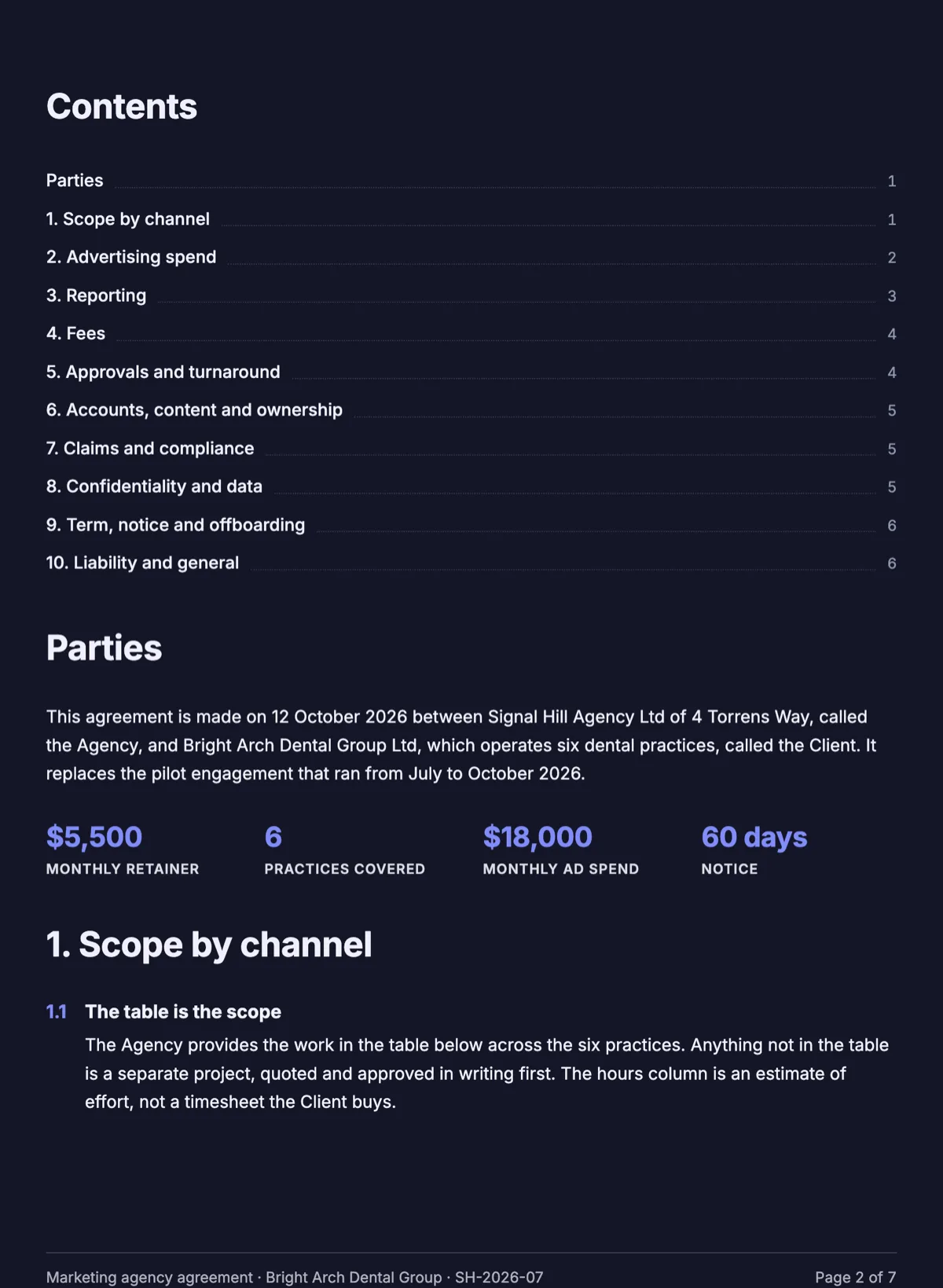 Marketing agency agreement with a channel scope and ad spend held apartThe two things that break an agency relationship are a scope nobody can point at and a fee that quietly includes the advertising budget. This retainer puts the work in a table with the hours and the reported metric for each channel, then keeps every dollar of ad spend in the accounts of the client where it belongs.
Questions people ask
Do payment terms run in business days or calendar days?
Calendar days unless the clause says otherwise, which is why a fourteen day term ending on a long weekend gives less time than it looks. If a payment run is weekly, say business days and name the run. Mixing the two in one contract is a common drafting slip worth checking.
What is a reasonable payment term for a small business in Australia?
There is no statutory maximum for private contracts. Government and large business codes have pushed toward twenty to thirty days, and the Australian Small Business and Family Enterprise Ombudsman publishes guidance on payment times. Fourteen to thirty days is the common commercial range, and anything longer belongs in the rate.
Can a customer change the payment terms after signing?
Not unilaterally, unless the contract gives that right. A notice announcing new terms across all suppliers is an offer to vary, not a variation. If the supplier keeps invoicing on the old terms and the customer keeps paying late, the argument becomes about conduct, which is the uncertainty the clause exists to remove.
Does the payment clause need to mention GST?
It helps, but the tax treatment belongs in its own clause so the payment clause stays about timing. Wording that says amounts are payable in full without deduction, sitting beside a separate clause stating prices are exclusive of GST, keeps both readable. Mixing gross up language into the due date is where confusion starts.
Is an emailed invoice enough to start the clock?
Yes, if the contract says so. Name the address, say receipt is presumed on the day of sending, and require the supplier to use that address rather than an individual mailbox. Without that, a customer can argue the invoice never reached accounts payable, and the supplier must prove delivery to someone who may have left.
Can payment be made conditional on the work being accepted?
It can, and suppliers should insist acceptance is defined rather than left to satisfaction. Tying payment to a written acceptance notice, with acceptance deemed to occur if no notice and no defect list arrives within a stated number of days, gives both sides a date. Payment on satisfaction is payment at the customer's option.
Put the clause in a finished document
The button opens the document generator with a starting description already filled in. Change it to match your own agreement before you run it.
Create a document with OneCraftRelated clauses
- Invoicing clause: when invoices go out and what they must showAn invoicing clause says when invoices go out and what they must show to be payable. Australian sample wording, the tax invoice checklist and three variants.
- Late payment interest clause: setting a rate that holdsA late payment interest clause sets what accrues on an overdue invoice. Australian sample wording at 8 percent, cash rate linked and UK statutory variants.
- Deposit clause: what happens to money paid up frontA deposit clause takes money up front and says what happens to it. Australian sample wording, refundable and non refundable variants, and the unfair terms risk.
- Suspension for non payment clause: pausing work, not ending itA suspension for non payment clause lets a supplier pause work on an overdue invoice without terminating. Sample wording, notice periods and three variants.
For everything the document generator can do, see the document maker.
Step by step in the builder: Create a document with AI, then Every document component and when to use it.
Written and checked by the OneCraft team. Last checked .