Contract clause
Deposit clause: what happens to money paid up front
A deposit clause requires part of the price before the work starts and says what becomes of that money. It names the amount, when it is paid, whether it is credited against the final invoice, and what happens to it if the customer cancels or the supplier does not perform.
A deposit does two jobs at once, funding the early cost of a job and proving the customer is serious. The clause only works if it says which of those jobs it is doing.
Nuwan Madhusanka · Co-founder
4 min read · Published
Sample clause
a wedding booking between Wattle Lane Photography and a couple holding a reception at a Yarra Valley venue eleven months later
3. Booking fee 3.1 The Client must pay a booking fee of thirty per cent (30%) of the Total Fee within five (5) business days of signing this Agreement. The date is not held for the Client until the booking fee is received. 3.2 The booking fee is credited in full against the final invoice for the Services. 3.3 If the Client cancels more than ninety (90) days before the Event Date, Wattle Lane Photography refunds the booking fee less five hundred dollars ($500), which represents the cost of the booking work already performed and of holding the date. 3.4 If the Client cancels ninety (90) days or fewer before the Event Date, the booking fee is retained, because the date can no longer reasonably be resold. 3.5 If Wattle Lane Photography cannot attend the Event for any reason other than an act or omission of the Client, the booking fee is refunded in full.
Sample wording, not legal advice.
Variants
Fully refundable on notice
The supplier can resell the slot easily and wants a low friction booking.
The Customer must pay a deposit of twenty per cent (20%) of the Price on booking. The deposit is credited against the final invoice. If the Customer cancels by written notice at least fourteen (14) days before the Start Date, the Supplier refunds the deposit in full within ten (10) business days. If the Customer cancels later than that, the Supplier refunds the deposit less any cost it has already committed and cannot recover, and must provide evidence of that cost on request.
Non refundable for a stated reason
The deposit funds materials or a subcontractor booking that cannot be unwound.
The Customer must pay a deposit of forty per cent (40%) of the Price before the Supplier orders materials. The deposit is not refundable, because the Supplier applies it immediately to a non returnable materials order placed for this job and to securing an installation window. The Supplier must give the Customer the materials order reference on request. If the Supplier does not place that order, the deposit is refunded in full.
Staged deposit
The job has a long lead time and one large deposit is too much exposure for the customer.
The Customer must pay ten per cent (10%) of the Price on signing to secure the production slot, and a further twenty per cent (20%) fourteen (14) days before the Start Date. Each amount is credited against the final invoice. If the Customer cancels before the second instalment falls due, the first instalment is retained and the second is not payable. Neither amount is refundable after the Supplier has begun manufacture.
What to negotiate
Refundable, forfeited, or credited
Customers read a deposit as a part payment they get back. Suppliers read it as security they keep. The clause has to pick. The workable middle is credited against the final invoice, refundable up to a stated date, and retained after it.
The size of the forfeited amount
A forfeit that is far larger than the loss caused by cancelling starts to look like a penalty, and in a standard form consumer or small business contract it is also exposed as an unfair term. Suppliers who tie the retained amount to real cost, and can produce the order or the roster to prove it, keep the clause.
What happens if the supplier cancels
A one sided deposit clause covers only customer cancellation. Customers will ask for the mirror, a full refund plus a stated period to pay it if the supplier withdraws. Most suppliers concede this quickly, because refusing it signals the clause was drafted without them ever failing to turn up.
The risk of leaving it out
Without a deposit clause the supplier has no right to money before performance, so a customer who walks away on the morning of the job leaves nothing behind. Worse, a deposit taken without a clause has no agreed character, so whether it can be kept is argued from scratch, and a court asked to decide will look at the supplier's actual loss rather than at the amount held.
The unfair terms exposure
Where the contract is a standard form and the other side is a consumer or a small business, the unfair contract terms regime in the Australian Consumer Law applies, and a clause that keeps a large deposit regardless of when the customer cancels is the shape regulators look for. The Australian Competition and Consumer Commission has pursued booking and cancellation terms on exactly that basis. Two features move a clause out of the danger zone: the retained amount reflects real loss, and the customer can see how it was calculated before they sign.
Deposit, part payment or penalty
The label on the money matters less than what the clause does with it. A booking fee credited to the final invoice is a part payment. A sum retained on cancellation is a liquidated amount, and it survives only if it is a genuine estimate of loss rather than a deterrent. The safest structure separates the two ideas in different sub clauses, so the part payment is obvious and the forfeit sits beside the reason for it. Then the argument is about the number, not the character of the money.
Where it sits in a generated document
A booking fee clause belongs early, usually right after the fee, because it is a condition of the date being held at all. Generated agreements place it as a numbered clause with the cancellation tiers as sub numbers, which makes the ninety day line easy to quote in an email. Every amount is written into the document as content, since input fields are not used, so a signed copy and the sender's copy always read the same.
Documents that carry this clause
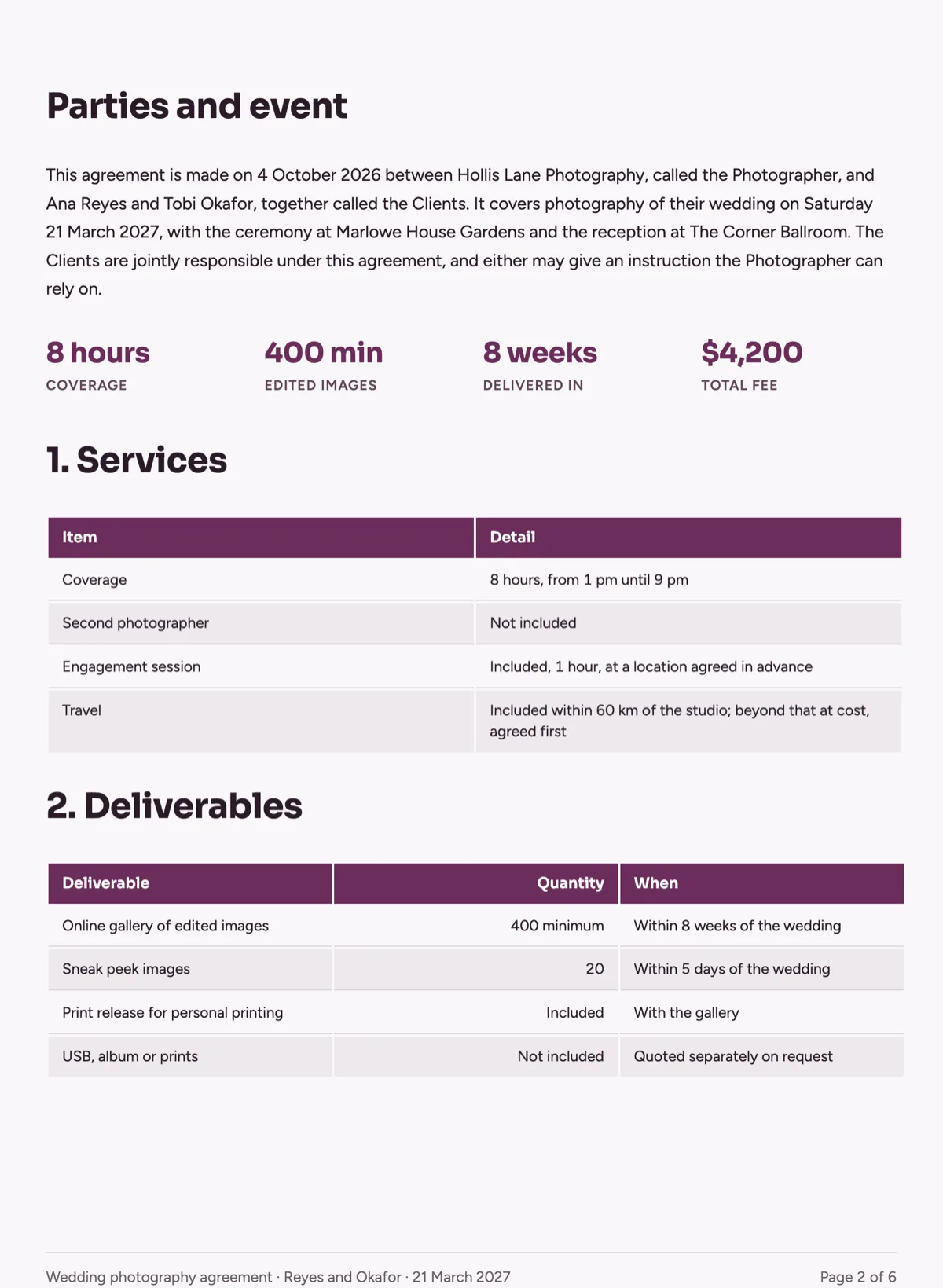 Photography contract template with deliverables you can countA photography contract is mostly a list of numbers: hours, images, weeks, dollars and the date after which the deposit is gone. This one writes every number down, then handles the three things that go wrong with weddings, a postponement, a sick photographer and an argument over who owns the photos.
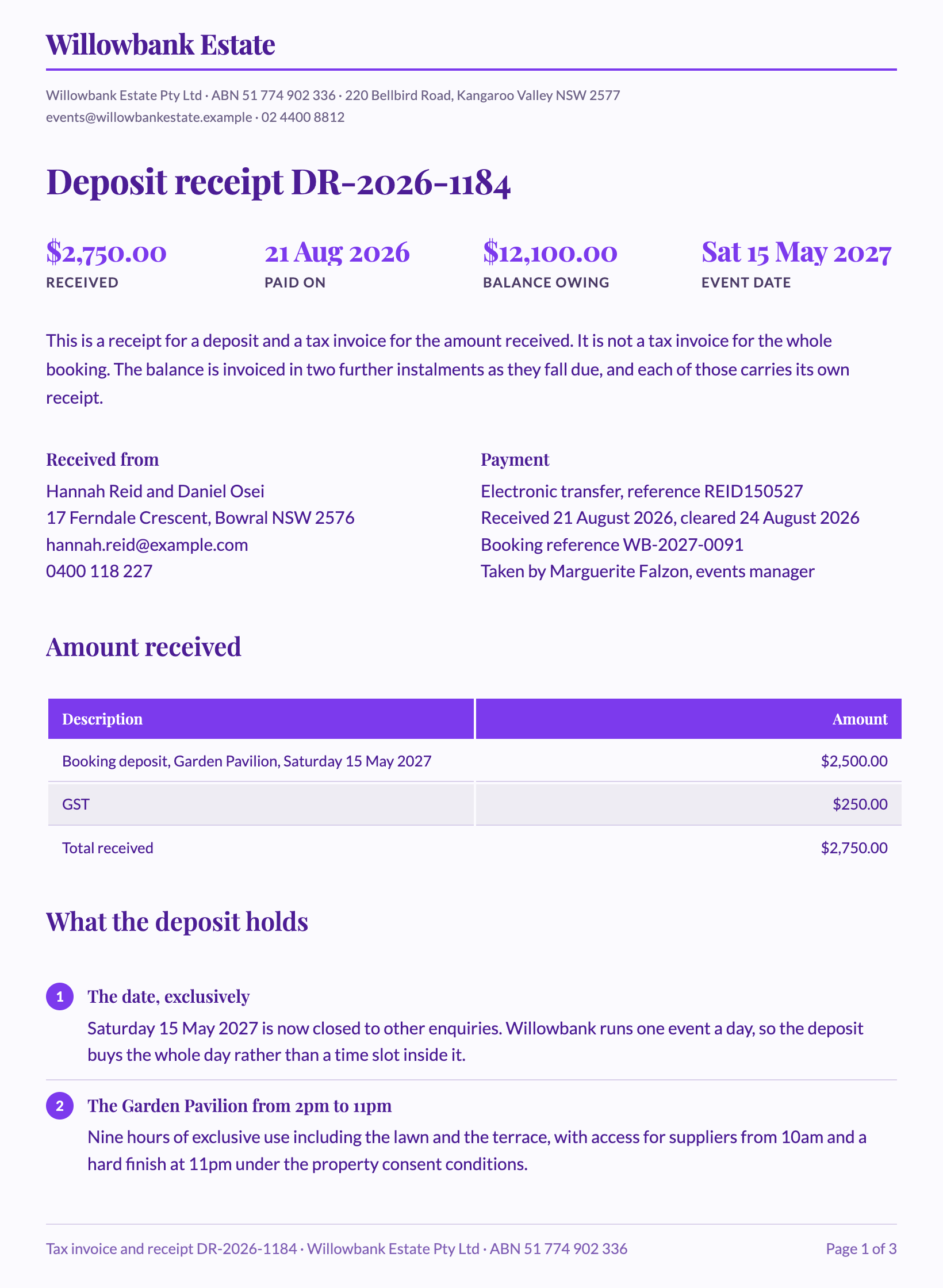 Deposit receiptA couple pays $2,750 to hold a Saturday in May. The receipt has to do three jobs at once: prove the payment, say what it buys, and be honest about the date after which the money stops being refundable.
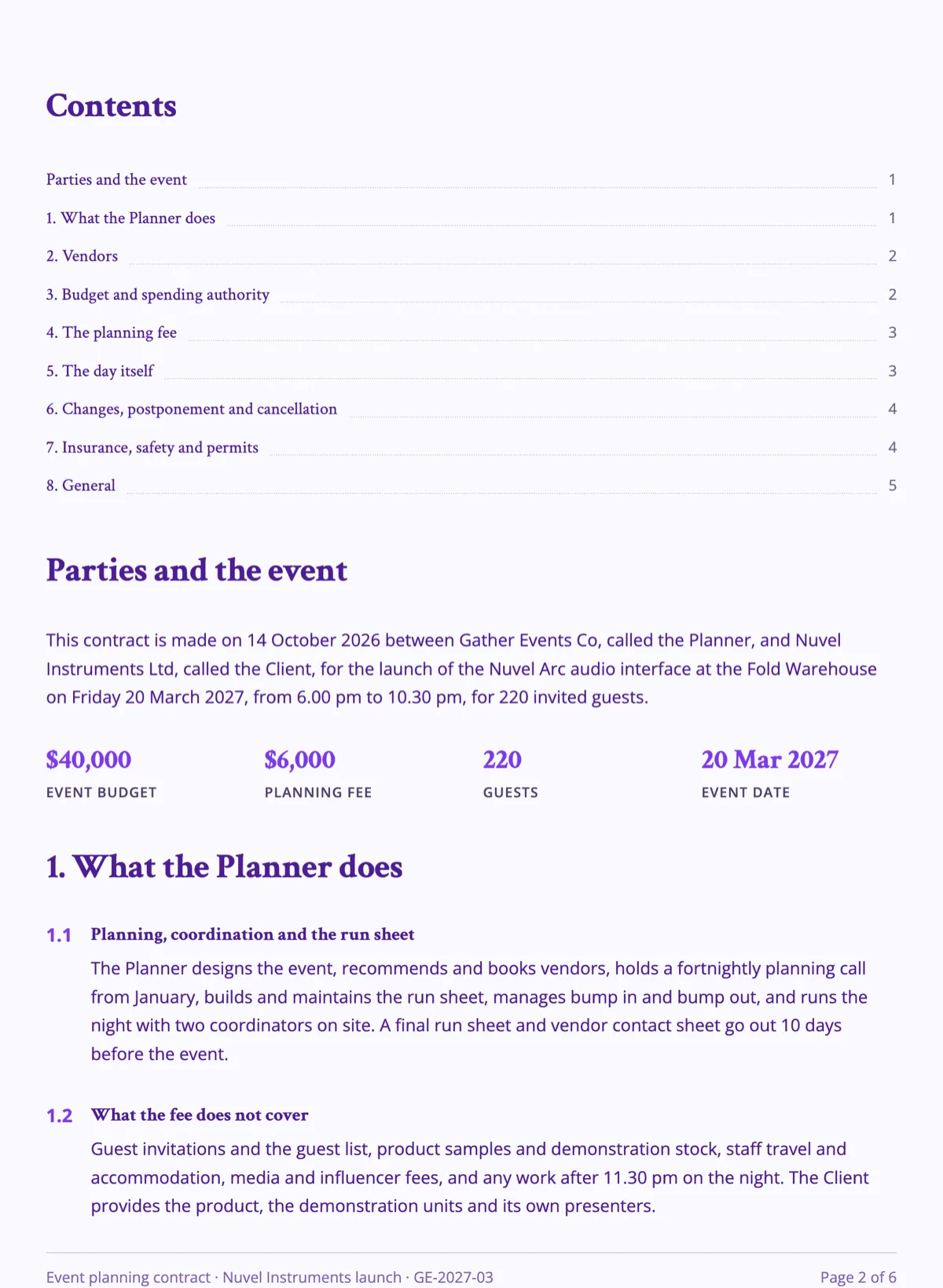 Event planning contract with a vendor table and a spending limitMost event disputes are really one of two arguments: who was actually contracted to the caterer, and who approved the extra $3,000. This contract answers both on the first two pages, with a vendor table that names the contracting party on every line and a spending limit the planner cannot quietly exceed.
Questions people ask
Can a deposit be completely non refundable in Australia?
It can be drafted that way, and it holds better when the clause explains why, for example that the money funds a non returnable materials order. A blanket forfeit with no stated reason, in a standard form contract with a consumer or small business, is the kind of term the unfair contract terms rules were written for.
How much deposit is normal?
Ten to fifty per cent depending on how much the supplier has to spend before it can invoice. Trades ordering materials sit at the top of that range, service businesses at the bottom. The useful test is not the market figure but whether the number matches the cost the supplier commits before the first milestone falls due.
Is a booking fee the same as a deposit?
In ordinary use, yes, and the words are interchangeable in most contracts. The difference that matters is whether the money is credited against the final price or held separately as security. Say which in the clause, because a customer who thinks a booking fee is extra will dispute the final invoice.
What if the customer changes the date instead of cancelling?
Deal with it explicitly, because otherwise a reschedule becomes a cancellation followed by a new booking and the deposit outcome is unclear. A common approach allows one transfer to a new date inside a stated window at no cost, treats a second transfer as a cancellation, and keeps the original deposit applied to the new date.
Does the supplier have to hold the deposit in a separate account?
Not as a general rule in a commercial contract, though some regulated trades and some state schemes impose their own handling rules. If the clause promises the money is held rather than used, that promise is enforceable, so do not write it unless it is true. Most suppliers simply say the deposit is applied to costs.
Can a deposit be forfeited if the supplier caused the cancellation?
No, and a clause that tries to do it is both commercially indefensible and an obvious target. Draft the mirror obligation: if the supplier cannot perform for a reason other than something the customer did, the deposit comes back in full, within a stated number of business days.
Put the clause in a finished document
The button opens the document generator with a starting description already filled in. Change it to match your own agreement before you run it.
Create a document with OneCraftRelated clauses
- Milestone payment clause: paying by stageA milestone payment clause splits the price into stages released on acceptance. Sample wording for a four stage software build, variants and what to negotiate.
- Payment terms clause: when the money is actually dueA payment terms clause fixes when an invoice falls due and how it is paid. Australian sample wording, net 30 and seven day variants, and what to negotiate.
- Retention money clause: holding back part of a progress claimA retention money clause holds back part of each progress claim until defects are fixed. Australian sample wording, release triggers and a bank guarantee swap.
For everything the document generator can do, see the document maker.
Step by step in the builder: Create a document with AI, then Send a document for signature.
Written and checked by the OneCraft team. Last checked .