Contract clause
Retention money clause: holding back part of a progress claim
A retention money clause holds back a percentage of each progress payment as security that the work will be finished and any defects fixed. It states the percentage, the overall limit, when each part of the money is released, and what the head contractor may use it for in the meantime.
Retention is the money a subcontractor has earned and cannot spend. Getting it back is a paperwork exercise, and the clause decides how long that exercise takes.
Nuwan Madhusanka · Co-founder
4 min read · Published
Sample clause
an electrical subcontract between Vergen Electrical and Kaldor Construct on a two stage warehouse project in Western Sydney
8. Retention 8.1 Kaldor Construct may retain five per cent (5%) of the amount certified in each progress claim, until the total retained reaches five per cent (5%) of the Subcontract Sum. 8.2 Retention money is security for the performance of the Subcontract Works and for the rectification of Defects, and for no other purpose. 8.3 Fifty per cent (50%) of the retention money must be released to Vergen Electrical within fifteen (15) business days after the Date of Practical Completion of the Subcontract Works. 8.4 The balance must be released within fifteen (15) business days after the end of the Defects Liability Period, less any amount Kaldor Construct has properly applied under clause 8.5. 8.5 Kaldor Construct may apply retention money to the cost of rectifying a Defect only if it has given Vergen Electrical written notice of the Defect, a reasonable opportunity to rectify it, and written notice of the amount to be applied. 8.6 Vergen Electrical may substitute an unconditional bank guarantee for the retention money at any time.
Sample wording, not legal advice.
Variants
Bank guarantee instead of cash
The subcontractor can obtain a guarantee and would rather keep the cash in its own account.
In place of cash retention, the Subcontractor must provide two unconditional bank guarantees, each for two and a half per cent (2.5%) of the Subcontract Sum, issued by an Australian authorised deposit taking institution. The Head Contractor must return the first guarantee within fifteen (15) business days after Practical Completion and the second within fifteen (15) business days after the end of the Defects Liability Period. The Head Contractor may call on a guarantee only after giving notice of the amount claimed and the reason.
Retention held in a trust account
The project is of a size or type where a state scheme requires retained money to be held on trust for the subcontractor.
The Head Contractor must hold all retention money in a trust account established for that purpose and must not use it for any purpose other than a payment permitted by this Subcontract and by the legislation governing the account. The Head Contractor must give the Subcontractor, within ten (10) business days of a written request, a statement showing the retention money held for the Subcontract and every withdrawal made from it.
No retention below a threshold
The parties do the administration only where the amount is worth holding.
No retention money is held where the Subcontract Sum is less than fifty thousand dollars ($50,000). For those subcontracts the Subcontractor instead warrants the Subcontract Works for a period of twelve (12) months from Practical Completion and must rectify a Defect notified during that period within ten (10) business days of the notice. The Head Contractor may recover the reasonable cost of rectifying a Defect the Subcontractor has failed to rectify as a debt.
What to negotiate
The percentage and the cap
Five per cent of each claim capped at five per cent of the contract sum is the common shape, with ten per cent of each claim to a five per cent limit also seen. Subcontractors push for the cap to be stated explicitly, because a clause that retains a percentage of every claim without a limit keeps growing with variations.
Release triggers
Half at practical completion and half at the end of the defects period is the standard split. The negotiation is about what practical completion means and who declares it. Subcontractors ask for a deemed date if no notice is issued within a stated period, since the most common reason retention is not released is that nobody signed the certificate.
What the money may be used for
Head contractors sometimes draft retention as security for any obligation, which lets it answer a general claim. Subcontractors limit it to rectification of defects and completion of the works, with notice and an opportunity to rectify first. Tying the money to a named purpose is what makes a later deduction reviewable.
The risk of leaving it out
With no retention clause a head contractor holding money back has no contractual basis for it, so the deduction is simply an underpayment that can be pursued as a debt or through a statutory payment claim. From the other direction, a head contractor without retention carries the cost of rectifying a subcontractor's defects itself, and its only security is a claim against a business that may already have moved on.
Security of payment and trust account rules
Construction payments sit inside a statutory framework as well as a contract. Each state and territory has security of payment legislation giving a contractor a route to a progress payment on short timeframes, and several jurisdictions add rules about how retained money is held, including trust account requirements on larger projects and reporting obligations to the regulator. A retention clause has to be read beside that legislation, because wording that would delay or bar a payment claim will not necessarily work, and a clause that is silent about a mandatory trust account does not remove the obligation.
Common mistakes
The clause holds a percentage of every claim and never states a maximum. It ties release to a defects liability period that starts on a date the contract never defines. It allows the head contractor to apply retention without notifying the subcontractor, which turns a security into a self help remedy. And it ignores interest, so money sits for a year with no one saying who earns the benefit of it.
Where it sits in a generated document
Retention belongs in the payment section of a subcontract, immediately after progress claims, and it needs the defects liability period defined before it is used. A generated subcontract numbers every clause, so the release triggers can point at the practical completion clause by number instead of restating it. Dates and percentages are written into the document as content, so the executed copy carries the same figures the parties agreed.
Documents that carry this clause
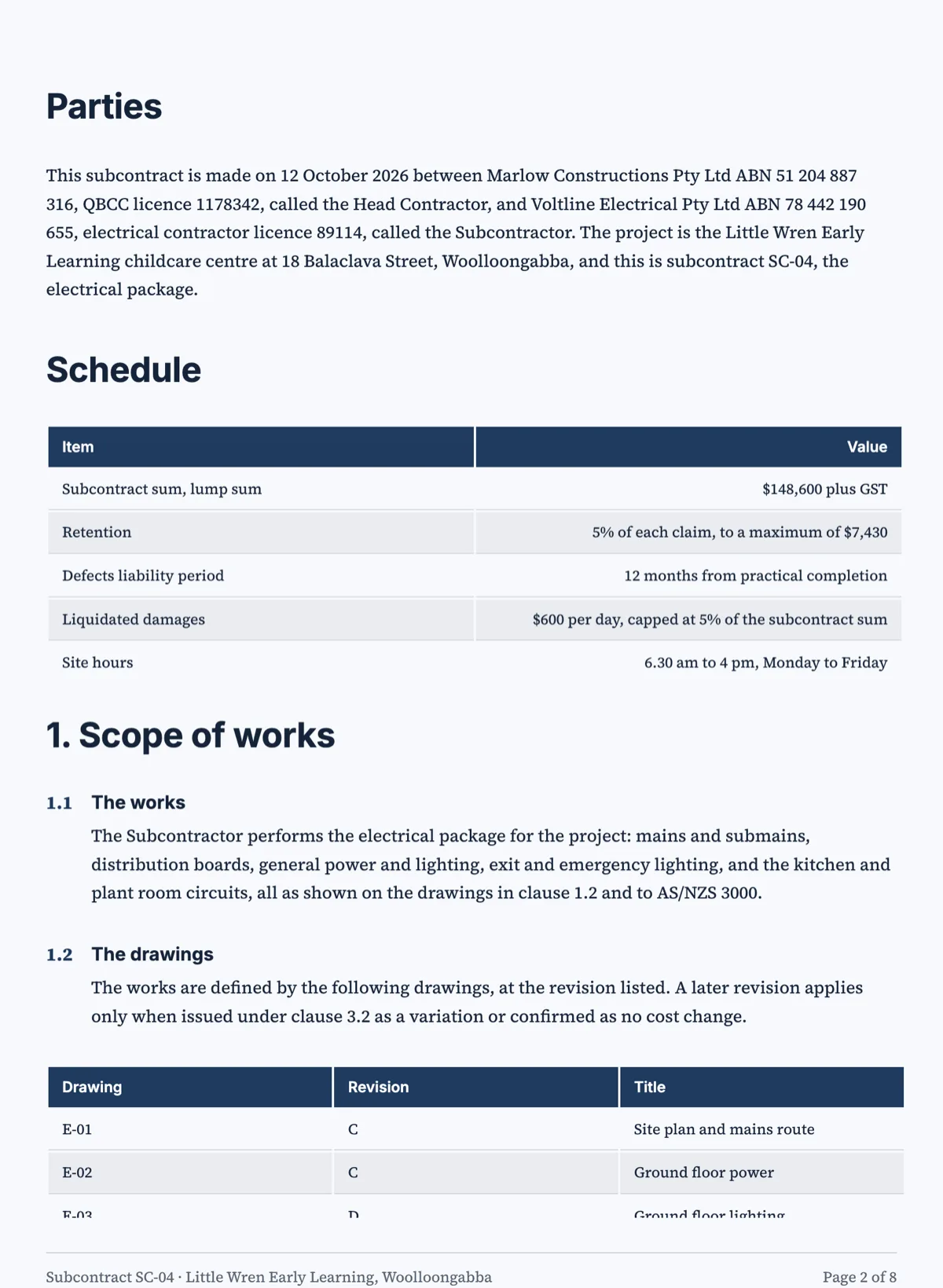 Subcontractor agreement template that flows the head contract downA subcontract exists to pass the head contract's obligations down one level and move the money back up on time. This one names the scope by drawing, sets the progress claim dates against the security of payment rules, holds retention and states the insurances, so the trade knows exactly when it is paid and for what.
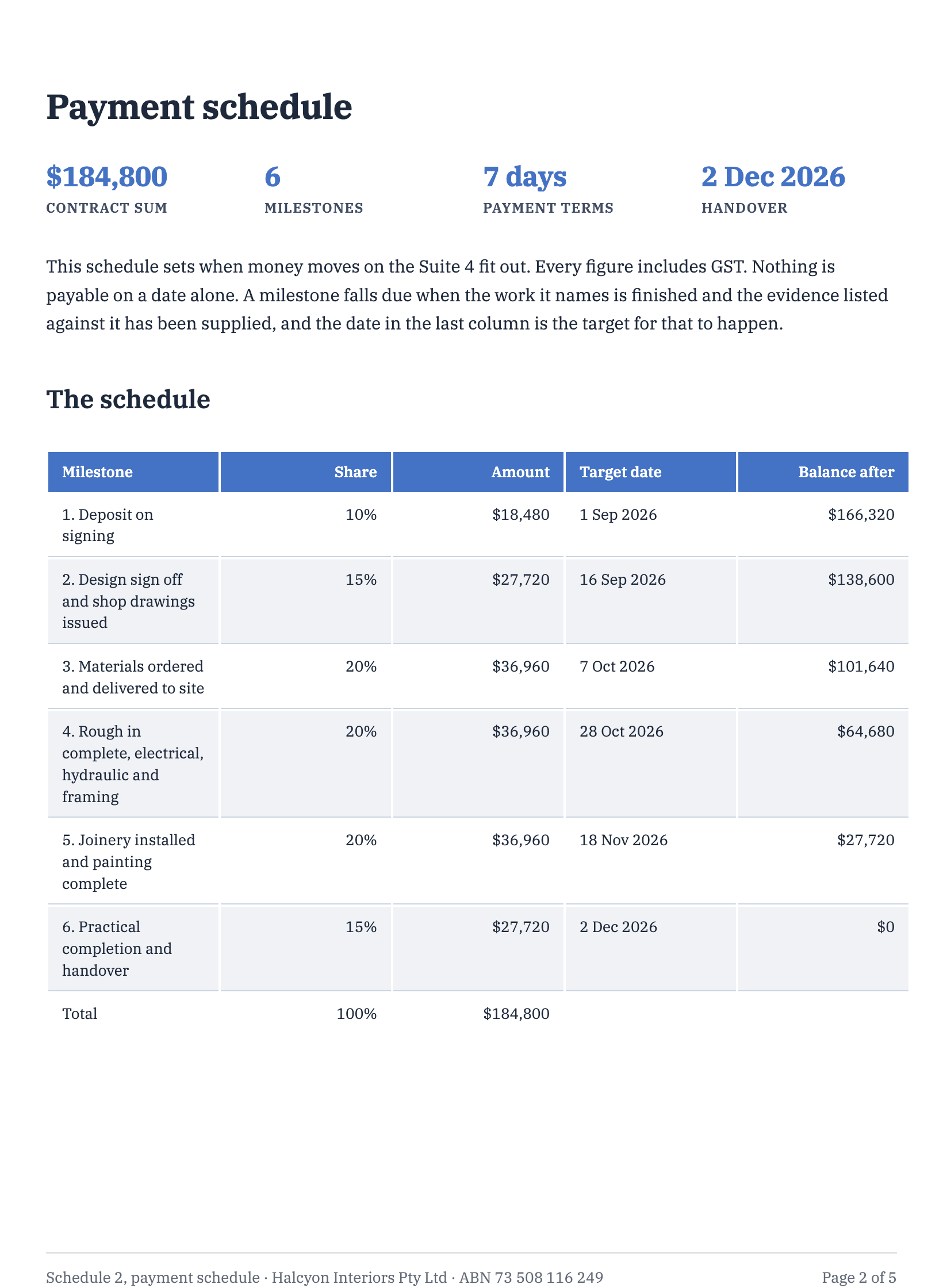 Payment scheduleA $184,800 fit out is paid in six milestones, and every one of them is a piece of work rather than a date. The running balance column is the part both sides check, because it falls to zero only when the handover pack changes hands.
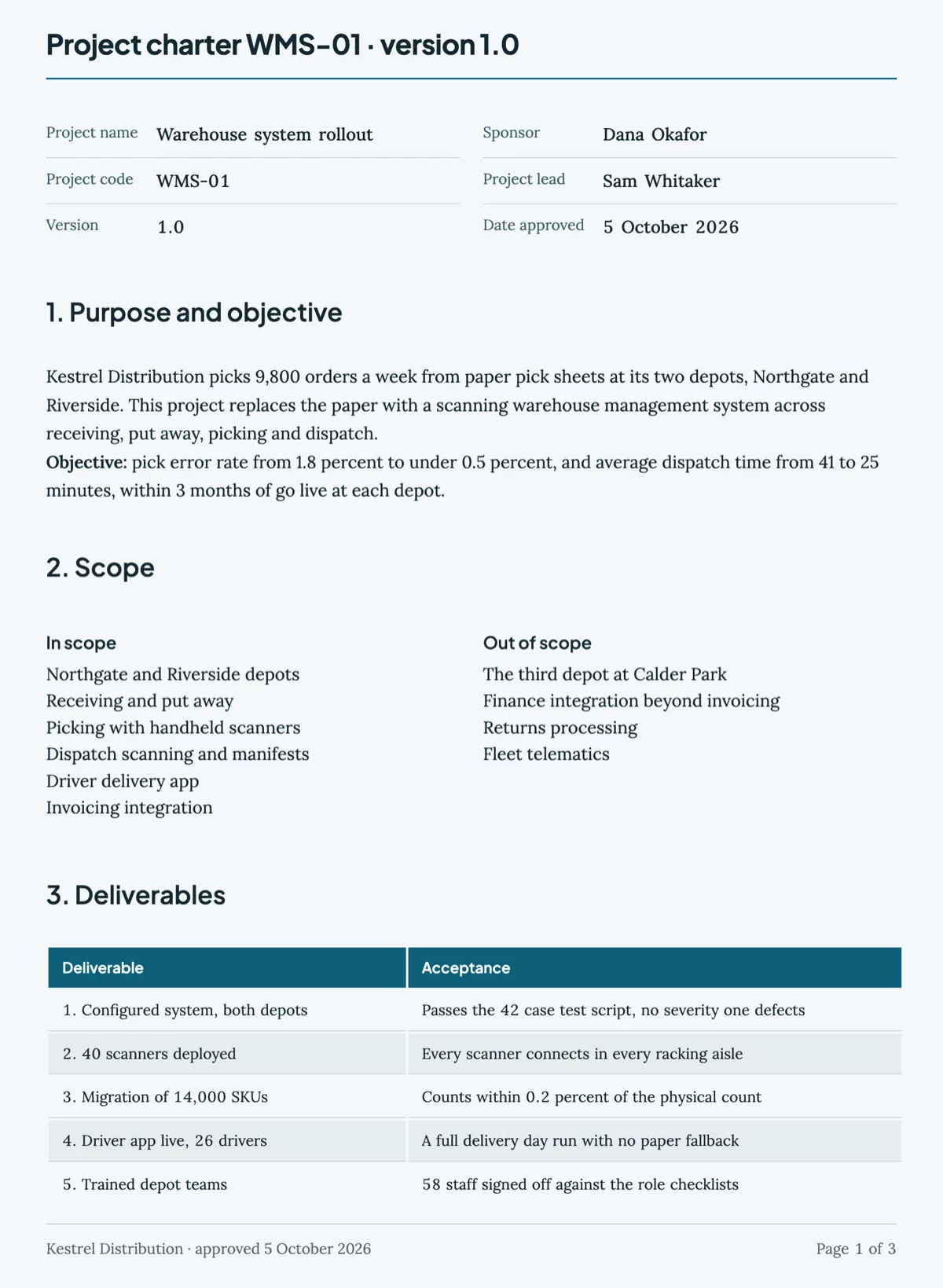 Project charter template with the scope in and out on one pageA charter exists so that a project starts with a sponsor's signature on a page that says what it is and is not. This one fits a system rollout on three pages: a measurable objective, scope in and out as two lists side by side, the team with their authority, a $341,000 budget, five milestones on a timeline and the five risks worth naming on day one.
Questions people ask
How much retention is normal in Australian construction contracts?
Five per cent of each progress claim, capped at five per cent of the contract sum, is the most common arrangement, and ten per cent of each claim to a five per cent cap also appears. The percentage matters less than the cap and the release triggers, since an uncapped percentage keeps growing as variations are added.
When must retention money be released?
When the contract says, which is usually half at practical completion and the balance at the end of the defects liability period. Subcontractors should ask for a fixed number of business days after each trigger and a deemed trigger date if no certificate is issued, because an unissued certificate is the usual reason money is still held.
Does retention have to be held in a trust account?
It depends on the jurisdiction and the project. Several Australian states have introduced trust account requirements for retained money on projects above a threshold, together with reporting duties. Those obligations apply whatever the subcontract says, so a head contractor cannot avoid them by drafting and a subcontractor should check the scheme that covers the project.
Can a head contractor use retention money for anything it likes?
Not if the clause is drafted properly. Limit the purpose to completing the works and rectifying defects, require written notice of the defect and an opportunity to rectify, then require notice of the amount applied. Without those steps retention becomes a general fund the head contractor can draw on, and the subcontractor learns after the fact.
Is a bank guarantee better than cash retention?
For the subcontractor, usually yes, because the cash stays in its own account and the guarantee can only be called after the notice steps in the contract. The cost is the facility fee and the security the bank requires. Head contractors accept guarantees readily when the issuer is an Australian authorised deposit taking institution.
Who earns interest on retention money?
Whoever the contract says, and most contracts say nothing, which means the head contractor keeps it. On a large subcontract held for a year the amount is real. Subcontractors who cannot win the interest point usually trade it for a shorter release period, which is worth more in cash flow terms anyway.
Put the clause in a finished document
The button opens the document generator with a starting description already filled in. Change it to match your own agreement before you run it.
Create a document with OneCraftRelated clauses
- Milestone payment clause: paying by stageA milestone payment clause splits the price into stages released on acceptance. Sample wording for a four stage software build, variants and what to negotiate.
- Set off clause: deducting what the other side owesA set off clause lets one party deduct what the other owes it from what it owes. Australian sample wording, a no set off variant, and the insolvency position.
- Warranty clause: promising a standard and backing itA warranty clause promises a fact is true or that work meets a standard. Australian sample wording for a ninety day defects warranty, variants and remedies.
For everything the document generator can do, see the document maker.
Step by step in the builder: Create a document with AI, then Send a document for signature.
Written and checked by the OneCraft team. Last checked .