Contract clause
Warranty clause: promising a standard and backing it
A warranty clause is a contractual promise that a stated fact is true, or that work will meet a described standard for a stated period. Breaking it is a breach whether or not anyone was careless, and the clause usually names the remedy, which is often repair or re performance rather than money.
A warranty is worth what its remedy is worth. A twelve month promise whose only answer is a repair the supplier controls is a very different bargain from one that gives money back.
Nuwan Madhusanka · Co-founder
4 min read · Published
Sample clause
a website build between Kestrel Digital and Tidewater Marine, a boat servicing business replacing a booking page it wrote itself
11. Warranties 11.1 Kestrel Digital warrants that it has the right to enter into this Agreement and that the Deliverables do not infringe the intellectual property rights of a third party. 11.2 Kestrel Digital warrants that for ninety (90) days after the Go Live Date the Website will operate materially in accordance with the Specification when used on the browsers listed in Schedule 2. 11.3 If the Client notifies Kestrel Digital in writing of a failure to meet the warranty in clause 11.2 during that period, Kestrel Digital must rectify the failure at its own cost within ten (10) business days, or within a longer period the parties agree in writing. 11.4 The warranty in clause 11.2 does not apply to a failure caused by a change the Client or a third party makes to the Website, by content the Client supplies, or by a third party service the Website relies on. 11.5 The Client warrants that it owns or is licensed to use all content it supplies and that the content does not infringe any third party right. 11.6 These warranties are in addition to any right the Client has that cannot lawfully be excluded.
Sample wording, not legal advice.
Variants
Mutual authority warranties only
Neither party will warrant an outcome, so the clause is kept to the basics both can safely give.
Each party warrants that it is properly constituted and has the power to enter into and perform this Agreement, that the person signing for it is authorised to do so, that entering into this Agreement does not breach any other agreement binding on it, and that it holds every licence and registration required to perform its obligations. Neither party gives any other warranty except a warranty that cannot lawfully be excluded.
Fitness for a stated purpose
The customer has told the supplier what the thing is for and is relying on the supplier's judgement.
The Supplier warrants that the Equipment is fit for the purpose stated in Schedule 1, being continuous operation in a coastal environment for at least eight hours a day, and that it will remain fit for that purpose for twelve (12) months from delivery when maintained in accordance with the manufacturer's instructions. The Supplier acknowledges that the Customer disclosed that purpose before entering into this Agreement and relies on the Supplier's skill and judgement.
Defects warranty with a repair or replace remedy
The supplier will stand behind the work but wants to control what happens when something fails.
The Supplier warrants the Works against defects in materials and workmanship for twelve (12) months from Practical Completion. Where a defect is notified within that period, the Supplier must, at its option, repair the defect or replace the affected part, at its own cost, within fifteen (15) business days of the notice. Where the Supplier fails to do so, the Customer may have the defect rectified by another party and recover the reasonable cost as a debt.
What to negotiate
Outcome or effort
Customers want a warranty that the thing works. Suppliers offer a warranty that they will perform with due care and skill, which is a promise about conduct rather than result. The settlement usually warrants conformity with a written specification, since that gives the customer an objective test and gives the supplier a boundary.
The remedy
Suppliers want the remedy limited to repair, replacement or re performance, at their option, within a stated period. Customers accept that provided there is a fallback if the supplier does not fix it, typically a right to engage someone else and recover the cost. Without the fallback, the remedy depends on the party in breach.
Knowledge qualifiers
Adding to its knowledge to a warranty converts a promise about facts into a promise about awareness, which is much weaker. It is appropriate for things the giver genuinely cannot verify, such as whether a third party intends to sue, and inappropriate for things inside its own records. Customers should query every one.
The risk of leaving it out
Without express warranties the customer relies on statutory guarantees and on implied terms, which exist but are harder to apply to a bespoke deliverable than a written specification would be. There is also no agreed period, no notification process and no defined remedy, so a defect three months after delivery becomes an argument about whether anything was promised at all.
Contractual warranties beside the statutory ones
Australian law supplies consumer guarantees under the Australian Consumer Law for many supplies of goods and services, including acceptable quality, fitness for a disclosed purpose and due care and skill, and those guarantees apply whatever the contract says. A contractual warranty sits on top of them, and its value is precision: it names the specification, the period, the notification process and the remedy, none of which the statutory guarantees define for a bespoke build. Good drafting says expressly that the contractual warranties are in addition to rights that cannot be excluded, which avoids an argument that the clause was trying to replace them.
Common mistakes
The warranty period runs from delivery when nobody agrees what delivery means. The warranty covers the deliverable and says nothing about content or changes the customer makes, so every failure becomes contested. The remedy is repair at the supplier's option with no time limit and no fallback. And the clause appears to exclude statutory guarantees, which overreaches and weakens the whole risk section when a court reads it down.
Where it sits in a generated document
Warranties come before the liability clauses, because the exclusions and the cap operate on the claims the warranties create. A generated build agreement numbers each warranty separately so the exclusions can carve out particular ones by number instead of by description. Where a warranty refers to a specification, the specification is generated as a schedule in the same document rather than described inside the clause.
Documents that carry this clause
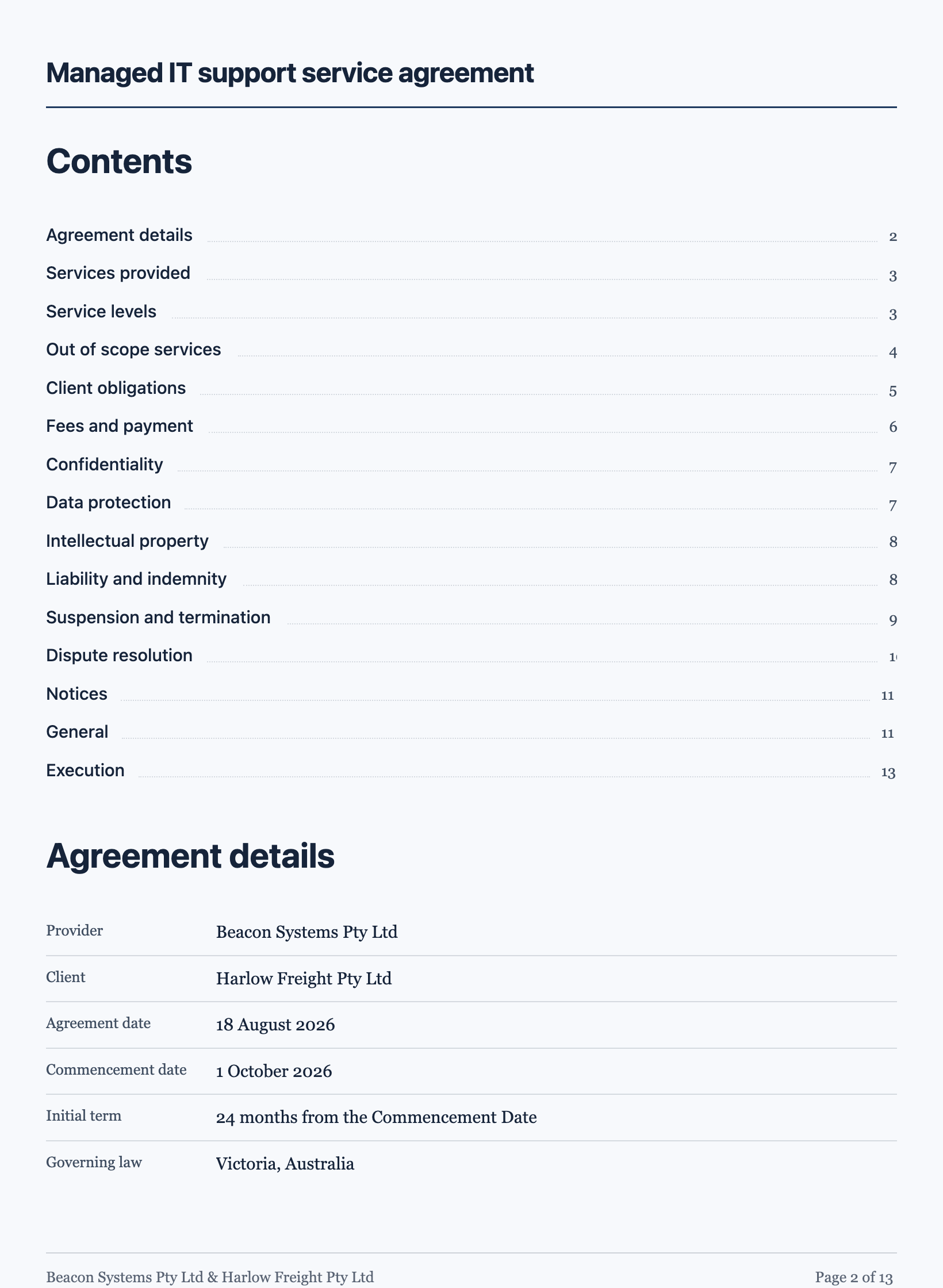 Service agreementBeacon Systems supports Harlow Freight’s IT for an initial 24 months from 1 October 2026 at $8,400 a month plus GST, with 40 hours included and $220 an hour beyond them. Twelve numbered clauses cover the services, a four level severity table, client duties, fees with a CPI adjustment, confidentiality, privacy, IP, a liability cap, termination and a three step dispute ladder.
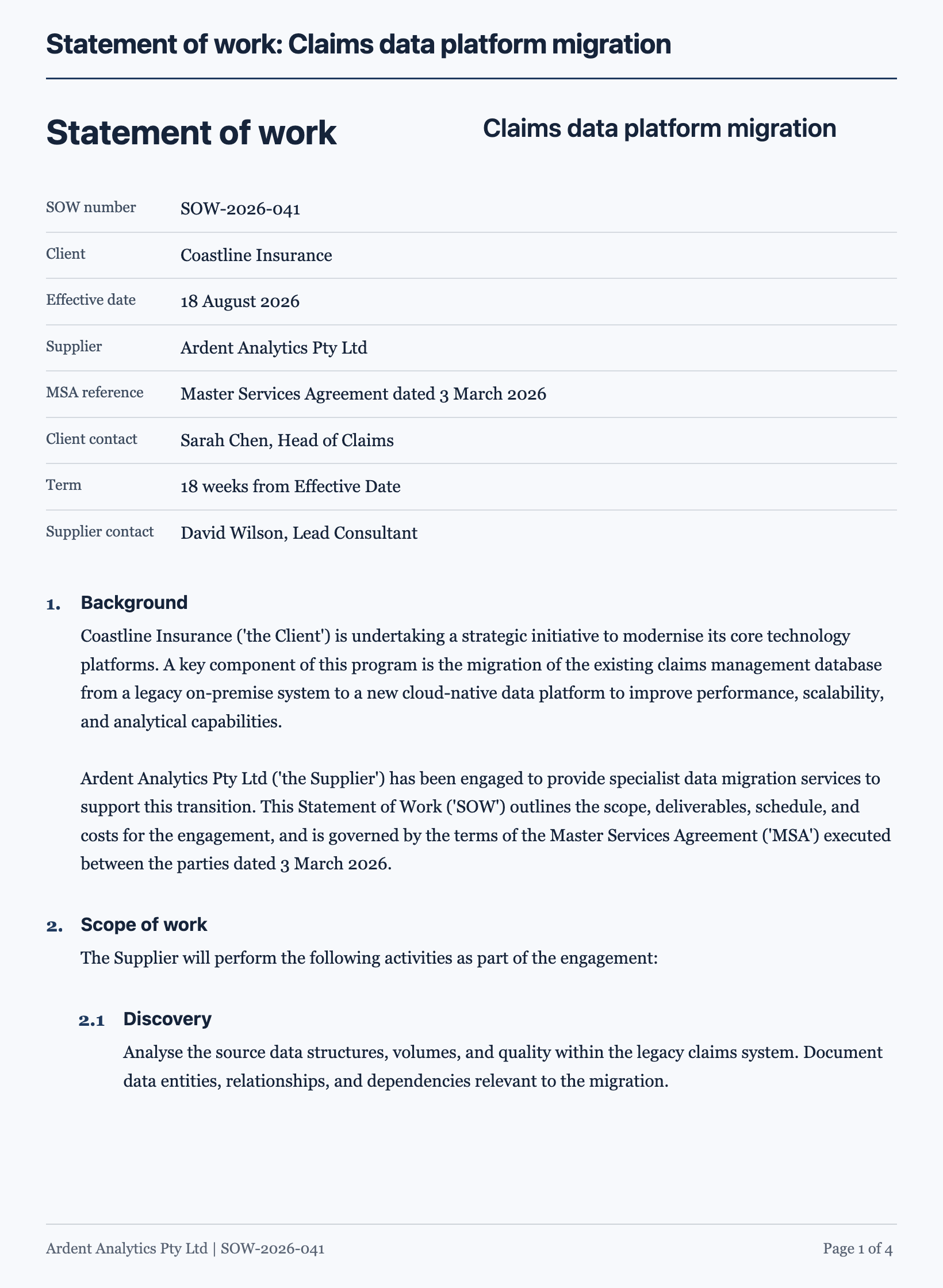 Statement of work template under a master agreementArdent Analytics migrates Coastline Insurance’s claims database to a cloud platform over 18 weeks under SOW-2026-041, governed by a master services agreement dated 3 March 2026. The work is time and materials with four roles priced by the day and a $412,000 estimate before GST, five dated deliverables, ten business days to accept each one, and five assumptions written down before anyone starts.
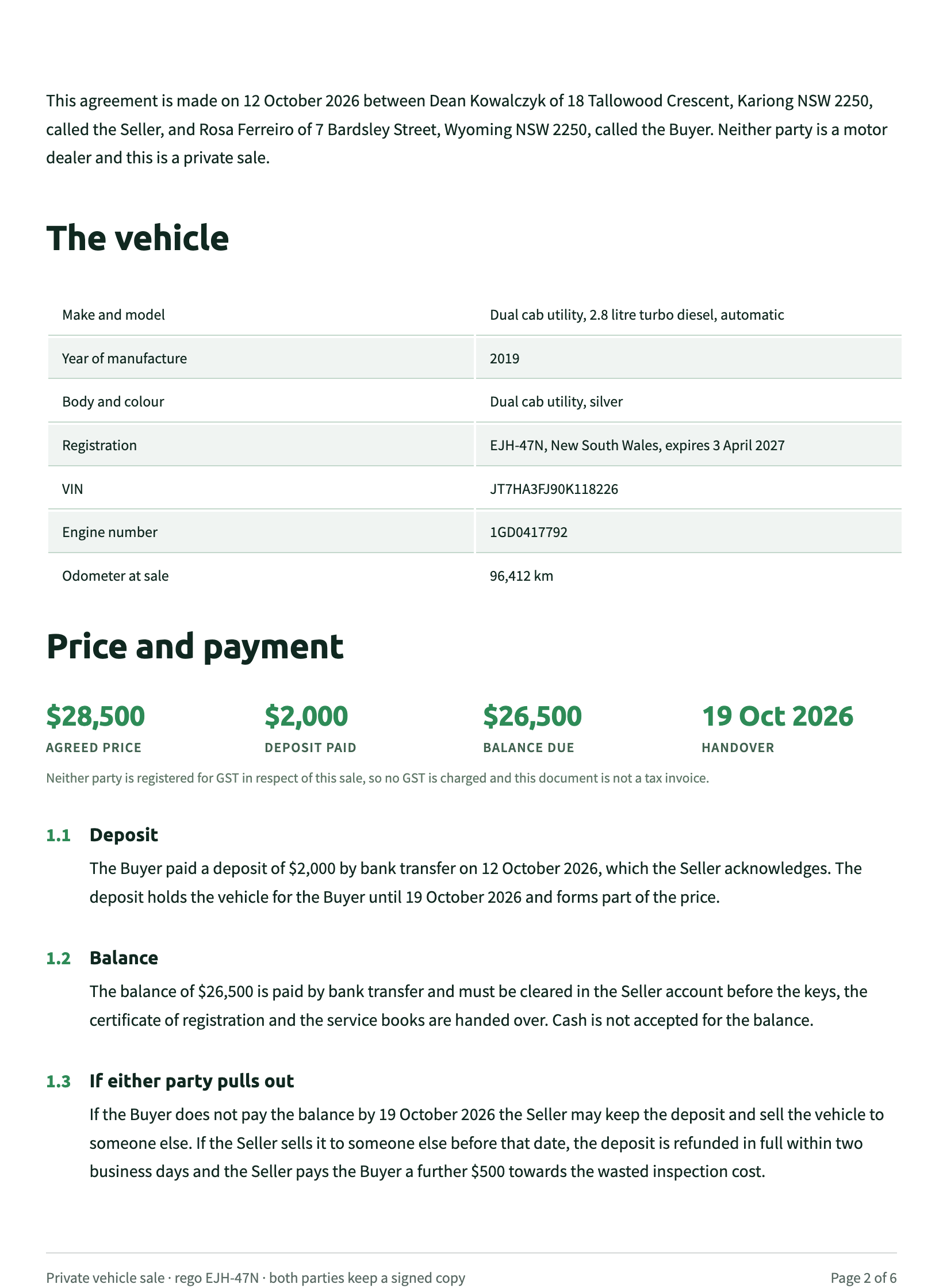 Vehicle sale agreement templateA dual cab ute is changing hands between two people on the Central Coast for $28,500. No dealer, so no statutory warranty and no guarantee of clear title. What the buyer gets instead is five written warranties, a register certificate number, and a mechanic's report obtained before the balance moves.
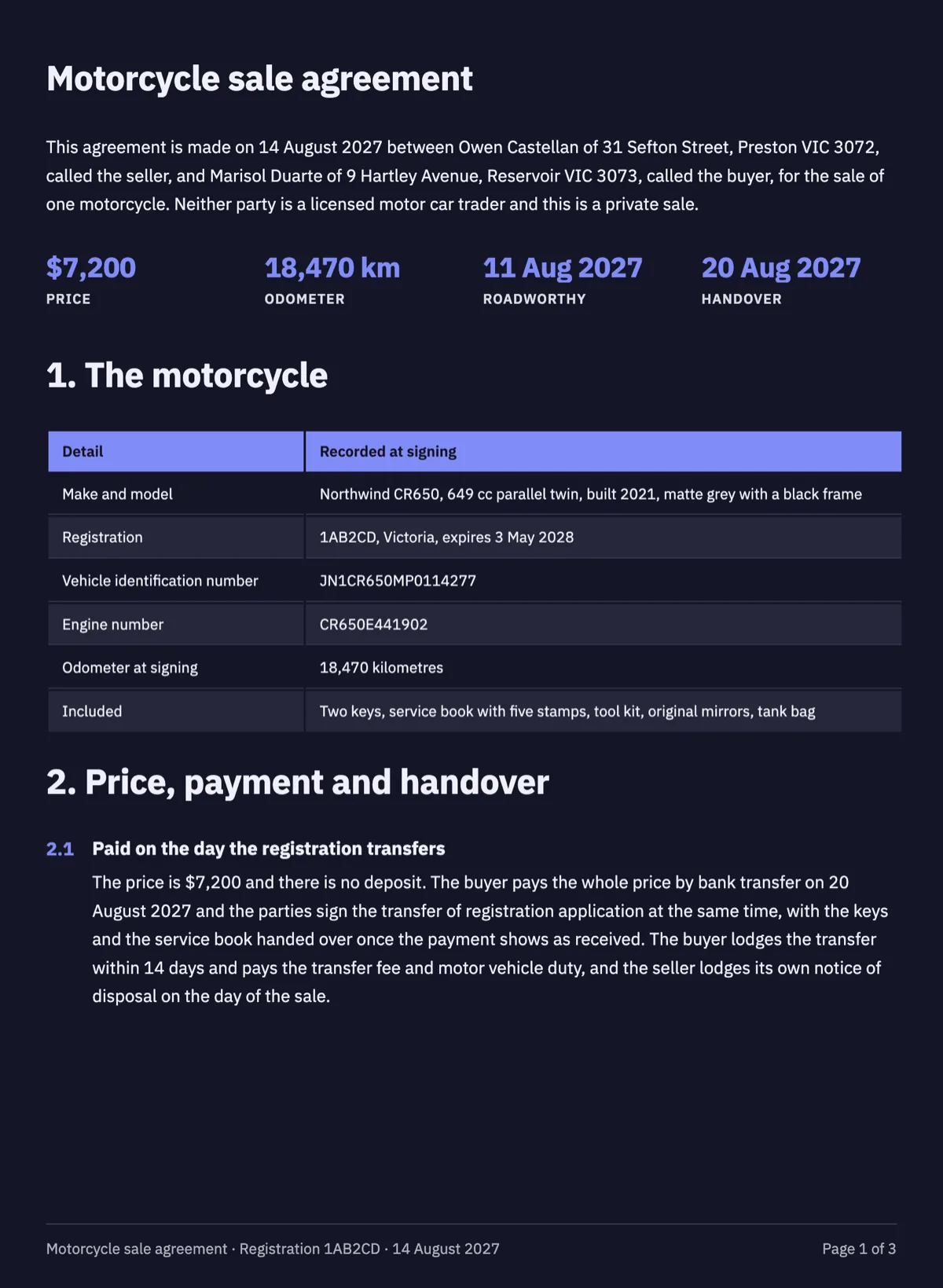 Motorcycle sale agreement with the VIN, odometer and roadworthyA private bike sale is usually settled in a driveway with a bank transfer and a handshake, and that is exactly when the roadworthy certificate and the finance search get skipped. This agreement records both before the money moves, along with the two numbers that decide whether the bike is what the advertisement said it was.
Questions people ask
What is the difference between a warranty and a guarantee?
In contract drafting a warranty is a promise by a party to the agreement, enforceable as a term of it. A guarantee in the Australian Consumer Law sense is a statutory right that applies to a supply regardless of what the contract says. A guarantee in the older sense is a third party promising to answer for someone else's obligation.
How long should a defects warranty run?
Ninety days is common for software configuration, twelve months for physical work and building trades, and longer where a component carries a manufacturer warranty that can be passed through. The period should match how long a latent defect usually takes to appear in that kind of work, not a round number chosen for symmetry.
Can the remedy be limited to repair or re performance?
Yes, and for many supplies the legislation expressly contemplates limiting liability for a breach of certain guarantees to remedies such as resupply or the cost of resupply, provided the supply is not of a kind ordinarily acquired for personal use. The customer should still insist on a fallback if the repair is not done in time.
What is a knowledge qualifier?
Wording such as to the best of its knowledge, which changes a promise that a fact is true into a promise that the party is not aware it is untrue. It is reasonable for matters the party genuinely cannot check, such as a third party's intentions, and unreasonable for anything in its own records. Each one should be justified.
Should the customer give warranties too?
Usually, and they are easy to overlook. The customer typically warrants that it owns or is licensed to use the content and materials it supplies, that it has authority to contract, and that the information it gave about its systems is accurate. Those warranties are what let the supplier carve out failures the customer caused.
Does a warranty survive termination?
Only if the survival clause says so, and a defects warranty usually needs to. Without it, a customer who terminates for convenience in month ten of a twelve month warranty may lose the benefit of the remaining period. List the warranty clause by number in the survival provision rather than relying on general words.
Put the clause in a finished document
The button opens the document generator with a starting description already filled in. Change it to match your own agreement before you run it.
Create a document with OneCraftRelated clauses
- Disclaimer of warranties clause: what can and cannot be excludedA disclaimer of warranties clause removes implied warranties as far as the law allows. Australian sample wording with the consumer guarantees carve out.
- Limitation of liability clause: putting a ceiling on exposureA limitation of liability clause puts a ceiling on what one party can recover. Australian sample wording, three variants, the carve outs and the UK test.
- Indemnity clause: promising to cover someone else's lossAn indemnity clause is a promise to cover the other party's loss from a named event. Australian sample wording, three variants and what each side negotiates.
For everything the document generator can do, see the document maker.
Step by step in the builder: Create a document with AI, then Every document component and when to use it.
Written and checked by the OneCraft team. Last checked .