Contract clause
Disclaimer of warranties clause: what can and cannot be excluded
A disclaimer of warranties clause states that no promise is given beyond those written in the agreement, and excludes terms the law would otherwise imply. In Australia it can never reach the statutory consumer guarantees, so the workable version excludes implied terms and then preserves those guarantees expressly.
The capitalised disclaimer copied from an American licence does very little in Australia and can make things worse. What survives here is a narrower clause that says what it is doing.
Indunil Asanka · Co-founder
4 min read · Published
Sample clause
a licence of scheduling software by Quillhaven Systems to small clinics, supplied without customisation and used by businesses rather than consumers
12. No other warranties 12.1 Other than the warranties expressly given in clause 11, and other than any guarantee, condition or warranty that cannot lawfully be excluded, Quillhaven Systems gives no warranty in relation to the Software and excludes every term that would otherwise be implied into this Agreement by statute, at general law or by custom. 12.2 Without limiting clause 12.1, Quillhaven Systems does not warrant that the Software will be free from error, that it will operate without interruption, that it will meet the Customer's own requirements, or that it will be compatible with software or hardware not listed in Schedule 2. 12.3 Nothing in this clause excludes, restricts or modifies a consumer guarantee under the Australian Consumer Law that applies to the supply. 12.4 Where the Australian Consumer Law permits a supplier to limit its liability for a failure to comply with a guarantee, and the supply is not of a kind ordinarily acquired for personal, domestic or household use or consumption, Quillhaven Systems limits its liability for that failure to supplying the Software again or paying the cost of having it supplied again.
Sample wording, not legal advice.
Variants
Australian compliant version
The supply is business to business in Australia and the clause has to work under the Australian Consumer Law.
Except as expressly set out in this Agreement, and subject to any right that cannot lawfully be excluded, the Supplier excludes all implied terms, warranties and conditions. Where the Australian Consumer Law applies and the supply is not of a kind ordinarily acquired for personal, domestic or household use, the Supplier's liability for failing to comply with a guarantee is limited, at the Supplier's option, to resupplying the services or paying the cost of having them resupplied.
United States style disclaimer
The contract is governed by the law of a United States state, where conspicuous disclaimer language is what makes the exclusion effective.
EXCEPT AS EXPRESSLY PROVIDED IN THIS AGREEMENT, THE SOFTWARE IS PROVIDED ON AN AS IS AND AS AVAILABLE BASIS, AND LICENSOR DISCLAIMS ALL WARRANTIES, WHETHER EXPRESS, IMPLIED OR STATUTORY, INCLUDING THE IMPLIED WARRANTIES OF MERCHANTABILITY AND FITNESS FOR A PARTICULAR PURPOSE AND ANY WARRANTY ARISING FROM COURSE OF DEALING OR USAGE OF TRADE. Some jurisdictions do not allow the exclusion of certain warranties, in which case this disclaimer applies to the fullest extent permitted.
United Kingdom version
The contract is governed by English law and the customer is a business rather than a consumer.
Except as expressly stated in this Agreement, all warranties, conditions and other terms implied by statute or common law are excluded to the fullest extent permitted by law. Nothing in this Agreement excludes or limits liability for death or personal injury caused by negligence, for fraud, or for any other liability that cannot lawfully be excluded. The parties confirm that this clause has been negotiated and that they consider it reasonable in the circumstances known to them.
What to negotiate
What the express warranties actually cover
A disclaimer is only acceptable to a customer if the express warranties beside it are worth having. The real negotiation is therefore in the warranty clause, not the disclaimer. Customers who concede a broad disclaimer usually win a tighter specification, a longer defects period, or a service level with credits attached.
Error free and uninterrupted
Suppliers disclaim these because no software meets them. Customers accept the disclaimer and then ask for an availability commitment in a service level schedule, which is a measurable promise rather than an absolute one. That trade is the standard outcome and it suits both sides better than arguing about the word error.
Whether the statutory carve out is explicit
Some suppliers prefer a general to the extent permitted by law formula. Customers and regulators prefer an express statement that the consumer guarantees are not excluded, because it is plain on the face of the document. The express version also protects the supplier from having the whole clause read down.
The risk of leaving it out
Without a disclaimer, terms implied by statute, at general law and by trade custom sit alongside the express warranties, and a customer can point to any of them. For a standardised product sold to many customers, that means liability shaped by each buyer's circumstances rather than by the specification the supplier published, which is exactly what the clause is meant to prevent.
What the Australian Consumer Law does not allow
The consumer guarantees cannot be excluded, restricted or modified, and a term that purports to do so is void. They also reach many business purchases, not only consumer ones. The Australian Competition and Consumer Commission has taken action over statements that told buyers their rights were limited when they were not. What the legislation does permit, for supplies that are not of a kind ordinarily acquired for personal, domestic or household use, is limiting liability for breach of certain guarantees to specified remedies such as resupply or the cost of resupply. That narrower limitation is the lawful version of what an American disclaimer tries to do in one sweep.
Common mistakes
The capitalised American disclaimer is used unchanged in an Australian contract, where it excludes warranties that were never implied here and appears to exclude guarantees that cannot be excluded. The clause disclaims everything without preserving the express warranties, so the two clauses contradict each other. There is no statutory carve out, so the whole provision is exposed. And it is used on a consumer facing supply, where the limitation remedy is not available at all.
Where it sits in a generated document
The disclaimer goes immediately after the express warranties, because it is defined by reference to them. A generated licence numbers both, so the disclaimer can say other than the warranties in clause 11 and mean something checkable. The statutory carve out is written as its own sub clause so it cannot be read as subordinate to the exclusion above it, and the document states the position without citing the legislation.
Documents that carry this clause
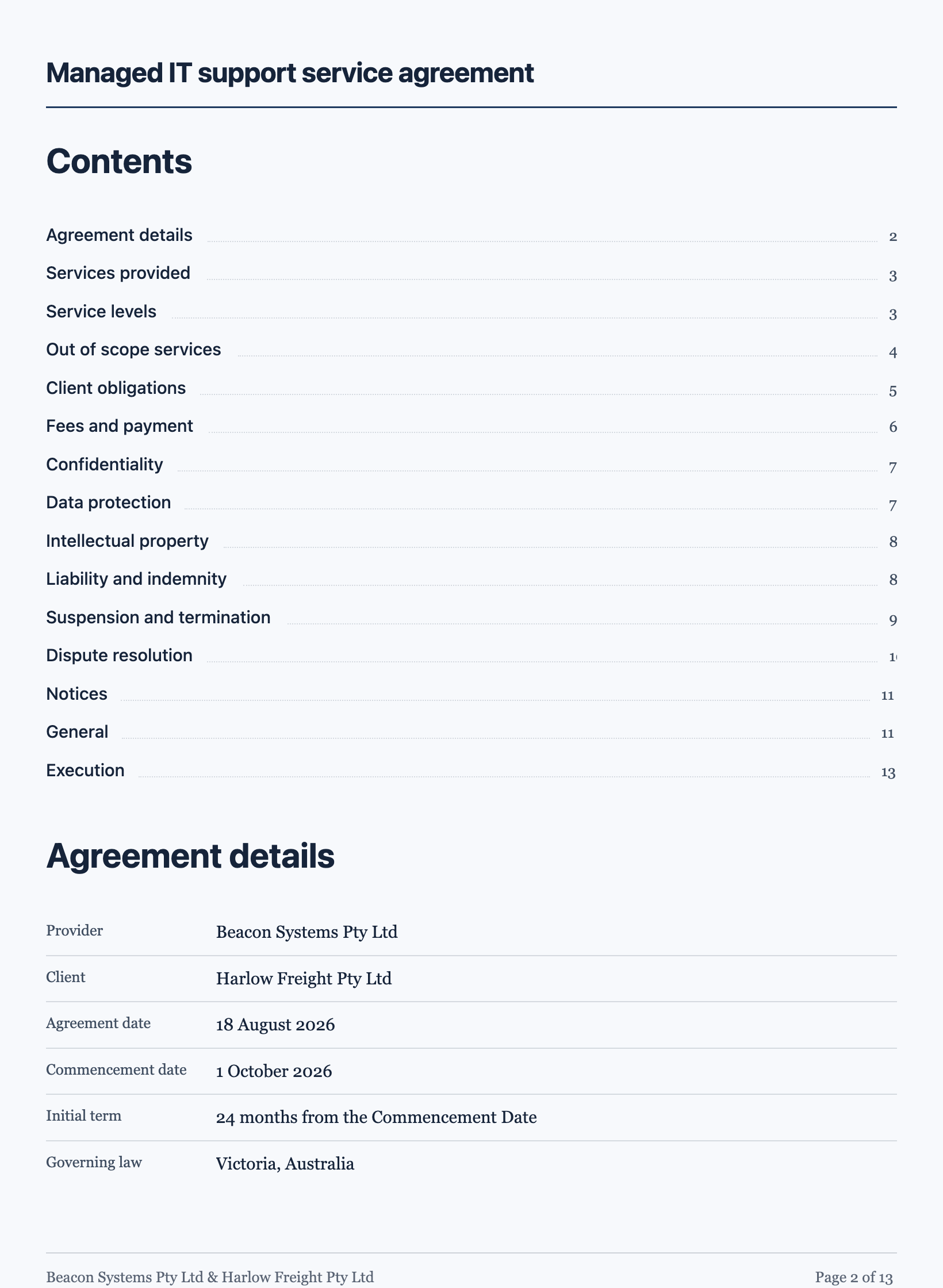 Service agreementBeacon Systems supports Harlow Freight’s IT for an initial 24 months from 1 October 2026 at $8,400 a month plus GST, with 40 hours included and $220 an hour beyond them. Twelve numbered clauses cover the services, a four level severity table, client duties, fees with a CPI adjustment, confidentiality, privacy, IP, a liability cap, termination and a three step dispute ladder.
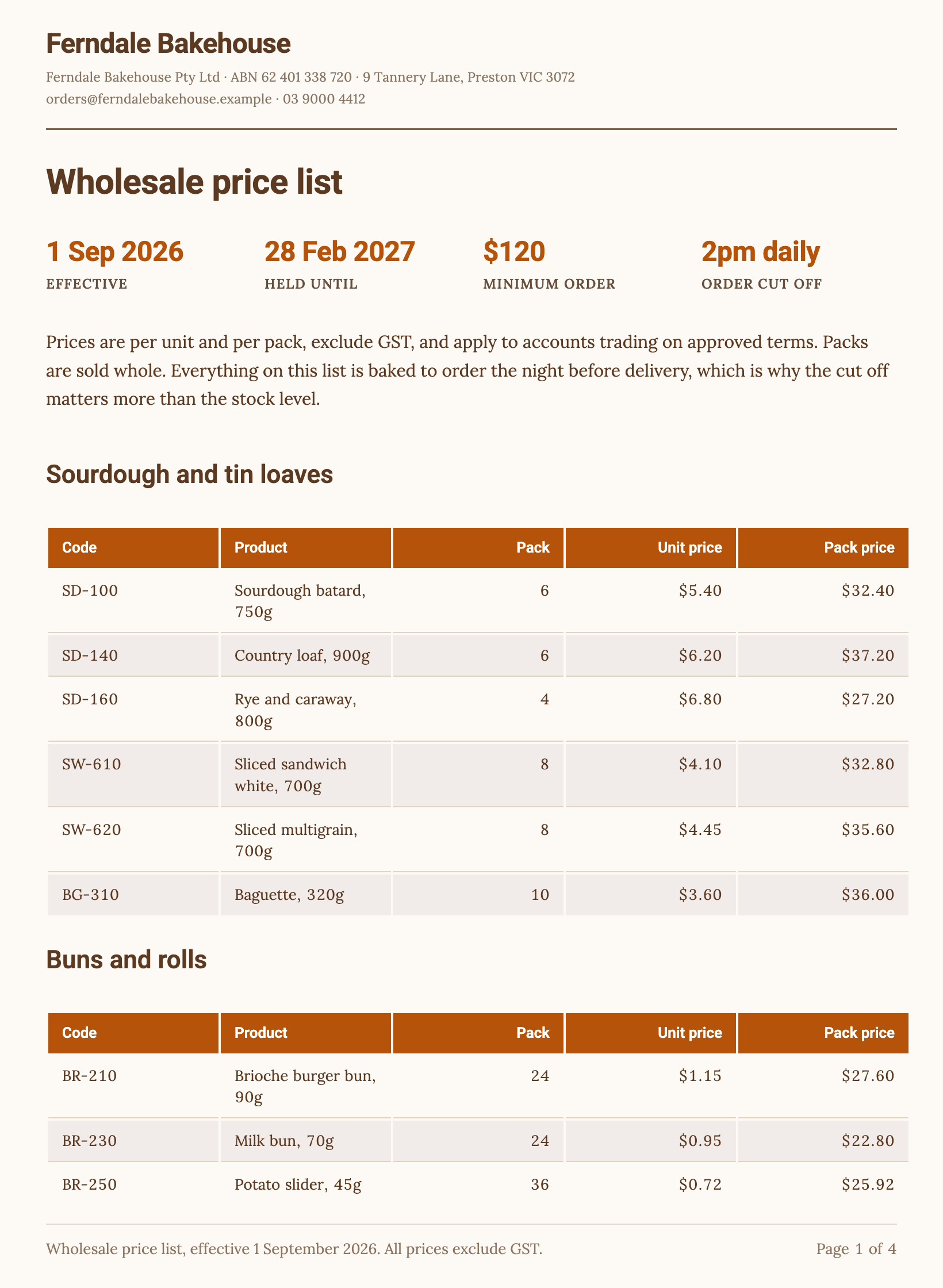 Wholesale price listA bakehouse sells to cafes, so the price that matters is the pack price, not the unit price. This list shows both for seventeen products, then the four things that decide what a cafe actually pays: volume, zone, cut off and terms.
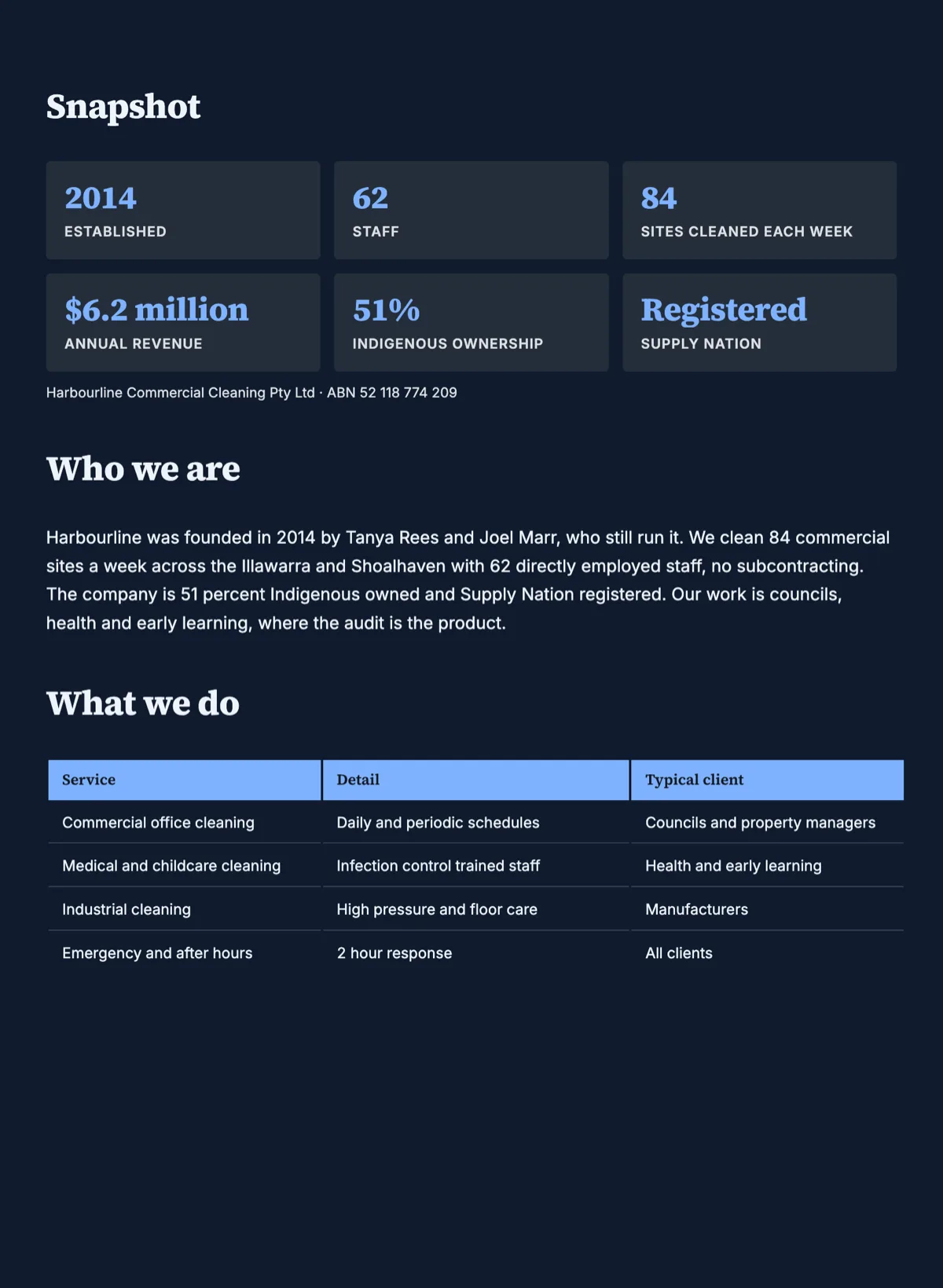 Capability statement template with past performance in numbersA capability statement is read by a procurement officer with forty of them, in about ninety seconds, looking for the numbers that let them shortlist. This one is four pages for a cleaning company chasing council work: the six number snapshot up front, three past contracts with values and outcomes, and the certifications and insurances in a table they can check.
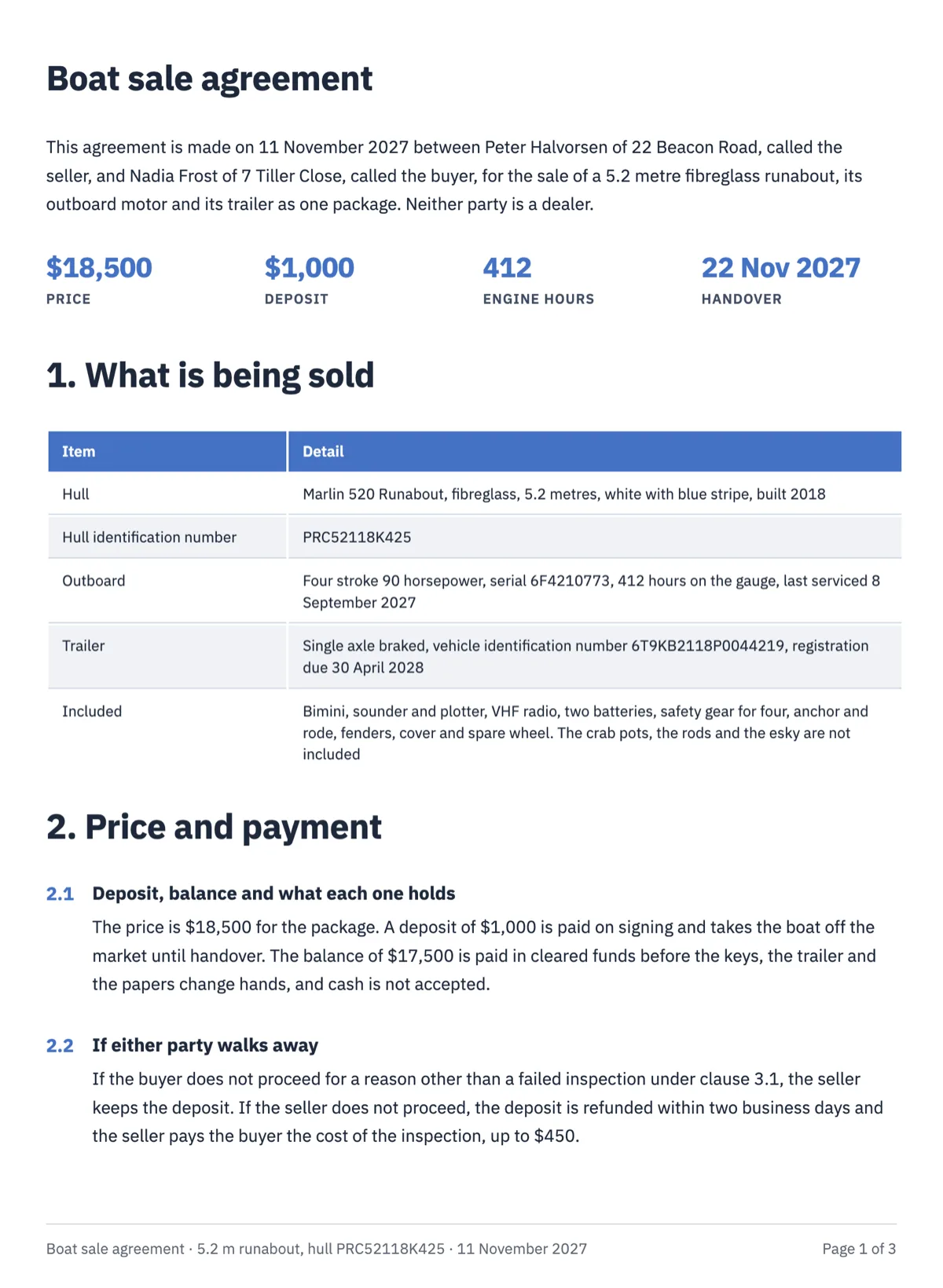 Boat sale agreement template with the hull ID, trailer and an as is clauseA private boat sale moves three things at once: a hull, a motor and a trailer, each with its own number and its own way of carrying a debt. This agreement lists all three in a specification table, gives the buyer a sea trial and a search before the balance moves, then sets out exactly what changes hands on the day.
Questions people ask
Can a contract exclude the Australian consumer guarantees?
No. The guarantees apply to a supply regardless of what the contract says, and a term purporting to exclude, restrict or modify them is void. Telling a buyer otherwise has itself attracted regulator action. What a supplier can do, for supplies not ordinarily acquired for personal use, is limit its liability for breach to remedies such as resupply.
Does an as is disclaimer work in Australia?
Not in the way it works in the United States. The phrase has no special statutory effect here, the implied warranties it names are American ones, and it does not touch the statutory guarantees. Used unchanged it can also look like an attempt to exclude rights that cannot be excluded, which weakens the rest of the clause.
Should the disclaimer be in capital letters?
In some United States jurisdictions conspicuous text is what makes a disclaimer of implied warranties effective, which is why the convention exists. Australian law has no such requirement, so capitals add nothing here except difficulty reading it. Keep the formatting normal and put the substance in the wording.
Can a supplier disclaim that software is error free?
Yes, and it is standard, because no software of any size is free of defects. Customers rarely fight it, and instead ask for a measurable availability or response commitment in a service level schedule. That gives the customer something enforceable and gives the supplier a target it can actually meet.
What is the difference between excluding and limiting?
Excluding removes a term or a liability entirely. Limiting keeps it and caps the response, for example by confining the remedy to resupply. The distinction matters because Australian law forbids excluding the statutory guarantees while permitting a limitation of liability for some of them in business supplies, so the drafting has to use the right one.
Does the disclaimer apply to fraud or misleading conduct?
No, and a clause should not try. Liability for fraud cannot be excluded, and liability for misleading or deceptive conduct under the Australian Consumer Law cannot be contracted away either. A disclaimer that appears to cover statements made during the sales process is one of the least defensible parts of a standard form contract.
Put the clause in a finished document
The button opens the document generator with a starting description already filled in. Change it to match your own agreement before you run it.
Create a document with OneCraftRelated clauses
- Warranty clause: promising a standard and backing itA warranty clause promises a fact is true or that work meets a standard. Australian sample wording for a ninety day defects warranty, variants and remedies.
- Limitation of liability clause: putting a ceiling on exposureA limitation of liability clause puts a ceiling on what one party can recover. Australian sample wording, three variants, the carve outs and the UK test.
- Consequential loss clause: excluding indirect and flow on lossA consequential loss clause removes indirect losses such as lost profit from a claim. Australian sample wording, three variants and the naming problem.
For everything the document generator can do, see the document maker.
Step by step in the builder: Create a document with AI, then Every document component and when to use it.
Written and checked by the OneCraft team. Last checked .