Contract clause
Set off clause: deducting what the other side owes
A set off clause lets a party deduct an amount the other party owes it from an amount it is about to pay. It names which debts qualify, whether they must be certain or merely claimed, and whether the deduction can be made before the other side has agreed the amount is owed.
Set off looks like an accounting convenience and works as leverage. Whoever holds the right to deduct decides who funds a dispute while it is being resolved.
Indunil Asanka · Co-founder
4 min read · Published
Sample clause
a freight services agreement between Marlow Logistics and a wholesale nursery whose stock is sometimes damaged in transit
12. Set off 12.1 The Customer may set off against any amount payable to Marlow Logistics an amount that Marlow Logistics owes the Customer under clause 9 for loss of or damage to Goods, provided the amount has been agreed in writing or determined under clause 16. 12.2 The Customer must give Marlow Logistics written notice at least five (5) business days before making a deduction under clause 12.1, stating the invoice affected, the amount and the basis of the claim. 12.3 Marlow Logistics must not set off any amount against a sum it owes the Customer without the Customer's written consent. 12.4 A deduction made under clause 12.1 does not limit either party's other rights, and is not an admission by Marlow Logistics that the amount claimed is owed. 12.5 This clause does not apply to an amount the Customer claims but which Marlow Logistics disputes in writing within five (5) business days of the notice under clause 12.2.
Sample wording, not legal advice.
Variants
Mutual set off
The parties invoice each other in both directions and neither has the stronger bargaining position.
Either party may set off against any amount it owes the other under this Agreement any amount then due and payable to it by that other party under this Agreement. A party exercising this right must give written notice of the deduction, the invoice affected and the amount, on or before the day the deduction is made. Neither party may set off an amount that is genuinely disputed in writing at the time of the deduction.
No set off
The supplier funds its operations from invoice receipts and cannot have a payment reduced while a claim is argued.
The Customer must pay every amount due under this Agreement in full, without set off, counterclaim, deduction or withholding of any kind, except any deduction or withholding required by law. Any claim the Customer has against the Supplier must be pursued separately and does not entitle the Customer to withhold or reduce a payment. This clause does not limit the Customer's right to recover an amount properly owed to it.
Set off limited to undisputed sums
Both sides accept set off in principle but want it unavailable as a pressure tactic.
A party may set off an amount only if the amount is undisputed, meaning the other party has agreed it in writing or it has been determined by a court or by an expert appointed under clause 16. An amount the other party disputes in writing within ten (10) business days of receiving notice of the claim is not undisputed for the purposes of this clause, and no deduction may be made in respect of it until the dispute is resolved.
What to negotiate
Certain debts or claimed amounts
The whole negotiation sits here. A right to deduct anything the customer claims turns every quality complaint into a payment reduction. A right limited to amounts agreed or determined protects the supplier's cash flow. Most commercial contracts land on agreed or determined, with a short notice period before any deduction is made.
Whether the right runs both ways
Customers usually propose a one way clause in their own favour and suppliers ask for the mirror. Since a supplier rarely owes the customer money outside a claim, mutual wording costs the customer little and reads far better. Refusing symmetry is often what prompts the supplier to ask for a no set off clause instead.
Group companies
Customers sometimes ask to set off amounts owed by or to their related entities. That widens the exposure a long way, because a supplier then funds a dispute it had with a different company. The usual answer limits set off to amounts arising under this agreement between these two parties.
The risk of leaving it out
Silence does not remove set off. Equitable set off can still be available where the cross claim is closely connected to the amount claimed, so a customer may deduct anyway and argue about it later. A no set off clause is the only way to take that away, and a supplier who assumed silence was enough often learns otherwise on a large invoice.
What happens in insolvency
Set off changes character once a party goes into liquidation. The Corporations Act 2001 provides for mutual credits and debts between a company in liquidation and a creditor to be set off against each other, with only the balance provable or payable. That statutory set off operates on the state of accounts and is not something a contract can simply exclude, so a no set off clause that works perfectly during normal trading may not survive the counterparty's collapse. Both sides should price that in rather than rely on the clause alone.
Common mistakes
The clause allows deduction of any amount the customer considers owing, which is a discretion dressed as a right. It requires no notice, so the supplier discovers the deduction from a short payment and starts a reconciliation exercise. It sits in the same paragraph as the payment terms, so the payment obligation reads as conditional. And in construction contracts, wording that limits deduction rights has to be checked against security of payment legislation, which has its own rules about withholding.
Where it sits in a generated document
Set off belongs in the payment section, immediately after the obligation to pay, because it qualifies that obligation. Generated agreements number the clauses, so a set off sub clause can cross reference the liability clause that produces the deductible amount and the dispute clause that determines it. That cross referencing only works if the numbering is stable, which is why this kind of document is generated as numbered content rather than as running prose.
Documents that carry this clause
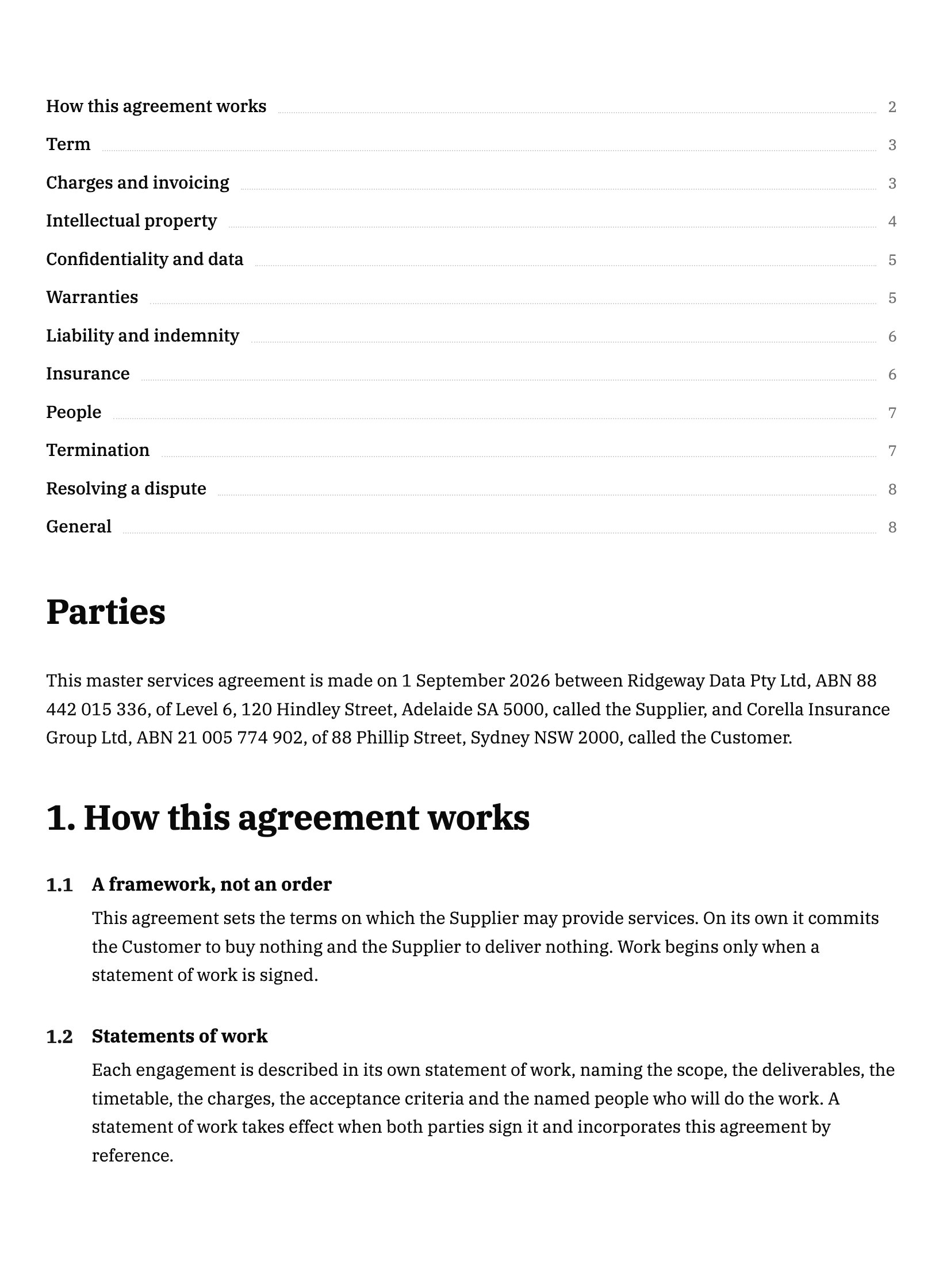 Master services agreementA data consultancy and an insurer sign this once and then buy work under it for three years. It is the rare contract whose whole purpose is to make the next twenty contracts short.
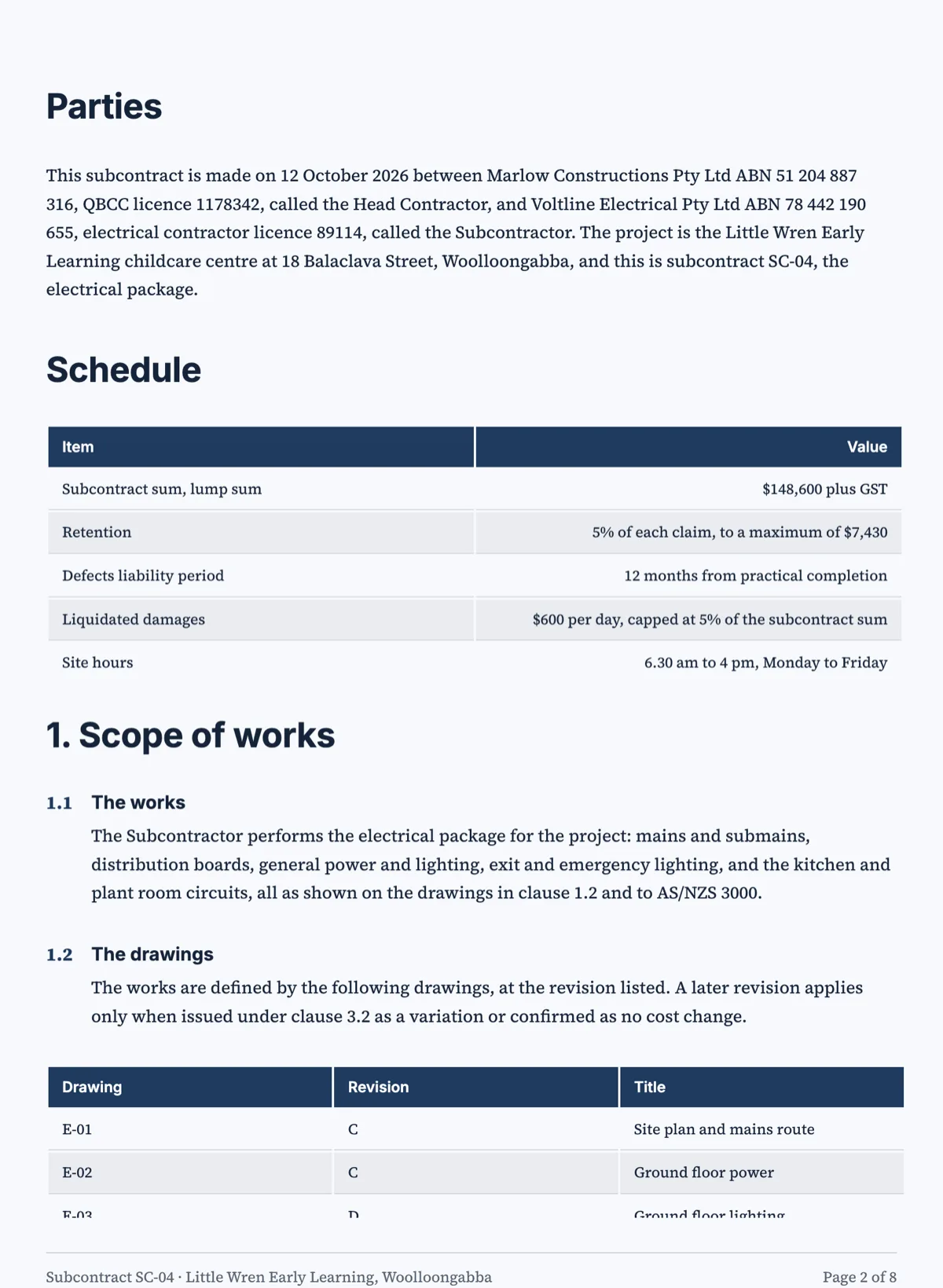 Subcontractor agreement template that flows the head contract downA subcontract exists to pass the head contract's obligations down one level and move the money back up on time. This one names the scope by drawing, sets the progress claim dates against the security of payment rules, holds retention and states the insurances, so the trade knows exactly when it is paid and for what.
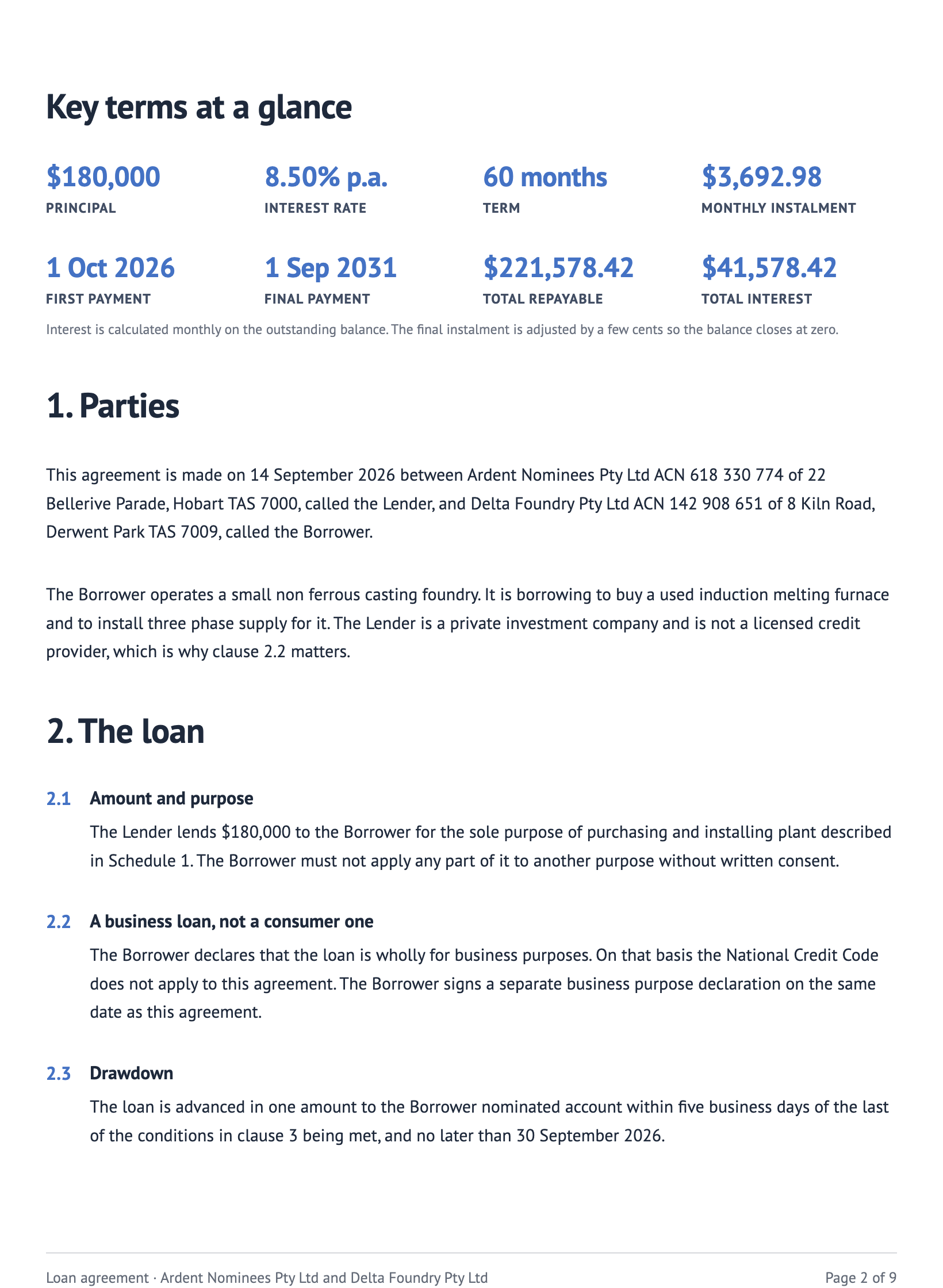 Loan agreement templateA Tasmanian foundry is borrowing $180,000 from a private investment company to buy a used induction furnace. The lender is not a bank, so everything a bank would take for granted has to be written down: what has to happen before the money moves, what is registered over what, and how long the borrower gets to fix a default.
Questions people ask
Can a customer deduct money from an invoice without a set off clause?
Sometimes. Equitable set off may be available where the customer's cross claim is so closely connected to the supplier's claim that it would be unfair to allow recovery without accounting for it. It is not automatic and it is argued rather than assumed, which is why suppliers who need certainty ask for an express no set off clause.
Is a no set off clause enforceable in Australia?
Between commercial parties it is generally effective for ordinary trading, and clear wording is the requirement. Two limits matter. In a standard form small business contract it can be examined under the unfair terms rules, and statutory set off on liquidation operates independently of what the contract says.
Should set off be mutual?
Usually yes, because the symmetry costs the party with more bargaining power very little and removes the main objection to the clause. In practice the customer exercises it far more often, since it is the one making payments. A one way clause is what drives a supplier to demand no set off at all.
Can set off be used against retention money?
Only if both clauses are read together, and they often are not. Retention is already money withheld for a defined purpose, so allowing a further deduction from a payment claim can double up. Draft the two clauses so retention answers defects and set off answers other proven claims, with no overlap.
What notice should a party give before deducting?
Enough for the other side to check the arithmetic, which in practice is five to ten business days, stating the invoice, the amount and the basis. Without notice the deduction appears as an unexplained short payment, the supplier's credit control chases it as an overdue amount, and a commercial issue becomes a collections issue.
Does set off apply to disputed amounts?
That is the central drafting question. Suppliers insist on agreed or determined amounts only. Customers want to deduct on a claim, because that is where the leverage is. A workable compromise permits deduction of undisputed amounts and freezes the rest until a short dispute process has run.
Put the clause in a finished document
The button opens the document generator with a starting description already filled in. Change it to match your own agreement before you run it.
Create a document with OneCraftRelated clauses
- Late payment interest clause: setting a rate that holdsA late payment interest clause sets what accrues on an overdue invoice. Australian sample wording at 8 percent, cash rate linked and UK statutory variants.
- Retention money clause: holding back part of a progress claimA retention money clause holds back part of each progress claim until defects are fixed. Australian sample wording, release triggers and a bank guarantee swap.
- Suspension for non payment clause: pausing work, not ending itA suspension for non payment clause lets a supplier pause work on an overdue invoice without terminating. Sample wording, notice periods and three variants.
For everything the document generator can do, see the document maker.
Step by step in the builder: Create a document with AI, then Every document component and when to use it.
Written and checked by the OneCraft team. Last checked .