Contract clause
Milestone payment clause: paying by stage
A milestone payment clause splits the price into named stages and releases each one when the deliverable for that stage is accepted. It fixes what each milestone is, what it is worth, who decides it has been met, and how long that decision may take before payment falls due anyway.
Milestones sound like a scheduling device and behave like a credit control device. The stage that is worth arguing about is never the first one, it is the last one, where most of the margin usually sits.
Indunil Asanka · Co-founder
4 min read · Published
Sample clause
a fixed price build between Bluegum Software and Tallow Creek Stables, a riding school replacing its paper booking book with an online system
4. Milestones and payment 4.1 The Price is payable in four instalments of twenty five per cent (25%) each, one on Acceptance of each Milestone listed in the Milestone Schedule. 4.2 The Developer must give the Client a written Completion Notice when it considers a Milestone complete, listing the deliverables provided. 4.3 The Client has ten (10) business days from the Completion Notice to give a written Acceptance Notice or a Defect Notice listing each item that does not meet the Specification for that Milestone. 4.4 If the Client gives neither notice within that period, the Milestone is deemed accepted. 4.5 If the Client gives a Defect Notice, the Developer must remedy the listed items and may give a further Completion Notice, and clause 4.3 applies again to the remedied items only. 4.6 The Developer may invoice for a Milestone on Acceptance, and the invoice is payable under clause 5.
Sample wording, not legal advice.
Variants
Acceptance triggered
The deliverable can be tested against a written specification, so acceptance is a factual question.
Each instalment falls due on Acceptance of the corresponding Milestone. Acceptance occurs when the Client gives a written Acceptance Notice, or when the deliverable passes the tests set out in the Test Plan for that Milestone, or when ten (10) business days pass after a Completion Notice without a written Defect Notice, whichever happens first. A Defect Notice must identify the specific requirement in the Specification that the deliverable fails to meet.
Date triggered
The work is continuous and cannot be cut into testable deliverables, such as a long discovery or research engagement.
The Price is payable in six equal instalments, the first on the Commencement Date and each of the remaining five on the first business day of each following month. Each instalment is payable whether or not a specific deliverable has been provided in that month, because the Supplier commits its team for the whole period. The Client may terminate for convenience on thirty (30) days notice and is then liable only for instalments falling due before the end of the notice period.
Hybrid with a final holdback
The customer will not pay the last stage in full until the system has run in production for a period.
Ninety per cent (90%) of the Price is payable across the Milestones in the Milestone Schedule. The remaining ten per cent (10%) is payable thirty (30) days after Go Live, provided no Severity One Defect remains open at that time. A Severity One Defect means a defect that prevents a booking from being created or a payment from being recorded. The holdback is not security for any other obligation and is released in full once that condition is met.
What to negotiate
Who decides a milestone is met
Suppliers want deemed acceptance after a fixed period of silence. Customers want a real review. The settled shape gives the customer a short window with an obligation to list defects against the specification, and deems acceptance if nothing arrives, so a busy customer cannot stall a payment by not replying.
How much sits in the last milestone
Customers load the final stage to keep leverage until the whole thing works. Suppliers resist carrying most of their margin into the riskiest moment. A common compromise is even stages with a small percentage holdback released after a stated period in production, which gives leverage without moving a quarter of the price to the end.
Whether a defect blocks the whole stage
A single cosmetic issue should not hold twenty five per cent of the price. Suppliers ask that only defects that stop the milestone being used can block acceptance, with the rest logged for the next stage. Customers accept it once severity levels are defined in the contract rather than judged later.
The risk of leaving it out
With no milestone clause a fixed price project either bills on completion, which asks the supplier to fund the whole build, or bills monthly against nothing in particular, which asks the customer to pay without any test of progress. Both end in the same place: an argument late in the project about how much of the work is really done, with no agreed measure to settle it.
How the clause interacts with security of payment law
In construction and related trades, state security of payment legislation gives a contractor a statutory route to a progress payment and imposes short response times on a payment claim. A milestone clause cannot contract out of that scheme, and wording that tries to make payment conditional on something the legislation treats as irrelevant is at risk. Outside construction there is no equivalent statutory backstop, which is exactly why the acceptance mechanism in the contract carries so much weight.
Common mistakes
The schedule names four milestones and the payment clause refers to five. The deliverable for a milestone is described as a working system rather than as something testable, so acceptance becomes an opinion rather than a finding. There is no deemed acceptance, so silence blocks the invoice forever. And nobody says what happens to earlier milestones on termination, which leaves the supplier arguing for a quantum it cannot point to in the document.
Where it sits in a generated document
Milestones need two places in the document: the numbered clause that sets the mechanism, and a table listing the stages with their dates and amounts. A generated statement of work carries both, because a table is one of the available block types and the clause text can refer to it by name. Numbers in that table are written as document content rather than as fillable inputs, so the version sent for signature reads the same as the version the parties reviewed.
Documents that carry this clause
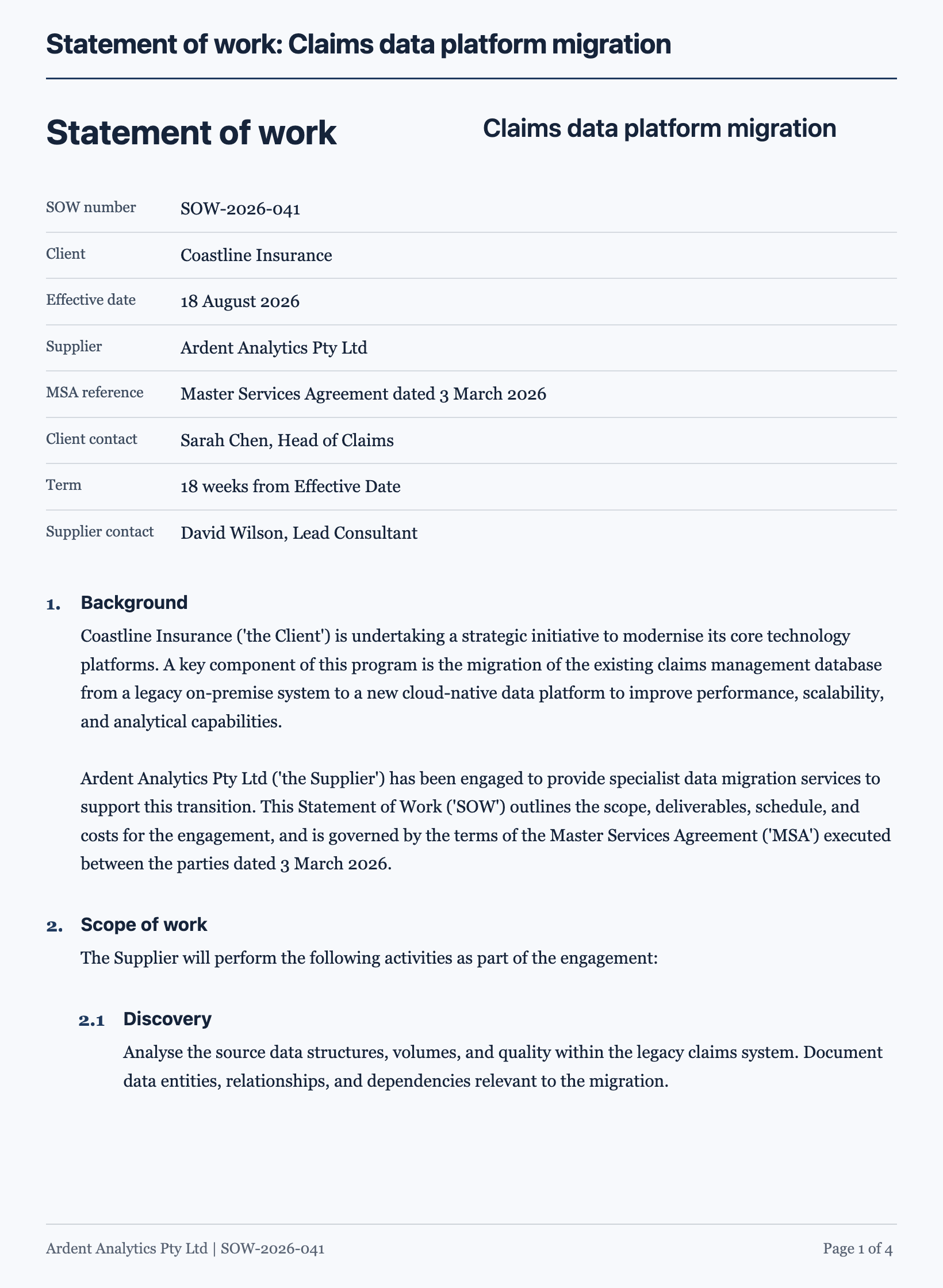 Statement of work template under a master agreementArdent Analytics migrates Coastline Insurance’s claims database to a cloud platform over 18 weeks under SOW-2026-041, governed by a master services agreement dated 3 March 2026. The work is time and materials with four roles priced by the day and a $412,000 estimate before GST, five dated deliverables, ten business days to accept each one, and five assumptions written down before anyone starts.
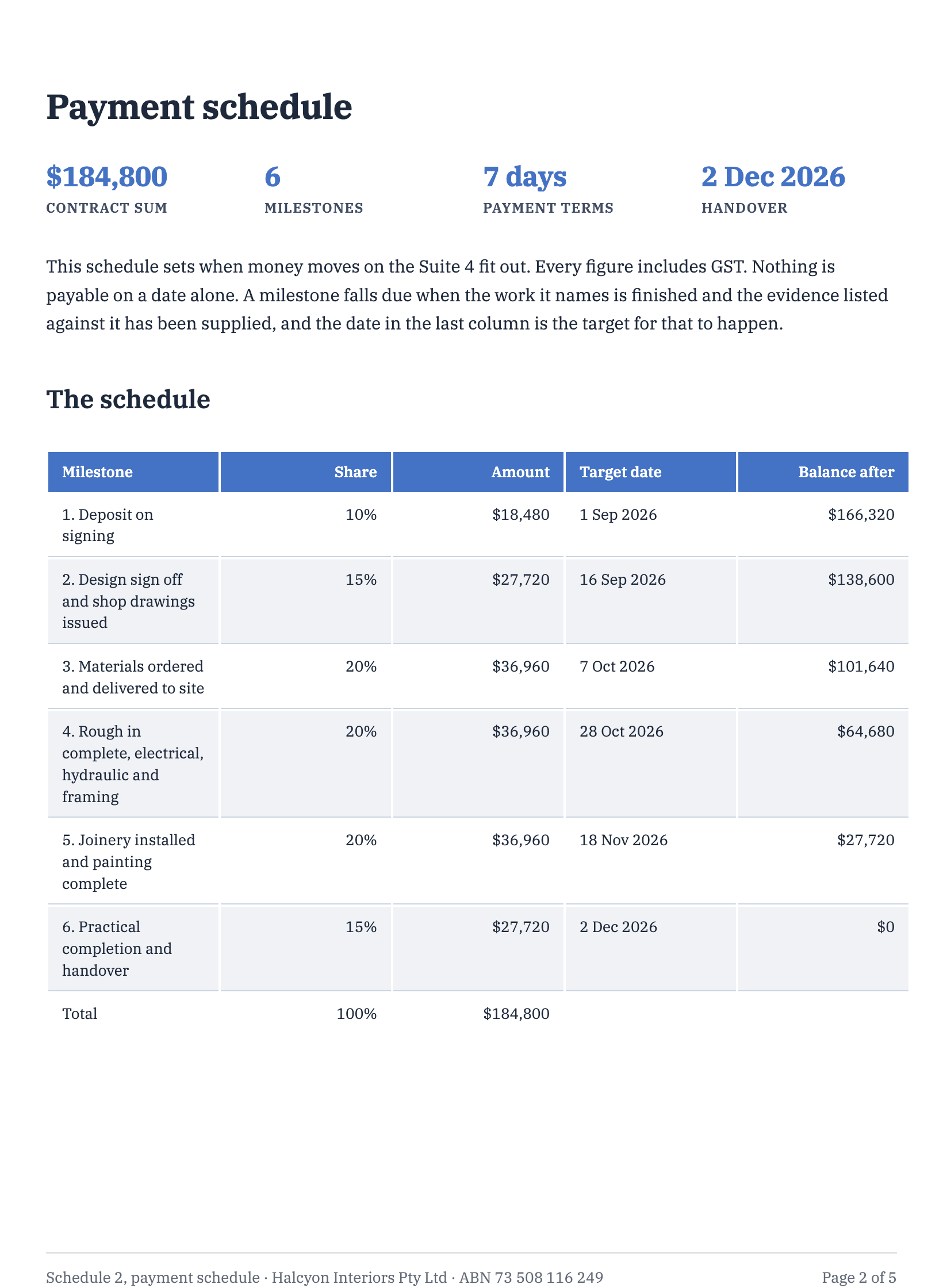 Payment scheduleA $184,800 fit out is paid in six milestones, and every one of them is a piece of work rather than a date. The running balance column is the part both sides check, because it falls to zero only when the handover pack changes hands.
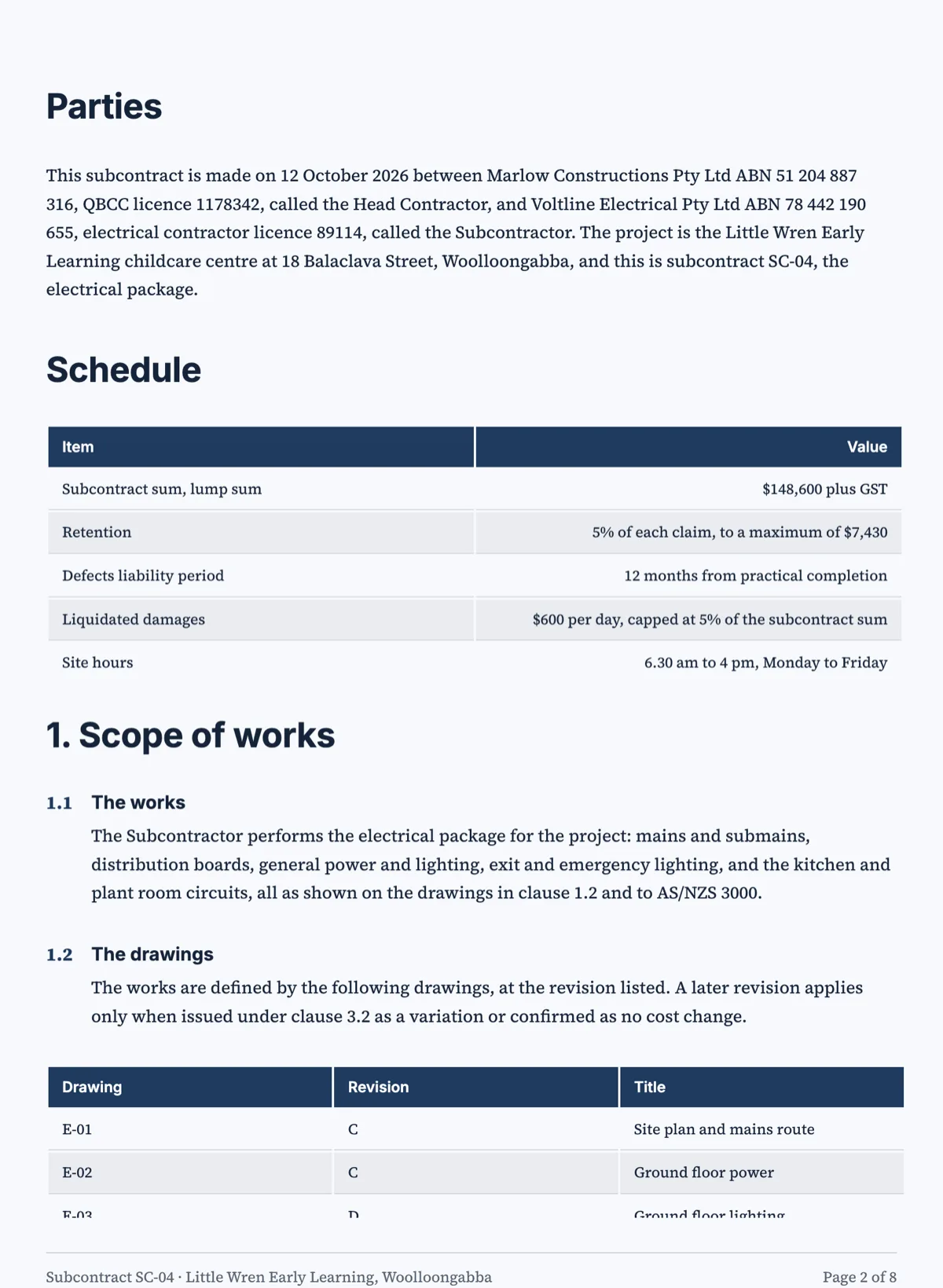 Subcontractor agreement template that flows the head contract downA subcontract exists to pass the head contract's obligations down one level and move the money back up on time. This one names the scope by drawing, sets the progress claim dates against the security of payment rules, holds retention and states the insurances, so the trade knows exactly when it is paid and for what.
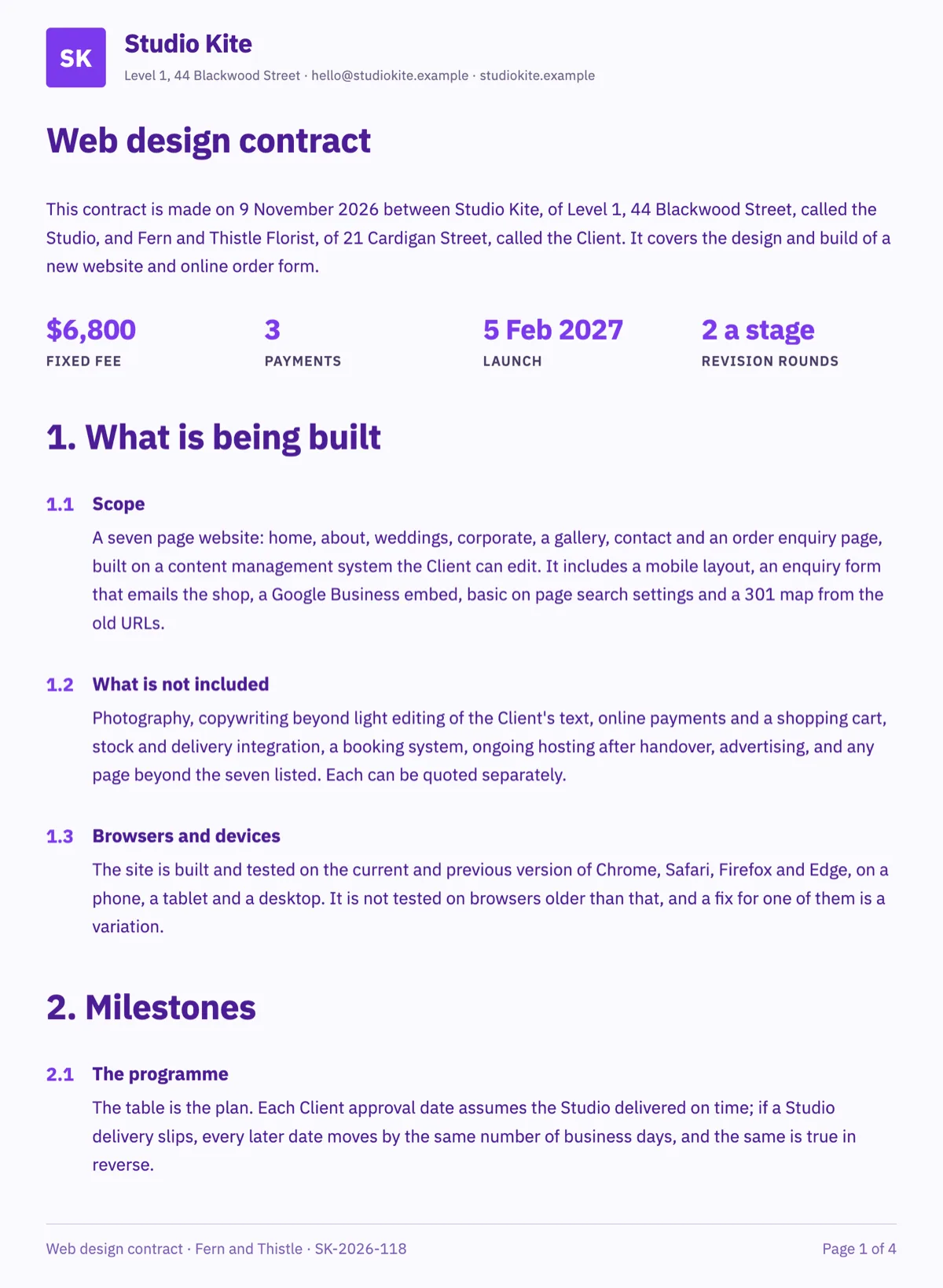 Web design contract template with milestones and revision roundsWebsite projects rarely fail on design. They stall because the content never arrives and nobody wrote down what happens next. This contract dates every milestone on both sides, deems a stage approved if the client goes quiet, and moves the launch by a day for every day the copy is late.
Questions people ask
How many milestones should a project have?
Enough that neither side carries more than a few weeks of unpaid work, and few enough that each one has a deliverable worth testing. Three to six is the usual range on a project of a few months. Ten milestones on a short build produces ten acceptance arguments and ten invoices for the same total.
What is deemed acceptance?
A term saying that if the customer neither accepts nor lists defects within a stated period after being told a stage is complete, the stage counts as accepted. It exists because silence is the most common way a payment stalls. Customers usually accept it when the period is realistic and the supplier must list what it delivered.
Can a customer withhold a milestone payment for a minor defect?
Only if the clause lets them. Draft it so acceptance can be refused only for a defect that prevents the milestone being used for its stated purpose, with everything else recorded and fixed in the next stage. Without that limit, one cosmetic item can hold a quarter of the price indefinitely.
Do milestone payments need separate invoices?
Yes, and that is a feature rather than an overhead. One invoice per accepted milestone gives a clean audit trail, keeps the payment term running from a single event, and avoids a part paid invoice that nobody can reconcile. Reference the milestone name and the acceptance date on the invoice itself.
What happens to milestones if the project is terminated early?
Say it in the clause. The usual position is that accepted milestones are payable in full, work in progress on the current milestone is payable on a stated basis such as time recorded, and nothing is payable for later stages. Silence here is where most termination disputes on fixed price projects begin.
Is a milestone payment the same as a progress payment?
They overlap. A progress payment is usually measured by how much work has been done in a period, often on a percentage basis. A milestone payment is tied to a defined deliverable being accepted. Construction contracts tend to use progress claims, while software and design projects tend to use milestones.
Put the clause in a finished document
The button opens the document generator with a starting description already filled in. Change it to match your own agreement before you run it.
Create a document with OneCraftRelated clauses
- Retention money clause: holding back part of a progress claimA retention money clause holds back part of each progress claim until defects are fixed. Australian sample wording, release triggers and a bank guarantee swap.
- Deposit clause: what happens to money paid up frontA deposit clause takes money up front and says what happens to it. Australian sample wording, refundable and non refundable variants, and the unfair terms risk.
- Invoicing clause: when invoices go out and what they must showAn invoicing clause says when invoices go out and what they must show to be payable. Australian sample wording, the tax invoice checklist and three variants.
For everything the document generator can do, see the document maker.
Step by step in the builder: Create a document with AI, then Every document component and when to use it.
Written and checked by the OneCraft team. Last checked .