Contract clause
Proportionate liability clause: paying only your share
A proportionate liability clause deals with whether a party that contributed to a loss pays only its own share of it, or can be pursued for the whole amount. Each Australian state has a statutory scheme for certain claims, and the clause either accepts that scheme or tries to contract out of it.
Two consultants make the same mistake on one project and one of them has gone under. Whether the survivor pays half or all of it is decided by a clause most people skip.
Indunil Asanka · Co-founder
4 min read · Published
Sample clause
a structural engineering appointment between Merrivale Consulting and a developer building a four storey apartment block, with a separate certifier and a separate architect on the same project
18. Apportionment of liability 18.1 The parties agree that the provisions of any legislation providing for proportionate liability apply to any apportionable claim arising out of or in connection with this Agreement, to the extent that legislation applies. 18.2 The Consultant's liability for an apportionable claim is limited to the proportion of the loss or damage that the court or tribunal determines the Consultant is responsible for, having regard to the responsibility of each concurrent wrongdoer. 18.3 The Client must not settle a claim with another concurrent wrongdoer on terms that prevent the Consultant from establishing that wrongdoer's responsibility. 18.4 The Consultant must give the Client written notice of any other person it believes is a concurrent wrongdoer in relation to a claim, within twenty (20) business days of becoming aware of the claim. 18.5 This clause does not limit the Consultant's obligation to maintain professional indemnity insurance under clause 16.
Sample wording, not legal advice.
Variants
Contracting out where the state permits it
The client is in a jurisdiction that allows the scheme to be excluded by express agreement and wants full recovery from one party.
To the extent permitted by law, the parties agree that the operation of any proportionate liability legislation is excluded in relation to all rights, obligations and liabilities arising under or in connection with this Agreement, whether those rights, obligations or liabilities are sought to be enforced in contract, in tort or otherwise. The Consultant is liable for the whole of any loss the Client suffers, subject only to the limits of liability in clause 17.
Contracting in expressly
The consultant wants certainty that the scheme applies, particularly where the governing law might change.
The parties agree that any apportionable claim arising under this Agreement is to be determined in accordance with the proportionate liability legislation of the jurisdiction whose law governs this Agreement, and that neither party will argue that the legislation has been excluded. Each party acknowledges that this allocation of risk has been taken into account in setting the Fee and the limits of liability in this Agreement.
Silent, with a duty to disclose other wrongdoers
Neither party wants to take a position on the legislation but both want the process to work.
This Agreement does not exclude or modify the operation of any proportionate liability legislation. Where a party becomes aware of a claim to which such legislation may apply, it must notify the other party in writing within twenty (20) business days and must provide the information in its possession about any other person whose acts or omissions may have contributed to the loss. Neither party may settle with another wrongdoer in a way that prejudices the other party's position.
What to negotiate
Whether to exclude the scheme at all
Clients want one party accountable for the whole loss, because chasing four defendants is slow and one of them is usually insolvent. Consultants want the scheme preserved, and so do their insurers. Insurance is often decisive: a policy may not respond to liability the consultant assumed only because it contracted out.
Which state the contract is under
The answer changes across the country, so the governing law clause quietly decides this one. A client that drafts an exclusion into a national template will find it works in some jurisdictions and not in others. The safer approach is a clause that operates to the extent permitted by law in the governing jurisdiction.
Settlement with other wrongdoers
If the client settles cheaply with the architect, the engineer may be left arguing about a share the client has already given away. A duty not to settle in a way that prevents another party establishing responsibility, plus prompt notice of claims, is a fair and usually uncontroversial addition.
The risk of leaving it out
If the clause is absent, the statutory scheme applies of its own force to the claims it covers, which for a consultant is usually the protective outcome. The gap that matters is process rather than principle: with no notice obligations and no restriction on settling with other wrongdoers, a party can find the apportionment argument has been shaped without it.
The state by state position on contracting out
Queensland is the clearest case. Section 7(3) of the Civil Liability Act 2003 preserves freedom of contract across the Act but expressly carves out the proportionate liability part, so parties cannot contract out of it. New South Wales and Western Australia go the other way and allow the scheme to be excluded by express agreement. Victoria, South Australia, Tasmania, the Australian Capital Territory and the Northern Territory are silent, which is generally read as leaving contracting out open but less certain than a statute that says so. Schemes also differ in what they cover, though economic loss and property damage claims for breach of a duty of care, and claims for misleading conduct, are the common core.
What the schemes do not cover
Proportionate liability is not a general rule about splitting blame. The Queensland scheme, for example, applies to claims for economic loss or property damage arising from a breach of a duty of care and to misleading conduct claims, and expressly does not apply to claims arising out of personal injury or to claims by a consumer. A wrongdoer who acted fraudulently, or who intended to cause the loss, remains severally liable for the whole amount. Those boundaries matter more in practice than the drafting, because they decide whether the clause has anything to operate on.
Where it sits in a generated document
Apportionment sits with the liability clauses and should be read beside the cap and the insurance obligation, since all three answer the same question of how much can be recovered and from whom. A generated consulting appointment numbers each of them so the apportionment clause can refer to the insurance clause by number. The clause states the position and does not cite the legislation, because a contract is not a commentary.
Documents that carry this clause
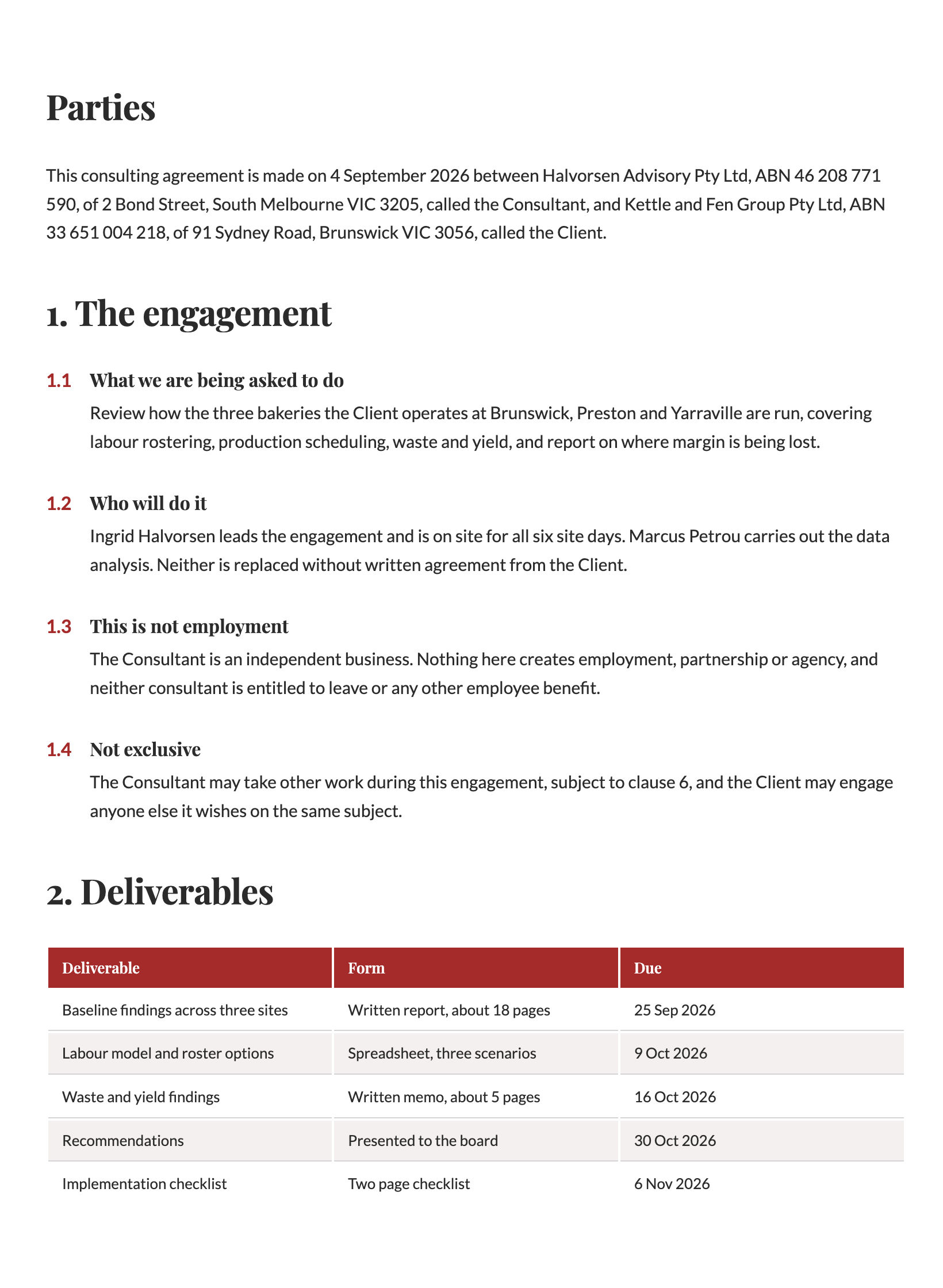 Consulting agreementAn advisory firm reviews three bakeries over seven weeks. What makes this agreement useful is not the fee clause but the two clauses that say what the advice is not.
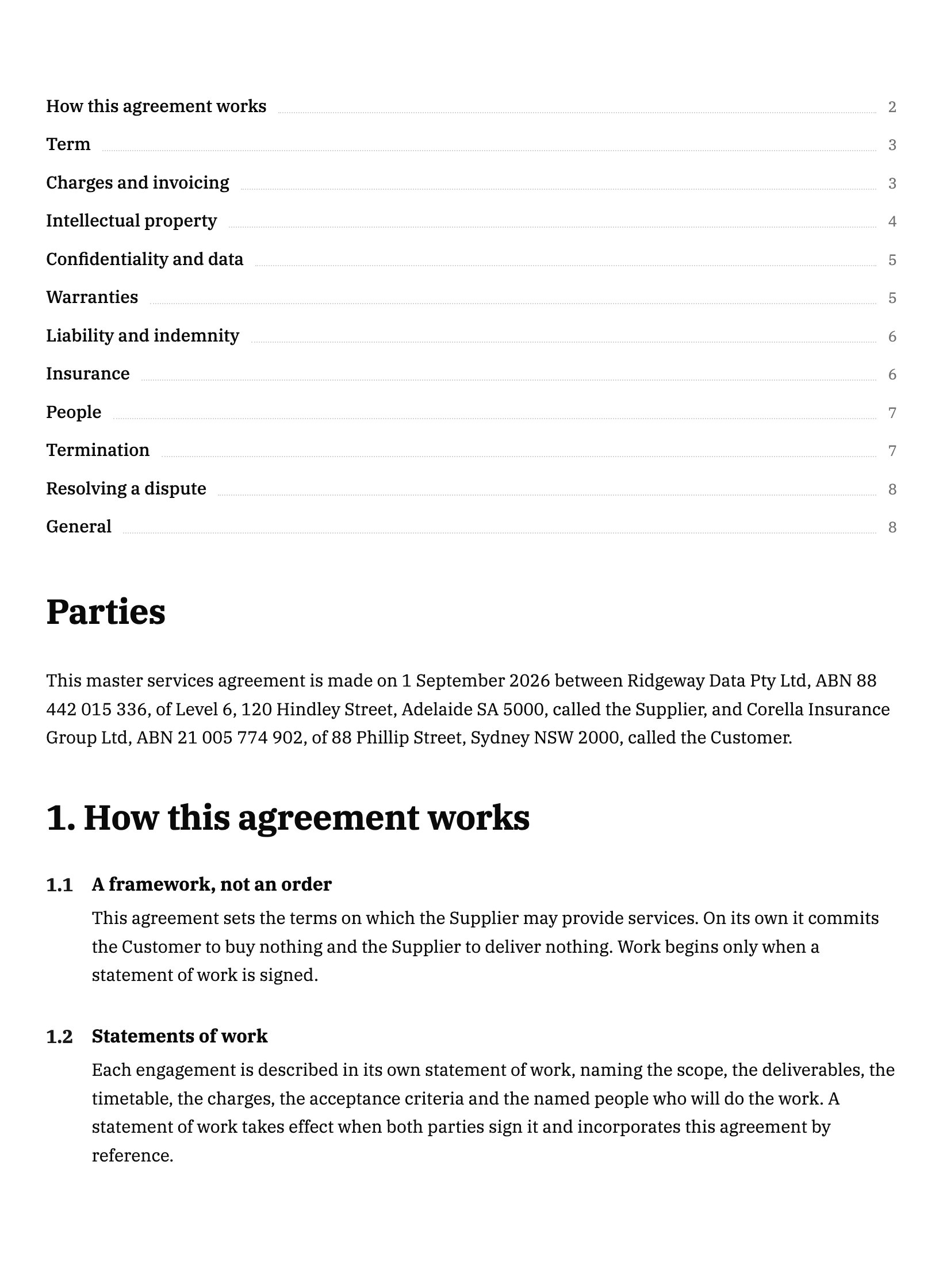 Master services agreementA data consultancy and an insurer sign this once and then buy work under it for three years. It is the rare contract whose whole purpose is to make the next twenty contracts short.
Questions people ask
What is proportionate liability?
A statutory scheme under which a defendant who is one of several concurrent wrongdoers pays only the share of the loss the court finds it responsible for, instead of being liable for the whole amount. It replaced the older position for certain claims, and it shifts the risk of an insolvent co defendant from the other defendants onto the plaintiff.
Can parties contract out of proportionate liability in Australia?
It depends on the state. Queensland expressly prevents contracting out of its proportionate liability part while allowing freedom of contract elsewhere in the Act. New South Wales and Western Australia permit exclusion by express agreement. Several other jurisdictions say nothing, which is usually read as leaving it available but untested.
Which claims does the scheme apply to?
Broadly, claims for economic loss or damage to property arising from a breach of a duty of care, and claims for misleading or deceptive conduct. Personal injury claims are outside it, and so are consumer claims in some jurisdictions. That coverage is what decides whether the clause does anything at all in a given dispute.
Why do insurers care about a contracting out clause?
Because excluding the scheme means the insured has accepted liability for loss caused by someone else. A professional indemnity policy may not respond to liability assumed under a contract that the insured would not otherwise have borne. Consultants should check the policy before agreeing to exclude the legislation, not afterwards.
Does a liability cap replace proportionate liability?
No, they answer different questions. Apportionment decides the share of the loss a party is responsible for, and the cap decides the maximum payable once that share is known. A consultant with a cap but no apportionment protection can still be exposed to the whole loss up to the cap.
What happens if a co defendant is insolvent?
Under a proportionate liability scheme, the plaintiff carries that shortfall rather than the remaining defendants. That is precisely why clients try to contract out where they can, and why consultants and their insurers resist. It is the single most consequential difference between the two positions.
Put the clause in a finished document
The button opens the document generator with a starting description already filled in. Change it to match your own agreement before you run it.
Create a document with OneCraftRelated clauses
- Limitation of liability clause: putting a ceiling on exposureA limitation of liability clause puts a ceiling on what one party can recover. Australian sample wording, three variants, the carve outs and the UK test.
- Indemnity clause: promising to cover someone else's lossAn indemnity clause is a promise to cover the other party's loss from a named event. Australian sample wording, three variants and what each side negotiates.
- Insurance clause: which policies, what amounts, what proofAn insurance clause sets the policies a contractor must hold, the amounts and the proof. Australian sample wording, typical cover levels and three variants.
For everything the document generator can do, see the document maker.
Step by step in the builder: Create a document with AI, then Every document component and when to use it.
Written and checked by the OneCraft team. Last checked .