Contract clause
Waiver of subrogation clause
A waiver of subrogation clause stops an insurer stepping into its insured's shoes to recover from the other contracting party after paying a claim. It keeps a tenant, hirer or contractor from being chased by an insurer for a loss the policy was bought and paid for to cover.
Two parties agree who carries a risk, one of them insures it, and then the insurer pays out and sues the other party anyway. This clause closes that loop, which is why it turns up in almost every lease and equipment hire agreement.
Nuwan Madhusanka · Co-founder
4 min read · Published
Sample clause
a commercial tenancy between Quayside Property Group and Marlow Books, a fictional bookseller in a Perth arcade
1. Building Insurance. The Landlord must keep the Building insured against fire, storm and impact damage for its full replacement value. 2. Waiver of Subrogation. The Landlord must ensure that the policy taken out under clause 1 either names the Tenant as an insured or contains an endorsement under which the insurer waives any right of subrogation against the Tenant and the Tenant's employees. 2.1 The Landlord must give the Tenant a copy of the endorsement, or a certificate of currency recording it, within 10 business days of a written request. 2.2 Clause 2 does not apply to loss caused by the Tenant's fraud or wilful damage. 3. Tenant Insurance. The Tenant must keep its stock, fit out and glass insured, and must ask its insurer for a matching waiver in favour of the Landlord. 4. No Double Recovery. Neither party may claim from the other an amount it has already recovered under a policy held under this clause.
Sample wording, not legal advice.
Variants
Mutual waiver
Both parties insure their own property in the same building or on the same site, and neither wants the other's insurer arriving after a fire.
Each party must ensure that every policy it holds in respect of property at the Premises contains a waiver by the insurer of any right of subrogation against the other party, its employees and its contractors, in respect of loss covered by that policy. Each party must give the other written evidence of the waiver on request, and neither party may bring a claim against the other for loss that is covered, or would have been covered but for that party's failure to keep the policy on foot.
One way, in favour of the hirer
Equipment hire, where the owner insures the plant and the hirer simply operates it.
The Owner must ensure that its insurance of the Equipment contains an endorsement waiving any right of subrogation against the Hirer and the Hirer's employees in respect of damage to the Equipment occurring during the Hire Period. The waiver does not extend to damage caused by use of the Equipment outside the permitted purpose, by an operator who does not hold the required licence, or by the Hirer's wilful act, and the Hirer remains liable for the excess under the policy.
Limited to insured loss only
The party giving the waiver is willing to give up recovery only as far as the policy actually responds, not beyond it.
Each party waives any right of recovery against the other in respect of loss or damage to property, but only to the extent that the loss is actually paid under a policy of insurance held by the party suffering it. Nothing in this clause affects a claim for an amount that exceeds the policy limit, for a deductible or excess, or for loss falling within a policy exclusion, and nothing in it requires a party to take out insurance it is not otherwise obliged to hold.
What to negotiate
Whether the insurer will actually agree
A clause promising a waiver is worthless if the policy does not carry one. Insurers often give the endorsement for commercial property, sometimes for a small premium adjustment, and sometimes refuse it. The workable approach is an obligation to use reasonable efforts to obtain the endorsement, plus a duty to tell the other party promptly if the insurer declines, so the risk can be priced rather than discovered after a fire.
What the waiver does not cover
The excess, any loss above the policy limit, and anything the policy excludes all sit outside the waiver, and the party who thought it was protected is often surprised. Most drafts state plainly that the waiver runs only as far as the policy responds. Fraud and wilful damage are carved out in almost every version, because no insurer will waive recovery against deliberate destruction of the insured property.
Naming the other party as an insured instead
Naming the other party on the policy achieves much the same result and is sometimes easier to obtain than a subrogation endorsement, since an insurer cannot subrogate against its own insured. The trade off is that the named party can also make claims, which affects the claims history and may affect the premium. Landlords often prefer the endorsement for that reason, and tenants are usually indifferent.
The risk of leaving it out
Without the clause the insurer that pays a claim can sue the other contracting party in the insured's name to get its money back, even though the contract had already allocated that risk and the premium had been paid to carry it. The party sued is then defending a claim it reasonably believed had been insured away, usually with no cover of its own for it.
What subrogation actually is
Subrogation is the insurer's right, once it has paid a claim, to pursue in the insured's name anyone who caused the loss. It is the reason insurance does not simply absorb risk out of the system. The insured has already been paid, so the recovery goes to the insurer rather than to them, and the insured often learns about the proceedings only when a statement is requested. In a contract where two parties have already agreed who carries a risk, the insurer's right cuts across that agreement, because the insurer was not a party to it and is not bound by how the parties divided things up between themselves.
Why an insurer has to agree
A contract between a landlord and a tenant cannot take a right away from a third party who never signed it, so a clause that simply says the insurer waives subrogation does nothing on its own. What the clause really does is oblige one party to get its insurer to give the waiver, usually as a policy endorsement, and then to prove it. That is why the useful drafting is an obligation plus evidence: obtain the endorsement, produce it or a certificate of currency recording it, and tell the other party if the insurer refuses. A promise with no evidence step attached is a promise nobody checks until a claim is already running.
Where it sits in a generated document
The document generator writes an agreement as numbered content, so the waiver normally appears as a sub clause under the insurance obligation it depends on, rather than as a separate section elsewhere in the document. The generated text is written from the description it is given and it never prints citations, so any reference to a policy type or a statute has to be checked before the document is used. Describing both the insurance obligation and the waiver in the same sentence of the prompt keeps them together in the finished draft.
Documents that carry this clause
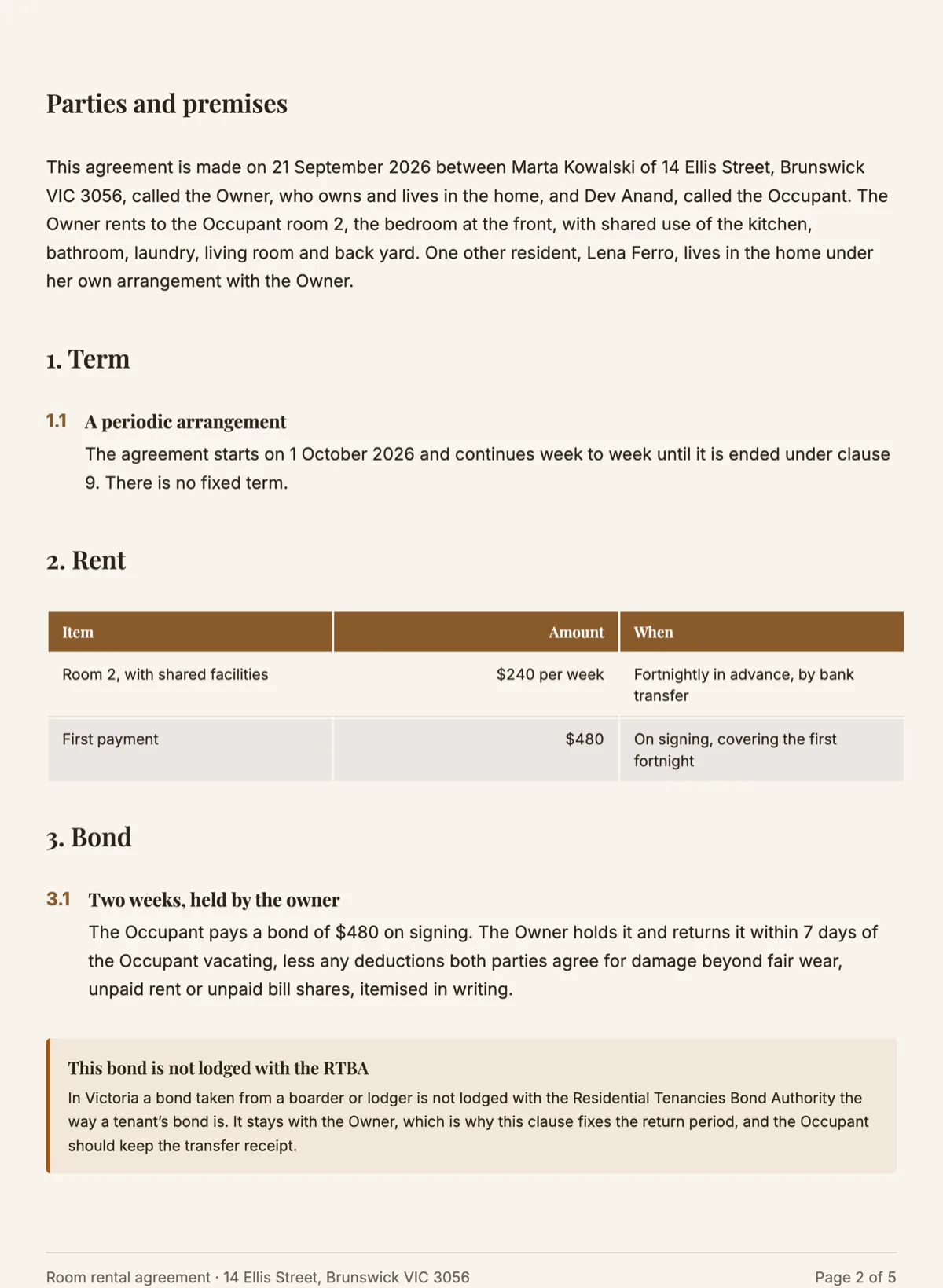 Room rental agreement template for one room in a shared homeRenting a room is not the same as renting a house, and most templates copy a residential lease and hope. This one is written for one room with shared kitchen and bathroom, prices the bills split, lists the rules that matter, and says plainly that the occupant is a boarder or lodger and what that changes.
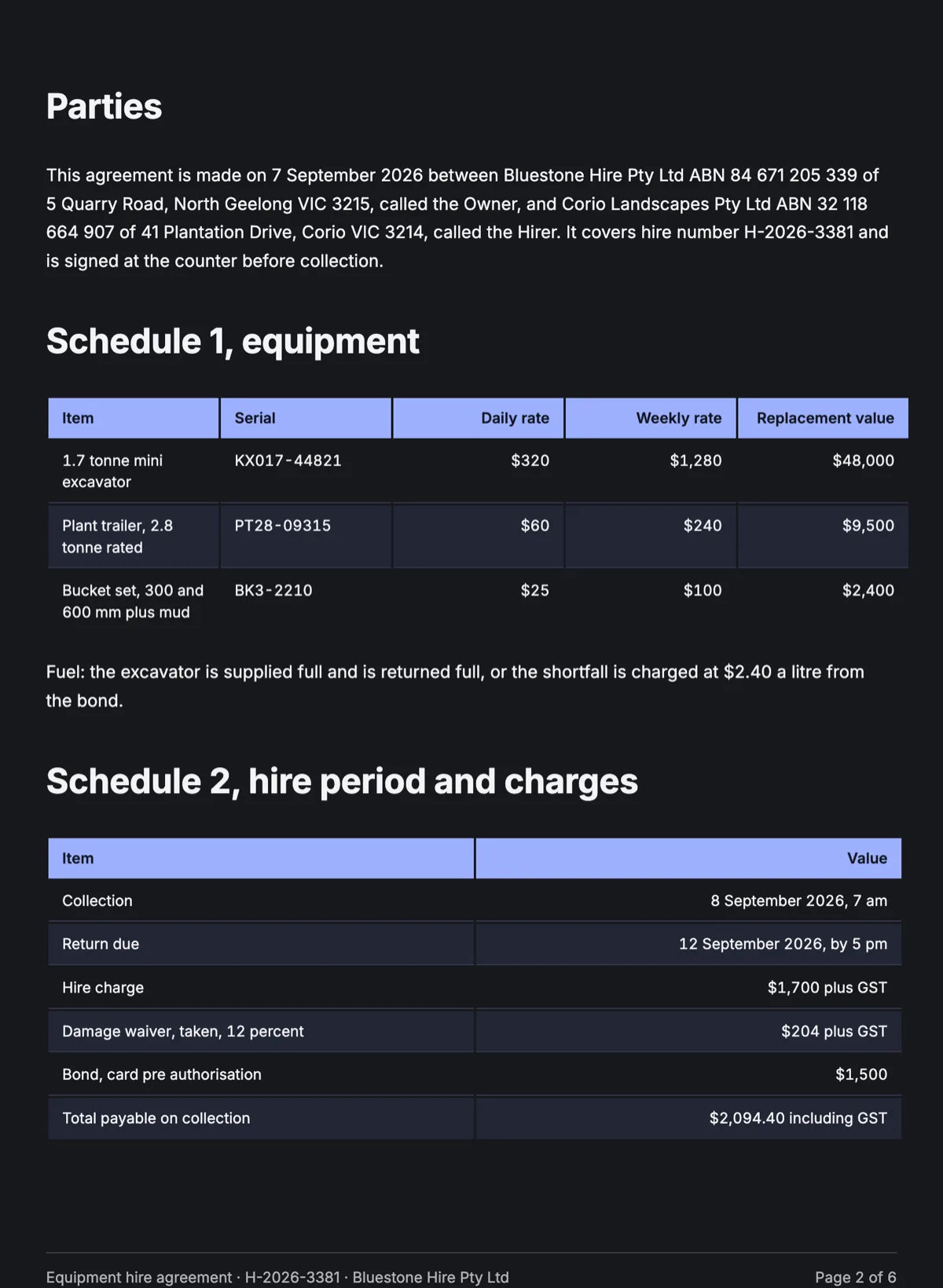 Equipment hire agreement template with the rates in a scheduleA hire agreement is a price list, an insurance decision and a return date, and the argument is always about the day it came back. This one puts the equipment and rates in a schedule, makes the damage waiver a choice with its price, and defines late return in hours so there is nothing to interpret.
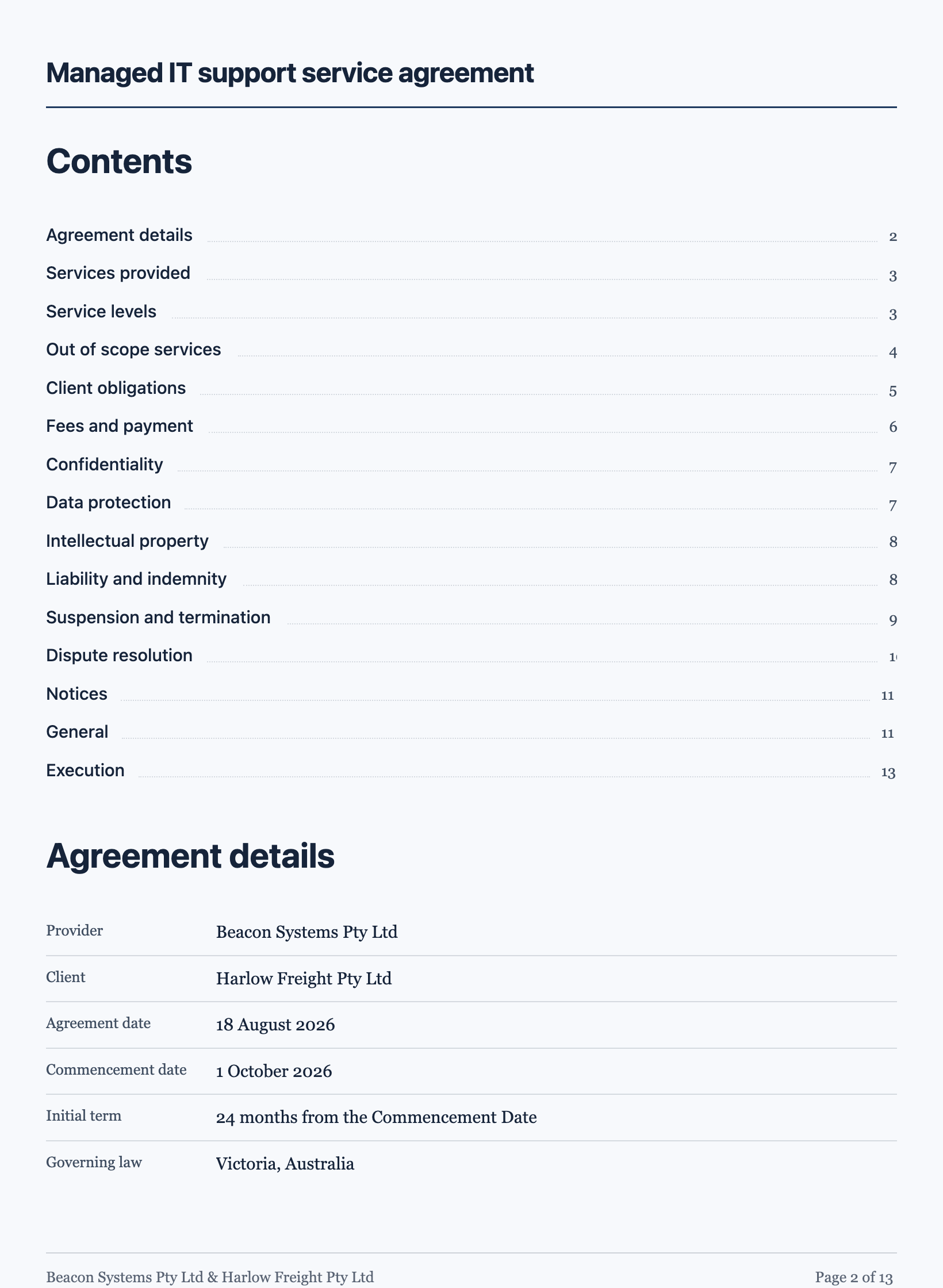 Service agreementBeacon Systems supports Harlow Freight’s IT for an initial 24 months from 1 October 2026 at $8,400 a month plus GST, with 40 hours included and $220 an hour beyond them. Twelve numbered clauses cover the services, a four level severity table, client duties, fees with a CPI adjustment, confidentiality, privacy, IP, a liability cap, termination and a three step dispute ladder.
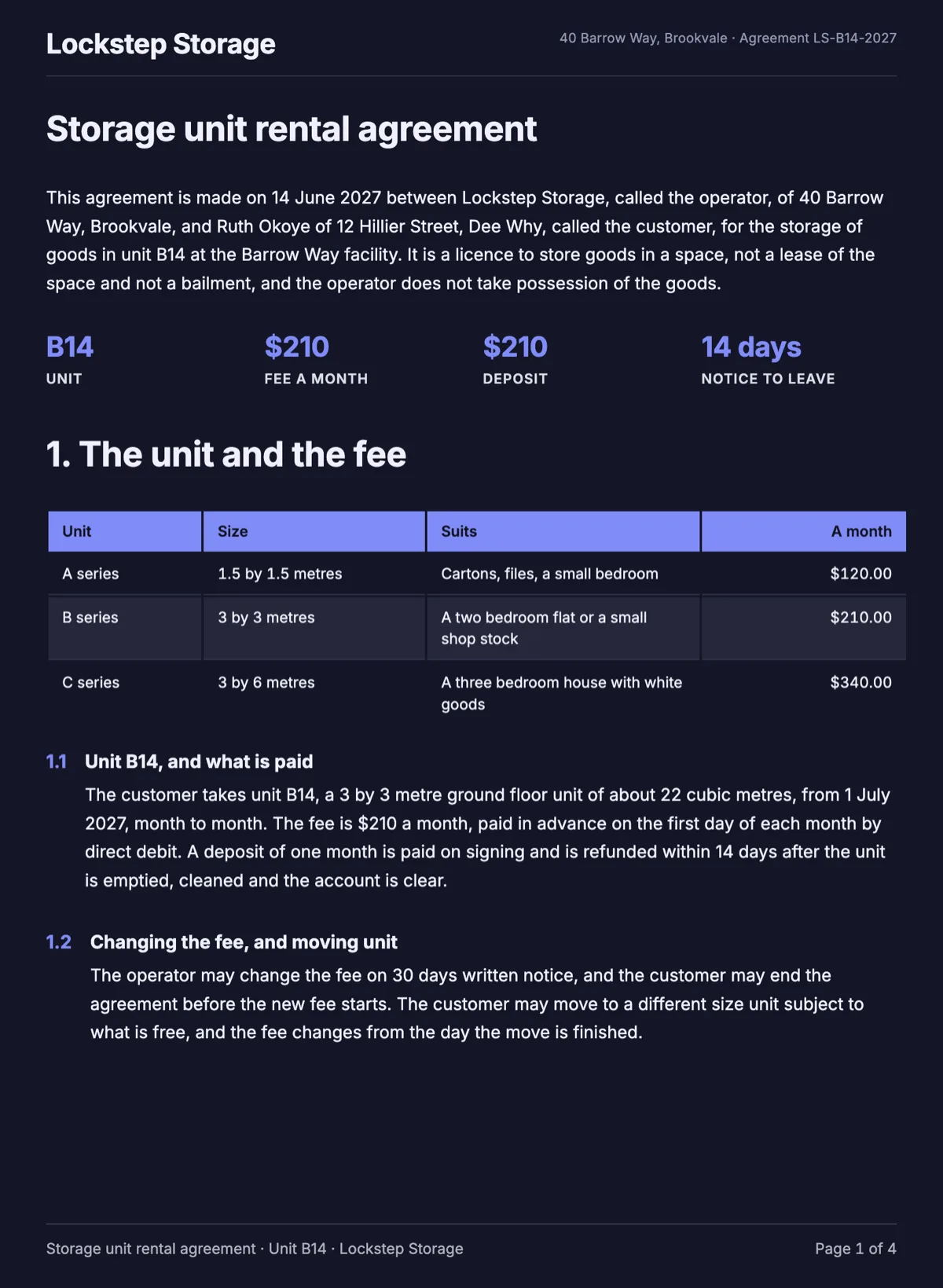 Storage unit rental agreement with access hours and a lien clauseSelf storage looks like a lease and is not one, which is why the agreement has to say what it actually is before it says anything else. This one opens by calling itself a licence to store goods in a space, then sets the access hours, the prohibited items and the exact sequence that happens when the account falls behind.
Questions people ask
What does waiver of subrogation mean in plain English?
It means an insurer agrees not to chase the other party to the contract for money it has already paid out to its own customer. Without the waiver, paying a claim gives the insurer the right to sue whoever caused the loss, in the name of the insured, and that person is usually the tenant, hirer or contractor on the other side of the agreement.
Can two parties waive subrogation without the insurer?
Not effectively. The right belongs to the insurer, and a contract between two other people cannot remove it. What the parties can do is promise each other to obtain the waiver from their insurers as a policy endorsement, and to produce evidence of it. A clause that only says the insurer waives its rights, with no obligation to get that agreement, achieves nothing.
Does a waiver of subrogation increase the premium?
Sometimes, and often not at all for standard commercial property cover. The endorsement removes one route of recovery for the insurer, so pricing depends on how likely that recovery was. The practical step is to ask the broker before the contract is signed rather than after, because a refusal discovered later leaves one party carrying a risk it thought it had dealt with.
Is the excess still payable under a waiver?
Normally yes. The waiver stops the insurer recovering what it paid, but the deductible or excess was never paid by the insurer, so it sits outside the waiver unless the clause says otherwise. Equipment hire agreements often make this explicit by leaving the hirer responsible for the excess while waiving recovery of everything above it.
Should the clause be mutual?
In a lease or a shared site it usually should be, because both parties insure something and either could cause the other's loss. A one way waiver is common where only one party insures the property in question, such as hired plant owned by the supplier. Making it mutual removes the argument about which insurer moves first after an incident.
Does a waiver cover deliberate damage?
Almost never. Fraud and wilful damage are carved out of nearly every waiver, because no insurer agrees to give up recovery against someone who destroyed the insured property on purpose. The carve out is usually written into the clause itself so that the limit is clear on the face of the contract rather than buried in the policy wording.
Put the clause in a finished document
The button opens the document generator with a starting description already filled in. Change it to match your own agreement before you run it.
Create a document with OneCraftRelated clauses
- Insurance clause: which policies, what amounts, what proofAn insurance clause sets the policies a contractor must hold, the amounts and the proof. Australian sample wording, typical cover levels and three variants.
- Hold harmless clauseA hold harmless clause promises not to hold the other side responsible for a named risk. Sample wording, how it differs from an indemnity, what to negotiate.
- Liquidated damages clauseA liquidated damages clause fixes what delay costs before it happens. Sample fit out wording, the Australian penalty test, caps, and what each side negotiates.
For everything the document generator can do, see the document maker.
Step by step in the builder: Create a document with AI, then Document builder components.
Written and checked by the OneCraft team. Last checked .