Contract clause
Hold harmless clause
A hold harmless clause is a promise by one party not to hold the other responsible for loss arising from a named activity or risk. It appears in waivers, venue hire and site access documents, where the person accepting the risk records that acceptance in writing before taking part.
The phrase turns up most often in American drafting, where defend, indemnify and hold harmless run together as one formula. Read in Australia it usually adds little that an indemnity and a release do not already do, which is why it pays to know what the words carry.
Nuwan Madhusanka · Co-founder
4 min read · Published
Sample clause
a bouldering session waiver between Granite Loft Climbing and a school group from Marraweena College, both fictional
1. Assumption of Risk. The Participant acknowledges that bouldering at Granite Loft Climbing involves a risk of injury, including falls from height and contact with fixed holds, and takes part voluntarily with that risk in mind. 1.1 The School confirms that every Participant in the Marraweena College group has read this document or had it read to them by a supervising teacher. 2. Hold Harmless. The School and each Participant agree to hold Granite Loft Climbing, its staff and its contractors harmless from any claim for loss, injury or property damage arising out of the Session, other than a claim caused by the negligence of Granite Loft Climbing or by a breach of a consumer guarantee. 2.1 Nothing in clause 2 limits a right that cannot lawfully be excluded, restricted or modified. 3. Supervision. The School remains responsible for supervising Participants away from the climbing floor, including in the change rooms and the car park.
Sample wording, not legal advice.
Variants
Unilateral, in favour of the operator
The usual form on a waiver, where one party runs the activity and the other takes part in it.
The Participant agrees to hold Granite Loft Climbing, its staff and its contractors harmless from any claim for personal injury, loss or property damage arising out of the Participant's use of the facility, other than a claim caused by the negligence of Granite Loft Climbing or arising under a consumer guarantee that cannot lawfully be excluded. This clause binds the Participant and any person claiming through the Participant, including a parent or guardian who signs on the Participant's behalf.
Reciprocal hold harmless
Two businesses sharing a site or running an event together, where either one could cause the other's loss.
Each party holds the other harmless from any claim for loss or damage arising out of the Event, to the extent that the claim is caused by the acts or omissions of the party seeking to rely on this clause. Neither party holds the other harmless for loss caused by that other party's own negligence, fraud or wilful misconduct, and nothing in this clause affects a right that cannot lawfully be excluded, restricted or modified.
Broad form United States wording
A United States contract where the formula is expected and the drafter wants defence costs covered as well as the judgment.
Contractor shall defend, indemnify and hold harmless Owner, its officers, employees and agents from and against any and all claims, demands, losses, damages, liabilities and expenses, including reasonable attorney fees, arising out of or relating to performance of the Work, to the fullest extent permitted by applicable law. Several states restrict how far this wording can reach where the owner was itself at fault, so the clause is normally tested against the law of the named state before it is used.
What to negotiate
Whether negligence is carved out
The party taking on the risk asks that the clause stop at loss it actually caused, so the operator stays answerable for a faulty anchor or an untrained instructor. The operator asks for the widest release it can get. The usual landing point is a clause that covers the ordinary risks of the activity and expressly leaves out loss caused by the operator's own negligence or breach.
Who else is covered
An operator wants the release to reach its staff, its contractors and its landlord, because a claim aimed at one instructor reaches the operator in the end anyway. The signing party wants that group closed and named. The compromise is a defined group set out once in the document, rather than an open reference to related entities that nobody can list when a claim arrives.
Whether defence costs are included
American drafting joins defend to hold harmless, which turns a passive promise into a duty to fund a defence from the day a claim is served. Australian drafters usually split the two, because funding a defence and paying a judgment are different exposures with different numbers. If defence costs are in scope, say plainly whether the paying party also chooses the lawyers.
The risk of leaving it out
Without it the operator falls back on the general law of negligence and on whatever release and indemnity the document already carries. A participant injured during an ordinary risk of the activity can argue that nobody told them the risk sat with them, and the operator has no signed record that the risk was described, accepted and taken on before the session began.
Hold harmless against indemnity
The two do different work, even though they usually arrive in the same sentence. An indemnity is a promise to pay for a loss, so it creates an obligation the other party can enforce as a debt. A hold harmless promise is defensive: the promising party agrees not to bring the claim at all, which is closer to a release. In a document carrying both, the indemnity moves money and the hold harmless limb closes off a counterclaim. Drafting them as one line is common, and it makes it harder to work out which effect survives if part of the clause fails.
How it is read in Australia
Australian courts read a release against the party relying on it, so a clause meant to cover the operator's own negligence has to say so in clear words rather than by implication. The consumer guarantees in Schedule 2 of the Competition and Consumer Act 2010 sit above the clause for services supplied to a consumer, and a contract term cannot exclude, restrict or modify them. A waiver for a recreational service can go further than one for an ordinary service, but the rules differ by state, so the clause normally names the state whose law applies and keeps a savings sentence for rights that cannot be given up.
Where it sits in a generated document
The document generator writes an agreement as numbered content, so a hold harmless promise arrives as its own numbered clause with sub clauses under it, rather than as a paragraph buried in a schedule. The generated text is written from the description it is given and it never prints citations, so any statute reference in a draft has to be checked against the legislation before the document is used. Where the document ends in a signature block, each party in that block becomes one signer, so a school signing for a whole group produces one signature, not one per participant.
Documents that carry this clause
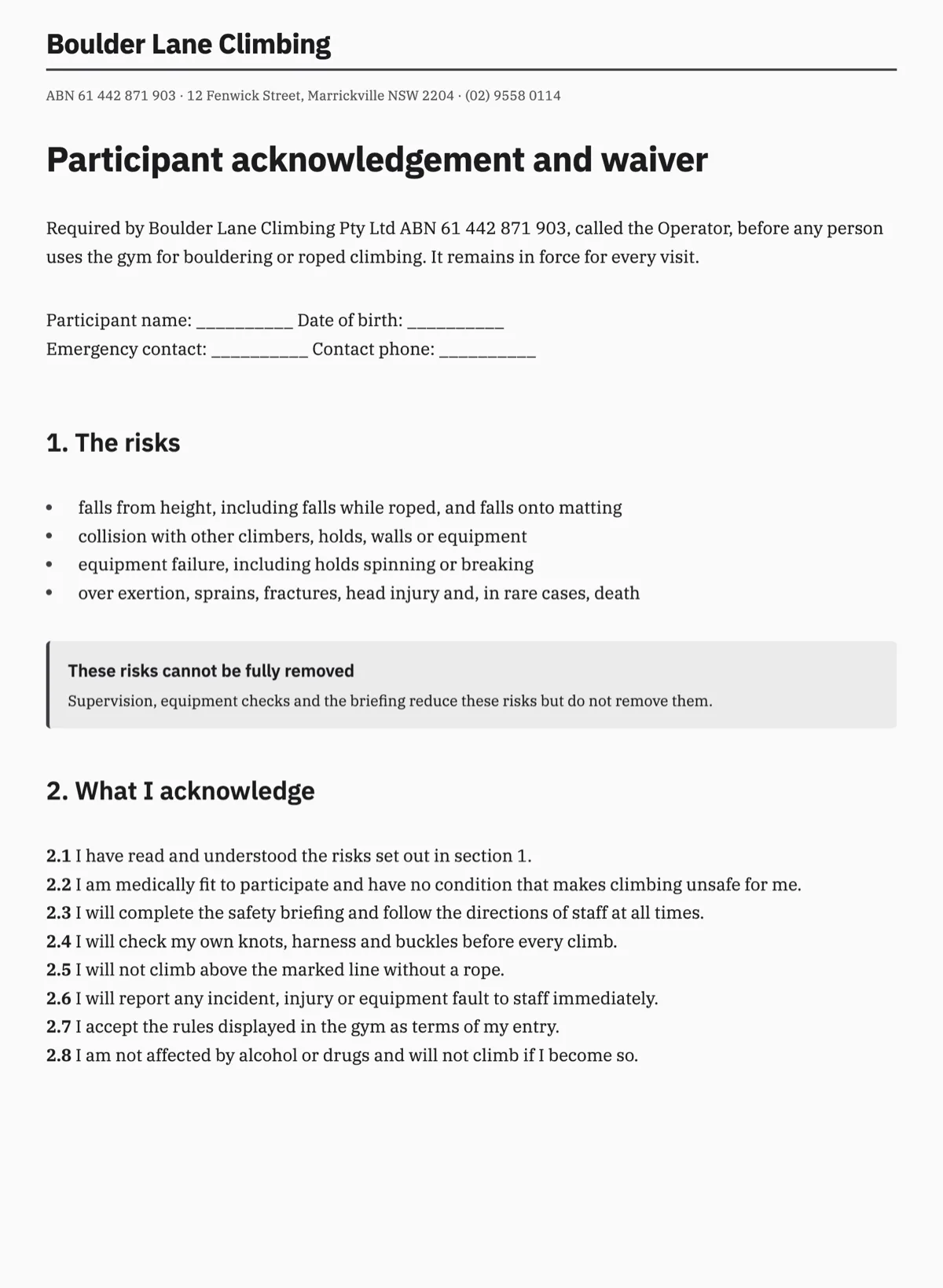 Liability waiver template written for Australian recreational servicesMost waivers in Australia are copies of American forms and exclude things that cannot be excluded, which makes the whole document weaker. This one names the real risks, takes the acknowledgements one by one, and uses the recreational services exclusion the way the consumer law actually permits, with a guardian block for minors.
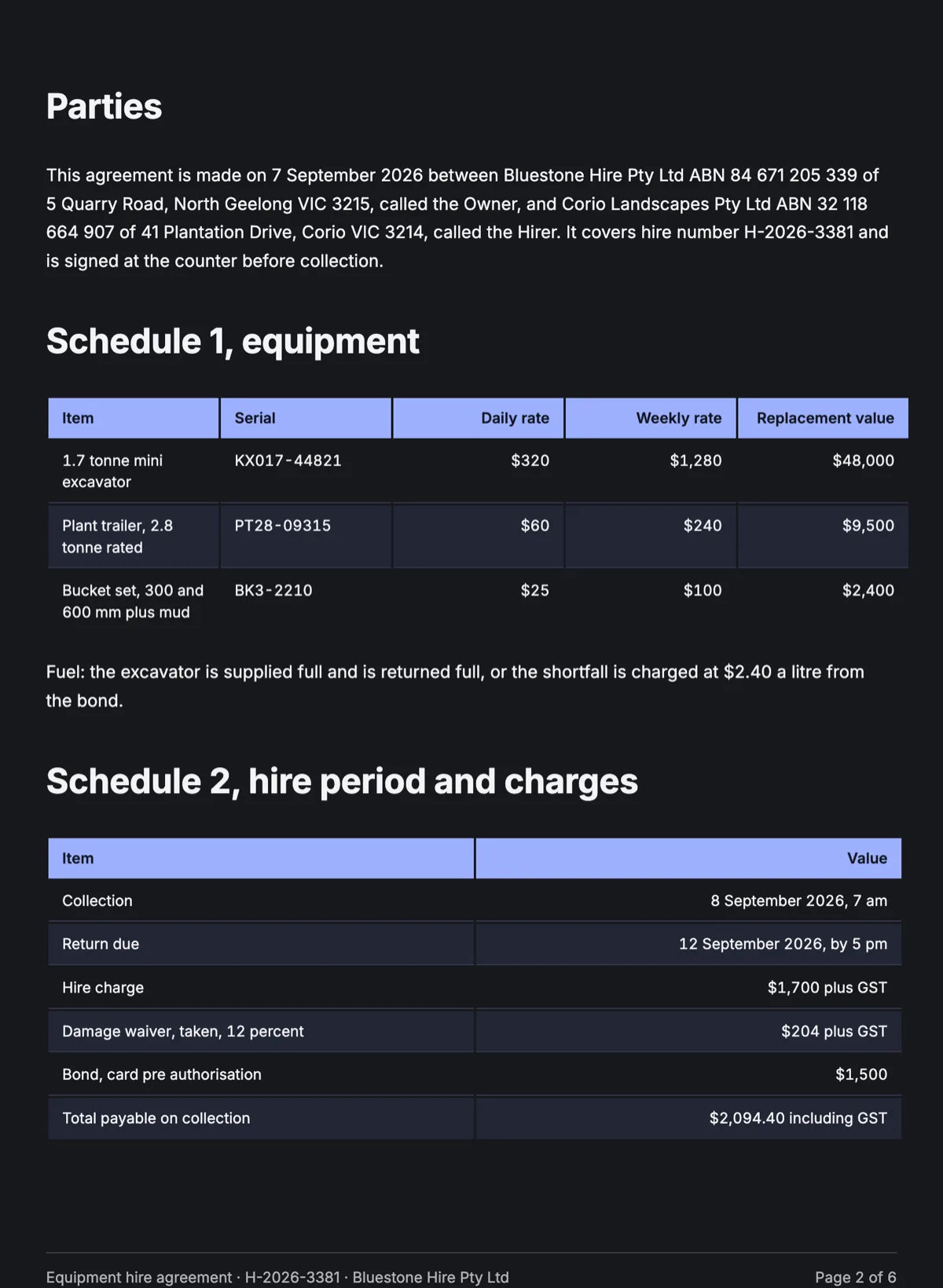 Equipment hire agreement template with the rates in a scheduleA hire agreement is a price list, an insurance decision and a return date, and the argument is always about the day it came back. This one puts the equipment and rates in a schedule, makes the damage waiver a choice with its price, and defines late return in hours so there is nothing to interpret.
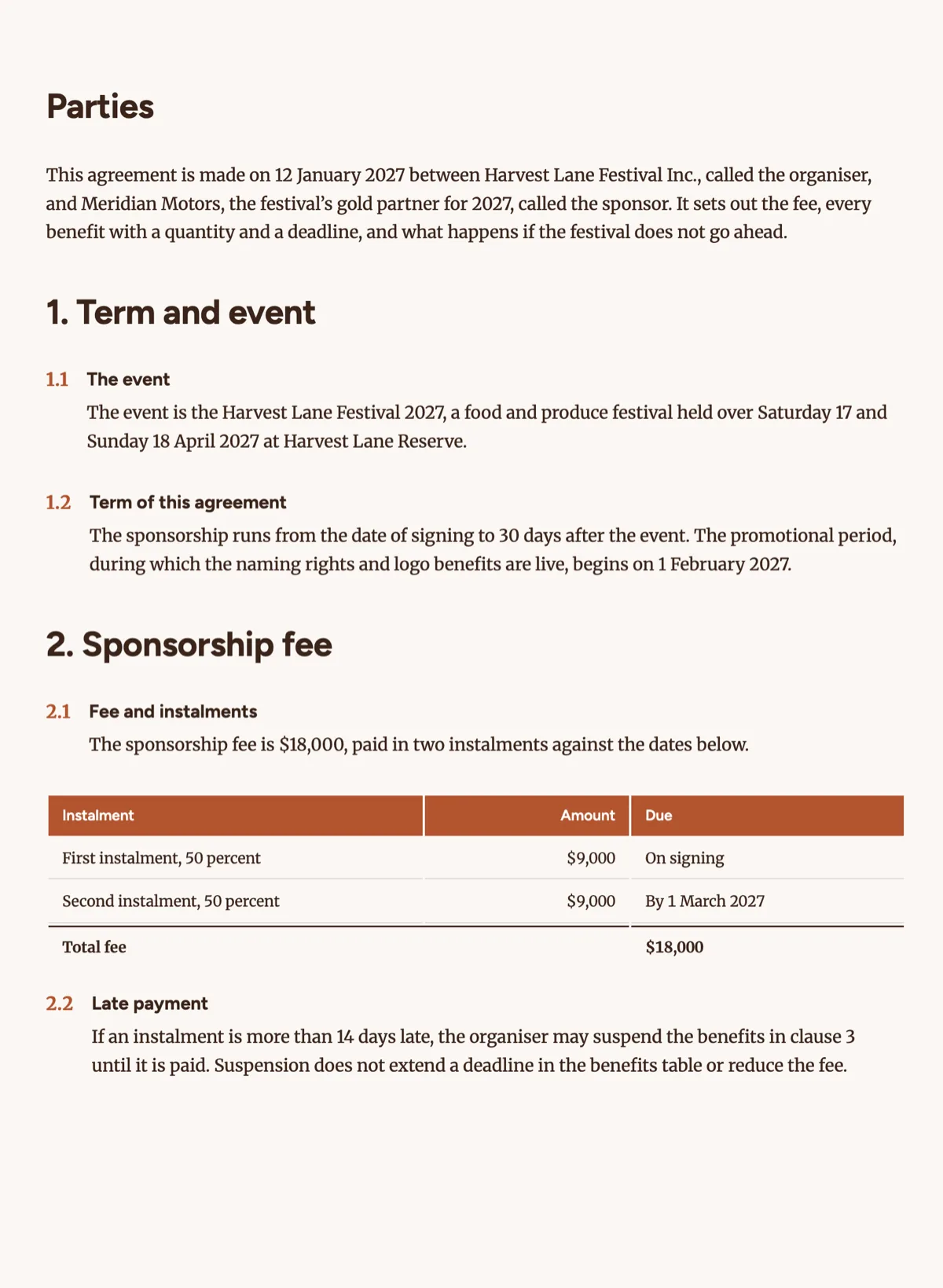 Sponsorship agreement template that lists every benefit with a numberSponsorship falls apart in the delivery, when nobody can find the email that said how many banners and which stage. This agreement is the benefits list as a table with quantities and dates, the $18,000 fee in instalments tied to those dates, and the two clauses sponsors care about most: exclusivity, and what happens if the event does not go ahead.
Questions people ask
Is a hold harmless clause the same as an indemnity?
No. An indemnity is a promise to pay for a loss, so it creates an obligation the other side can enforce as a debt. A hold harmless promise says the promising party will not pursue the other for that loss at all, which works more like a release. Many contracts run the two together, and the combined phrase does both jobs at once.
Does a hold harmless clause stop a personal injury claim?
Not on its own. It records that the signer accepted a known risk, which is useful evidence, but a court still asks whether the operator met its own duty of care and whether the wording is clear enough to cover what actually happened. A clause that tries to excuse the operator's negligence without saying so plainly is usually read narrowly.
Can a parent sign a hold harmless clause for a child?
A parent can sign the document and take on their own obligations under it, but the position on releasing a child's own future claim differs by state and is not settled by the clause itself. Operators normally ask the parent or the school to sign, keep the risk description in plain words, and treat the signature as evidence rather than as a complete answer.
Why do American contracts say defend, indemnify and hold harmless?
The three words cover three different exposures: funding a defence when a claim is served, paying what the claim finally costs, and giving up the right to bring the claim at all. American drafting keeps the formula because courts there have interpreted it for decades. Australian drafters more often split the limbs so it is clear which one applies to which loss.
Does the Australian Consumer Law override a hold harmless clause?
For services supplied to a consumer, the guarantees in Schedule 2 of the Competition and Consumer Act 2010 cannot be excluded, restricted or modified by a contract term. A clause that tries to do so has no effect to that extent, which is why most Australian waivers carry a sentence saving any right that cannot lawfully be given up.
Where does the clause belong in a contract?
It sits with the other risk clauses, next to the indemnity, the liability cap and the insurance obligation, because the four are read together. Burying it in an operations schedule hides it. In a short waiver it usually comes after the description of the activity and the acknowledgement of risk, so the reader meets the risk before the release.
Put the clause in a finished document
The button opens the document generator with a starting description already filled in. Change it to match your own agreement before you run it.
Create a document with OneCraftRelated clauses
- Indemnity clause: promising to cover someone else's lossAn indemnity clause is a promise to cover the other party's loss from a named event. Australian sample wording, three variants and what each side negotiates.
- Waiver of subrogation clauseA waiver of subrogation clause stops an insurer suing the other party after it pays a claim. Sample lease wording, mutual and one way versions, insurer consent.
- Liquidated damages clauseA liquidated damages clause fixes what delay costs before it happens. Sample fit out wording, the Australian penalty test, caps, and what each side negotiates.
For everything the document generator can do, see the document maker.
Step by step in the builder: Create a document with AI, then Document builder components.
Written and checked by the OneCraft team. Last checked .