Contract clause
Trade secrets clause
A trade secrets clause singles out information whose value comes from being secret, such as a formula, a process or a supplier list, and protects it without a time limit. It sits alongside the ordinary confidentiality clause, which usually expires a few years after the contract ends.
A three year confidentiality tail is sensible for pricing and forecasts and useless for a recipe. Separating the two lets one obligation expire on schedule while the other runs for as long as the secret lasts.
Nuwan Madhusanka · Co-founder
4 min read · Published
Sample clause
an employment agreement between Saltbush Brewing, a fictional craft brewery in Ballarat, and its production manager
1. Trade Secrets. Trade Secrets means information of the Employer that derives commercial value from not being generally known, and that the Employer takes reasonable steps to keep secret, including the Harvest Ale yeast propagation method, the hop blend ratios in the Recipe Book, the supplier list in Schedule 2 and the fermentation temperature profiles. 2. Obligation. The Employee must not use or disclose a Trade Secret except as required to perform their duties, and must not remove a Trade Secret from the Employer's premises or systems without written authorisation. 3. Duration. Clause 2 applies during employment and continues after employment ends for as long as the information remains a Trade Secret. 4. Reasonable Steps. The Employer will restrict access to the Recipe Book to named personnel, keep it in a locked cabinet and an access controlled folder, and record who has been given access. 5. Return. On the last day of employment the Employee must return every copy of any document containing a Trade Secret, in any format.
Sample wording, not legal advice.
Variants
Perpetual protection, carved out of the confidentiality tail
The standard commercial form, where ordinary confidential information expires and genuine secrets do not.
The obligations in clause 8 apply to Confidential Information during the Term and for three years after this agreement ends. In respect of information that is a Trade Secret, those obligations continue for as long as the information remains a Trade Secret, without limit of time. Information stops being a Trade Secret when it becomes generally known other than through a breach of this agreement, or when the disclosing party stops taking reasonable steps to keep it secret.
With the United States whistleblower notice
Any contract with a United States employee or contractor that governs the use of trade secrets or confidential information.
Notice of immunity: under the Defend Trade Secrets Act, an individual is not held criminally or civilly liable under any federal or state trade secret law for disclosing a trade secret in confidence to a federal, state or local government official, or to an attorney, solely for the purpose of reporting or investigating a suspected violation of law, or in a complaint or other document filed under seal in a lawsuit or other proceeding. Nothing in this agreement limits that immunity.
Tied to a named list with defined access
Manufacturing and food businesses where a small number of documents carry nearly all of the value.
The Trade Secrets protected by this clause are the documents listed in Schedule 2 and any working copy or derivative of them. Access to those documents is restricted to the personnel named in Schedule 3, who must sign the access register before each use and must not photograph, copy or transmit any part of them. The Company must review Schedule 3 every six months and remove any person who no longer requires access, and must recover any working copy issued to that person.
What to negotiate
Naming the secrets or describing them
A named list is far easier to enforce, because the party alleging misuse can point to a document rather than argue about categories. The counter argument is that a list goes stale and can miss something developed later. Most contracts do both: a general definition plus a schedule of named items, with the schedule reviewed at set intervals.
The reasonable steps obligation
Protection depends on the owner actually treating the information as secret. Employees and contractors increasingly ask what those steps are, because an unrestricted shared drive undermines the clause they are being asked to sign. Writing the steps into the contract, such as restricted access and an access register, makes the obligation credible and gives the owner something to point to later.
Duration after the relationship ends
Owners want perpetual protection over the secret and often ask for it over everything else as well. The workable split is a fixed tail for ordinary confidential information and an indefinite obligation limited to genuine trade secrets. Defining when something stops being a trade secret closes the loop, so the indefinite obligation has a natural end.
The line against ordinary skill and knowledge
A person cannot unlearn how to do their job, and a clause that tries to stop them using general skill is unlikely to be enforced and unpleasant to negotiate. Employees ask for wording confirming that general skill and experience are theirs to take. Employers accept it once it is clear the carve out does not reach named documents or specific formulations.
The risk of leaving it out
Without the clause the information falls under the ordinary confidentiality obligation and expires with it, commonly three to five years after the contract ends, which is far shorter than the life of a formula or a process. Protection then depends on the general law of confidence, where the owner must prove the information had the necessary quality of confidence and was treated as secret.
Australia has no trade secrets statute
Unlike copyright, patents and trade marks, trade secrets in Australia are not registered and are not created by a specific Act. Protection comes from contract and from the equitable action for breach of confidence, which requires the information to have the necessary quality of confidence, to have been communicated in circumstances importing an obligation of confidence, and to have been used or disclosed without authority. That makes the contract clause load bearing rather than supplementary. It also makes the owner's own behaviour part of the case: information circulated freely inside a business, stored without restriction and shared without agreements is harder to describe as secret, whatever the contract says about it.
The United States notice requirement
Contracts with United States employees and contractors carry an extra step. Under the Defend Trade Secrets Act, an employer that does not include notice of the statutory whistleblower immunity in an agreement governing the use of trade secrets or confidential information cannot recover exemplary damages or attorney fees from that individual in an action brought under the Act. The immunity itself protects disclosure made in confidence to a government official or an attorney solely to report or investigate a suspected violation of law, and disclosure in a document filed under seal. The notice is short, it costs nothing to include, and leaving it out quietly reduces the remedies available years later.
Where it sits in a generated document
The document generator writes an agreement as numbered content, so a trade secrets clause usually appears as a numbered section next to the confidentiality clause, with the definition, the obligation, the duration and any access controls as sub clauses. The generated text is written from the description it is given and it never prints citations, so any statutory notice in a draft has to be checked against the legislation before the document is used. Naming the categories of secret in the description produces a definition that is worth enforcing.
Documents that carry this clause
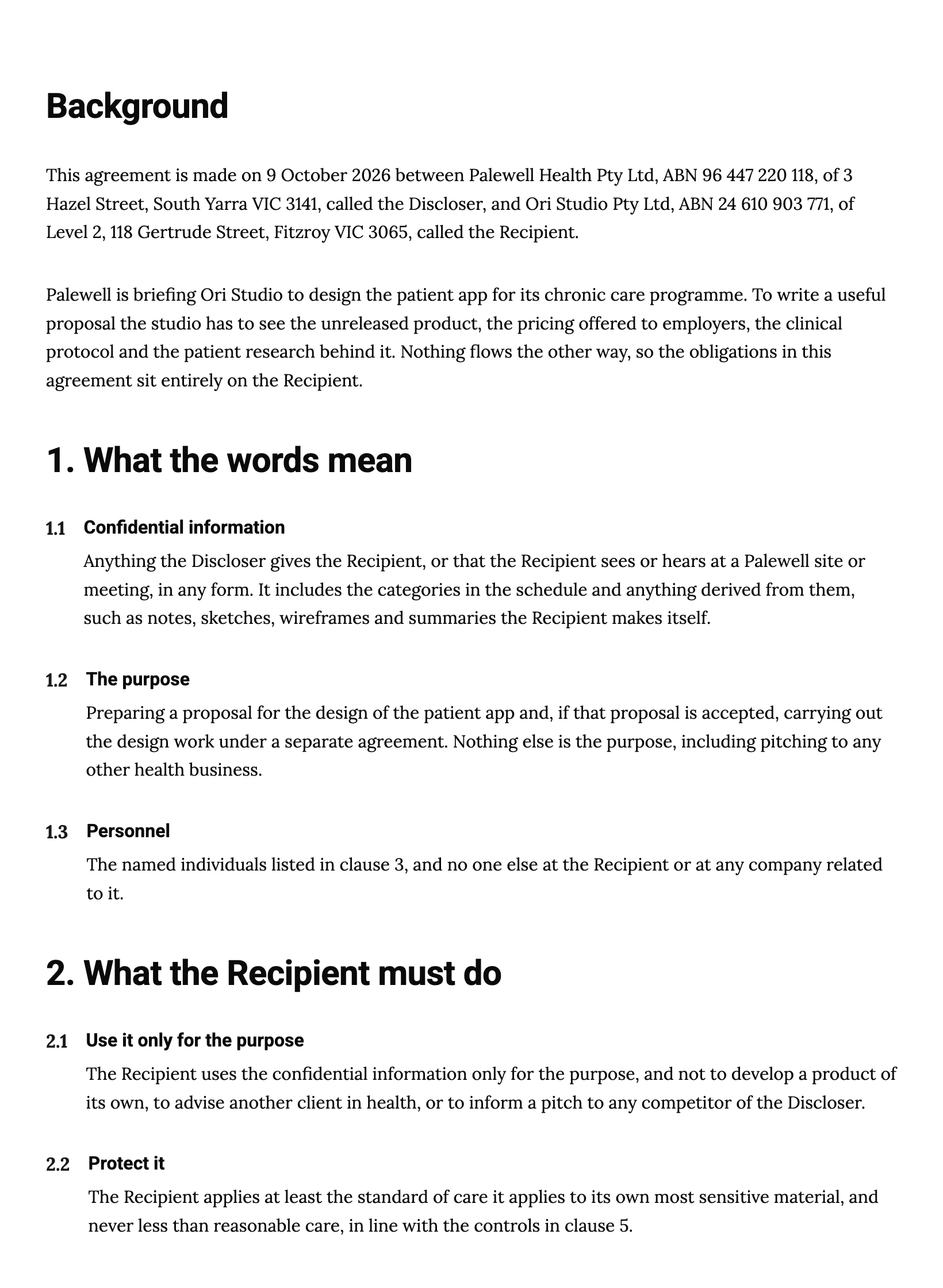 One way NDAA health company has to show a design studio an unreleased app, its employer pricing and its patient research. The studio is showing nothing back, which is exactly when an agreement should run in one direction.
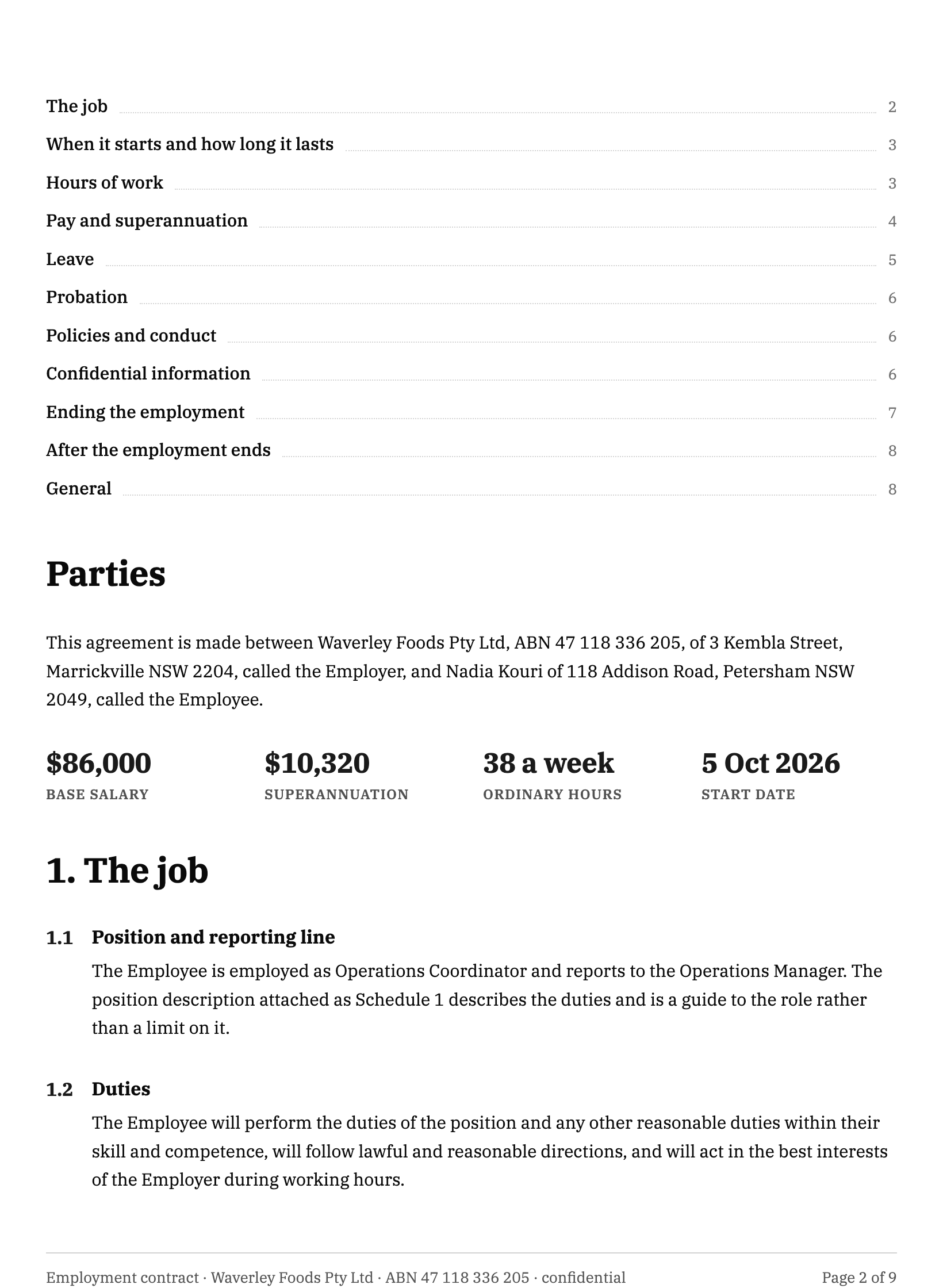 Employment contractA full time ongoing contract for an operations coordinator on $86,000 plus $10,320 of superannuation. Eleven numbered clauses, a leave table drawn from the National Employment Standards, and a notice table that scales with service.
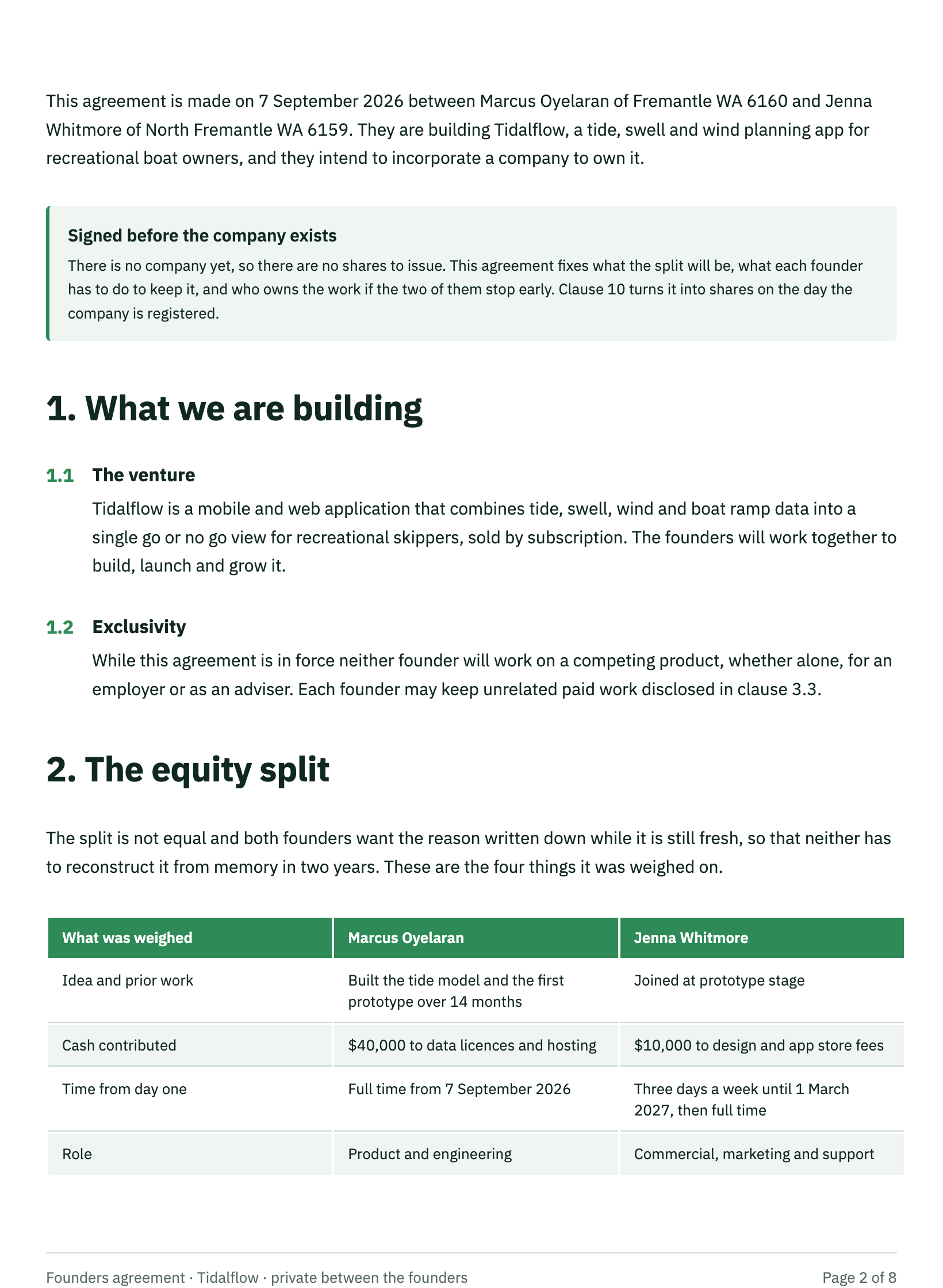 Founders agreement templateTwo people in Fremantle are building a tide and swell planning app and have not registered a company yet. There are no shares to issue, so this agreement fixes the split, records why it is 55/45 while the memory is fresh, and turns itself into shares on the day the company exists.
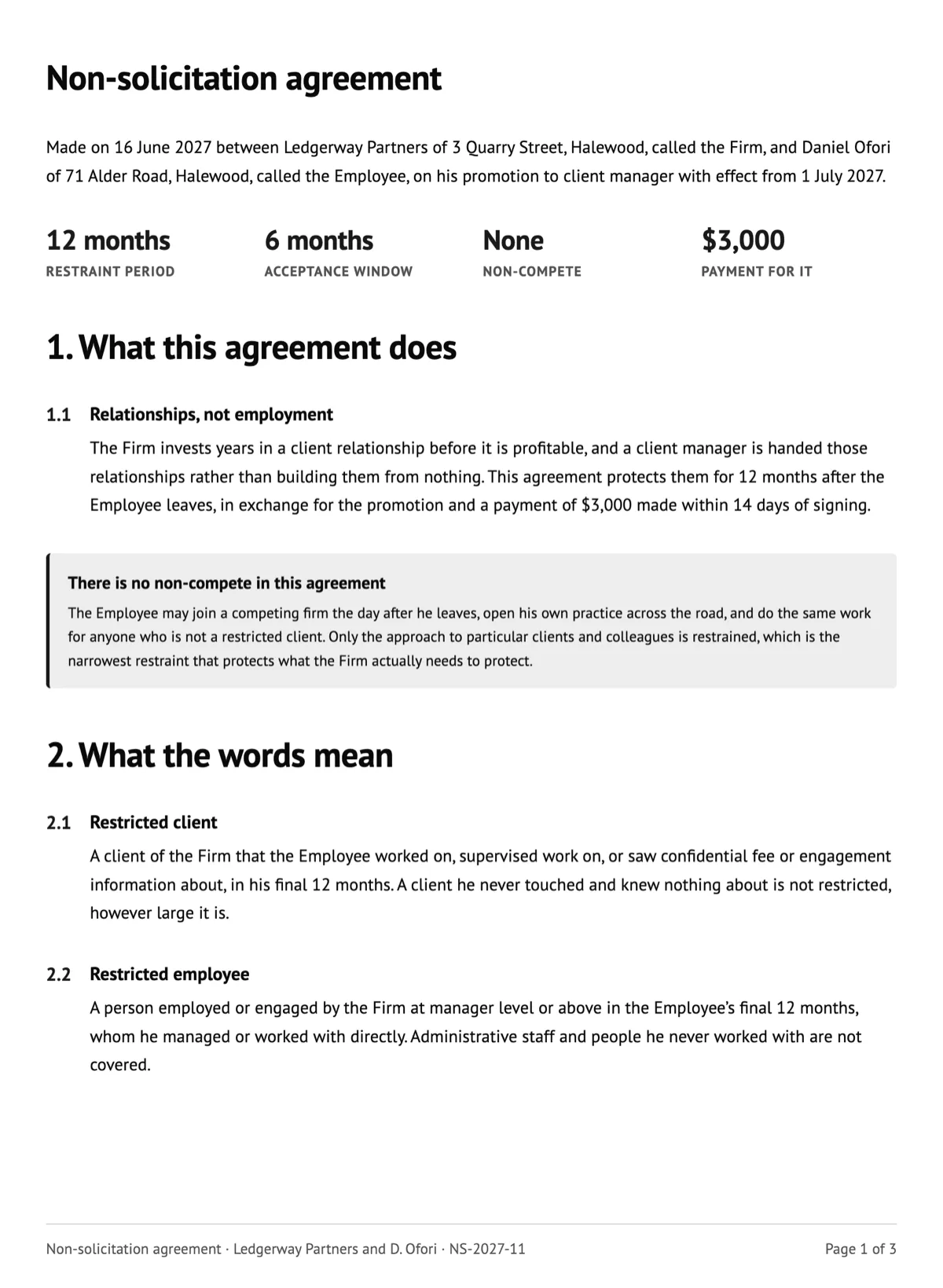 Non-solicitation agreement for clients, staff and durationA non-solicitation agreement restrains the approach, not the work. This one lets an accounting manager join a competitor the day after he leaves, and stops him approaching the clients he handled or the colleagues he managed for twelve months, with a six month window in which he also cannot accept work from those clients.
Questions people ask
What counts as a trade secret?
Information that has commercial value because it is not generally known, and that the owner takes reasonable steps to keep secret. Formulas, manufacturing processes, supplier lists, pricing models and customer data are typical examples. Information that circulates freely inside a business, or is shared without restriction, is difficult to describe as a trade secret however valuable it is.
How long does trade secret protection last?
For as long as the information stays secret, which is why the clause is drafted without a fixed end date. That is the main practical difference from an ordinary confidentiality obligation, which usually expires three to five years after the agreement ends. The protection stops if the information becomes generally known through no breach of the contract.
Is there a trade secrets law in Australia?
There is no registration system and no dedicated Act. Protection comes from the contract and from the equitable action for breach of confidence, which requires the information to have the necessary quality of confidence, to have been received in confidence, and to have been used without authority. That makes a clearly drafted clause more important, not less.
What is the Defend Trade Secrets Act notice?
It is a short immunity notice that United States employers must include in agreements governing the use of trade secrets or confidential information. Without it, the employer cannot recover exemplary damages or attorney fees from that individual in an action under the Act. The immunity covers disclosure to a government official or attorney to report a suspected violation of law.
Can an employee be stopped from using what they learned?
Not generally. A person's general skill, knowledge and experience travel with them, and a clause that tries to prevent that is unlikely to be enforced. What can be protected is specific information, such as a named formulation, a documented process or a customer list, which is why identifying the secrets precisely matters more than broad wording.
Should trade secrets be listed in a schedule?
Listing them makes enforcement much easier, because the owner can point to a document instead of arguing about categories. The risk is that a list goes stale. Most contracts use a general definition plus a named schedule reviewed at set intervals, which gives the certainty of a list without leaving later developments unprotected.
Put the clause in a finished document
The button opens the document generator with a starting description already filled in. Change it to match your own agreement before you run it.
Create a document with OneCraftRelated clauses
- Confidentiality clauseA confidentiality clause inside a wider contract, not a standalone NDA. Sample consulting wording, mutual and one way variants, the tail period and exceptions.
- Return of confidential information clauseA return of confidential information clause says what is given back or destroyed at the end. Sample wording, backup carve outs and the destruction certificate.
- Non disparagement clauseA non disparagement clause stops a party making negative statements about the other. Sample settlement wording, mutual versions and review site carve outs.
For everything the document generator can do, see the document maker.
Step by step in the builder: Create a document with AI, then Document builder components.
Written and checked by the OneCraft team. Last checked .