Contract clause
Non disparagement clause
A non disparagement clause is a promise not to make statements that damage the other party's reputation. It appears most often in settlement agreements and exit documents, where both sides want the relationship to end without a public account of why it ended.
The clause is easy to agree and easy to draft too widely. A promise that covers truthful statements to a regulator, a court or a health and safety inspector is a promise that will not hold and should not be asked for.
Indunil Asanka · Co-founder
4 min read · Published
Sample clause
a settlement between Saltbush Brewing, a fictional craft brewery in Ballarat, and a departing venue manager
1. Mutual Non Disparagement. Neither party may make any public statement that is disparaging of the other party, or of the other party's business, products or personnel. 1.1 For the Employer, clause 1 applies to statements made by its directors and by its managers, and the Employer must take reasonable steps to ensure they comply. 2. Exceptions. Clause 1 does not apply to: 2.1 a statement made to a court, a tribunal, a regulator, a work health and safety authority or the Fair Work Ombudsman; 2.2 a statement made to obtain legal, medical or financial advice; 2.3 a truthful statement made in response to a lawful request for a reference; or 2.4 a statement made to the party's immediate family. 3. Agreed Statement. If either party is asked why the employment ended, that party may say only that the parties separated on agreed terms. 4. No Admission. Nothing in this clause is an admission by either party of any fact or liability.
Sample wording, not legal advice.
Variants
Mutual, in a settlement
The standard and fairest form, because both sides have something they would rather was not discussed publicly.
Each party agrees not to make, publish or authorise any statement that disparages the other party, including any statement about the other party's business, conduct, products or personnel. This clause does not prevent a party from making a truthful statement required by law, to a court or tribunal, to a regulator, or in the course of obtaining professional advice. This clause does not prevent either party from correcting a statement of fact that the other party has published about them.
One way, given by the departing party
Exit arrangements where the employer asks for the promise and gives nothing equivalent back.
The Employee must not make any statement, in any medium, that is disparaging of the Company, its officers, its employees or its products. This clause does not prevent the Employee from making a disclosure to a regulator, from giving evidence, from making a complaint to the Fair Work Ombudsman or a work health and safety authority, from discussing their own employment conditions with a union or a legal adviser, or from making any disclosure protected by law. The Employee may state the fact of their former employment and their role.
With a review site carve out
Consumer and small business contracts, where a term stopping honest feedback is difficult to defend.
Neither party may publish a statement about the other that is knowingly false or made without a reasonable basis. Nothing in this agreement prevents the Customer from publishing an honest review of the goods or services supplied, including a negative one, on any platform, and the Supplier must not require the removal of such a review as a condition of any refund, remedy or further supply. This clause does not limit either party's rights under the Australian Consumer Law.
Limited to the subject of the dispute
Commercial settlements where a general reputational promise is wider than either party actually needs.
Neither party may make any statement to a third party about the Dispute, the Proceedings or the terms of this deed, other than a statement that the matter has been resolved on confidential terms. This clause does not restrict either party from making statements about any other matter, including about the other party's goods or services generally, and does not restrict a disclosure required by law or made to a regulator, an auditor or a professional adviser.
What to negotiate
Whether it is mutual
A one way promise given by a departing employee or a smaller supplier is common and is the version most often resisted. Making it mutual costs the stronger party little, since it rarely intends to comment anyway, and it changes how the document reads. Where the promise stays one way, the party giving it usually asks for a narrower scope in exchange.
Who the promise binds inside an organisation
A company cannot control what every employee says, so a clause binding the company for all statements by any employee is unworkable. The usual settlement names the people it covers, commonly directors and senior managers, and adds an obligation to take reasonable steps to ensure they comply. That is enforceable and does not promise the impossible.
The exceptions that must be there
Statements to a court, a regulator, a work health and safety authority or the Fair Work Ombudsman, disclosures protected by law, and statements made to obtain professional advice all need to sit outside the clause. A clause without them may be unenforceable and can look like an attempt to suppress a lawful complaint, which is worse for the party that asked for it.
What each side may say if asked
Silence invites speculation, so many settlements include an agreed statement, such as that the parties separated on agreed terms. Both sides then have something accurate to give a third party. Where a reference is likely to be requested, agreeing its wording at the same time removes the most common source of later argument.
The risk of leaving it out
Without the clause each party is free to describe the relationship and its ending however it likes, limited only by defamation law and by any confidentiality obligation that survives. For a business, the practical exposure is a detailed public account of a dispute it settled precisely to avoid, published by someone with nothing further to lose.
What the clause cannot stop
A non disparagement promise does not override statutory rights. In Australia the general protections provisions of the Fair Work Act 2009 protect a person exercising a workplace right, which includes making a complaint or inquiry in relation to their employment, and a clause used to punish someone for doing so creates a separate problem for the employer. Disclosures to work health and safety authorities and to regulators sit outside as well, as do statements made under compulsion in legal proceedings. Drafting exceptions for these is not a concession, it is what keeps the rest of the clause credible, and a clause without them invites the argument that the whole provision was aimed at suppressing a lawful complaint.
Honest reviews and consumer facing contracts
In a consumer or small business contract, a term stopping the other party from publishing an honest review is difficult to defend. The unfair contract terms regime in Schedule 2 of the Competition and Consumer Act 2010 applies to standard form contracts of that kind, and a term restricting one party's right to say something true about the goods or services it received is the sort of imbalance the regime is aimed at. Making a refund or a remedy conditional on removing a review is a separate problem again. The safer drafting limits the promise to statements that are knowingly false or made without a reasonable basis, which protects against genuine damage without reaching honest feedback.
Where it sits in a generated document
The document generator writes an agreement as numbered content, so a non disparagement clause usually appears near the confidentiality and release provisions, with the exceptions listed as sub clauses. The generated text is written from the description it is given and it never prints citations, so any reference to a regulator or a statute in a draft has to be checked before the document is used. Where the document ends in a signature block, each party in that block becomes one signer, which is worth noting when a company and an individual both sign a settlement.
Documents that carry this clause
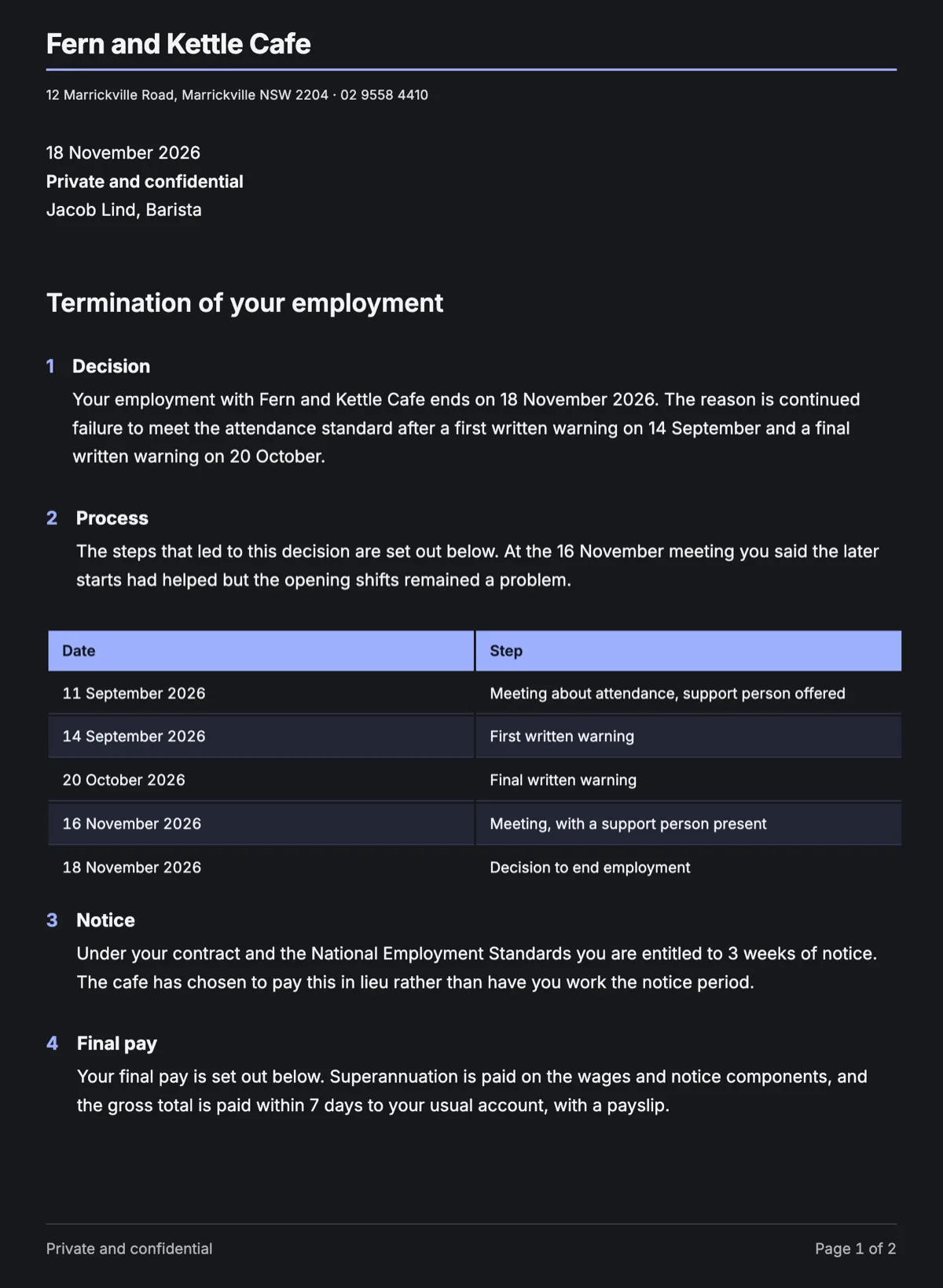 Termination letter template that shows the final payA termination letter is read twice, once by the employee in the meeting and once by a lawyer or a tribunal months later, and both need the same facts. This one states the reason and the process in dates, shows the final pay as a table with each component, and says what happens next, so there is nothing to ask afterwards.
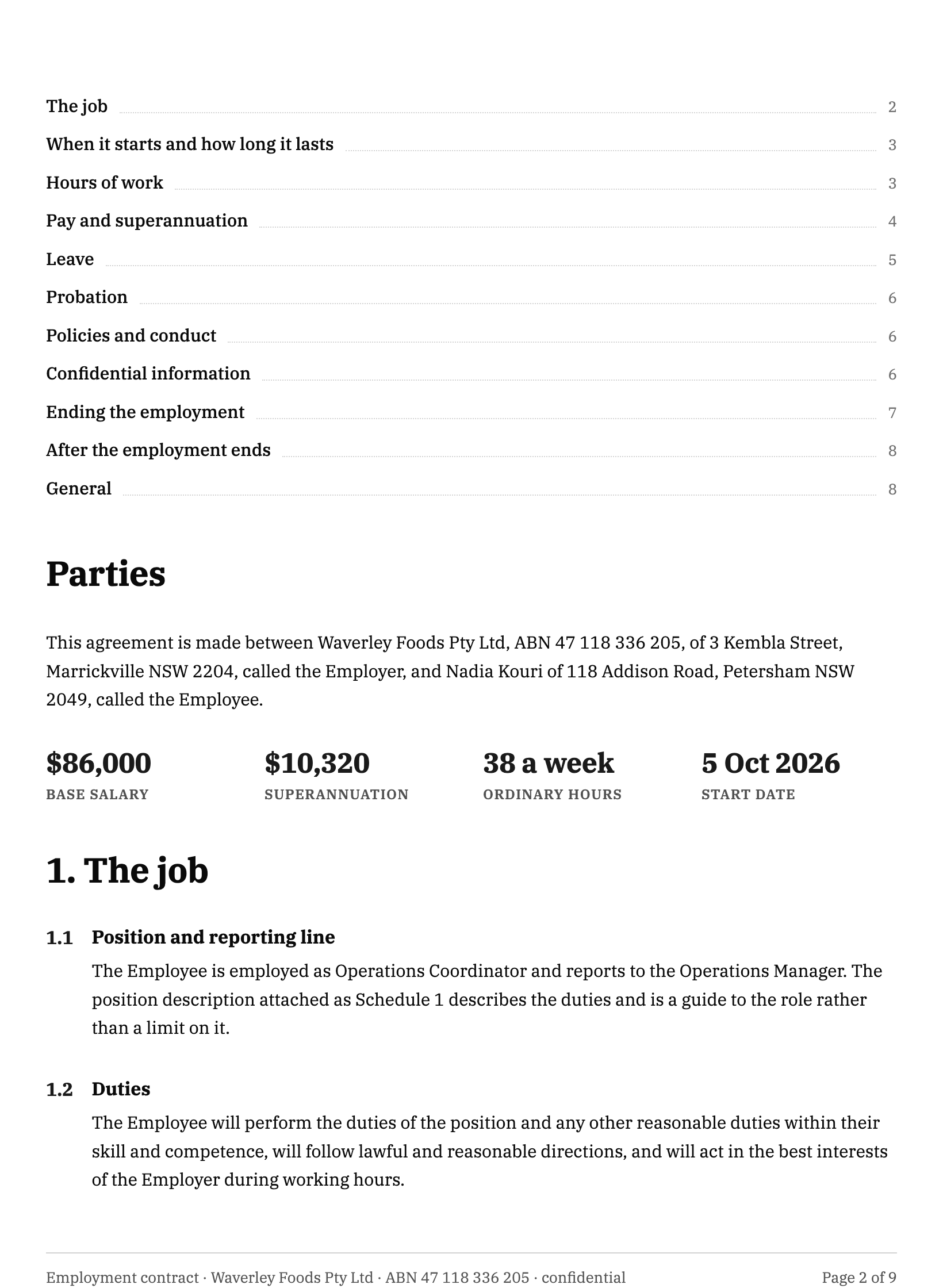 Employment contractA full time ongoing contract for an operations coordinator on $86,000 plus $10,320 of superannuation. Eleven numbered clauses, a leave table drawn from the National Employment Standards, and a notice table that scales with service.
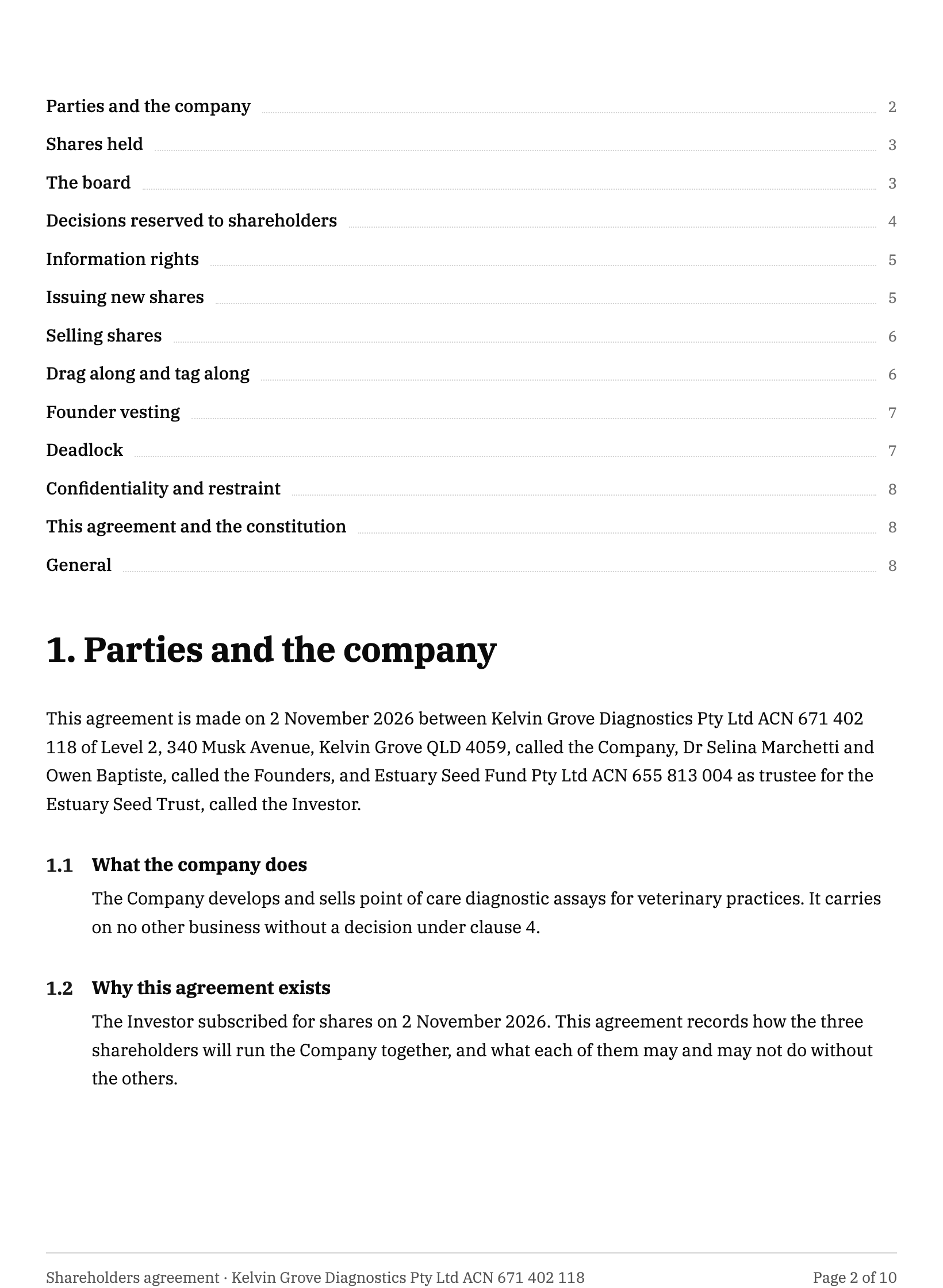 Shareholders agreement templateA veterinary diagnostics company has just taken $1.5 million from one seed fund. The founders keep 80 percent between them, so the whole agreement turns on a single number: the 75 percent consent threshold that puts the investor on one side of every decision that matters.
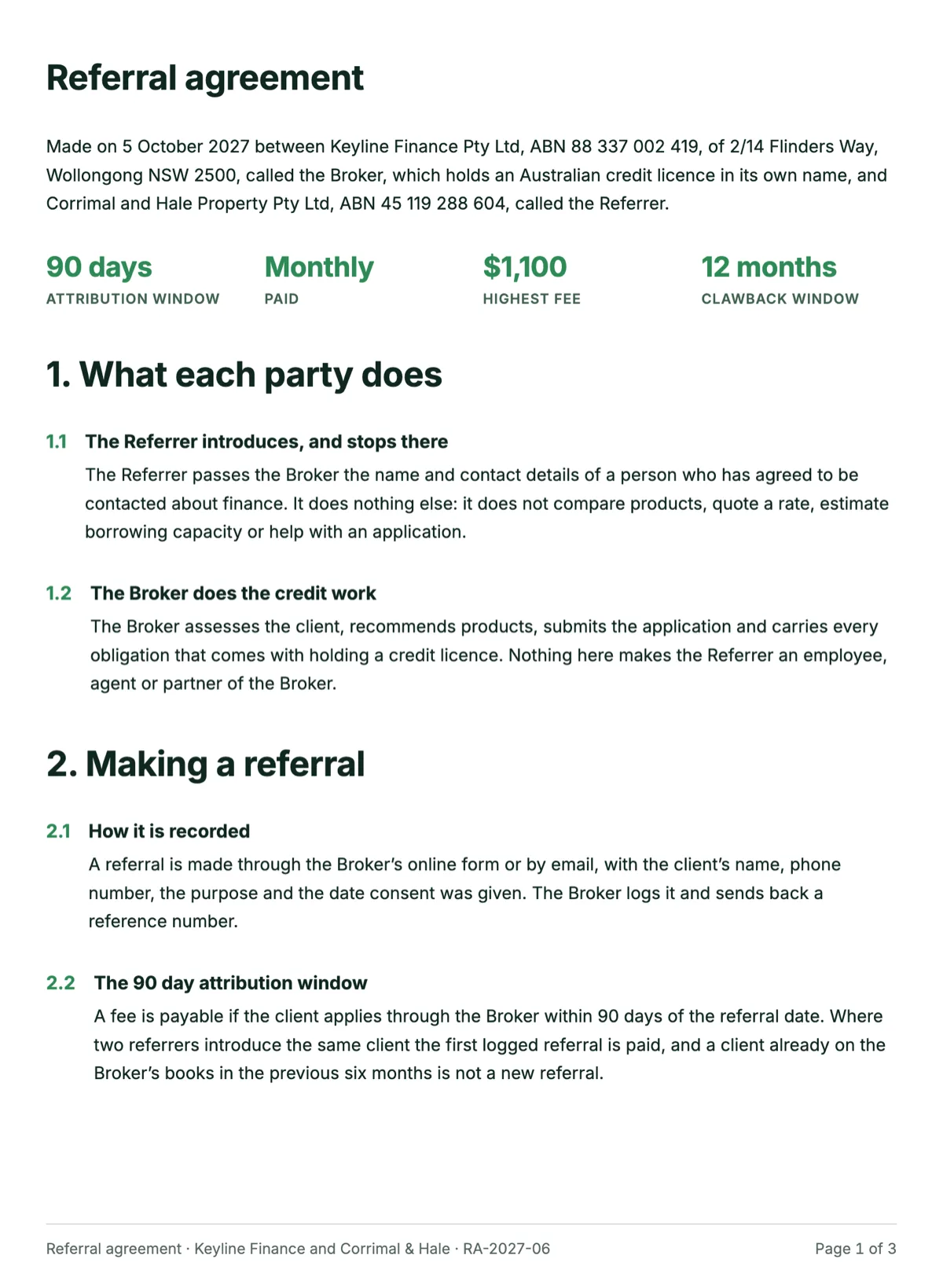 Referral agreement template with a fee table by productA referral agreement works when it is clear where the referral stops and the advice starts. This one has a real estate agency passing buyers to a mortgage broker for a fee that ranges from $250 to $1,100 by product, attributed for 90 days, paid monthly, and clawed back if the lender claws back first.
Questions people ask
Is a non disparagement clause enforceable in Australia?
A reasonably drafted one generally is, as a contractual promise. What weakens it is overreach. A clause that purports to stop a disclosure to a regulator, a complaint to the Fair Work Ombudsman or evidence given in proceedings is unlikely to be enforced in that respect, and it can create a separate problem for the party that asked for it.
Does it stop someone telling the truth?
A broadly drafted clause is aimed at statements that damage reputation, whether or not they are true, which is why the exceptions matter so much. Truth is a defence to defamation but it is not automatically a defence to breach of contract. The safer drafting limits the promise to statements that are knowingly false or made without a reasonable basis.
Can an employer stop a former employee complaining to the Fair Work Ombudsman?
No, and a clause attempting it is a poor idea. The general protections in the Fair Work Act 2009 protect a person exercising a workplace right, including making a complaint or inquiry in relation to their employment. Settlement documents should carve out regulators, courts and work health and safety authorities expressly.
Should the clause be mutual?
Usually, and it is the version most likely to be accepted quickly. The stronger party rarely intends to comment anyway, so agreeing to a mutual promise costs it little and removes an obvious objection. Where the promise stays one way, the party giving it normally negotiates a narrower scope and a fuller list of exceptions.
Can a business stop a customer leaving a bad review?
It should not try. In a standard form consumer or small business contract, a term restricting honest feedback is the kind of imbalance the unfair contract terms regime is aimed at, and conditioning a refund on removing a review is a separate problem. Limiting the promise to knowingly false statements is the defensible approach.
What can each party say if somebody asks what happened?
Whatever the agreed statement allows. Settlements commonly include one, such as that the parties separated on agreed terms, so both sides have something accurate to give a third party. Where a reference is likely to be requested, agreeing its wording at the same time removes the most common later argument.
Put the clause in a finished document
The button opens the document generator with a starting description already filled in. Change it to match your own agreement before you run it.
Create a document with OneCraftRelated clauses
- Publicity clauseA publicity clause says whether a supplier can name a client, use its logo or issue a release. Sample agency wording, consent variants and what to negotiate.
- Confidentiality clauseA confidentiality clause inside a wider contract, not a standalone NDA. Sample consulting wording, mutual and one way variants, the tail period and exceptions.
- Termination for cause clauseA termination for cause clause ends a contract for serious breach. Sample wording, what counts as material, cure periods and immediate termination events.
For everything the document generator can do, see the document maker.
Step by step in the builder: Create a document with AI, then Send a document for signature.
Written and checked by the OneCraft team. Last checked .