Contract clause
Holding over clause: staying on after the lease expires
A holding over clause sets the terms that apply when a tenant stays in the premises with the landlord's consent after the lease has expired. It usually creates a monthly tenancy on the same terms, fixes the rent for that period and says how much notice either party must give to end it.
Holding over happens more often than either side plans, usually because renewal talks run past the expiry date. A clause that settles the rent, the notice and which terms survive stops an informal arrangement turning into an argument about what kind of tenancy exists.
Indunil Asanka · Co-founder
4 min read · Published
Sample clause
a retail lease in Victoria between Glenrowan Street Nominees, a fictional landlord in Wangaratta, and Hopscotch Toys, whose lease expires while renewal terms are still being negotiated
24. Holding Over 24.1 If Hopscotch Toys remains in possession of the Premises with the consent of Glenrowan Street Nominees after the Expiry Date, other than under a new lease or an exercised option, it does so as a monthly tenant. 24.2 The monthly tenancy is on the terms of this Lease so far as they can apply to a monthly tenancy, except that there is no option to renew and no further rent review. 24.3 The Rent during the monthly tenancy is the Rent payable immediately before the Expiry Date increased by 10 percent, payable monthly in advance. 24.4 Either party may end the monthly tenancy by giving the other at least one month's written notice, which may expire on any day. 24.5 The Tenant's make good obligations, and the Landlord's obligation to return the Security Deposit, apply when the monthly tenancy ends as if that day were the Expiry Date.
Sample wording, not legal advice.
Variants
Same rent, no uplift
A tenant with bargaining power, or a landlord that wants the tenant to stay while a sale or redevelopment is settled.
If the Tenant remains in possession after the Expiry Date with the Landlord's consent, it holds the Premises as a monthly tenant at the Rent payable immediately before the Expiry Date, and otherwise on the terms of this Lease that can apply to a monthly tenancy. Either party may end the monthly tenancy by giving one month's written notice at any time.
Residential rental agreement in Victoria
A home, where a periodic agreement arises automatically under the Residential Tenancies Act 1997.
If the Renter continues to occupy the Premises after the fixed term of this agreement ends, without entering into a new fixed term agreement, the Renter occupies the Premises under a periodic residential rental agreement. The rental period is monthly if the rental period under this agreement is more than one month, and is otherwise the same as the rental period under this agreement, and the periodic agreement is on the terms of this agreement so far as they apply.
England and Wales protected business tenancy
A United Kingdom lease that has not been contracted out of the Landlord and Tenant Act 1954.
The parties acknowledge that, unless sections 24 to 28 of the Landlord and Tenant Act 1954 have been validly excluded, this tenancy will continue after the Contractual Expiry Date under section 24 of that Act until it is terminated in accordance with Part II of that Act, and that the rent payable during that continuation may be changed only as that Act allows.
What to negotiate
The rent while holding over
Landlords use a rent increase during holding over to push the tenant to sign a renewal or leave. Tenants argue that a large increase penalises slow negotiations that are not always their fault. A modest uplift, or no uplift for the first few months while genuine negotiations continue, is a common compromise.
Notice to end the monthly tenancy
One month is usual, but a tenant that must relocate a shop fit out may ask for longer. Landlords want flexibility to re let quickly. The Victorian Small Business Commission notes that a monthly holding over arrangement can be ended by either party on a month's written notice unless a different period has been agreed in writing.
The risk of leaving it out
Without a holding over clause a tenant who stays on after expiry while the landlord accepts rent usually becomes a periodic tenant, but the period, the rent and the lease terms that continue are left to inference. The landlord may find make good and insurance obligations uncertain, and the tenant may not know how much notice it must give to leave.
Victorian retail leases
The Retail Leases Act 2003 (Vic) provides that where a tenant, in accordance with the lease, stays in possession of retail premises after the lease expires, the lease is taken to continue for the purposes of the Act while the tenant remains in possession. The protections of the Act, such as the limits on recoverable outgoings, therefore keep applying during holding over. Separately, if a landlord fails to give a required option notice or renewal notice in time, the Act itself can extend the lease on the same terms, which is different from holding over by agreement.
Holding over in other settings
A Victorian renter who stays on after a fixed term agreement of 5 years or less ends is treated as renting under a periodic agreement on the same terms so far as they apply, with the same rental period, or a monthly period if rent had been payable for periods longer than a month. In England and Wales a business tenancy protected by the Landlord and Tenant Act 1954 continues automatically after its contractual expiry until it is ended under that Act, so a holding over clause cannot turn it into a simple monthly tenancy.
Where it sits in a generated document
A generated lease places holding over after the term and option provisions, with the rent, the notice and the continuing terms as numbered sub clauses that refer back to the rent and make good clauses by number. The generated text does not cite sources, so the statutory treatment of holding over where the premises are located is checked before signing.
Documents that carry this clause
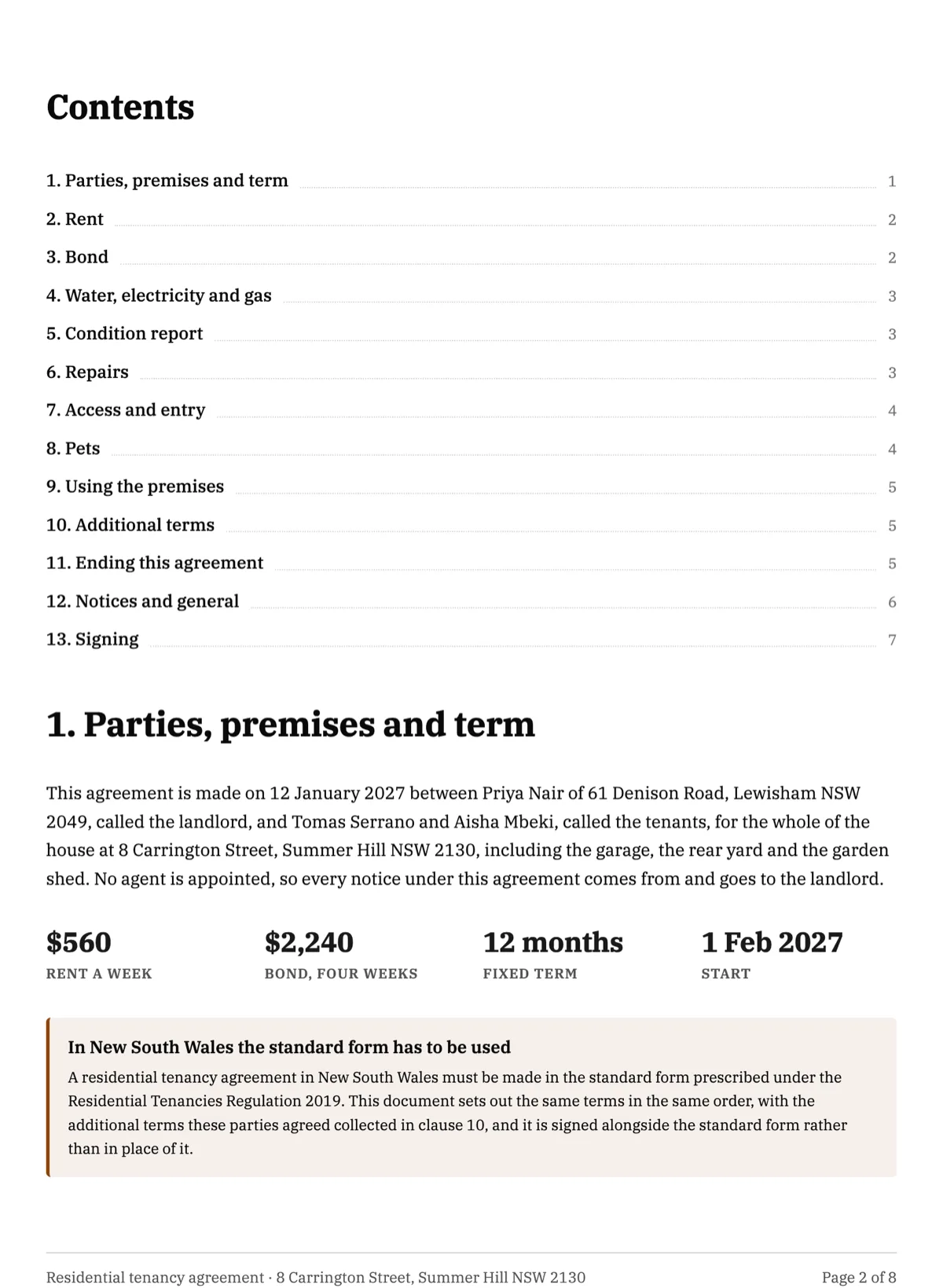 Residential lease agreement template for a New South Wales fixed termA residential tenancy is the one agreement where most of the terms are set by statute rather than by the parties, so the useful part of a template is the additional terms and the numbers. This one is a 12 month New South Wales fixed term at $560 a week, with the bond, the entry notice periods and the break fee written out exactly as the Act sets them.
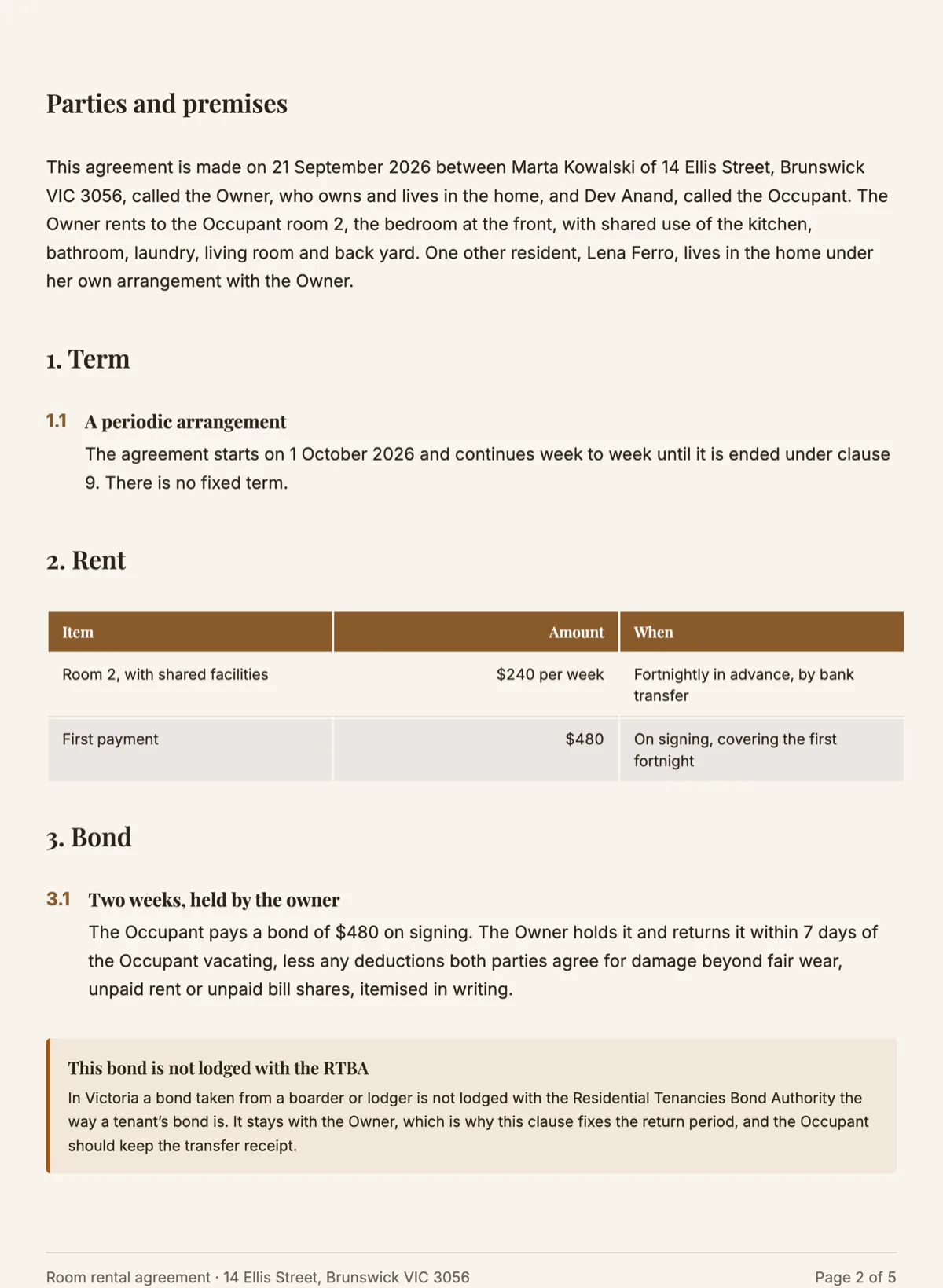 Room rental agreement template for one room in a shared homeRenting a room is not the same as renting a house, and most templates copy a residential lease and hope. This one is written for one room with shared kitchen and bathroom, prices the bills split, lists the rules that matter, and says plainly that the occupant is a boarder or lodger and what that changes.
Questions people ask
What is holding over in a lease?
Holding over is when a tenant stays in the premises after the lease expires, usually while a new lease is negotiated or the tenant arranges to move. If the landlord consents, for example by accepting rent, the tenant generally holds as a periodic tenant, and a holding over clause sets out the period, the rent and the terms.
How much notice ends a holding over tenancy?
Whatever the lease says, and one month is the most common period for a monthly tenancy. For Victorian retail leases, the Victorian Small Business Commission says either party can end a monthly holding over arrangement on a month's written notice unless they have agreed in writing on a different notice period.
Can a landlord increase the rent during holding over?
Yes, if the lease provides for it, and an increase is often used to encourage a prompt renewal decision. Without a clause the rent usually stays at the last rent payable. In a Victorian retail lease the Act continues to apply during holding over, so the increase is best written as a fixed percentage rather than left to the landlord's discretion.
Does make good apply at the end of holding over?
It should, and a well drafted clause says so. Treating the end of the monthly tenancy as the expiry date for make good, the return of the security deposit and similar obligations avoids an argument that those obligations fell due at the original expiry date, when the tenant was still lawfully trading from the premises.
Is holding over the same as extending the lease?
No. An extension changes the expiry date of the fixed term, usually by a written variation, and keeps all the terms, including any options. Holding over is a separate periodic tenancy after the fixed term has ended, which either party can end on short notice. Tenants negotiating a renewal often prefer a short written extension for that reason.
What if the landlord does not consent to the tenant staying?
A tenant who stays after expiry without consent, and without an extension or a statutory right to remain, occupies without any right to do so. It can be liable to pay the landlord for its use of the premises, and the landlord can take steps to recover possession, following the tenancy legislation where the premises are a home.
Put the clause in a finished document
The button opens the document generator with a starting description already filled in. Change it to match your own agreement before you run it.
Create a document with OneCraftRelated clauses
- Option to renew clause: the right to a further termAn option to renew clause gives a tenant the right to a further lease term if exercised in time. Victorian retail sample wording, variants and the notice rules.
- Make good clause: what a tenant leaves behindA make good clause sets the condition a tenant leaves the premises in at the end of a lease. Victorian retail sample wording, scope checklist and variants.
- Break clause in a commercial leaseA break clause lets a party end a lease early on a set date and conditions. UK sample wording for England and Wales, variants, and why breaks fail.
For everything the document generator can do, see the document maker.
Step by step in the builder: Create a document with AI, then Document builder components.
Written and checked by the OneCraft team. Last checked .