Contract clause
Break clause in a commercial lease
A break clause gives one or both parties the right to end a lease before its fixed expiry date by serving notice, usually only on set break dates and subject to conditions. If every condition is met, the lease ends on the break date. If one is missed, the break fails and the lease simply continues.
Break clauses in England and Wales are read strictly, so a small arrears figure or a partition left behind can keep a tenant bound for years. The safest break for a tenant has a clear date, a clear notice method and as few conditions as the landlord will accept.
Nuwan Madhusanka · Co-founder
4 min read · Published
Sample clause
a 5 year lease of an office suite in Bristol between Hartwell Estates Limited, a fictional landlord, and Brackenridge Design Limited, an architecture studio that wants a possible exit at month 18
9. Tenant's Break Right 9.1 The Tenant may end this Lease on the Break Date, being the date 18 months after the Term Commencement Date, by giving the Landlord at least 6 months written notice. 9.2 The break is effective only if, on the Break Date: (a) the Tenant has paid the Principal Rent due up to the Break Date; and (b) the Tenant gives up occupation of the Premises and leaves them free of its own occupiers. 9.3 No other condition applies. A breach of any other covenant does not prevent this Lease ending, but the Landlord keeps its right to claim damages for that breach. 9.4 If this Lease ends under this clause, the Landlord must refund to the Tenant within 20 business days any Principal Rent, service charge or insurance rent paid for any period after the Break Date. 9.5 Time is of the essence for giving notice and for the Break Date.
Sample wording, not legal advice.
Variants
Mutual break with a redevelopment right
A landlord planning redevelopment that wants the ability to recover possession, with a tenant that wants an exit too.
Either party may end this Lease on the fifth anniversary of the Term Commencement Date by giving the other at least 12 months written notice. The Landlord may serve notice only if it intends to redevelop all or a substantial part of the Building. The parties acknowledge that if the tenancy is one to which Part II of the Landlord and Tenant Act 1954 applies, the Landlord must also bring it to an end in accordance with that Act.
Landlord friendly conditional break
A landlord that wants the break to depend on full compliance, which tenants with little bargaining power sometimes accept.
The Tenant may end this Lease on the Break Date by giving at least 9 months written notice, but only if on the Break Date the Tenant has paid all sums due under this Lease, has materially complied with its covenants, and gives vacant possession of the Premises. The Landlord may waive any of these conditions in writing, and no waiver is to be implied from the Landlord's conduct.
Australian early termination right
A lease governed by Australian law, where the same idea is usually described as an early termination right.
The Tenant may terminate this Lease with effect from 30 June 2029 by giving the Landlord not less than 6 months written notice, provided the Rent is paid up to that date. On termination the Tenant must complete its make good obligations, and the Landlord must return the Security Deposit less any amount properly applied under this Lease. Termination does not affect any right either party has for an earlier breach.
What to negotiate
Conditions attached to the break
Every condition is another way for the break to fail. Tenants should resist conditions of full compliance with covenants and of vacant possession, and accept only payment of the principal rent. A landlord worried about the state of the premises can rely on a damages claim that survives the break rather than a condition that defeats it.
Refund of rent paid in advance
Rent is often payable quarterly in advance, so a break date part way through a quarter leaves the tenant paying for time after the lease ends. The Supreme Court held that no refund is implied, so the clause itself must say that rent for the period after the break date is repaid.
The risk of leaving it out
Without a break clause neither party can end a fixed term lease early except by agreement, forfeiture for breach or a surrender the other side accepts. A tenant whose business shrinks or moves stays liable for rent for the whole term, and its only exits are negotiating a surrender, assigning the lease or subletting where the lease allows.
Why break clauses fail
Courts in England and Wales treat a break as a conditional right, so its conditions and time limits are applied strictly. A notice served late, to the wrong address or in the wrong form may be ineffective. A condition requiring payment of all sums due can be failed by a small unpaid amount, and a condition requiring vacant possession can be failed by leaving goods or occupiers behind. In Marks and Spencer plc v BNP Paribas Securities Services Trust Company (Jersey) Ltd, decided in 2015, the Supreme Court refused to imply a term that the landlord must refund rent paid in advance for the period after a break date.
Breaks and the Landlord and Tenant Act 1954
A business tenancy protected by Part II of the Landlord and Tenant Act 1954 does not come to an end unless it is terminated in accordance with that Part, although the tenant can still end it by its own notice to quit or by surrender. A landlord's break notice is therefore usually accompanied by the procedure the Act requires, and the tenant may be able to apply for a new tenancy. The parties can exclude the renewal provisions before the lease is granted by following the procedure in section 38A.
Where it sits in a generated document
A generated lease numbers the break as its own clause, with the break date, the notice period, each condition and the refund of rent as separate sub clauses, which gives the tenant a ready checklist. The generated draft does not cite the Act or the case law, so both are checked before the lease is signed.
Documents that carry this clause
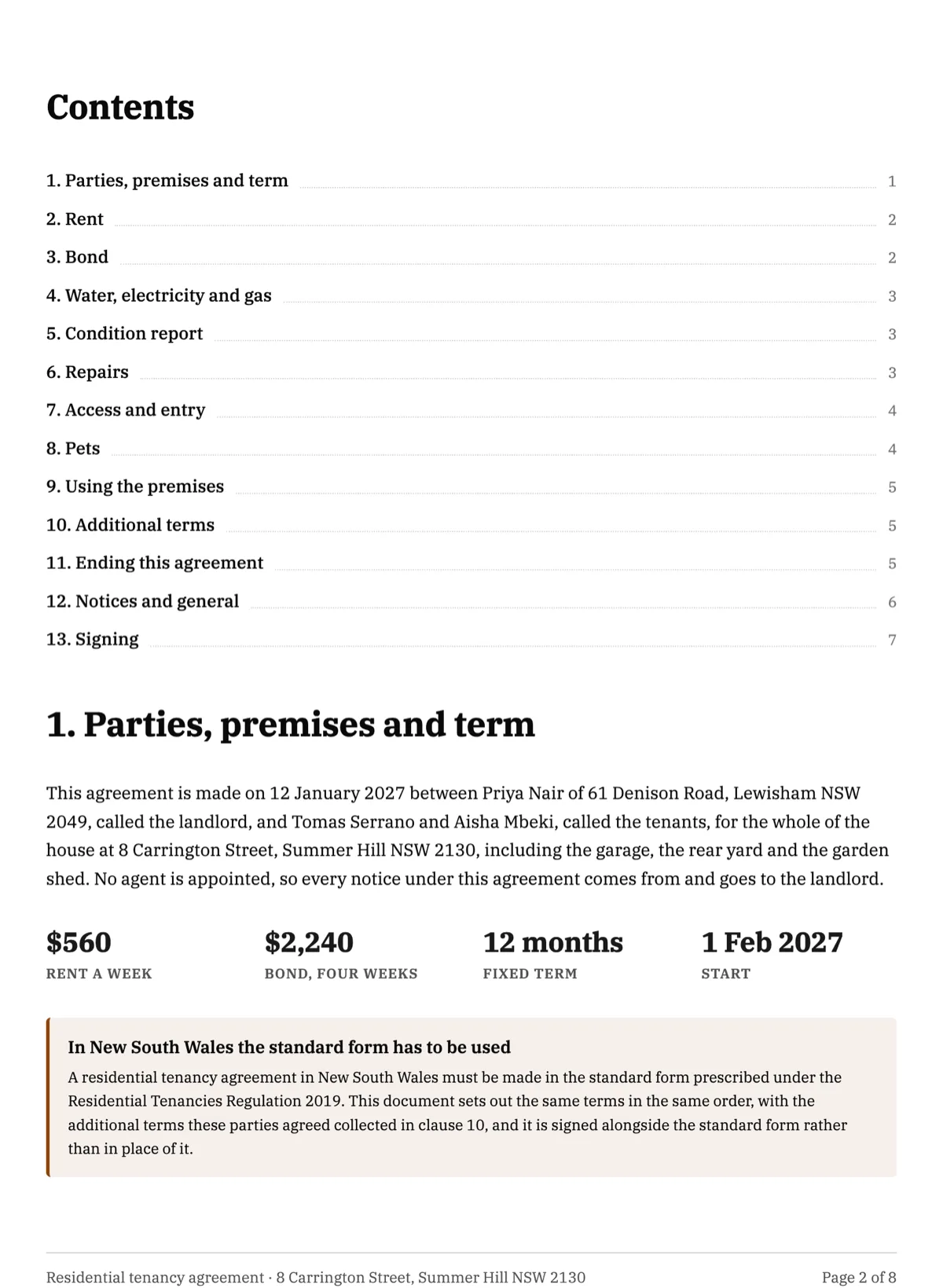 Residential lease agreement template for a New South Wales fixed termA residential tenancy is the one agreement where most of the terms are set by statute rather than by the parties, so the useful part of a template is the additional terms and the numbers. This one is a 12 month New South Wales fixed term at $560 a week, with the bond, the entry notice periods and the break fee written out exactly as the Act sets them.
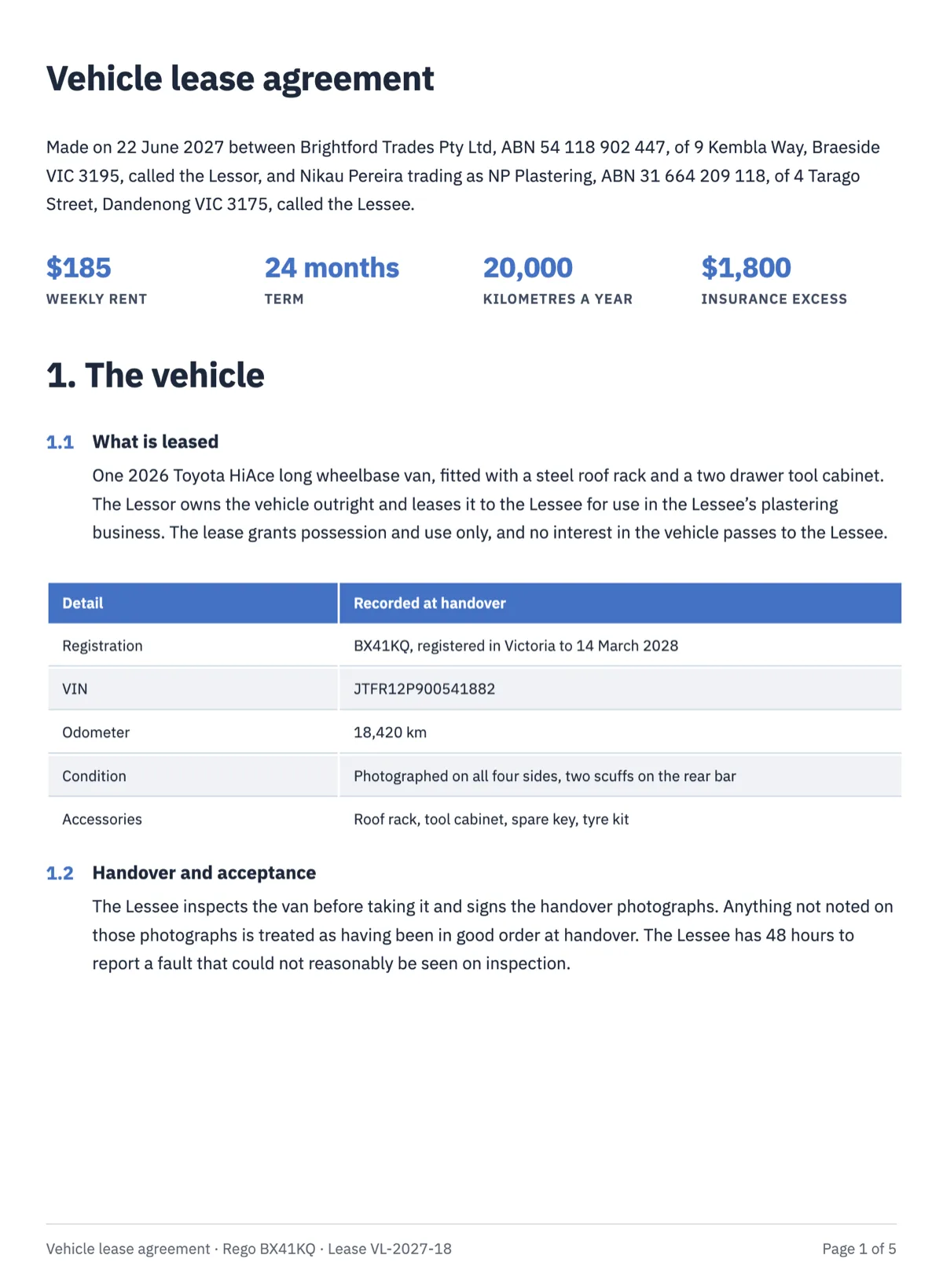 Vehicle lease agreement template with a kilometre capA vehicle lease agreement sets the weekly rent, the kilometres included and the state the vehicle has to come back in. This one leases a Toyota HiAce from a trades business to a plastering subcontractor for 24 months at $185 a week including GST, with 20,000 km a year.
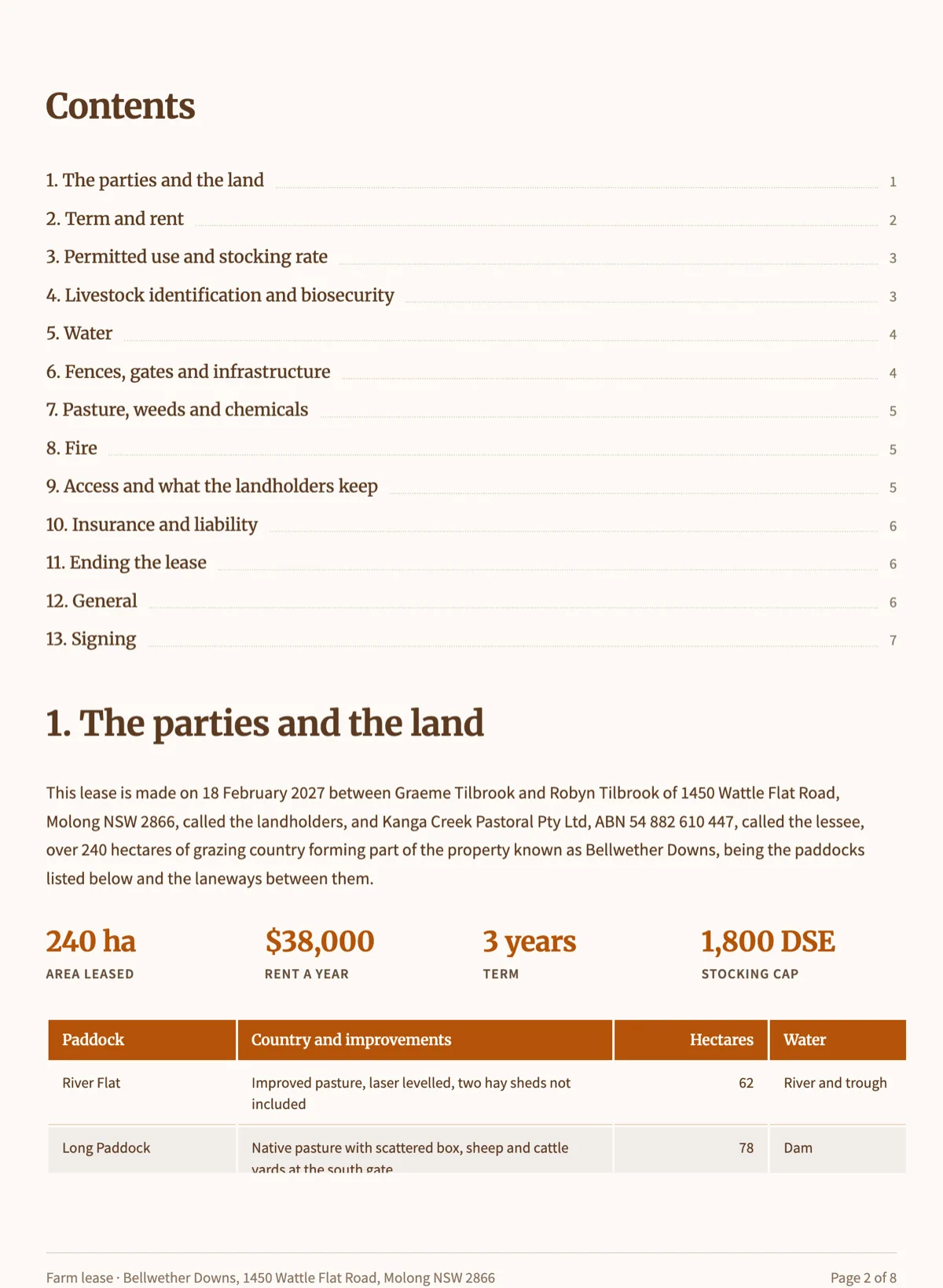 Farm lease agreement template with grazing rights and a fencing tableA grazing lease is a bet on country, and the two things that decide whether it was a good one are the stocking rate and who fixes the fence. This three year lease over 240 hectares caps stock in dry sheep equivalents, ties ground cover to a measurement twice a year, and puts every improvement in a table with a name beside it.
Questions people ask
What is a break date?
The break date is the day on which the lease ends if the break is validly exercised. Some leases give one fixed date, others a rolling right to break on any date after a certain point on notice. The notice period is counted back from the break date, so the date also fixes the last day for serving notice.
Does a tenant have to pay rent up to the break date?
Usually yes, and many break clauses make payment of the rent due by the break date a condition. Where rent is paid quarterly in advance, the tenant may have to pay a full quarter even though the lease ends part way through it, and it will receive a refund only if the lease says so.
What does vacant possession mean for a break?
It generally means handing the premises back free of people, the tenant's goods and anything that substantially stops the landlord using them. Leaving furniture, partitions or a subtenant in occupation risks the break failing. A condition that the tenant simply gives up its own occupation is much safer for the tenant.
Can a landlord waive a break condition?
Yes, a landlord can agree in writing that a condition does not need to be met. Tenants should not rely on conversations or on the landlord's silence. A tenant unsure whether it has complied should raise the point well before the break date and obtain written confirmation rather than waiting for the date to pass.
How should a break notice be served?
Strictly as the lease requires: by the correct party, to the correct recipient and address, in the required form and within the time limit. Many leases set out their own service methods or adopt a statutory service provision. Keeping proof of service and serving well before the deadline reduces the risk of a dispute.
Is a break clause the same as an early termination fee?
No. A break clause gives a right to end the lease on set terms, which may or may not include a payment. An early termination fee is a sum payable for ending a contract early, and in some cases it is tested against the rule on penalties. A break premium in a lease is usually a price for the right, agreed in advance.
Put the clause in a finished document
The button opens the document generator with a starting description already filled in. Change it to match your own agreement before you run it.
Create a document with OneCraftRelated clauses
- Option to renew clause: the right to a further termAn option to renew clause gives a tenant the right to a further lease term if exercised in time. Victorian retail sample wording, variants and the notice rules.
- Holding over clause: staying on after the lease expiresA holding over clause sets the terms when a tenant stays on after a lease expires. Victorian retail sample wording, residential and UK variants, notice rules.
- Sublease clause: renting the premises on to someone elseA sublease clause controls whether a tenant can rent part or all of the premises to someone else. Victorian retail and residential sample wording and variants.
- Early termination fee clauseAn early termination fee clause charges for ending a contract before the term ends. Sample wording, sliding scales, the penalty test and unfair terms limits.
For everything the document generator can do, see the document maker.
Step by step in the builder: Create a document with AI, then Document builder components.
Written and checked by the OneCraft team. Last checked .