Contract clause
Sublease clause: renting the premises on to someone else
A sublease clause controls whether a tenant may grant a sublease, letting part or all of the premises to a subtenant while the tenant keeps its own lease. It usually requires the landlord's consent, sets the grounds for refusing, and makes clear that the head tenant remains liable to the landlord for everything in the lease.
A sublease lets a tenant with surplus space recover some of its rent without giving up the lease, which is why landlords care who moves in. The clause decides whether consent can be refused at will, what the landlord may charge for considering a request and who answers for the subtenant.
Indunil Asanka · Co-founder
4 min read · Published
Sample clause
a retail lease in Victoria between Coolabah Court Pty Ltd, a fictional owner of a two storey building in Ballarat, and Driftwood Physiotherapy, which wants to sublet an upstairs treatment room
16. Subletting 16.1 Driftwood Physiotherapy must not sublet, license or part with possession of any part of the Premises without the written consent of Coolabah Court Pty Ltd. 16.2 The Landlord will not unreasonably withhold consent to a sublease of up to 30 percent of the lettable area to a registered health practitioner, if the Tenant gives the Landlord a copy of the proposed sublease, the subtenant's contact and business details and evidence of its insurance. 16.3 A sublease must be for a use within the Permitted Use, must end no later than the day before this Lease ends, and must not give the subtenant any greater rights than the Tenant has. 16.4 The Tenant remains liable for all its obligations under this Lease and is responsible for the acts of the subtenant as if they were its own. 16.5 The Tenant must pay the Landlord's reasonable legal and other expenses of investigating the proposed subtenant and preparing the consent, whether or not the sublease proceeds.
Sample wording, not legal advice.
Variants
Absolute discretion to refuse
A landlord that wants full control over who occupies a building, such as a small centre with a curated mix.
The Tenant must not grant a sublease, licence or concession over all or any part of the Premises, or otherwise part with occupancy of any part of the Premises, without the Landlord's prior written consent. The Landlord may give or refuse consent in its absolute discretion and without giving reasons, and may give consent on any conditions it considers appropriate.
Residential rental agreement in Victoria
A renter of a home who wants to sublet a room, where the Residential Tenancies Act 1997 applies.
The Renter must not sublet the whole or any part of the Premises without the Rental Provider's written consent, which the Rental Provider must not unreasonably withhold and must not refuse because of any attribute protected by the Equal Opportunity Act 2010. The Rental Provider will not charge a fee for considering or giving consent. The Renter, as head renter, has the responsibilities of a rental provider towards any subtenant.
Free subletting to related companies
A corporate group that moves teams between entities and needs flexibility without asking each time.
The Tenant may, without the Landlord's consent, share occupation of the Premises with or sublet any part of the Premises to a related body corporate of the Tenant, provided the Tenant gives the Landlord written notice within 10 business days, no relationship of landlord and tenant is created between the Landlord and that company, and the arrangement ends if the company ceases to be related to the Tenant.
What to negotiate
Grounds for refusing consent
A landlord with absolute discretion can refuse for any reason, which can leave a tenant paying for space it cannot use. Tenants ask for consent not to be unreasonably withheld, with the grounds listed: financial standing, a use within the permitted use, and no conflict with other tenants. Listing the documents needed for a request speeds up the process.
Rent above the head lease rent
Some landlords ask to share any rent the subtenant pays above the tenant's own rent for that space. Tenants resist, because they carry the risk of the subtenant defaulting and the cost of fitting the space out. A compromise shares the surplus only after the tenant's fit out and letting costs are recovered.
The risk of leaving it out
Without a subletting clause the lease may not prevent the tenant from subletting at all, leaving the landlord with an occupier it has never assessed. For a Victorian retail lease, a tenant without a clearly drafted restriction may argue it can sublet freely, and for a residential agreement the statutory consent rule applies in any event.
Sublease or assignment
A sublease creates a new, shorter interest under the tenant's lease, so the tenant stays in the building's chain of liability and deals with the subtenant as its landlord. An assignment transfers the whole lease to a new tenant, which then deals directly with the landlord. The two are controlled by separate clauses because the risks differ, and a sublease clause should not be used to achieve what is really a transfer of the entire premises for the rest of the term.
The Victorian rules
The Retail Leases Act 2003 (Vic) allows a retail lease to give the landlord an absolute discretion to refuse consent to a sublease, licence or concession, or to the tenant parting with occupancy. The Act generally stops a landlord recovering its costs of preparing a lease, but it does allow the landlord to claim the reasonable legal and other expenses of a sublease, including investigating the subtenant and obtaining consents. For homes, the Residential Tenancies Act 1997 requires the rental provider's written consent, which must not be unreasonably withheld, and Consumer Affairs Victoria states that no fee can be charged for giving it.
Where it sits in a generated document
A generated lease places subletting directly after the assignment clause, with the consent standard, the conditions and the continuing liability of the head tenant as numbered sub clauses. The generated draft does not cite sources, so the consent rules for the state and the kind of lease are checked before signing.
Documents that carry this clause
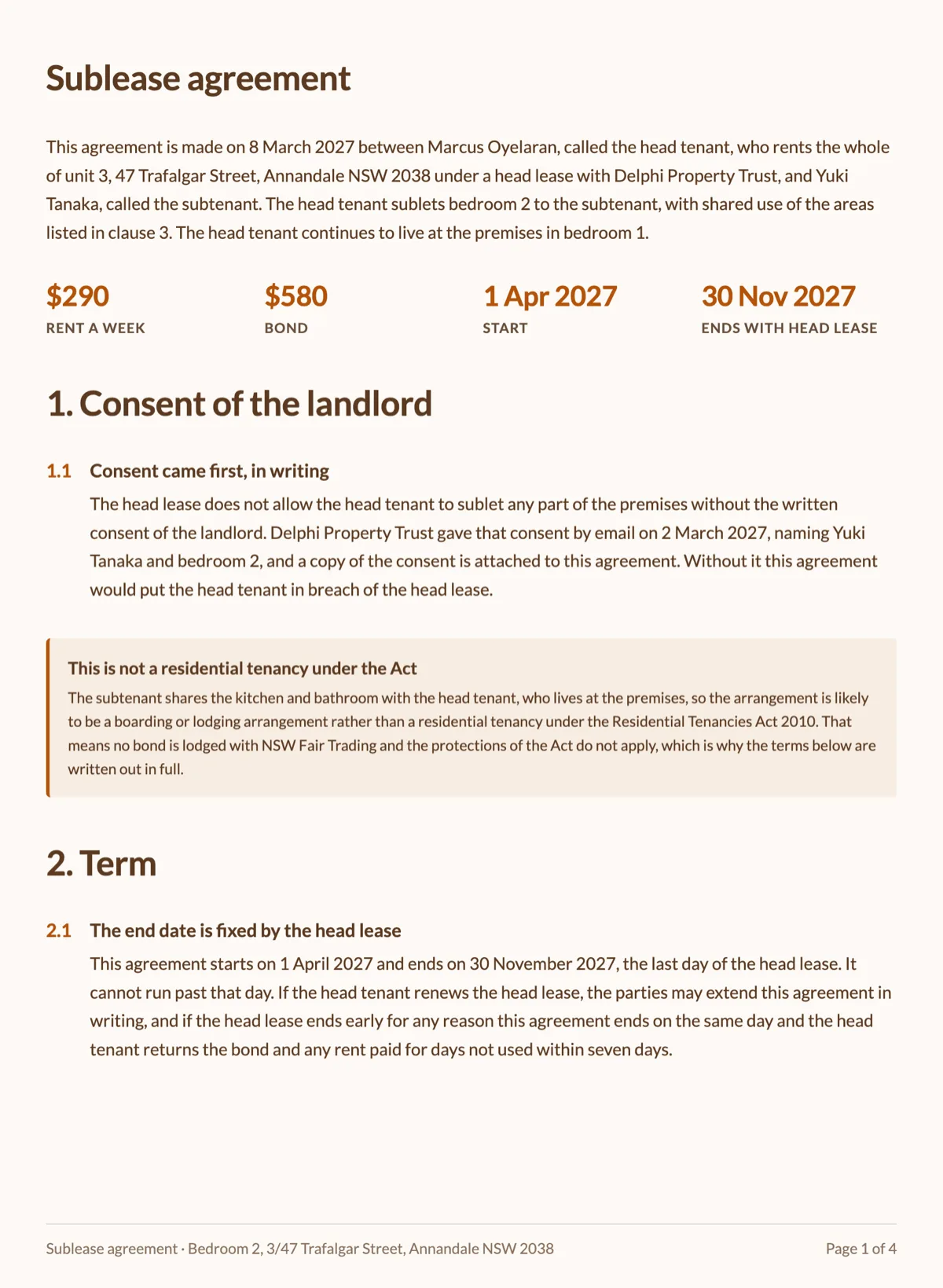 Sublease agreement template with the head lease consent recordedSubletting a room goes wrong in two places: the landlord never consented, and nobody wrote down what the occupant is actually renting. This agreement fixes the consent on the first page with a date and an email, then sets out the room, the shared areas and who keeps each one in order.
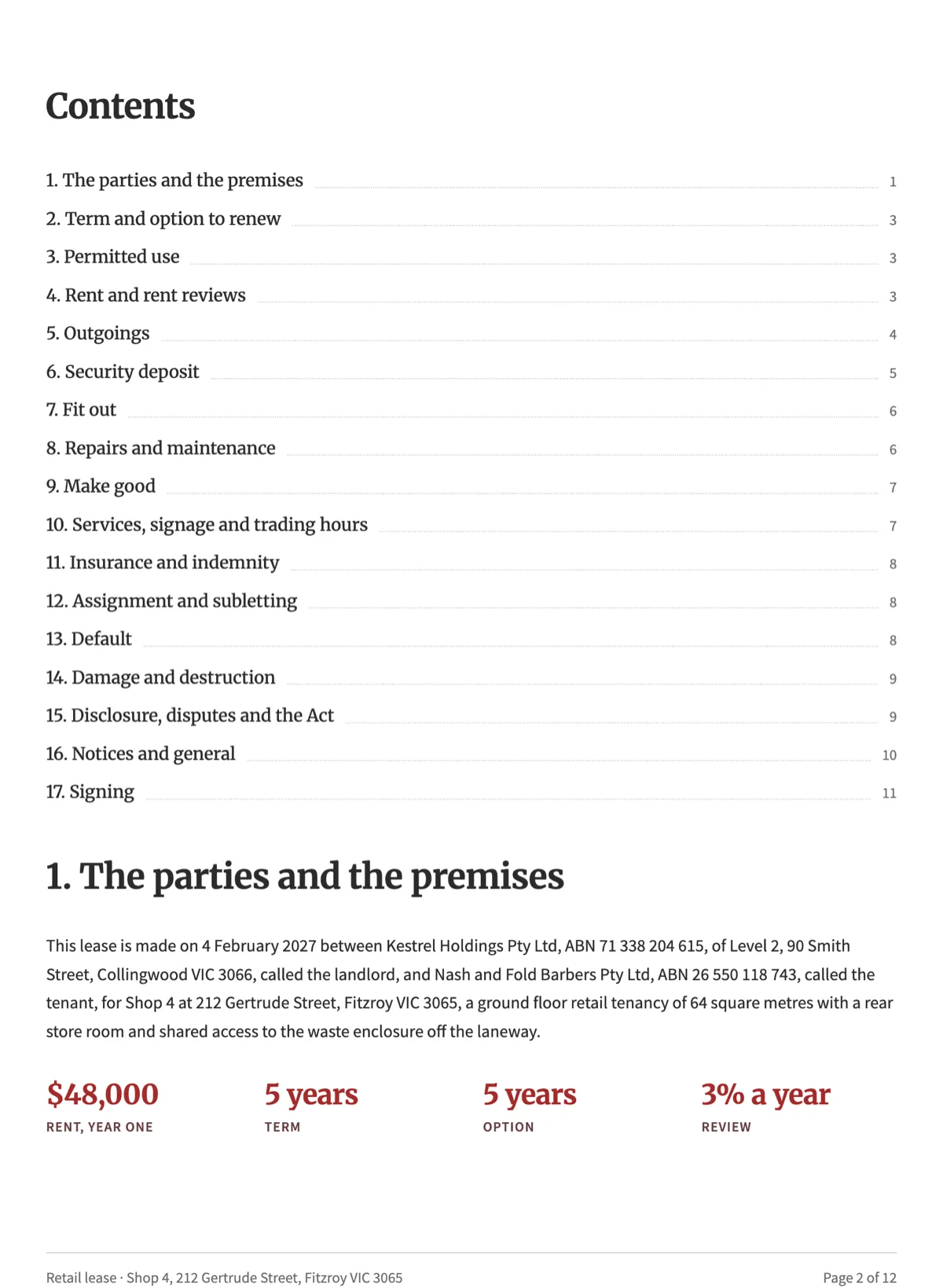 Commercial lease agreement template with outgoings and fit out termsA retail lease is decided by three numbers and two clauses: the rent, the review, the outgoings, the fit out contribution and the make good. This 12 page Victorian lease sets all five out in the open, including the outgoings the landlord is not allowed to recover at all.
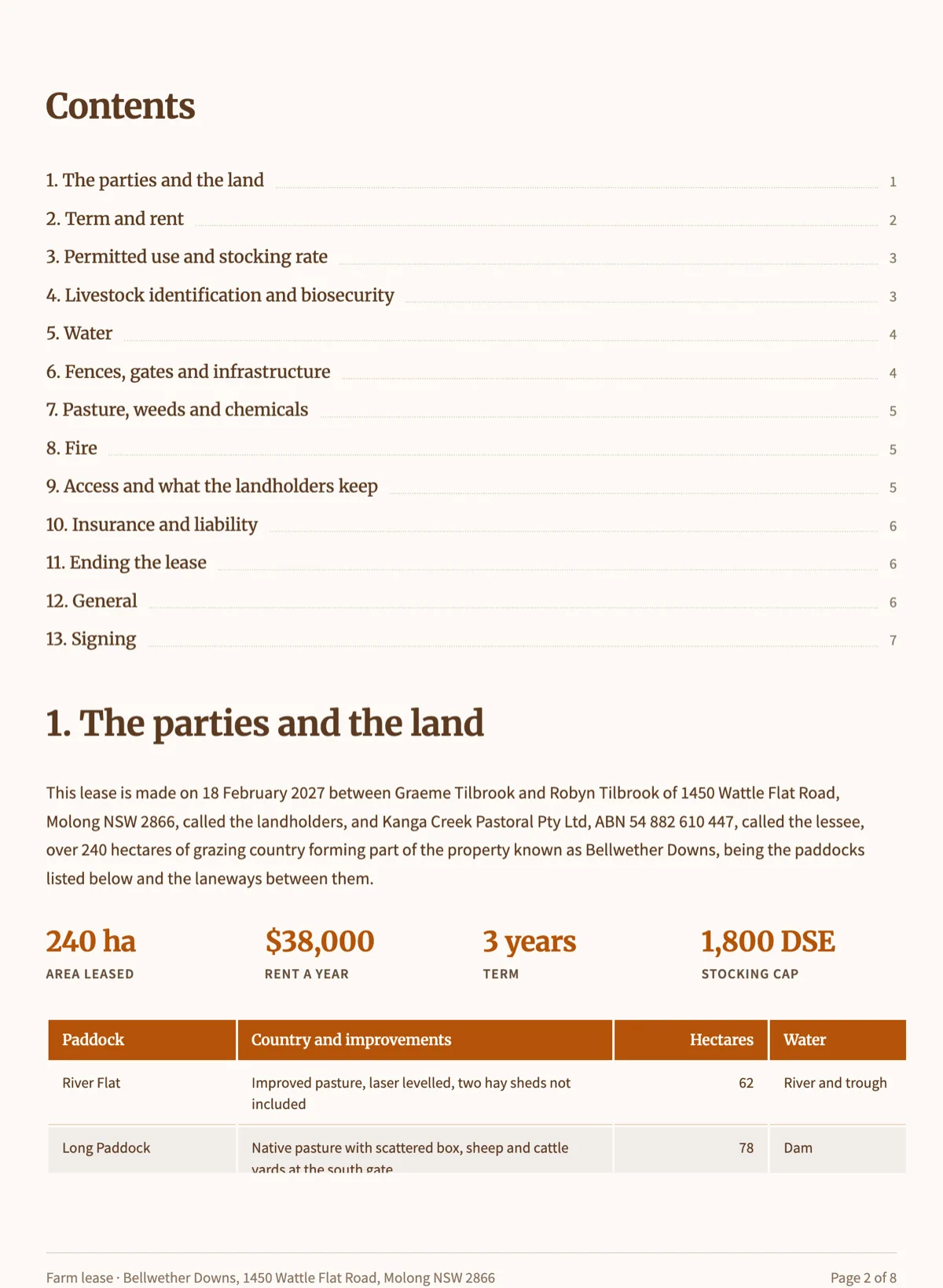 Farm lease agreement template with grazing rights and a fencing tableA grazing lease is a bet on country, and the two things that decide whether it was a good one are the stocking rate and who fixes the fence. This three year lease over 240 hectares caps stock in dry sheep equivalents, ties ground cover to a measurement twice a year, and puts every improvement in a table with a name beside it.
Questions people ask
Can a landlord refuse a sublease for no reason?
It depends on the lease and the legislation. A Victorian retail lease can give the landlord an absolute discretion to refuse a sublease, and then no reason is needed. If the lease says consent will not be unreasonably withheld, a refusal must have a genuine basis connected with the lease. A Victorian residential rental provider must not unreasonably withhold consent.
Is the head tenant still liable after subletting?
Yes. A sublease does not release the head tenant from the lease. It must still pay the rent and meet every obligation to the landlord, even if the subtenant stops paying or damages the premises, which is why head tenants take a bond and insurance from their subtenants and check their business before signing.
Can a landlord charge a fee for approving a sublease?
For a Victorian retail lease, the landlord may claim its reasonable legal and other expenses of the sublease, including investigating the subtenant and obtaining consents. For a Victorian residential rental agreement, Consumer Affairs Victoria states that the rental provider cannot charge a fee for giving permission to sublet.
What happens if a tenant sublets without consent?
It is usually a breach of the lease that can lead to termination. In a Victorian residential tenancy a sublet without the required consent is invalid unless the Tribunal decides consent was not required, and the rental provider can give notice to vacate. In a commercial lease the landlord's remedies are those in the default clause.
Does a sublease need to be in writing?
A written sublease is strongly preferable, and a landlord's consent usually requires a copy of it. It should state the subtenant's area, rent, term, use and bond, and it should end before the head lease ends. A sublease can never give the subtenant greater rights than the head tenant holds under its own lease.
Does a subtenant have rights against the head landlord?
Generally no direct contractual rights, because the subtenant's agreement is with the head tenant. If the head lease ends early, for example through termination for the head tenant's default, the sublease can fall away with it. A subtenant should therefore read the head lease and ask for written evidence that the landlord has consented.
Put the clause in a finished document
The button opens the document generator with a starting description already filled in. Change it to match your own agreement before you run it.
Create a document with OneCraftRelated clauses
- Assignment clause: who else may step into the contract's benefitsAn assignment clause controls whether a party can transfer its rights under a contract. Sample consent wording, a change of control trigger and three variants.
- Permitted use clause: what the premises may be used forA permitted use clause limits what leased premises may be used for. Victorian retail lease sample wording, narrow and broad variants, and what to negotiate.
- Break clause in a commercial leaseA break clause lets a party end a lease early on a set date and conditions. UK sample wording for England and Wales, variants, and why breaks fail.
For everything the document generator can do, see the document maker.
Step by step in the builder: Create a document with AI, then Send a document for signature.
Written and checked by the OneCraft team. Last checked .