Contract clause
Assignment clause: who else may step into the contract's benefits
An assignment clause controls whether a party may transfer its rights under a contract to someone else, such as a buyer of its business, a related company or a lender. It usually requires the other party's consent, sets the standard for refusing, and often treats a change in who owns the party as if it were an assignment.
A contract is signed with a counterparty someone has checked, and nobody wants to wake up owing performance to a stranger or depending on one. The assignment clause is where each side decides how much of that choice it keeps once the business behind the other signature changes hands.
Nuwan Madhusanka · Co-founder
4 min read · Published
Sample clause
a five year facilities maintenance agreement between Silverleaf Property Services, a fictional Canberra contractor, and Arrowfield Community Housing, which manages three hundred tenancies and expects Silverleaf's owners to sell within the term
19. Assignment and Change of Control 19.1 A party may not assign, transfer or declare a trust over any of its rights under this Agreement without the prior written consent of the other party, which must not be unreasonably withheld or delayed. 19.2 It is reasonable for Arrowfield Community Housing to withhold consent if the proposed assignee cannot demonstrate the financial capacity, licences and insurance required by clause 8. 19.3 Silverleaf Property Services may assign its right to receive payment to a financier by written notice, without consent, provided payment to the notified account discharges Arrowfield Community Housing's obligation. 19.4 A Change of Control of Silverleaf Property Services is treated as an assignment requiring consent under clause 19.1. Silverleaf must notify Arrowfield at least 20 Business Days before a proposed Change of Control. 19.5 An assignment does not release the assigning party from any obligation under this Agreement.
Sample wording, not legal advice.
Variants
No assignment at all
A personal services engagement where the identity of the provider is the whole point, such as a named consultant or artist.
Neither party may assign, transfer, subcontract or otherwise deal with any of its rights or obligations under this Agreement. Any purported assignment or transfer in breach of this clause is void and of no effect. This Agreement is personal to the parties and may only be performed by them.
Free assignment to related bodies corporate
Corporate groups that restructure regularly and cannot seek consent every time a contract moves between subsidiaries.
A party may assign this Agreement to a Related Body Corporate by written notice to the other party, without consent, provided the assignee has the capacity to perform the assigning party's obligations and the assigning party remains liable for the assignee's performance. If the assignee later ceases to be a Related Body Corporate of the assigning party, the Agreement must be assigned back to the assigning party or to another Related Body Corporate before that happens.
Consent in the absolute discretion of the other party
A customer that selected a supplier after lengthy due diligence and wants the right to say no for any reason.
The Supplier must not assign or transfer any right or obligation under this Agreement without the Customer's prior written consent, which the Customer may give or withhold in its absolute discretion and on any conditions it reasonably considers appropriate. The Customer may assign this Agreement to any government agency or successor entity that assumes its functions, by written notice to the Supplier.
What to negotiate
The standard for refusing consent
Consent not to be unreasonably withheld gives the assigning party a route and a court test. Absolute discretion gives none. Parties often land on the reasonable standard with a list of grounds that are deemed reasonable, such as the assignee's financial position, licensing or being a competitor, which reduces argument about what reasonable means.
Change of control
Assigning a contract and selling the company that holds it are legally different, since a share sale leaves the contracting entity unchanged. Customers close that gap by deeming a change of control to be an assignment. Suppliers push back where the clause catches internal reorganisations or listing on an exchange, and ask for those to be excluded.
Financing carve outs
Suppliers funding operations through debtor finance need to assign receivables without asking each customer. Customers accept an assignment of the right to be paid, on notice, provided payment to the notified account discharges them and no other right moves. That keeps the supplier's lender happy without changing who performs.
The risk of leaving it out
If the contract says nothing, the general law usually allows a party to assign the benefit of the contract, such as the right to be paid, without the other party's consent, unless the rights are personal in nature. The other party can find itself dealing with an assignee it never chose, while the assigning party remains responsible for obligations it no longer has any interest in performing.
Rights move, obligations do not
An assignment transfers rights. Burdens, the obligation to deliver, maintain or pay, stay with the original party unless all parties agree to a novation. That is why the sample says an assignment does not release the assigning party, which reflects the legal position and removes any argument about it. A clause titled assignment of this agreement, which purports to move both, only works if the other party's consent is given in a way that amounts to agreeing to the substitution. Where an actual change of party is intended, a novation deed is the correct document.
Legal and equitable assignments
State property laws, such as section 134 of the Property Law Act 1958 in Victoria, allow a legal assignment of a debt or other legal thing in action if it is absolute, in writing signed by the assignor, and written notice is given to the debtor. An assignment missing one of those elements can still take effect in equity, but the assignee may need the assignor joined in any action. For a contract clause the practical lesson is simple: require notice in writing, and say that payment to the notified account discharges the payer.
Where it sits in a generated document
Assignment sits in the general clauses, often next to subcontracting, because the two are negotiated together. A generated agreement numbers every clause, so a change of control definition, a consent standard and a receivables carve out can each become a separate sub clause that later provisions refer to. The document is written from the description and carries no citations, so any statutory reference should be checked.
Documents that carry this clause
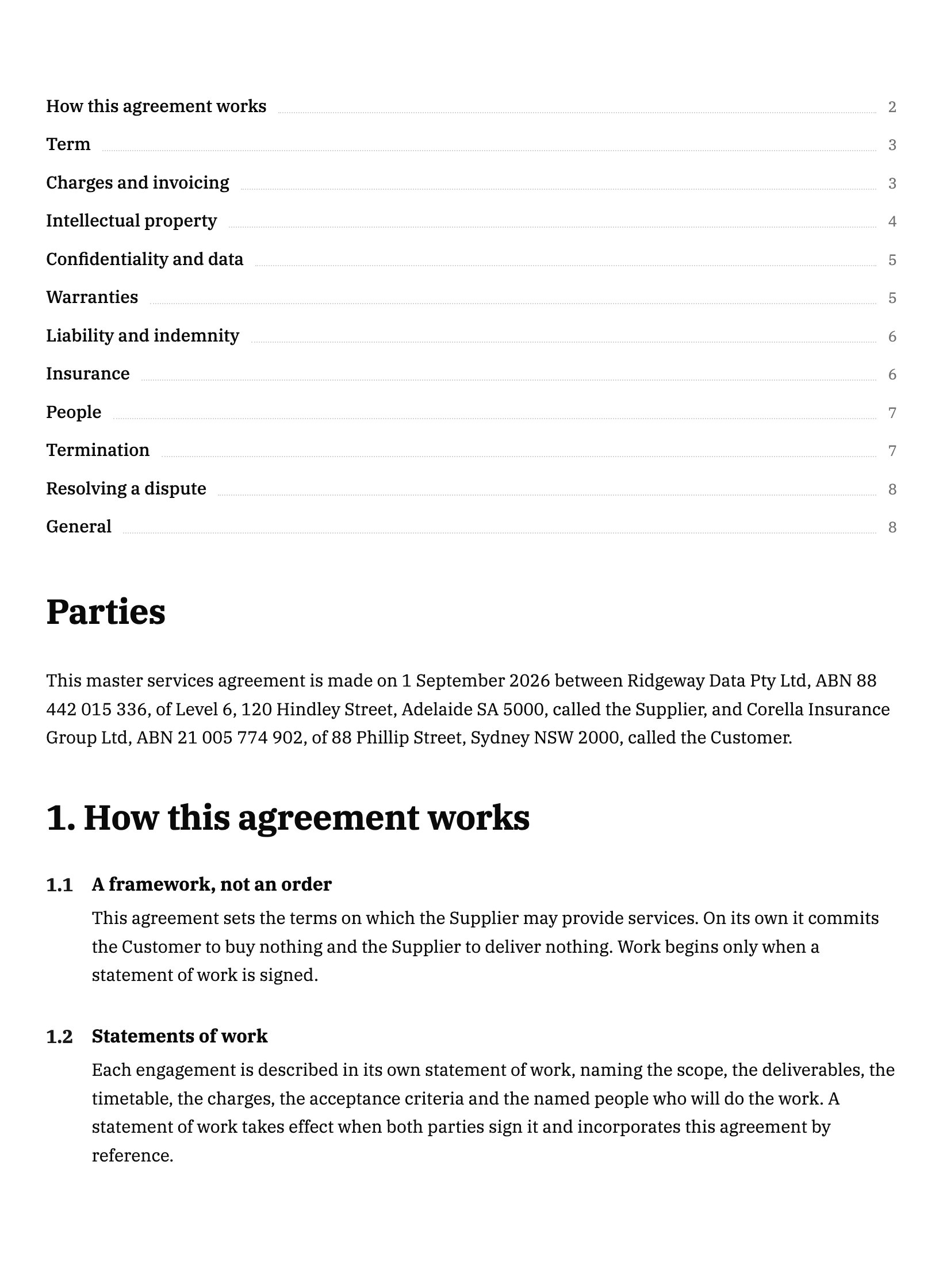 Master services agreementA data consultancy and an insurer sign this once and then buy work under it for three years. It is the rare contract whose whole purpose is to make the next twenty contracts short.
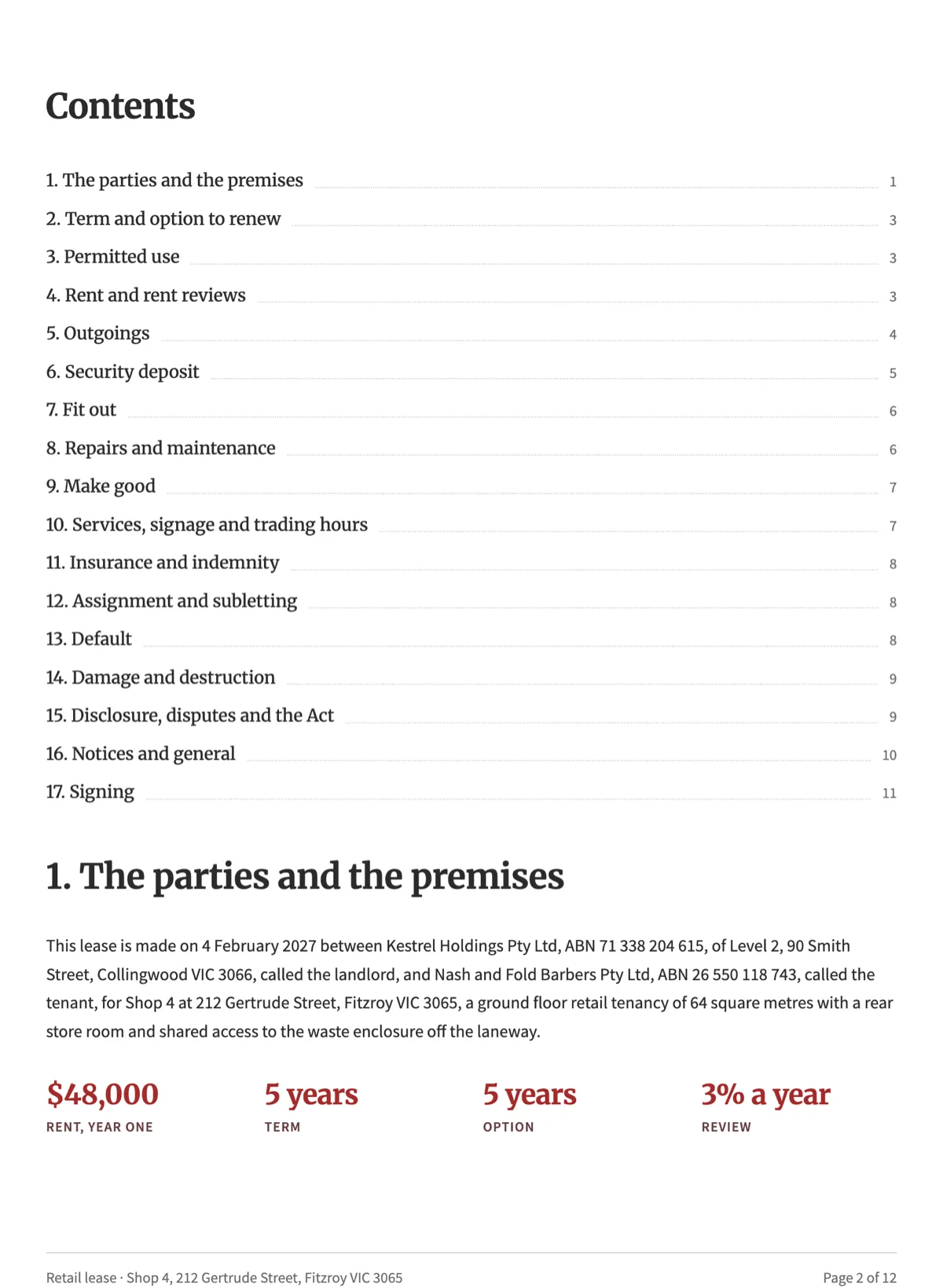 Commercial lease agreement template with outgoings and fit out termsA retail lease is decided by three numbers and two clauses: the rent, the review, the outgoings, the fit out contribution and the make good. This 12 page Victorian lease sets all five out in the open, including the outgoings the landlord is not allowed to recover at all.
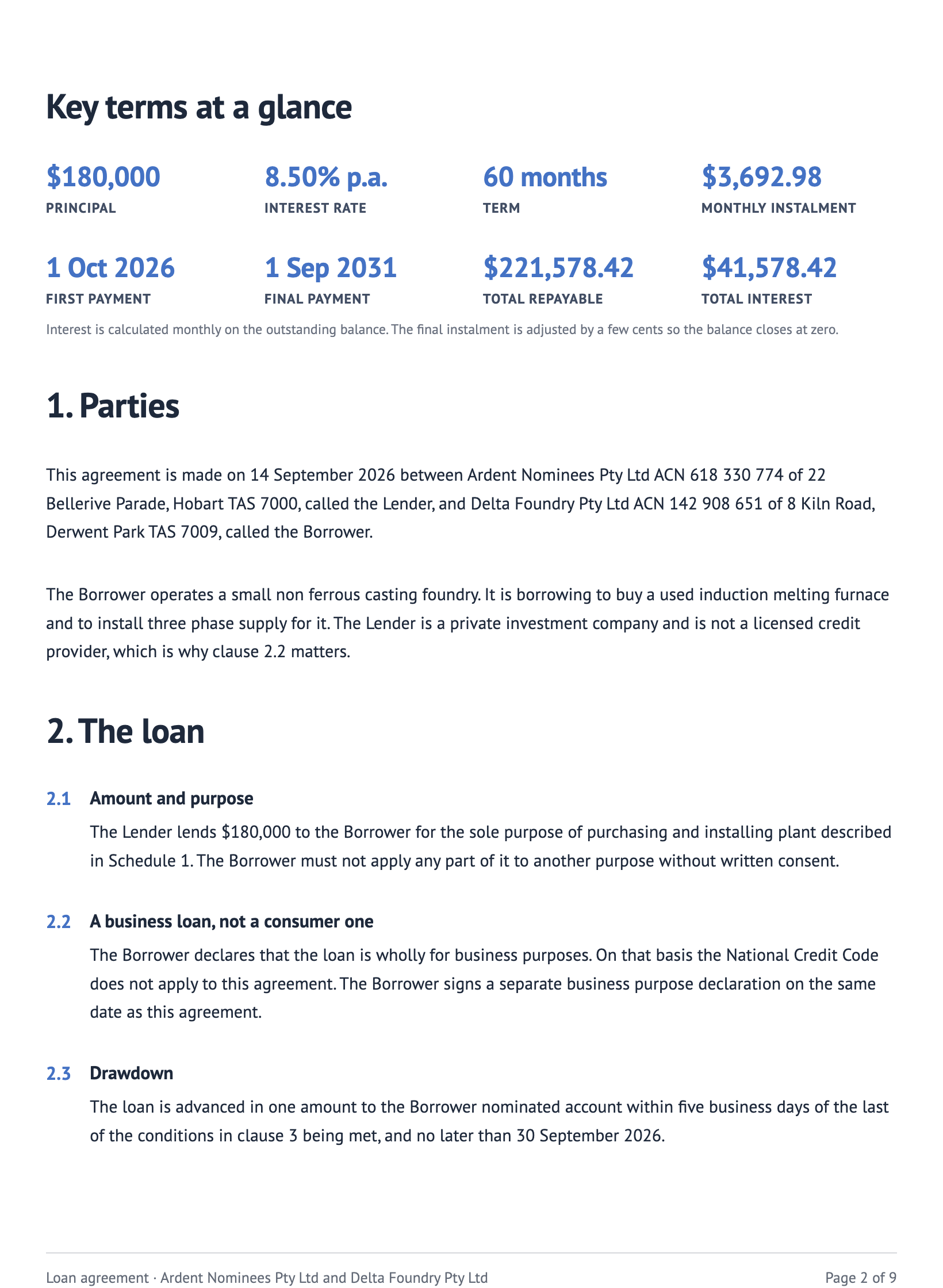 Loan agreement templateA Tasmanian foundry is borrowing $180,000 from a private investment company to buy a used induction furnace. The lender is not a bank, so everything a bank would take for granted has to be written down: what has to happen before the money moves, what is registered over what, and how long the borrower gets to fix a default.
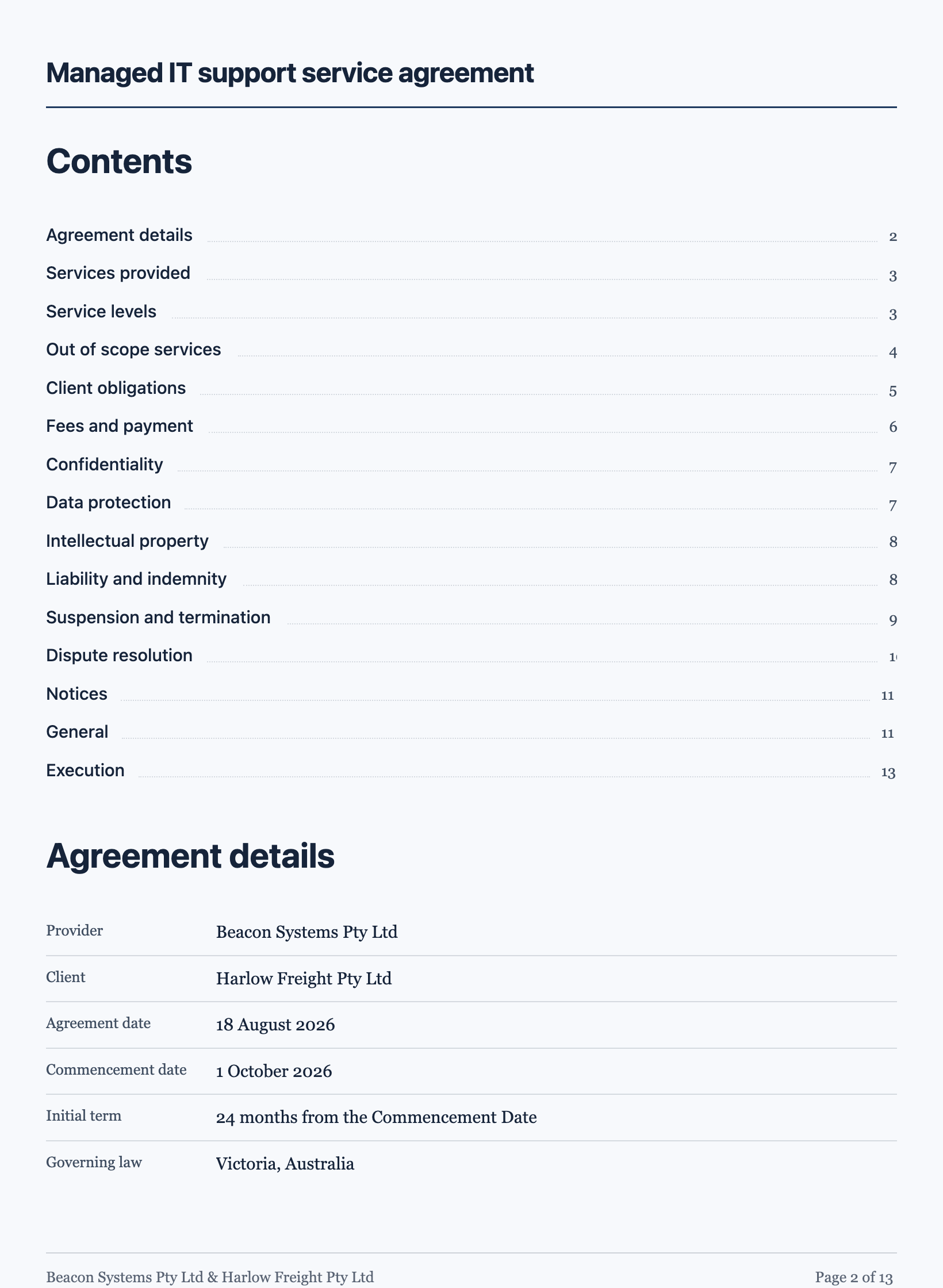 Service agreementBeacon Systems supports Harlow Freight’s IT for an initial 24 months from 1 October 2026 at $8,400 a month plus GST, with 40 hours included and $220 an hour beyond them. Twelve numbered clauses cover the services, a four level severity table, client duties, fees with a CPI adjustment, confidentiality, privacy, IP, a liability cap, termination and a three step dispute ladder.
Questions people ask
Can a contract be assigned without the other party's consent?
The benefit usually can if the contract is silent and the rights are not personal. Obligations cannot be transferred without consent under any wording, because that requires a novation. Most commercial contracts restrict assignment expressly, and an assignment made in breach of such a clause is generally ineffective against the other party.
Is a share sale an assignment?
No. The company that signed the contract still exists and remains the party, so nothing has been assigned. That is why customers add a change of control clause treating a sale of the controlling interest as an assignment requiring consent, or giving a termination right when control changes.
What does unreasonably withheld mean in practice?
A refusal is generally reasonable if it protects a legitimate interest connected to the contract, such as the assignee's financial strength, capability or being a direct competitor. Refusing to extract an unrelated concession is generally not. Listing deemed reasonable grounds in the clause narrows the argument considerably.
Can an assignment clause be unfair to a small business?
The Australian Consumer Law lists, as an example of a potentially unfair term, one that permits one party to assign the contract to the other's detriment without consent. A standard form small business contract giving only the larger party a free right to assign deserves a close look for that reason.
Does the assigning party stay liable?
Yes, for obligations, because an assignment moves rights only. Many clauses also make the assigning party guarantee that the assignee will perform, particularly for group transfers. Only a novation, with the remaining party's agreement, releases the original party from future obligations.
Should the clause cover a declaration of trust?
It is worth including. A party barred from assigning may try to hold the contract's benefits on trust for a buyer, which achieves much the same result economically. Prohibiting declarations of trust alongside assignment and transfer closes that route, and costs nothing in an ordinary commercial deal.
Put the clause in a finished document
The button opens the document generator with a starting description already filled in. Change it to match your own agreement before you run it.
Create a document with OneCraftRelated clauses
- Novation clause: agreeing now to swap a party laterA novation clause commits the parties to replace one party with another when a trigger occurs. Australian sample wording, deed form and business sale variants.
- Subcontracting clause: who else may do the work, and who answers for itA subcontracting clause decides whether a supplier can use others to do the work and who is liable when it does. Sample consent wording and three variants.
- Further assurances clause: signing whatever else the deal needsA further assurances clause obliges each party to sign and do whatever else is needed to make the deal work. Sample IP assignment wording and variants.
- Termination for insolvency clauseA termination for insolvency clause ends a contract when the other side fails. Sample wording, trigger lists, and the Australian ipso facto stay since 2018.
For everything the document generator can do, see the document maker.
Step by step in the builder: Create a document with AI, then Document builder components.
Written and checked by the OneCraft team. Last checked .