Contract clause
Subcontracting clause: who else may do the work, and who answers for it
A subcontracting clause controls whether a supplier may hand part of the work to other businesses, whether the customer must consent or be told, which obligations must flow down to the subcontractor, and who is responsible for the subcontractor's performance. The usual rule keeps the head supplier fully liable to the customer, as if it had done the work itself.
Customers choose a supplier after checking its insurance, security and references, then discover part of the job was done by a business they have never heard of. The subcontracting clause decides whether that is allowed and makes sure the checks the customer ran still count.
Indunil Asanka · Co-founder
4 min read · Published
Sample clause
a facilities services agreement between Myrtle Grove Services, a fictional Hobart maintenance contractor, and the Derwent Arts Centre, where specialist lift servicing and fire system testing will need licensed subcontractors
16. Subcontracting 16.1 Myrtle Grove Services must not subcontract any part of the Services without the prior written consent of Derwent Arts Centre, which must not be unreasonably withheld, except to the Approved Subcontractors listed in Schedule 5 for the services shown against their names. 16.2 Myrtle Grove Services must ensure each subcontractor holds the licences and insurance required by clause 11, complies with the site safety rules, and is bound by confidentiality and privacy obligations no less protective than those in this Agreement. 16.3 Myrtle Grove Services remains fully responsible for the Services and is liable for the acts and omissions of each subcontractor as if they were its own. 16.4 Myrtle Grove Services must give Derwent Arts Centre a copy of any subcontract terms relevant to clause 16.2 on request. 16.5 Derwent Arts Centre may, on reasonable grounds, require Myrtle Grove Services to stop using a subcontractor, and Myrtle Grove Services must arrange a replacement within 10 Business Days.
Sample wording, not legal advice.
Variants
No subcontracting
Personal or highly sensitive services, such as a consultant engaged for personal expertise or access to confidential systems.
The Consultant must perform the Services personally and must not subcontract, delegate or outsource any part of the Services to any other person. The Consultant may use administrative support staff it employs directly, provided they do not perform the substantive Services and are bound by confidentiality obligations equivalent to those in this Agreement.
Allowed with notice
Established suppliers using a changing panel of specialists, where the customer wants visibility but not a veto.
The Supplier may subcontract any part of the Services by giving the Customer at least 10 Business Days written notice identifying the subcontractor, the services to be subcontracted and the location where they will be performed. The Customer may object within 5 Business Days on reasonable grounds relating to capability, security, conflict of interest or compliance, in which case the Supplier must not use that subcontractor. The Supplier remains liable for all subcontracted Services.
Allowed freely
Commodity services where the customer cares only about the outcome and price, such as delivery or printing.
The Supplier may subcontract the performance of any of its obligations under this Agreement without the Customer's consent. Subcontracting does not relieve the Supplier of any obligation or liability under this Agreement, and the Supplier is responsible for the acts and omissions of its subcontractors as if they were its own acts and omissions.
What to negotiate
Flow down obligations
Customers want every key obligation, confidentiality, privacy, security, safety, insurance and audit rights, to apply to subcontractors. Suppliers accept flowing down obligations relevant to the subcontracted work but resist copying the whole head contract into every subcontract, which small specialists will not sign. A list of mandatory flow downs is the practical answer.
Offshore subcontracting
A subcontractor overseas can mean customer data leaves Australia. Customers ask for consent before any work involving their data is performed offshore, and for the location of each subcontractor to be disclosed. Suppliers with offshore delivery centres negotiate a pre approved list rather than case by case consent.
Direct rights against the subcontractor
Because the customer has no contract with the subcontractor, it cannot sue it directly. On larger projects customers ask for collateral warranties or deeds of direct obligation from key subcontractors, or step in rights allowing them to take over a subcontract if the head supplier fails. Suppliers usually limit these to a few critical subcontracts.
The risk of leaving it out
If a contract says nothing, a supplier can generally subcontract work unless the services are personal in nature, while remaining liable to the customer. The customer loses control over who enters its premises, handles its data or performs specialist work, and has no contractual right to require licences, insurance or confidentiality from those businesses.
Subcontracting is not assignment
Subcontracting and assignment are often confused. An assignment transfers rights under the contract to another party. Subcontracting leaves the contract exactly where it was: the supplier remains the customer's only counterparty and stays responsible for the work, while a separate contract below it engages the subcontractor. That is why subcontracting clauses are usually looser than assignment clauses. The customer's position is protected by the head supplier's continuing liability, so the questions are about quality, security and compliance of the people doing the work rather than about who the customer is dealing with. A supplier that wants to leave the contract entirely, rather than share the work, needs the customer's agreement to a novation instead, since no subcontract can release it.
Safety and privacy duties that travel with the work
Some obligations follow the work regardless of the contract chain. Under the model work health and safety laws adopted in most Australian jurisdictions, several businesses can share duties for the same workplace and must consult and coordinate with each other, so a customer, head contractor and subcontractor may each hold duties for a site. Entities covered by the Privacy Act 1988 must take reasonable steps under the Australian Privacy Principles to protect the personal information they hold, and that duty does not disappear when a service provider handles the records. A subcontracting clause that requires equivalent safety and privacy obligations to flow down reflects those shared responsibilities.
Where it sits in a generated document
Services agreements place subcontracting either beside delivery obligations or next to assignment near the end. Asking the generator for an approved subcontractor schedule gives a numbered clause that refers to it, and the builder's table block suits a list of names, services and locations. Everything about flow downs and notice comes from the written description, and no law is cited, so check the list before sending.
Documents that carry this clause
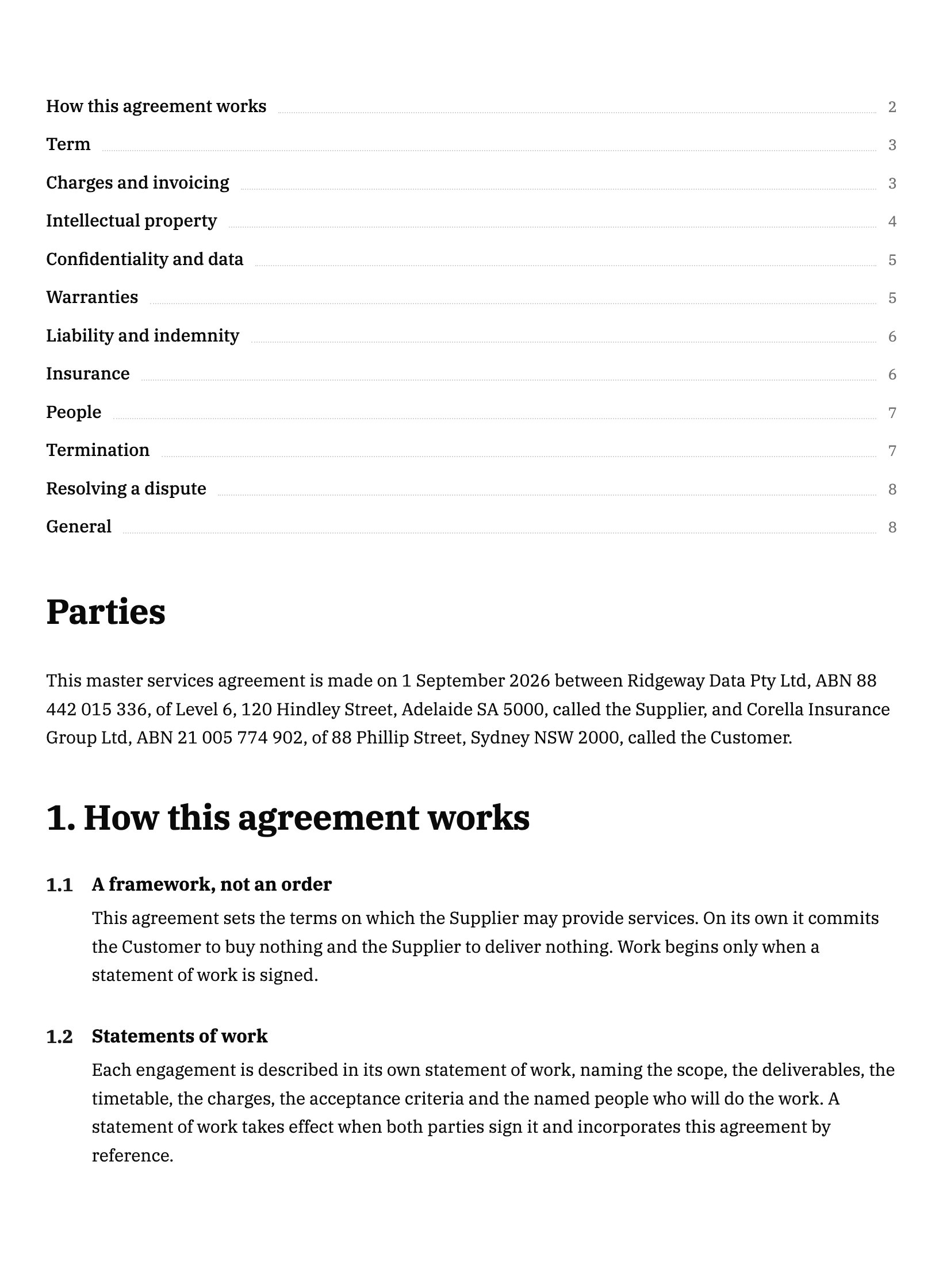 Master services agreementA data consultancy and an insurer sign this once and then buy work under it for three years. It is the rare contract whose whole purpose is to make the next twenty contracts short.
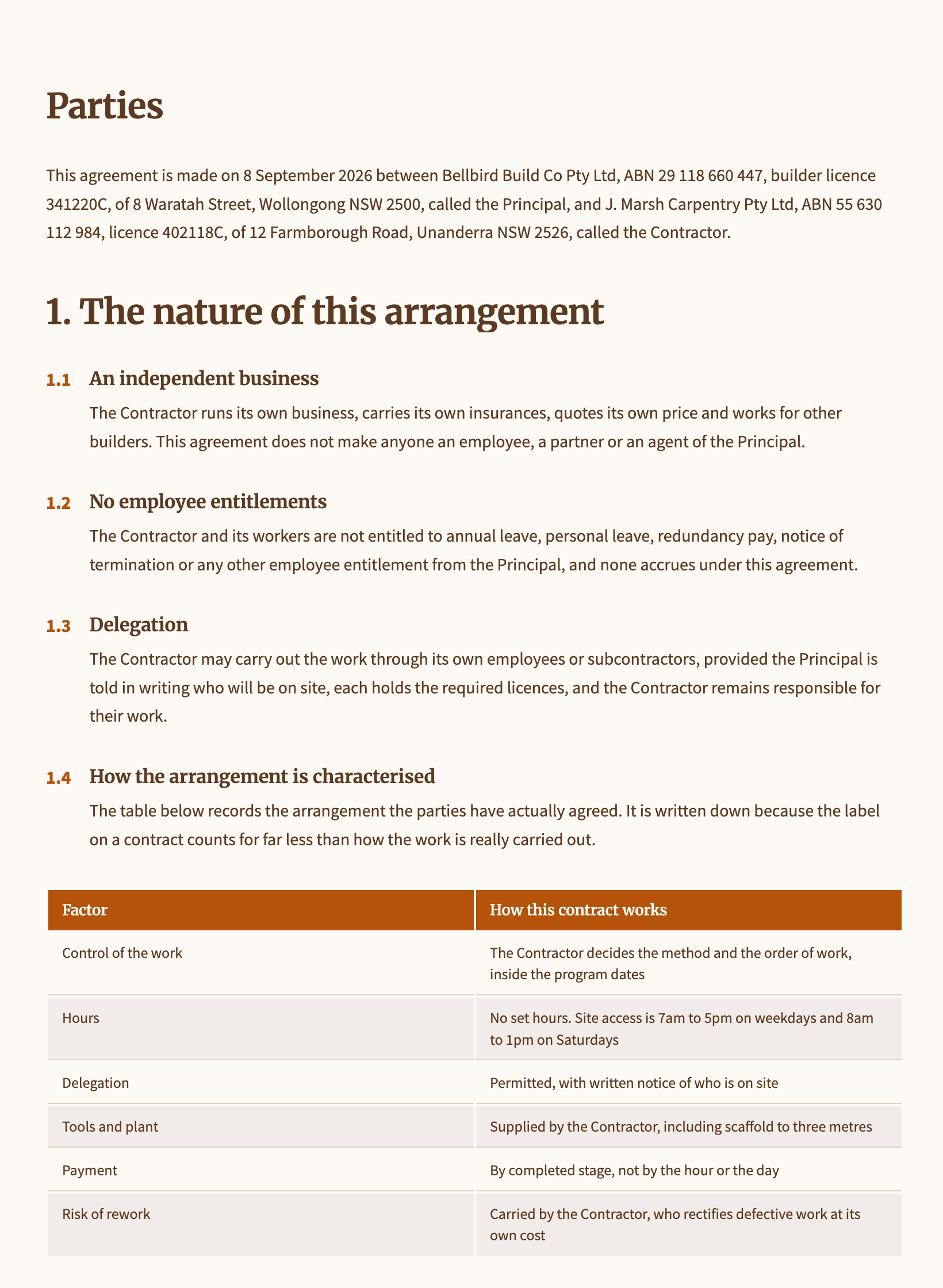 Independent contractor agreementA builder engages a carpentry business for one house. The interesting clause is not the price, it is the table that writes down who controls the work, because that is what decides whether this is a contract at all.
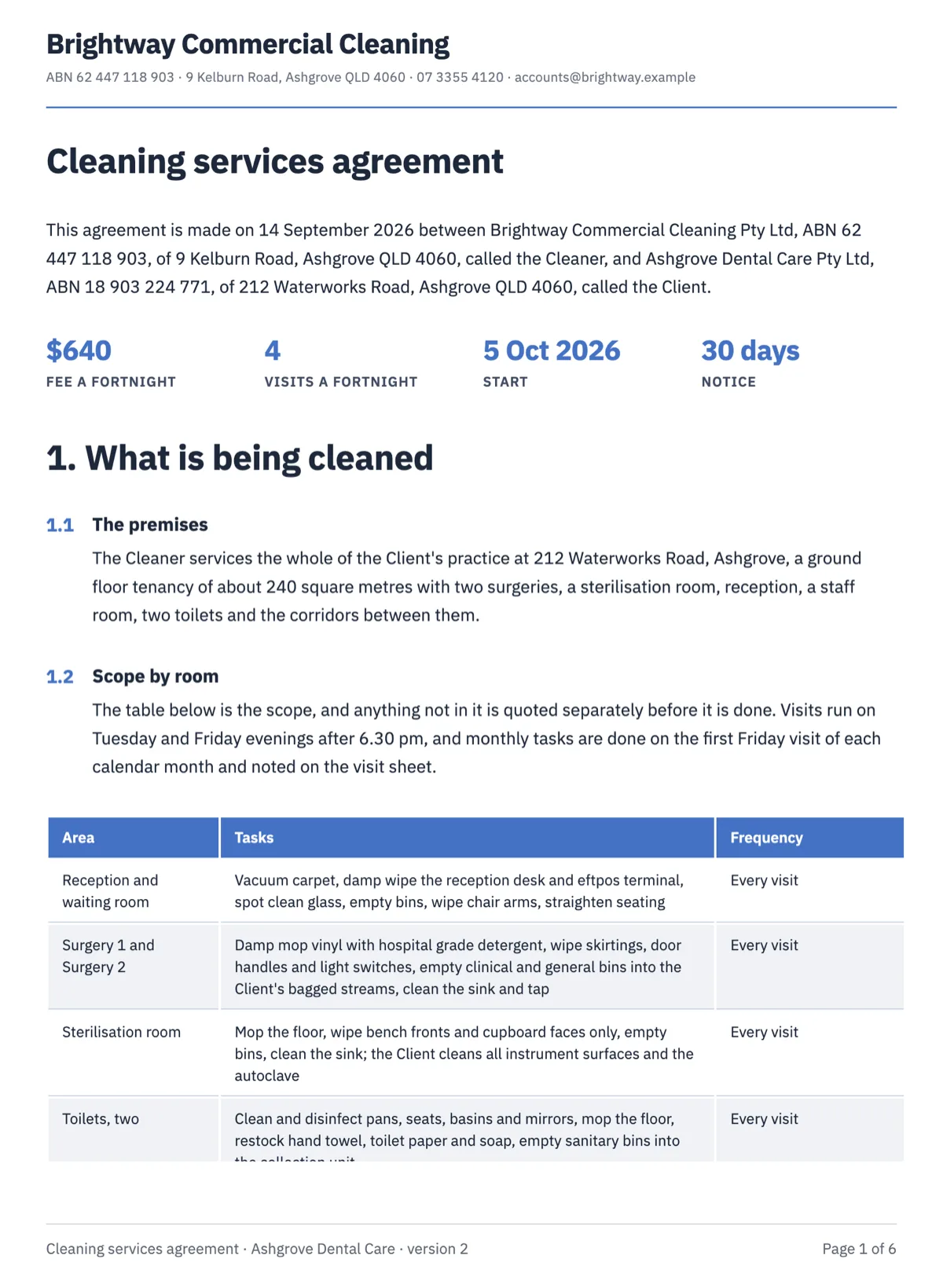 Cleaning services agreement template with a room by room scope tableAlmost every argument about commercial cleaning is an argument about what was in the scope, so this agreement puts the scope in a table with a room, a task list and a frequency on every line. It then settles what a dental practice worries about: who holds the keys, who has been police checked, and what the consumables cost.
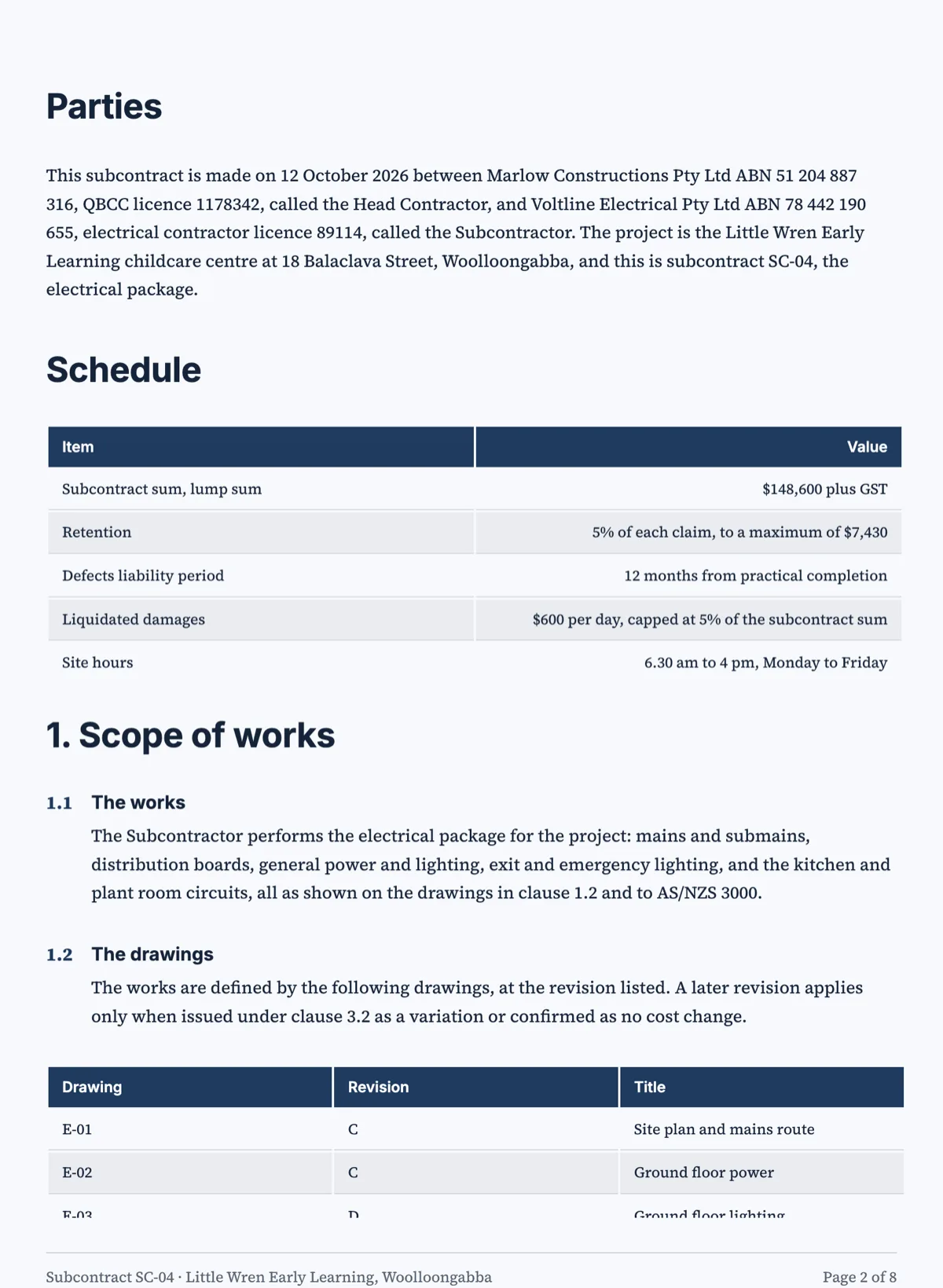 Subcontractor agreement template that flows the head contract downA subcontract exists to pass the head contract's obligations down one level and move the money back up on time. This one names the scope by drawing, sets the progress claim dates against the security of payment rules, holds retention and states the insurances, so the trade knows exactly when it is paid and for what.
Questions people ask
Is a supplier liable for its subcontractor's mistakes?
Generally yes, as between supplier and customer, because the supplier's contractual obligations remain its own. Clauses usually make that explicit by stating the supplier is liable for subcontractors' acts and omissions as if they were its own. The supplier then looks to its subcontract for recovery.
Can a customer refuse a subcontractor?
Only if the clause gives it a consent or objection right. Most negotiated clauses allow refusal on reasonable grounds, such as missing licences, security concerns or a conflict of interest. Refusing for purely commercial reasons, such as preferring the supplier to use its own staff, is usually not reasonable under that standard.
Does using a labour hire worker count as subcontracting?
It depends on the definition. Many clauses exclude individual contractors or labour hire workers who work under the supplier's direct supervision, treating them like employees, while capturing businesses that perform a defined part of the services themselves. The definition should say which approach applies.
What obligations should flow down to subcontractors?
Typically confidentiality, privacy and data security, work health and safety, insurance, compliance with laws and site rules, and audit or information rights relevant to the subcontracted work. Intellectual property assignment should also flow down where the subcontractor creates deliverables, otherwise the supplier cannot give the customer ownership it never received.
Should the customer see the subcontract?
Customers often ask for the parts relevant to flow down obligations rather than the whole document, since pricing between supplier and subcontractor is commercially sensitive. A right to see those parts on request, as in the sample, is a common compromise that lets the customer confirm compliance.
Can a subcontractor sue the customer for unpaid work?
Usually not in contract, because there is no contract between them. In construction, security of payment legislation gives subcontractors statutory rights against the party that engaged them, not the ultimate owner. Customers sometimes require evidence that subcontractors have been paid before paying the head supplier on larger projects.
Put the clause in a finished document
The button opens the document generator with a starting description already filled in. Change it to match your own agreement before you run it.
Create a document with OneCraftRelated clauses
- Key personnel clause: keeping the people the client choseA key personnel clause names the people who must work on a job and limits swapping them out. Sample schedule wording, consent, replacement and fee variants.
- Assignment clause: who else may step into the contract's benefitsAn assignment clause controls whether a party can transfer its rights under a contract. Sample consent wording, a change of control trigger and three variants.
- Relationship of the parties clause: no partnership, no agency, no employmentA relationship of the parties clause states a contract creates no partnership, agency or employment. Sample referral wording, four variants and its real limits.
- Insurance clause: which policies, what amounts, what proofAn insurance clause sets the policies a contractor must hold, the amounts and the proof. Australian sample wording, typical cover levels and three variants.
For everything the document generator can do, see the document maker.
Step by step in the builder: Create a document with AI, then Document builder components.
Written and checked by the OneCraft team. Last checked .