Contract clause
Relationship of the parties clause: no partnership, no agency, no employment
A relationship of the parties clause states that the contract does not make the parties partners, principal and agent, employer and employee, or joint venturers, and that neither may bind the other. It records intention and sets conduct rules, but a court decides the real relationship from how the parties actually deal with each other, not from the label.
Two businesses sharing customers, a brand or a revenue split can look like partners to an outsider, and a worker paid by invoice can still be an employee. This clause is where the parties say what they intend, while knowing a label on its own settles nothing.
Indunil Asanka · Co-founder
4 min read · Published
Sample clause
a referral agreement between Lilly Pilly Electrical, a fictional electrician in Ballarat, and Goldfields Solar Installs, which refers battery and switchboard work to the electrician for a fee per completed job
14. Relationship of the Parties 14.1 Lilly Pilly Electrical and Goldfields Solar Installs are independent businesses. Nothing in this Agreement creates a partnership, joint venture, agency, franchise, fiduciary or employment relationship between them or their personnel. 14.2 Neither party has authority to make any representation, incur any liability or enter into any contract on behalf of the other, and neither may hold itself out as having that authority. 14.3 Each party is solely responsible for its own personnel, including their wages, superannuation, workers compensation insurance, tax and licensing. 14.4 Goldfields Solar Installs must not describe Lilly Pilly Electrical as its partner or subsidiary in any quote, website or advertising, and must tell each referred customer that the electrical work is contracted directly with Lilly Pilly Electrical. 14.5 The Referral Fee is a fee for introductions and is not a share of profits.
Sample wording, not legal advice.
Variants
No partnership
Collaborations that share revenue or customers, such as co marketing or joint bids, where partnership law could otherwise be argued.
The parties do not intend to create, and this Agreement does not create, a partnership between them. Neither party is liable for the debts or obligations of the other. Any sharing of revenue under Schedule 2 is a contractual payment calculated by reference to revenue and does not constitute a sharing of profits of a business carried on in common.
No agency
Distribution, reseller and referral arrangements where customers might think the intermediary speaks for the supplier.
The Distributor buys and resells the Products on its own account and is not the agent of the Supplier. The Distributor has no authority to accept orders, give warranties, make representations or incur obligations on behalf of the Supplier, and must not state or imply that it has that authority. The Distributor must sell under its own name and on its own terms of sale.
No employment
Engagements of individual contractors, where the parties intend a genuine business to business relationship.
The Contractor is engaged as an independent contractor and not as an employee of the Company. The Contractor is responsible for its own taxation, superannuation, insurance and licences and is not entitled to leave or other employee benefits. The parties acknowledge that the nature of their relationship will be determined by the real substance and practical reality of the arrangement, and each party must conduct the engagement consistently with this clause.
All three in one clause
General commercial agreements where none of the three risks is high but the parties want a standard statement.
Nothing in this Agreement constitutes either party as the partner, agent, employee or legal representative of the other, or creates any joint venture or trust. Neither party has authority to bind the other. Each party remains responsible for its own employees, contractors, taxes and statutory obligations. Neither party may describe the relationship in any public statement in a way inconsistent with this clause.
What to negotiate
The clause does not decide sham contracting
Businesses engaging individuals sometimes treat the no employment wording as protection. Under the Fair Work Act 2009 the question is decided by the real substance and practical reality of the relationship, considering how the contract is performed. Contractors ask that the conduct match the label: control over how work is done, freedom to work for others, and their own tools and insurance.
Conduct obligations, not just statements
A statement that there is no agency is weak if the intermediary wears the supplier's uniform and signs customer quotes. Suppliers add conduct rules: how the intermediary describes itself, what it may say to customers, and which documents carry whose name. Intermediaries accept these if the supplier also avoids suggesting the intermediary acts on its behalf.
Revenue sharing wording
Receiving a share of profits is evidence of partnership under partnership statutes, although not conclusive. Parties sharing money describe it as a fee, commission or calculation by reference to revenue, and state that it is not a share of profits of a business carried on in common. The label helps only if the arrangement genuinely works that way.
The risk of leaving it out
Without the clause, the risk that a court finds a partnership, agency or employment relationship is decided purely from conduct, with nothing recording what the parties intended. A party could be exposed to the other's debts as a partner, bound by contracts the other signed as apparent agent, or liable for wages, leave and superannuation as an employer.
Why labels do not decide the relationship
Each of the relationships this clause disclaims is defined by substance. A partnership exists where persons carry on a business in common with a view of profit, whatever they call it. Agency can arise from apparent authority, where a principal's conduct leads third parties to believe someone acts for it. Employment is now assessed under section 15AA of the Fair Work Act 2009 by ascertaining the real substance, practical reality and true nature of the relationship, looking at the totality of the relationship and how the contract is performed in practice. That section was enacted in response to 2022 High Court decisions that gave more weight to the written terms.
What the clause is still good for
The clause earns its place in three ways. It records intention, which is relevant evidence when a relationship is borderline. It sets rules of conduct, such as how each party describes itself to customers, which reduces the facts that could support apparent authority. And it allocates responsibility for personnel, tax and insurance between the parties, which is enforceable between them even if a third party or regulator takes a different view of the relationship. Government contract templates, including the Commonwealth ClauseBank, carry a relationship of the parties clause for those reasons.
Where it sits in a generated document
In contractor and consulting agreements this clause often comes early, straight after the engagement, because it frames everything that follows; in commercial agreements it sits in the general clauses. A generated agreement numbers clauses wherever they are placed, and the conduct rules can become separate sub clauses. The text is produced from the description without legal citations.
Documents that carry this clause
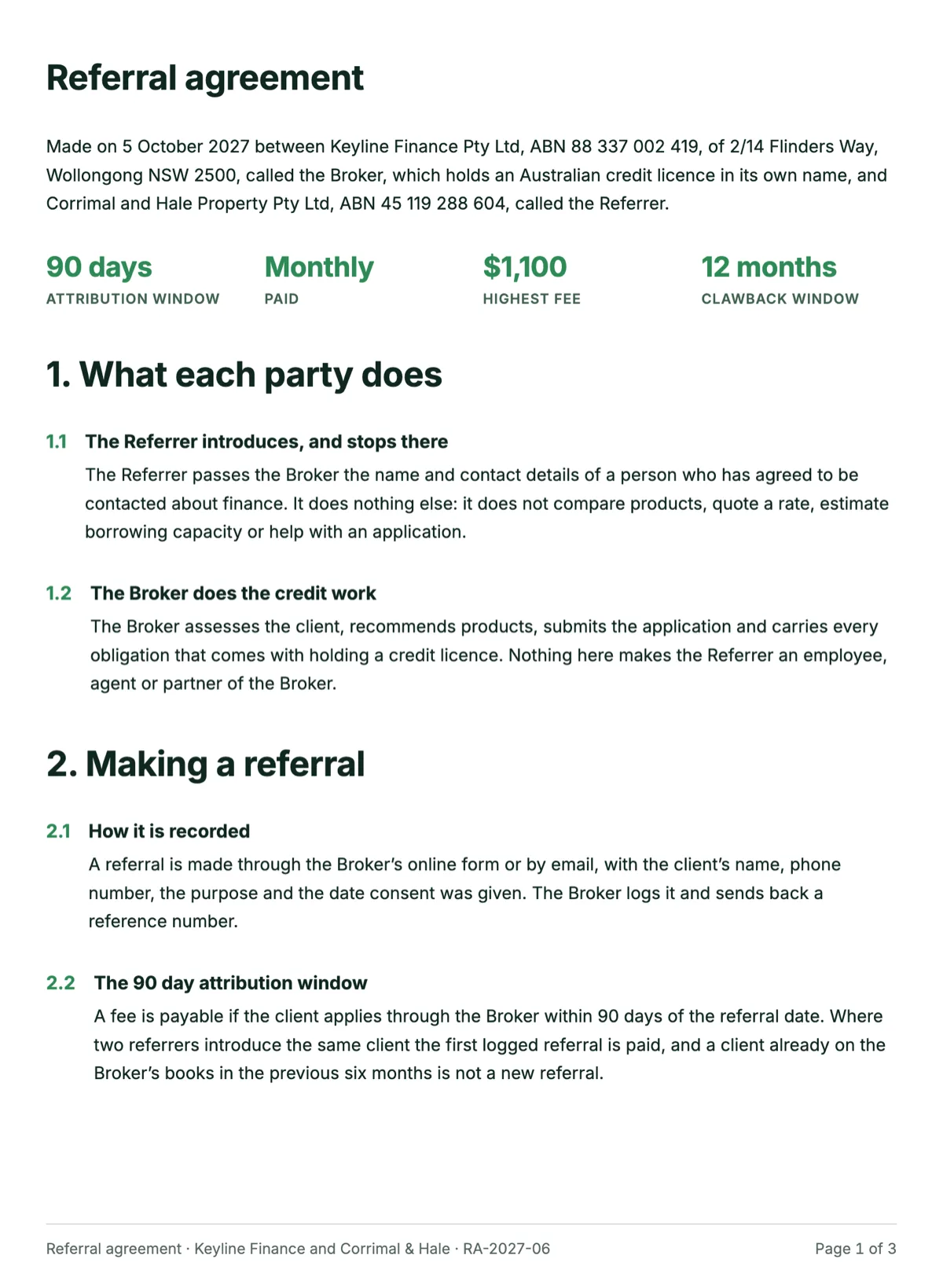 Referral agreement template with a fee table by productA referral agreement works when it is clear where the referral stops and the advice starts. This one has a real estate agency passing buyers to a mortgage broker for a fee that ranges from $250 to $1,100 by product, attributed for 90 days, paid monthly, and clawed back if the lender claws back first.
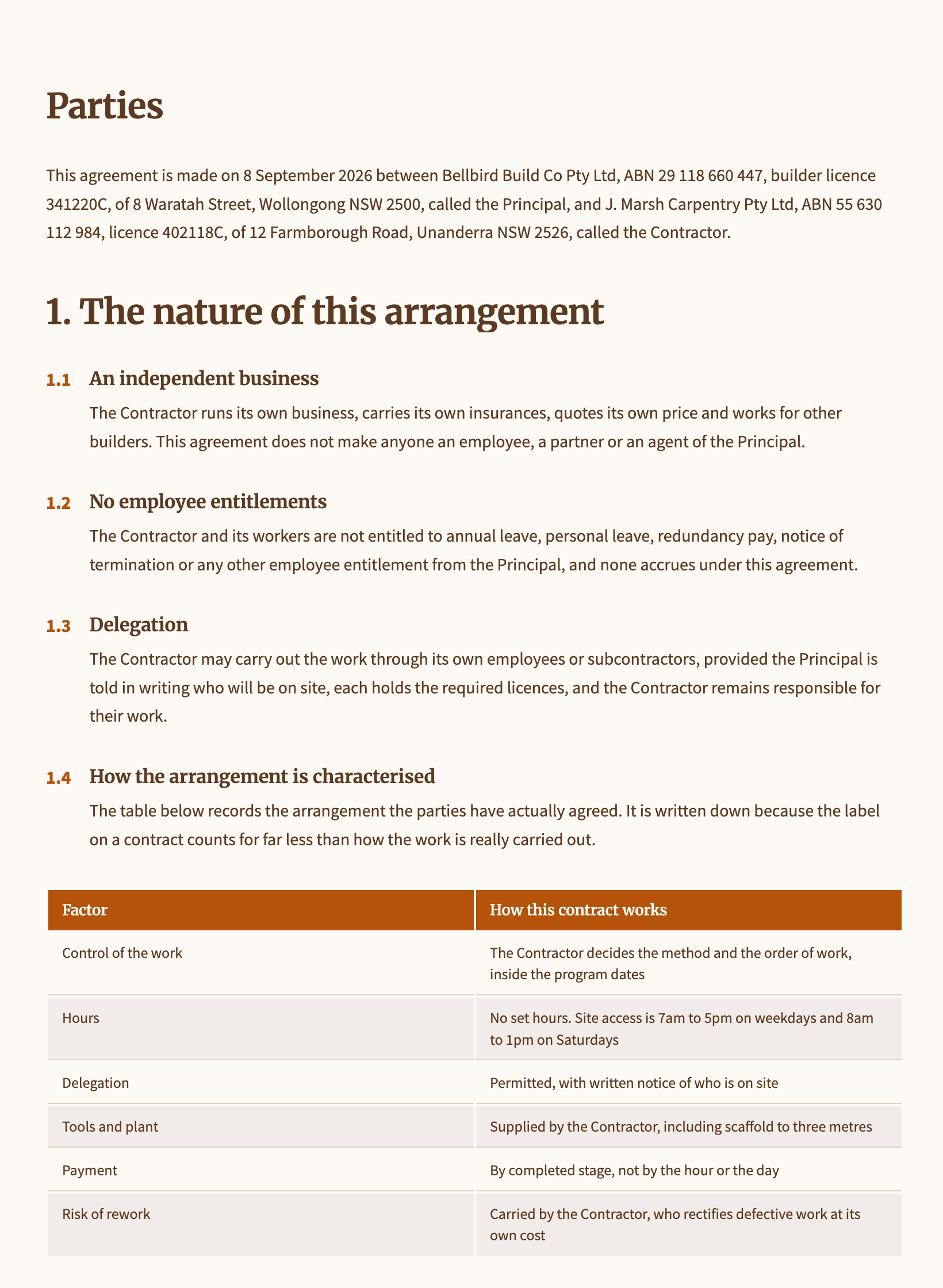 Independent contractor agreementA builder engages a carpentry business for one house. The interesting clause is not the price, it is the table that writes down who controls the work, because that is what decides whether this is a contract at all.
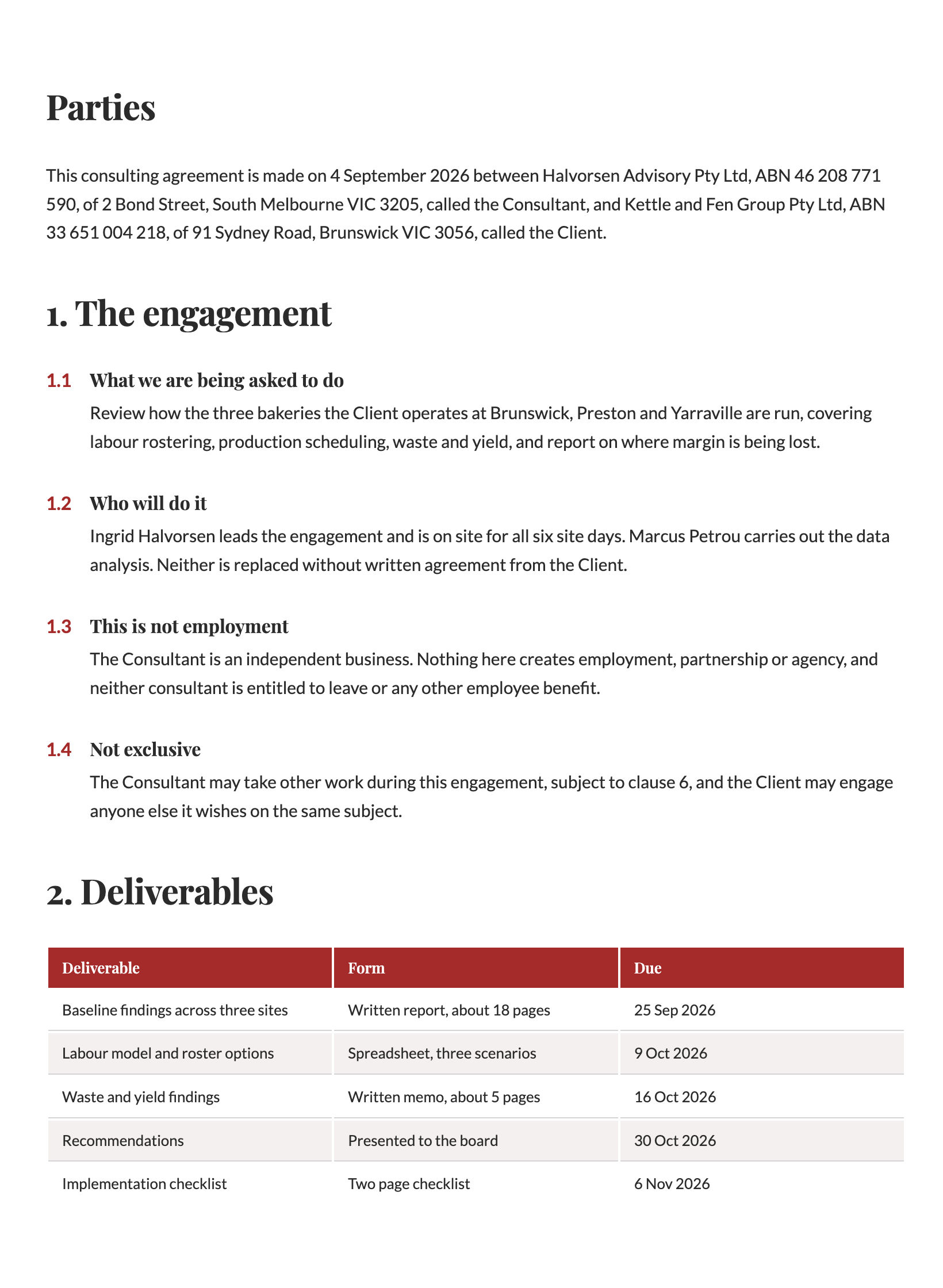 Consulting agreementAn advisory firm reviews three bakeries over seven weeks. What makes this agreement useful is not the fee clause but the two clauses that say what the advice is not.
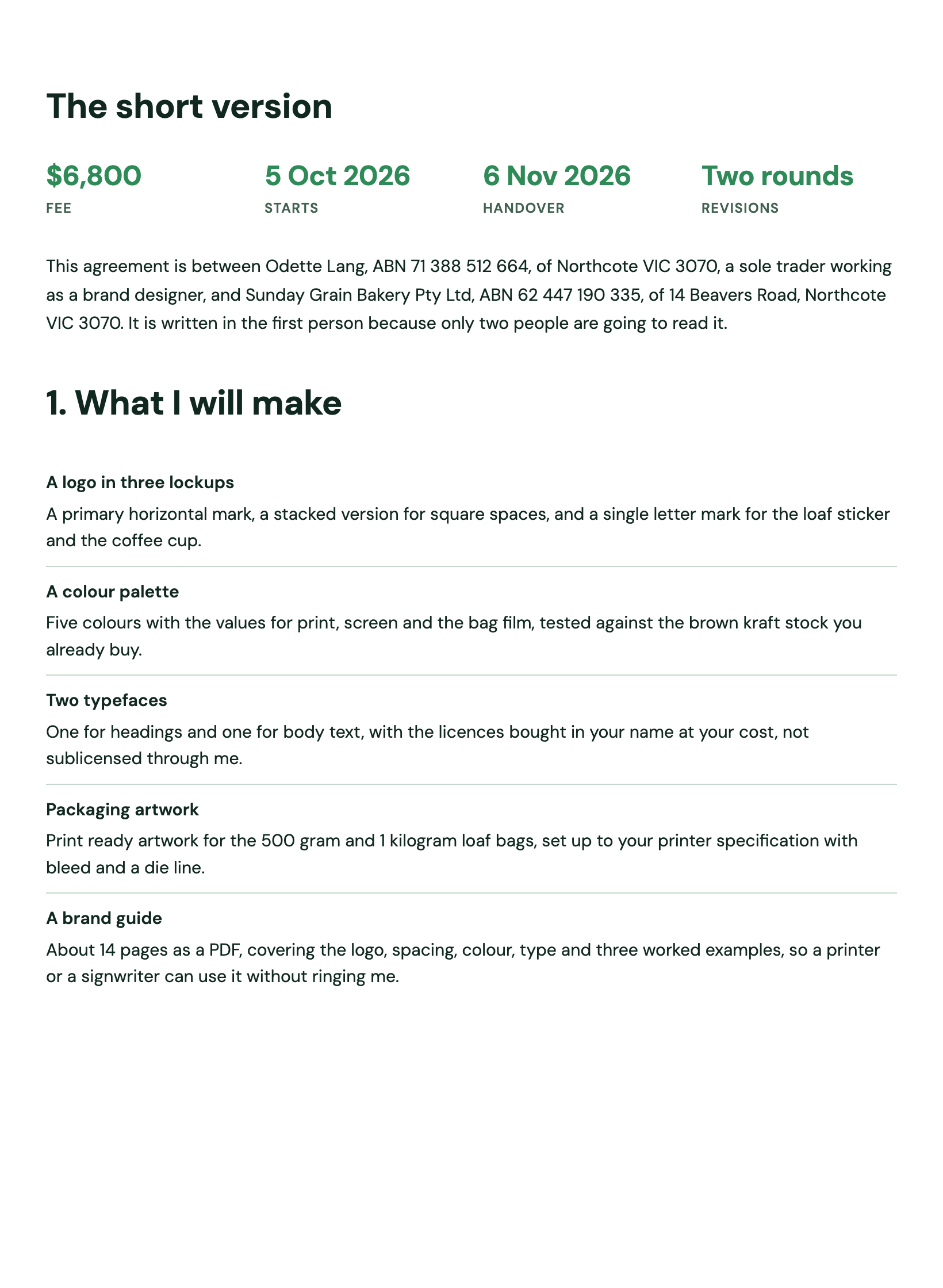 Freelance contractA brand designer and a bakery owner agree five weeks of work in language they can both read. It covers everything a longer contract would, and it never once says party of the first part.
Questions people ask
Does a no partnership clause prevent a partnership existing?
No. A partnership exists if the parties in fact carry on a business in common with a view of profit. The clause is evidence of intention and can help in a borderline case, but it cannot override conduct such as jointly owning assets, sharing profits and presenting to customers as one business.
Can a contract stop a worker being classed as an employee?
Not by labelling alone. Section 15AA of the Fair Work Act 2009 requires the real substance and practical reality of the relationship to be assessed, including how the contract operates in practice. A clause saying the worker is a contractor is relevant but will not prevail over working arrangements that look like employment.
What is apparent authority?
It is authority a third party reasonably believes someone has because of how the principal has presented them, even if no authority was actually given. A business that lets a reseller use its letterhead or email domain may be bound by what the reseller promises. Conduct rules in the clause help reduce that risk.
Should a joint venture agreement include this clause?
Usually yes, with care. Unincorporated joint ventures often state that the participants are not partners and that their liabilities are several, not joint. The rest of the agreement then has to be consistent, particularly around who can contract with third parties and how outputs, rather than profits, are shared.
Does the clause protect against claims by third parties?
Only partly. A third party who was not a party to the contract is not bound by what it says about the relationship. The clause is most effective when paired with conduct that makes the independence visible to customers and suppliers, such as separate branding and direct contracting.
Who pays superannuation under a relationship clause?
The clause can allocate responsibility between the parties, but it cannot remove a statutory obligation if the worker is in fact an employee or is treated as one for superannuation purposes. The ATO and the Fair Work Ombudsman each publish guidance on telling employees and contractors apart.
Put the clause in a finished document
The button opens the document generator with a starting description already filled in. Change it to match your own agreement before you run it.
Create a document with OneCraftRelated clauses
- Independent contractor clause and the test behind itAn independent contractor clause states the worker is not an employee. Australian sample wording, the whole of relationship test factors, UK and US notes.
- Subcontracting clause: who else may do the work, and who answers for itA subcontracting clause decides whether a supplier can use others to do the work and who is liable when it does. Sample consent wording and three variants.
- Key personnel clause: keeping the people the client choseA key personnel clause names the people who must work on a job and limits swapping them out. Sample schedule wording, consent, replacement and fee variants.
- Entire agreement clause: the written contract is the whole dealAn entire agreement clause says the signed contract is the whole deal. Australian sample wording, non reliance and US integration variants, and the ACL limit.
For everything the document generator can do, see the document maker.
Step by step in the builder: Create a document with AI, then Document builder components.
Written and checked by the OneCraft team. Last checked .