Contract clause
Entire agreement clause: the written contract is the whole deal
An entire agreement clause states that the signed document, with any listed schedules, records everything the parties agreed, and that earlier emails, quotes, brochures and conversations are not part of the contract. It narrows the argument about what was promised, but in Australia it cannot switch off liability for misleading or deceptive conduct.
Negotiations produce proposals, revised quotes and assurances made over coffee, and a year later each side remembers them differently. The entire agreement clause fixes the contract to the pages that were signed, which is exactly why it has to list every page that should count.
Nuwan Madhusanka · Co-founder
4 min read · Published
Sample clause
a supply agreement between Mulga Ridge Packaging, a fictional Toowoomba carton maker, and Eastbrook Fresh Produce, a grower supplying supermarkets that negotiated the deal over six weeks of emails and two site visits
21. Entire Agreement 21.1 This Agreement consists of these terms, Schedule 1 (Products and Specifications), Schedule 2 (Pricing) and Schedule 3 (Delivery Points), and any Purchase Order issued under clause 4. 21.2 This Agreement records the entire agreement between the parties about its subject matter and supersedes all prior proposals, quotations, correspondence, representations and understandings, whether written or oral. 21.3 Terms printed on or referred to in a Purchase Order, delivery docket, invoice or website of either party do not form part of this Agreement unless both parties agree in writing that they do. 21.4 If there is an inconsistency, these terms prevail over the Schedules, and the Schedules prevail over a Purchase Order. 21.5 Nothing in this clause limits or excludes any liability or remedy that cannot be limited or excluded by law.
Sample wording, not legal advice.
Variants
With a non reliance statement
A seller that made presentations during the sale and wants a written record that the buyer decided on the contract terms alone.
Each party acknowledges that, in entering into this Agreement, it has not relied on any statement, representation, warranty or promise made by or on behalf of the other party that is not expressly set out in this Agreement, and that it has made its own enquiries. This clause does not exclude liability for fraud or for any conduct for which liability cannot lawfully be excluded, including under the Australian Consumer Law.
Short form without a schedule list
A one page agreement where there are no schedules and the risk of competing documents is low.
This document is the whole agreement between the parties about its subject matter. It replaces anything the parties said, wrote or agreed about that subject matter before it was signed. It can only be changed in the way set out in the variation clause.
United States integration clause
A contract governed by a US state law, where integration language interacts with the parol evidence rule.
This Agreement, including its Exhibits, constitutes the final, complete and exclusive statement of the agreement between the parties with respect to its subject matter and supersedes all prior and contemporaneous negotiations, understandings and agreements, whether written or oral. No course of dealing, usage of trade or course of performance shall be used to supplement or explain any term of this Agreement, except as required by applicable law.
What to negotiate
Which documents are in
The biggest drafting error is excluding something both sides relied on, such as a technical specification attached to a proposal. Buyers review the negotiation file and ask for any promise that matters, a delivery window, a sample standard, a price hold, to be moved into a schedule. Once the clause is signed, anything left in the emails is very hard to enforce.
Non reliance wording
Sellers add an acknowledgment that the buyer relied on nothing outside the contract. Buyers resist where they were given forecasts or performance claims. The clause cannot defeat a misleading conduct claim under the Australian Consumer Law, but it can be used as evidence about reliance, so buyers who did rely on a statement should get it written in.
Purchase order and portal terms
Many disputes turn on which set of standard terms applies: the supplier's quote, the customer's purchase order or a portal click through. A sentence excluding printed terms on operational documents, plus an order of precedence, settles the battle of the forms before it starts.
The risk of leaving it out
Without the clause a party can argue that a promise made during negotiations became a term of the contract, or that a separate collateral contract exists alongside it. Courts decide those arguments on evidence of what was said and intended, which is slow and uncertain, and pre contract documents such as quotes and brochures can end up governing performance.
What the clause cannot do in Australia
Section 18 of the Australian Consumer Law prohibits misleading or deceptive conduct in trade or commerce, and that prohibition is statutory, not contractual. Parties cannot agree to exclude it. A buyer misled by a pre contract statement can still bring a claim despite an entire agreement clause. What the clause and a non reliance statement can do is bear on whether the buyer in fact relied on the statement, which is part of proving the loss. Separately, the unfair contract terms regime can make a one sided term void in a standard form consumer or small business contract, and its examples include a term limiting the evidence a party can bring.
Collateral contracts and later variations
Entire agreement wording is aimed at two arguments. The first is that a pre contract promise was a term, which the clause answers directly. The second is that a separate collateral contract was formed, where one party signed because of a promise the other made, and a clearly drafted clause makes that harder to establish. The clause looks backwards only. It does not stop the parties agreeing changes after signing, which is what the variation clause governs.
Where it sits in a generated document
Entire agreement belongs with the general clauses near the end of an agreement, beside variation, waiver and severability. A generated agreement numbers every clause, so naming the schedules in the description lets the clause list them and resolve a precedence order by number. The document is written from the description without citations, which means any Australian Consumer Law carve out wording needs a check before signing.
Documents that carry this clause
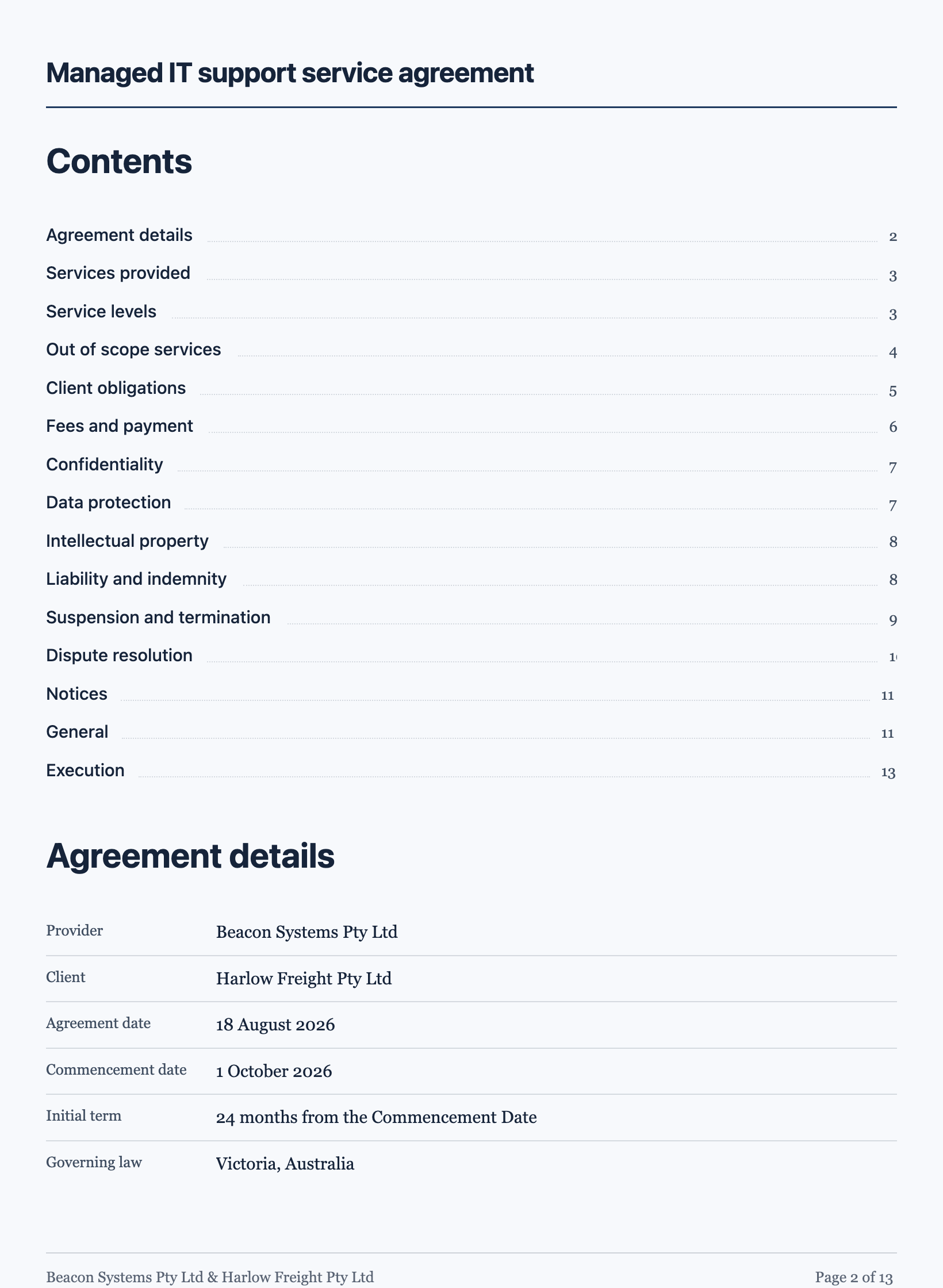 Service agreementBeacon Systems supports Harlow Freight’s IT for an initial 24 months from 1 October 2026 at $8,400 a month plus GST, with 40 hours included and $220 an hour beyond them. Twelve numbered clauses cover the services, a four level severity table, client duties, fees with a CPI adjustment, confidentiality, privacy, IP, a liability cap, termination and a three step dispute ladder.
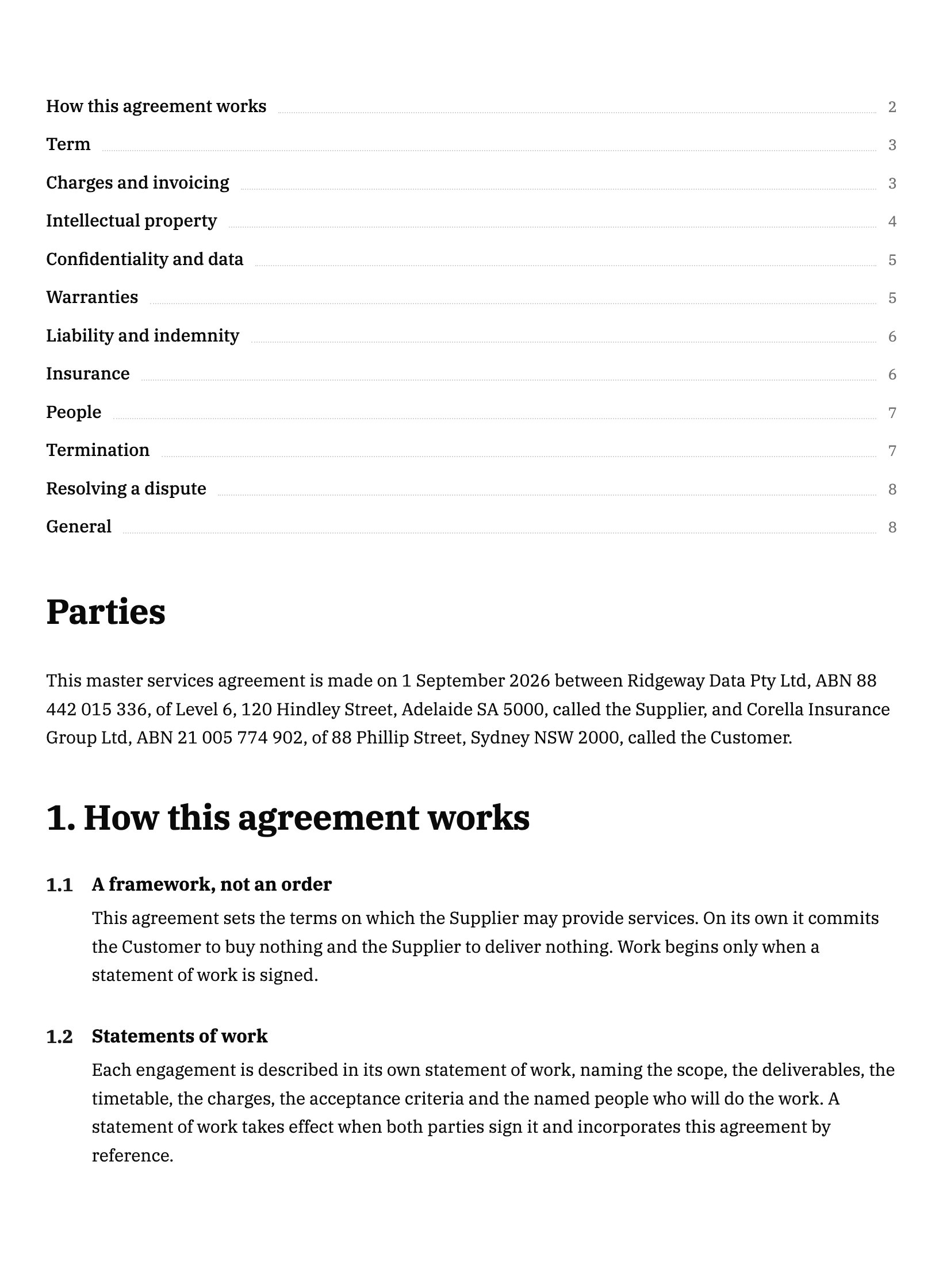 Master services agreementA data consultancy and an insurer sign this once and then buy work under it for three years. It is the rare contract whose whole purpose is to make the next twenty contracts short.
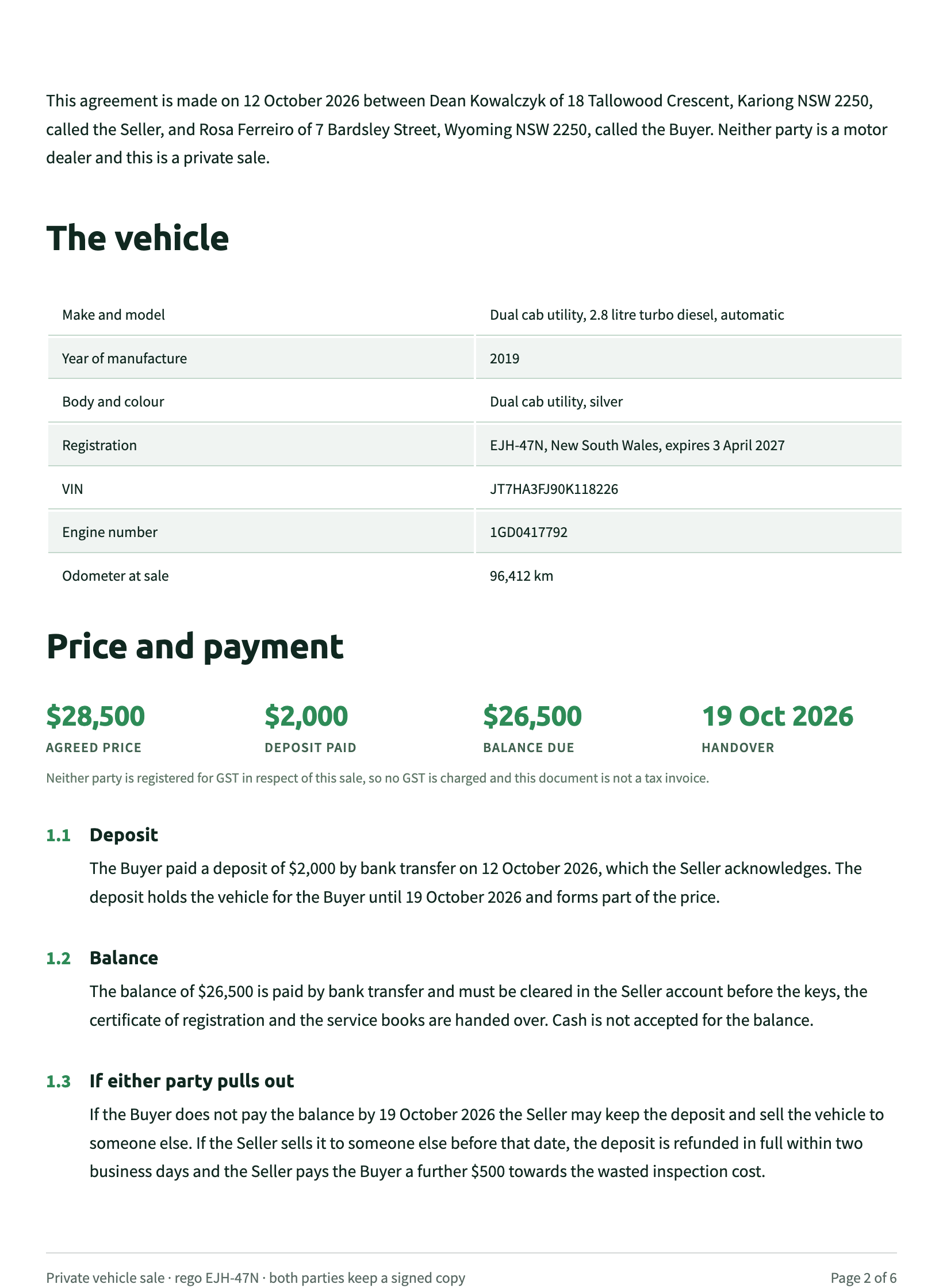 Vehicle sale agreement templateA dual cab ute is changing hands between two people on the Central Coast for $28,500. No dealer, so no statutory warranty and no guarantee of clear title. What the buyer gets instead is five written warranties, a register certificate number, and a mechanic's report obtained before the balance moves.
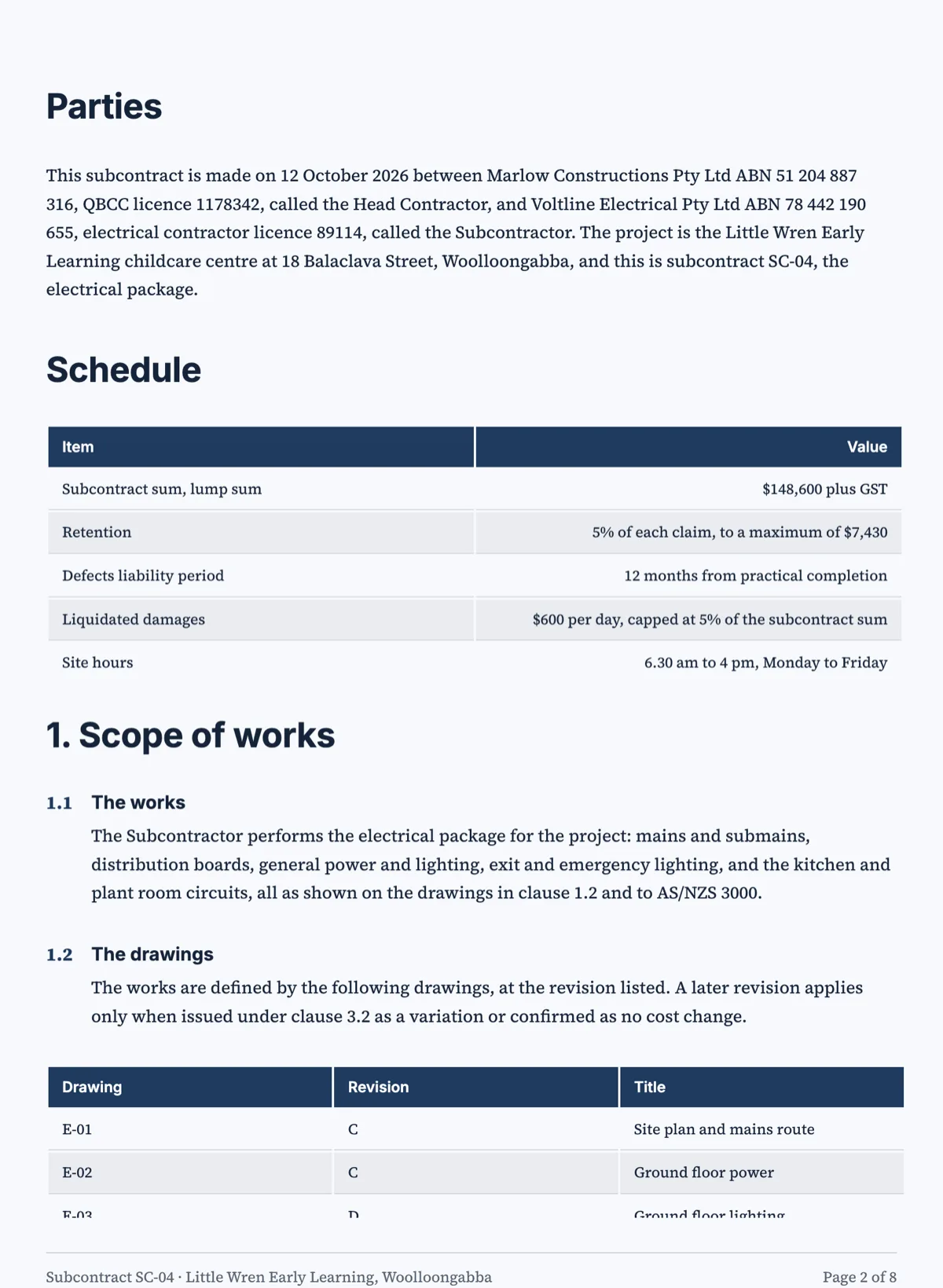 Subcontractor agreement template that flows the head contract downA subcontract exists to pass the head contract's obligations down one level and move the money back up on time. This one names the scope by drawing, sets the progress claim dates against the security of payment rules, holds retention and states the insurances, so the trade knows exactly when it is paid and for what.
Questions people ask
Is an entire agreement clause enforceable against misleading conduct claims in Australia?
No. Section 18 of the Australian Consumer Law is a statutory prohibition that parties cannot contract out of, so a buyer misled before signing can still sue despite the clause. The clause can be relevant evidence on whether the buyer actually relied on the statement, but it does not by itself defeat the claim.
Does an entire agreement clause stop verbal changes after signing?
Not on its own. It covers what happened before the contract was signed. Changes made afterwards are dealt with by the variation clause, which usually requires writing signed by both parties. Contracts that rely on the entire agreement clause to control later changes are relying on the wrong clause.
Should quotes and proposals be attached to the contract?
Only the parts that are meant to bind. Attaching a whole proposal imports its marketing language and assumptions as terms. The better approach extracts the scope, specifications and prices into schedules and leaves the proposal out, so the entire agreement clause excludes the sales material while keeping the commercial substance.
What is the difference between entire agreement and non reliance?
An entire agreement clause says what the contract consists of. A non reliance statement says a party did not rely on anything outside it when deciding to sign. The first limits contractual claims; the second is aimed at misrepresentation claims, and in Australia it cannot remove statutory liability.
Does the clause override a separate side letter?
It can, if the side letter was made before or at signing and is not listed. That is a common trap where a sales team gives a customer a letter promising a discount or extra service. Any side letter meant to survive must be listed in the clause or signed after the main agreement with express reference to it.
Why do US contracts call it an integration clause?
Because it declares the writing fully integrated, which under the parol evidence rule limits the use of earlier and contemporaneous agreements to add to or contradict the written terms. The purpose is the same as the Australian clause, though the evidential rules behind it differ between jurisdictions.
Put the clause in a finished document
The button opens the document generator with a starting description already filled in. Change it to match your own agreement before you run it.
Create a document with OneCraftRelated clauses
- Variation clause: the rule for changing the contract laterA variation clause sets how a contract can be changed after signing. Sample written variation wording, plus email and one sided price change variants.
- Severability clause: keeping the contract alive when one term failsA severability clause keeps a contract standing when one term is unenforceable. Sample cascading restraint wording, read down and replacement variants, limits.
- Waiver clause: tolerating a breach without giving up the rightA waiver clause says letting a breach slide once does not give up the right to act on it later. Sample lease wording, plus written and single instance variants.
- Disclaimer of warranties clause: what can and cannot be excludedA disclaimer of warranties clause removes implied warranties as far as the law allows. Australian sample wording with the consumer guarantees carve out.
For everything the document generator can do, see the document maker.
Step by step in the builder: Create a document with AI, then Document builder components.
Written and checked by the OneCraft team. Last checked .