Contract clause
Variation clause: the rule for changing the contract later
A variation clause, sometimes headed amendment, sets the only way the contract can be changed once signed: usually a written document signed by both parties, occasionally an exchange of emails, and in some standard terms a one sided right to change prices or policies on notice. It governs the method of change, not the commercial reasons for one.
Every long contract will need to change, and the danger is not the change itself but uncertainty about whether it happened. The variation clause decides what counts as a change before anyone relies on a phone call or a line in a meeting note.
Indunil Asanka · Co-founder
4 min read · Published
Sample clause
a two year bookkeeping services agreement between Blackbutt Ledger Services, a fictional bookkeeping firm in Geelong, and Harrow & Finch Joinery, whose owners want the flexibility to add payroll and remove quarterly reports as the business grows
18. Variation 18.1 This Agreement may be varied only by a document in writing that states it varies this Agreement, identifies the clauses or Schedule items affected, and is signed by an authorised representative of each party. 18.2 A variation may be signed and exchanged electronically under clause 38. 18.3 A variation takes effect on the date stated in it or, if no date is stated, on the date of the last signature. 18.4 Correspondence, meeting notes, invoices, timesheets and conduct do not vary this Agreement, even if they refer to a change in the Services or Fees. 18.5 If a signed variation is inconsistent with an earlier variation or with this Agreement, the later signed document prevails to the extent of the inconsistency. 18.6 Changes to the Services within a single Statement of Work are made under clause 19 (Change Control) and are not variations of this Agreement.
Sample wording, not legal advice.
Variants
Written and signed only
Agreements where changes are rare and significant, such as shareholder or finance documents.
No amendment or variation of this Agreement is effective unless it is in writing and signed by each party. The parties agree that this requirement applies to any variation of this clause itself. An unsigned draft, a term sheet or an exchange of correspondence that anticipates a signed variation does not vary this Agreement.
Email agreed variations
Small ongoing services relationships where formal documents for every change would never actually be prepared.
This Agreement may be varied by written agreement, including an exchange of emails in which one party proposes a specific change and the other replies confirming it. The confirming email must come from a person named in Item 4 of the Details. The proposing party must keep a record of each email variation and provide a list of all variations to the other party on request.
Unilateral price variation with notice and an exit right
Subscription or standard terms where a supplier needs to adjust prices across many customers without negotiating each one.
The Supplier may vary the Fees by giving the Customer at least 60 days written notice, but not more than once in any 12 month period. If the Customer does not accept the varied Fees, the Customer may terminate this Agreement by written notice given before the variation takes effect, without any termination fee. Fees paid in advance for any period after termination must be refunded.
What to negotiate
Email as writing
Requiring a signed document protects against casual changes, but in practice parties agree changes by email and then argue about whether that counted. Allowing email variations between named people, with a record kept, reflects how the relationship really works. Parties dealing with large amounts prefer a signed document for anything above a threshold.
One sided change rights
Suppliers on standard terms want to update prices, policies and service descriptions without consent. The Australian Consumer Law lists one sided rights to vary terms, to vary the upfront price without a right to terminate, and to vary what is supplied as examples of potentially unfair terms. Adding notice, a frequency limit and a free exit is the usual way to make such a right defensible.
Documents incorporated as updated
A clause saying the customer must comply with the supplier's policies as updated from time to time is a variation right in disguise. Customers ask for material updates to be notified, and for a right to object or exit where an update reduces the service or increases cost.
The risk of leaving it out
Without a variation clause a contract can be changed by any later agreement, including one made orally or inferred from conduct. That flexibility turns into uncertainty when the parties disagree about whether a conversation, a revised quote or a pattern of invoices changed the price or the scope, and each side then has to prove what was agreed and when.
Can the clause stop informal changes?
Legal systems answer this differently. In Rock Advertising v MWB Business Exchange Centres in 2018, the UK Supreme Court gave effect to a clause requiring variations to be in writing and signed, holding that an oral agreement to vary was ineffective, while leaving room for estoppel in some cases. Australian courts have been more willing to accept that parties who can make a contract can also vary it by later agreement, even informally. Either way, a clear clause shifts the burden onto the party asserting an informal change and makes the written record the starting point.
Variation, change control and new contracts
Well structured agreements separate three levels of change. Change control deals with scope, price and timing adjustments inside a project, through a request and approval procedure. The variation clause deals with changes to the agreement itself, such as the liability cap, the term or the payment terms. A change so fundamental that it rewrites the bargain may be better done as a replacement agreement. Saying in the variation clause which changes go through change control stops the two procedures competing and prevents a project manager from varying the master terms by approving a change request.
Where it sits in a generated document
The variation clause belongs in the general clauses with entire agreement and waiver, and it should cross refer to any change control and electronic signature clauses. A generated agreement numbers each clause, so those cross references can be written by number. The generated wording comes from the description and cites no cases, so the named representatives, notice periods and thresholds all need filling in and checking.
Documents that carry this clause
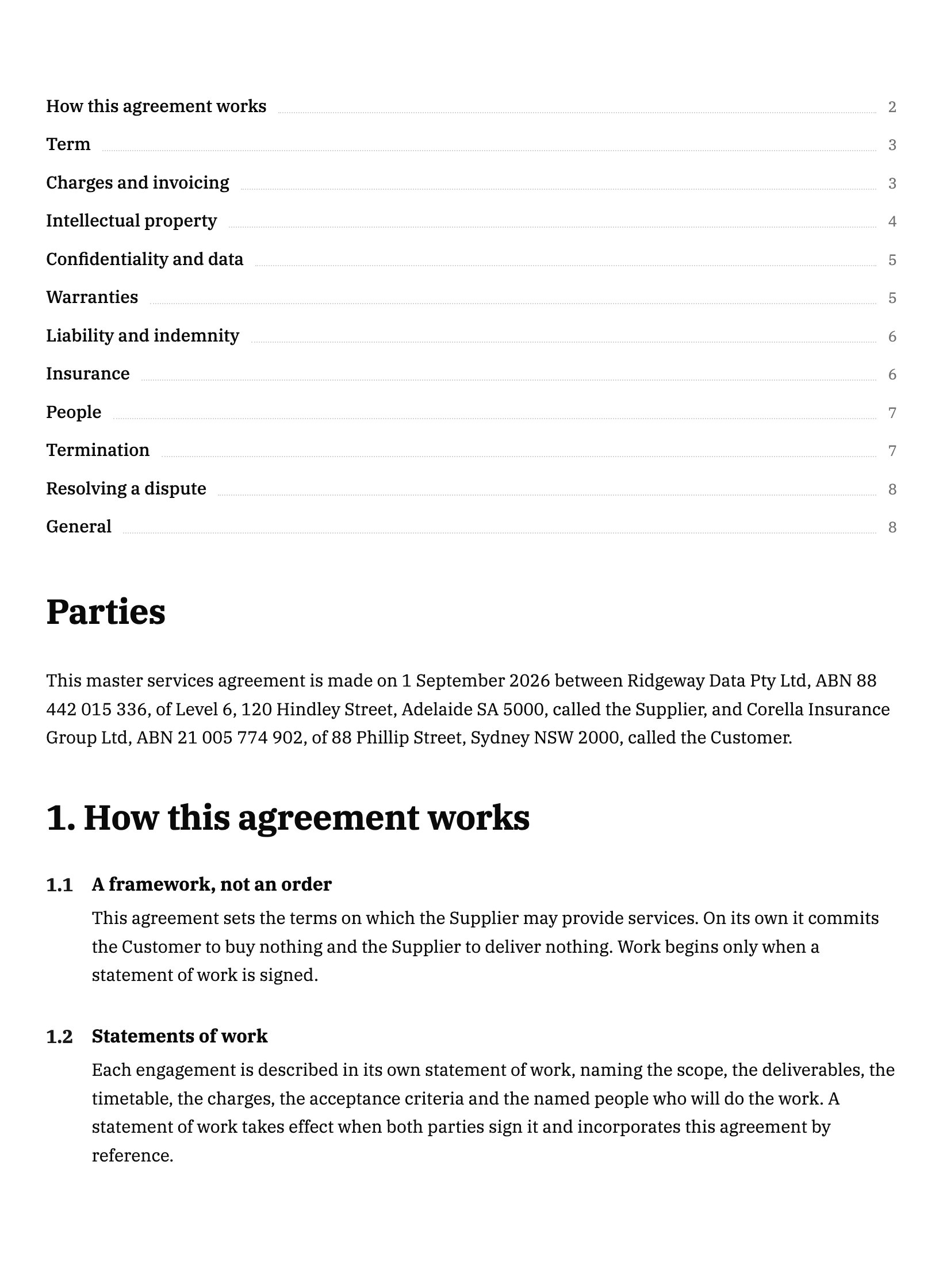 Master services agreementA data consultancy and an insurer sign this once and then buy work under it for three years. It is the rare contract whose whole purpose is to make the next twenty contracts short.
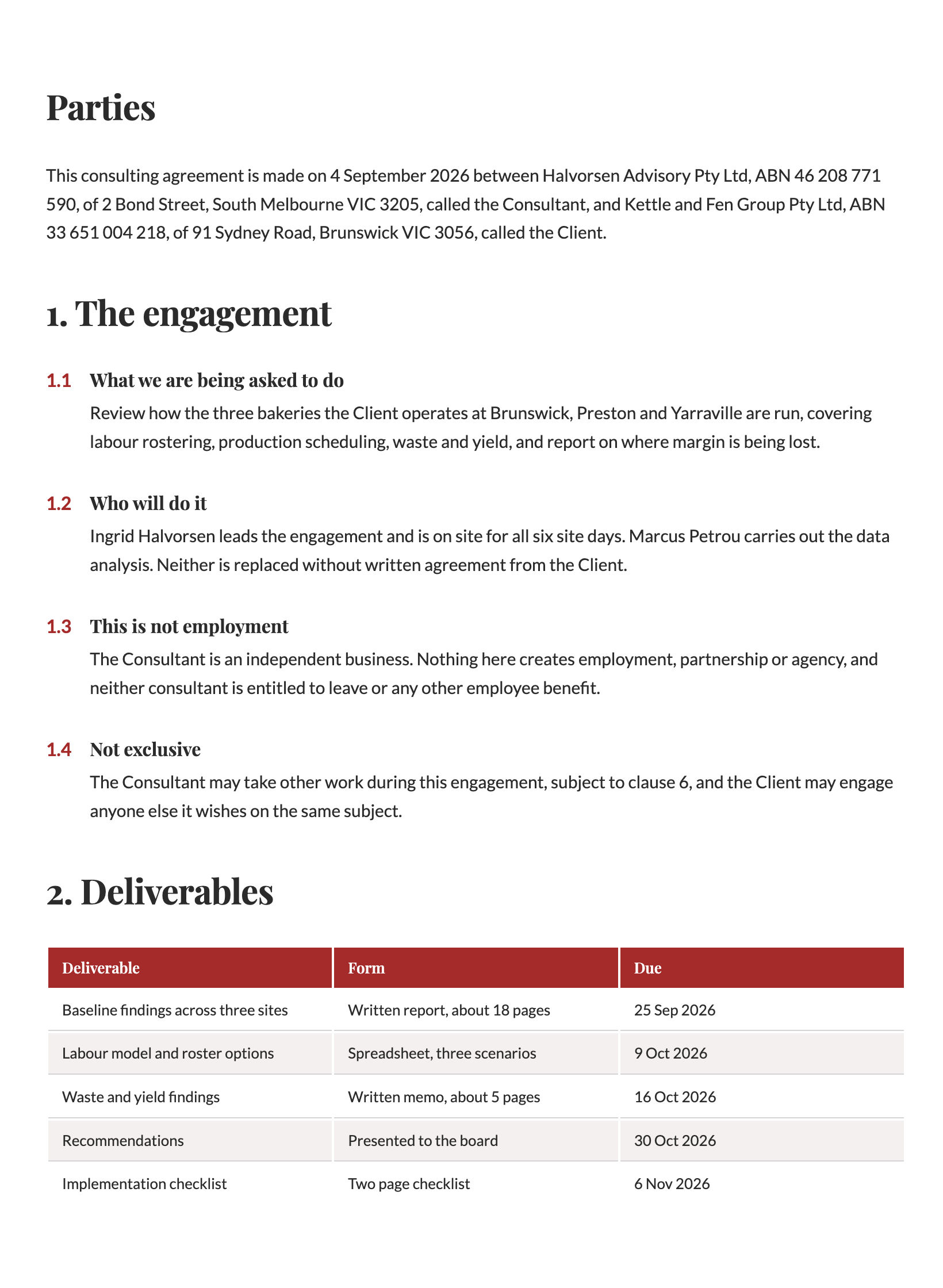 Consulting agreementAn advisory firm reviews three bakeries over seven weeks. What makes this agreement useful is not the fee clause but the two clauses that say what the advice is not.
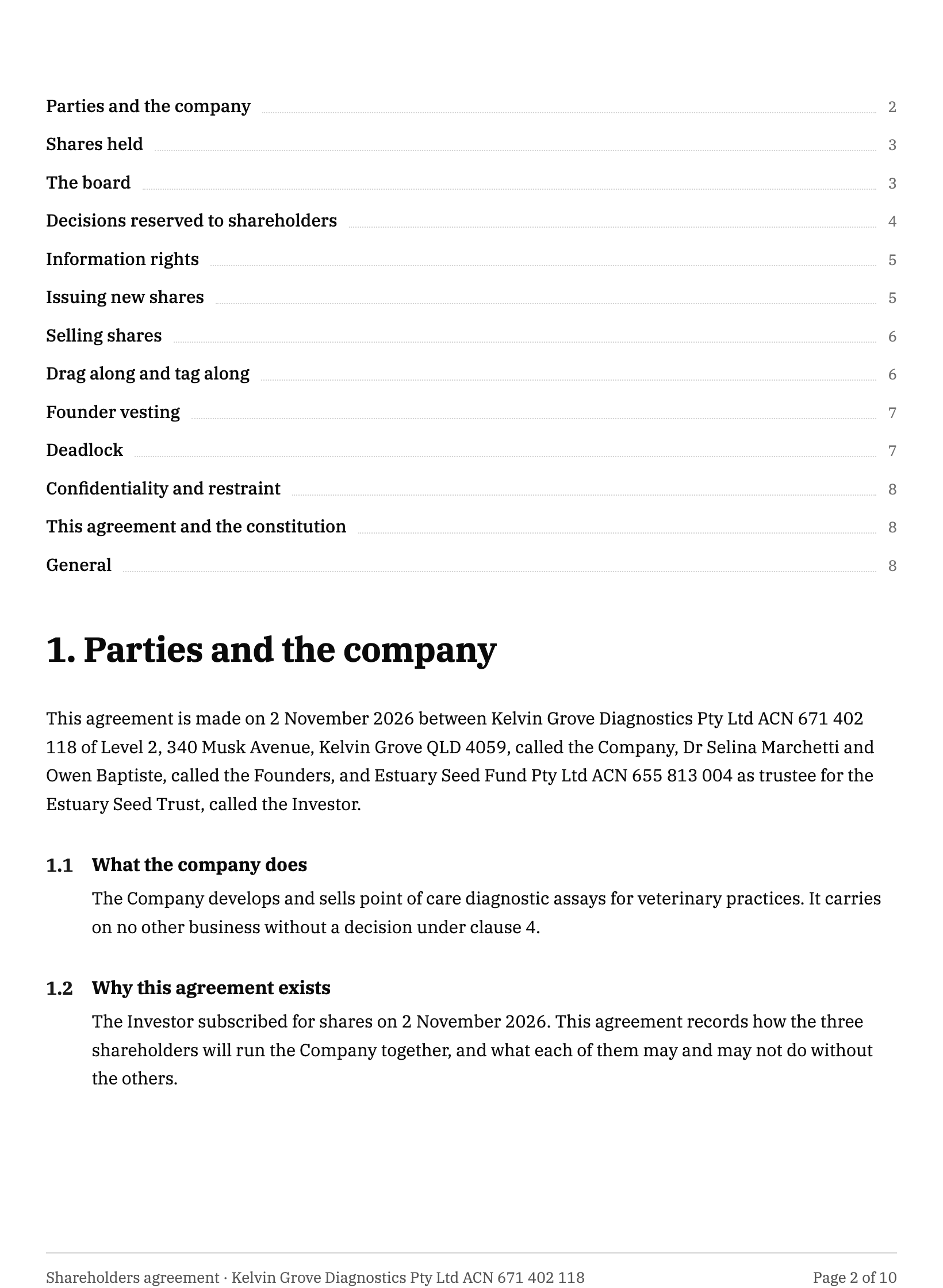 Shareholders agreement templateA veterinary diagnostics company has just taken $1.5 million from one seed fund. The founders keep 80 percent between them, so the whole agreement turns on a single number: the 75 percent consent threshold that puts the investor on one side of every decision that matters.
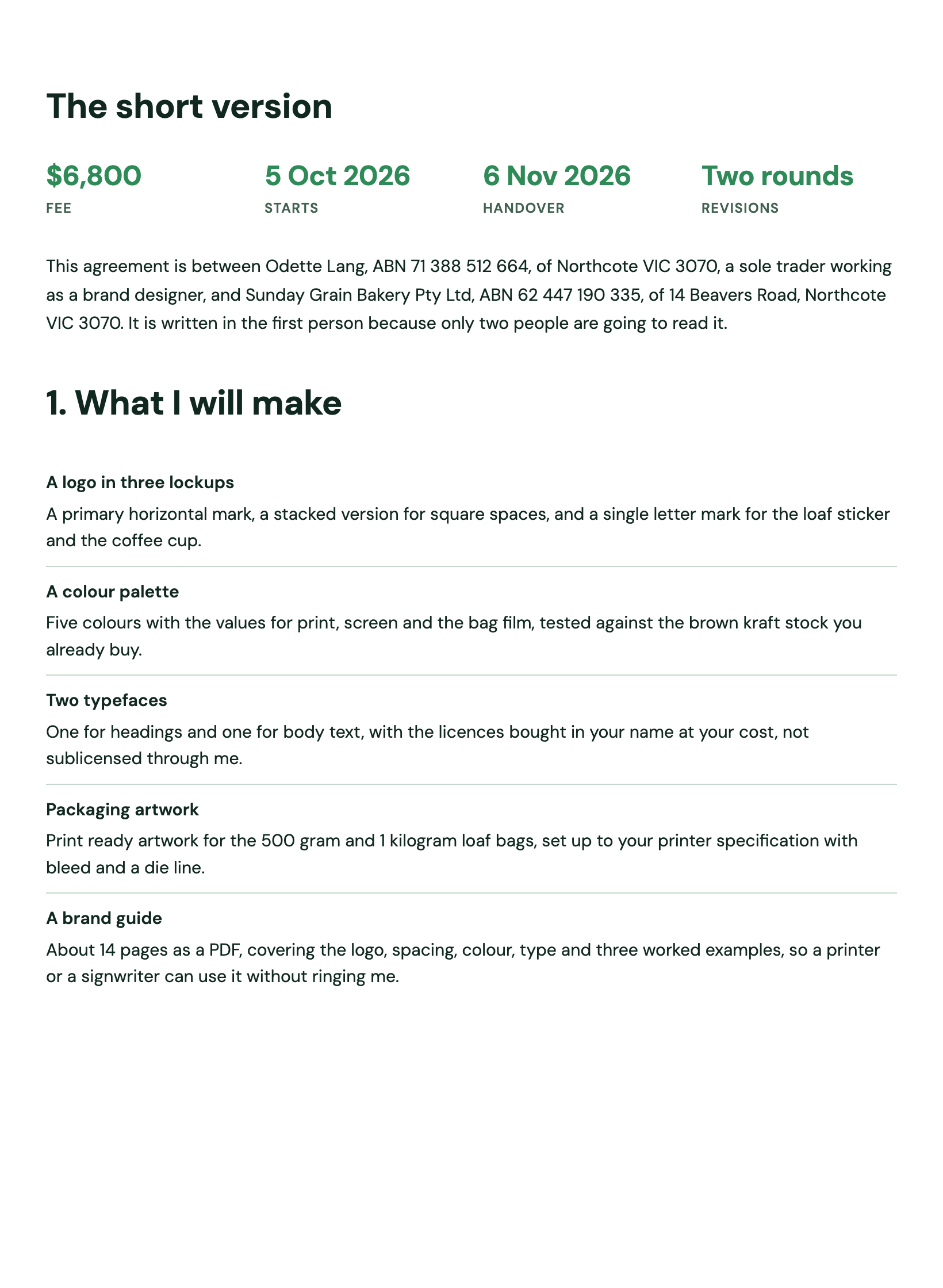 Freelance contractA brand designer and a bakery owner agree five weeks of work in language they can both read. It covers everything a longer contract would, and it never once says party of the first part.
Questions people ask
Is an email enough to vary a contract?
It depends on the clause. If the contract allows written variations and an email exchange clearly records both parties agreeing a specific change, an email can be enough. If the clause requires a signed document, an email may not satisfy it, although a typed name in an email can sometimes be treated as a signature.
Can a supplier change prices under a variation clause without agreement?
Only if the contract gives it a right to do so. In a standard form consumer or small business contract, a one sided right to vary the price without a right for the other party to terminate is an example of a potentially unfair term. Notice, limits on frequency and a free exit make the right much safer.
Does a variation need to be signed by the same people who signed the contract?
Not necessarily, but it must be signed by someone with authority to bind each party. Naming the roles authorised to sign variations in the clause removes doubt and stops a junior staff member agreeing a change the business did not approve.
What is the difference between a variation clause and a change control clause?
A variation clause governs changes to the contract's terms. A change control clause governs changes to the work within the contract, usually scope, timing and price, through a request, assessment and approval procedure. Many services agreements need both, with each clause stating what falls under the other.
Should the variation clause say variations can be signed electronically?
Yes, if the parties expect to sign electronically. Referring to the electronic signature clause, or stating that variations may be signed and exchanged electronically, removes any argument that a variation had to be signed in ink simply because the clause said signed.
What happens if two variations conflict?
The clause should say the later signed document prevails to the extent of the inconsistency. Without that rule, a long contract with many variations can end up with two different prices or dates, and the parties must argue about which was intended. A running list of variations helps avoid the problem.
Put the clause in a finished document
The button opens the document generator with a starting description already filled in. Change it to match your own agreement before you run it.
Create a document with OneCraftRelated clauses
- Change control clause: requesting, pricing and approving a scope changeA change control clause sets how scope changes on a services or software project are requested, priced and approved. Sample procedure, form fields and variants.
- Entire agreement clause: the written contract is the whole dealAn entire agreement clause says the signed contract is the whole deal. Australian sample wording, non reliance and US integration variants, and the ACL limit.
- Waiver clause: tolerating a breach without giving up the rightA waiver clause says letting a breach slide once does not give up the right to act on it later. Sample lease wording, plus written and single instance variants.
- Electronic signature clause: agreeing in the contract how it will be signedAn electronic signature clause records that the parties agree to sign electronically. Australian sample wording plus UK, US and deeds carve out variants.
For everything the document generator can do, see the document maker.
Step by step in the builder: Create a document with AI, then Document builder components.
Written and checked by the OneCraft team. Last checked .