Contract clause
Electronic signature clause: agreeing in the contract how it will be signed
An electronic signature clause records the parties' agreement that the contract may be signed electronically, names or describes the signing method, and says what record will prove who signed and when. It turns the general legal permission into specific consent, and it should carve out any document or party for which electronic execution is not available.
Laws in Australia, the United Kingdom and the United States already allow most contracts to be signed on screen. The clause does a narrower job: it records consent to a particular method in advance and fixes the evidence both sides will accept if a signature is later denied.
Indunil Asanka · Co-founder
4 min read · Published
Sample clause
an employment agreement between Saltmarsh Veterinary Group, a fictional network of animal hospitals in regional Victoria, and a new clinical director who will sign from interstate before relocating
38. Electronic Signature 38.1 Each party consents to this Agreement, and any variation or notice under it, being signed by electronic signature through the Signing Platform nominated by Saltmarsh Veterinary Group. 38.2 A signature applied through the Signing Platform after the signatory has verified the emailed one time code identifies the signatory and indicates their intention to be bound by the document signed. 38.3 The parties agree that the certificate of completion and event log generated by the Signing Platform are evidence of the identity of each signatory, the time of signing and the version of the document signed. 38.4 A party must not dispute the validity or enforceability of this Agreement only because it was signed or delivered electronically. 38.5 This clause does not apply to any document that the law requires to be signed in paper form or witnessed in the physical presence of a witness.
Sample wording, not legal advice.
Variants
Australian wording permitting any reliable method
Commercial contracts governed by Australian law where parties may use different platforms or a signed PDF.
The parties consent to this Agreement being executed by electronic signature using any method that identifies the signatory and indicates the signatory's intention in respect of the information communicated, and that is as reliable as appropriate for the purpose, within the meaning of the Electronic Transactions Act 1999 (Cth) and the corresponding legislation of each State and Territory. An electronically signed copy has the same effect as an original signed in ink.
United Kingdom wording
An agreement governed by the law of England and Wales, drafted with the Law Commission's 2019 statement of the law in mind.
The parties agree that this Agreement may be executed by electronic signature, and that an electronic signature is to be treated as the signatory's signature for all purposes. The parties rely on the position stated in the Law Commission's 2019 report on electronic execution of documents that an electronic signature can validly execute a document where the signatory intends to authenticate it and any required formalities are met. Any deed must be signed in the physical presence of a witness who attests the signature.
United States wording
An agreement with a US counterparty where the federal ESIGN Act and the state enactment of UETA apply.
Each party agrees to conduct this transaction by electronic means and consents to the use of electronic signatures and electronic records under the Electronic Signatures in Global and National Commerce Act, 15 U.S.C. 7001 et seq., and the Uniform Electronic Transactions Act as enacted in the governing state. Each party's electronic signature has the same legal effect as its handwritten signature, and an electronic record of this Agreement satisfies any requirement that it be in writing.
Deeds and excluded documents carve out
A transaction that mixes an ordinary agreement with deeds, guarantees or documents for lodgement at a registry.
This clause applies to this Agreement and any notice under it. It does not apply to any deed to be executed by an individual, any document to be lodged with a land titles office, or any statutory declaration, each of which must be signed in the manner required by the law that governs it. A company party may execute any deed electronically where section 127 of the Corporations Act 2001 (Cth) permits it.
What to negotiate
Named platform or any method
Naming a platform, and the identity check it uses, gives strong evidence and a single process. It also ties the other party to a system it did not choose and may not be able to access. The practical compromise names a preferred platform while accepting any method meeting the statutory reliability test, so one party's IT policy does not stall signing.
Evidence the parties accept
A clause agreeing that the platform's completion certificate and event log are evidence of identity, time and document version saves arguing about it later. Parties with less control over the platform ask that the record be supplied to them on completion, and that the agreement about evidence does not stop them showing the record is wrong.
Authority as well as method
An electronic signature proves a click by an email account, not that the person clicking could bind the company. Counterparties ask for a warranty that each signatory is authorised, or for company execution under section 127 so they can rely on the statutory assumptions. That point matters more than the choice of platform.
The risk of leaving it out
Most contracts can still be signed electronically without the clause, but a party wanting to escape can argue it never consented to that method, that the method was not reliable enough for the transaction, or that the electronic record is not the version it approved. The clause does not decide those arguments alone, but it removes the consent point and narrows the evidence dispute.
Why a clause helps when the law already allows it
Section 10 of the Electronic Transactions Act 1999 treats a signature requirement under a Commonwealth law as met where a method identifies the person and shows their intention, is reliable or proven in fact, and the person receiving the signature consents to that method. The state acts use the same model. A clause supplies the consent in writing before anyone signs, describes the method so reliability can be judged against something agreed, and records what evidence both parties will treat as proof. It turns a statutory test applied after a dispute into a process both parties signed up to.
What still needs paper or a witness
The clause cannot extend electronic signing to documents the law excludes. Each electronic transactions regime keeps exclusions in regulations, and wills, some powers of attorney, statutory declarations and land registry documents recur on those lists. Deeds depend on who signs: Australian companies may execute deeds electronically under section 127 of the Corporations Act 2001, while individuals follow state deed rules that can still require a witness. A clause that promises every document in a transaction can be signed on screen is promising something the parties cannot deliver.
Where it sits in a generated document
A signature block in a generated document holds one party per signer with a name, email and signing order, and sending it for signature makes each party a recipient. The certificate of completion prints, for each signer, the identity verification method, signing time, IP address, consent acceptance with its version, and document and signature image hashes, which is the record a clause like 38.3 points to.
Documents that carry this clause
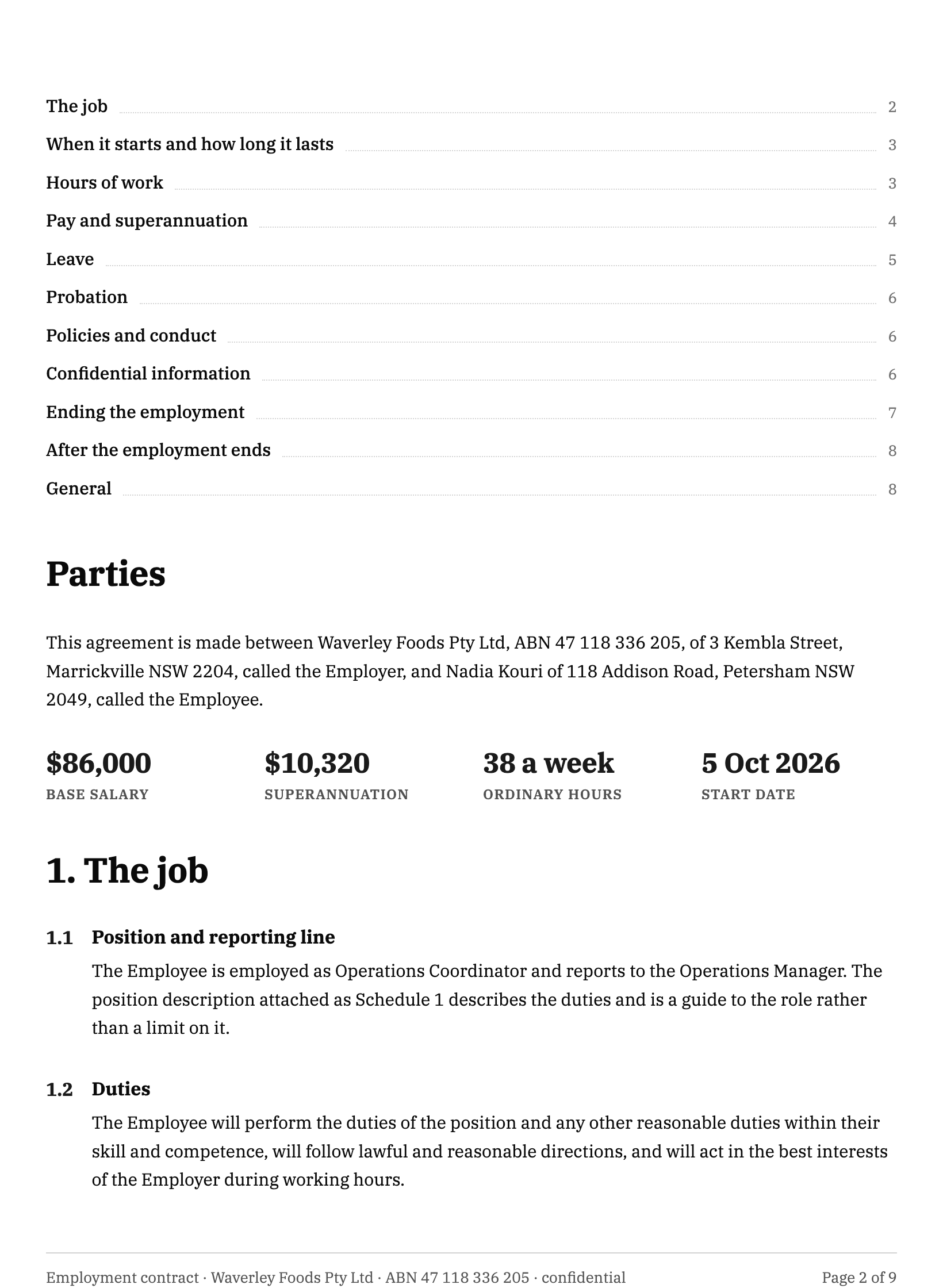 Employment contractA full time ongoing contract for an operations coordinator on $86,000 plus $10,320 of superannuation. Eleven numbered clauses, a leave table drawn from the National Employment Standards, and a notice table that scales with service.
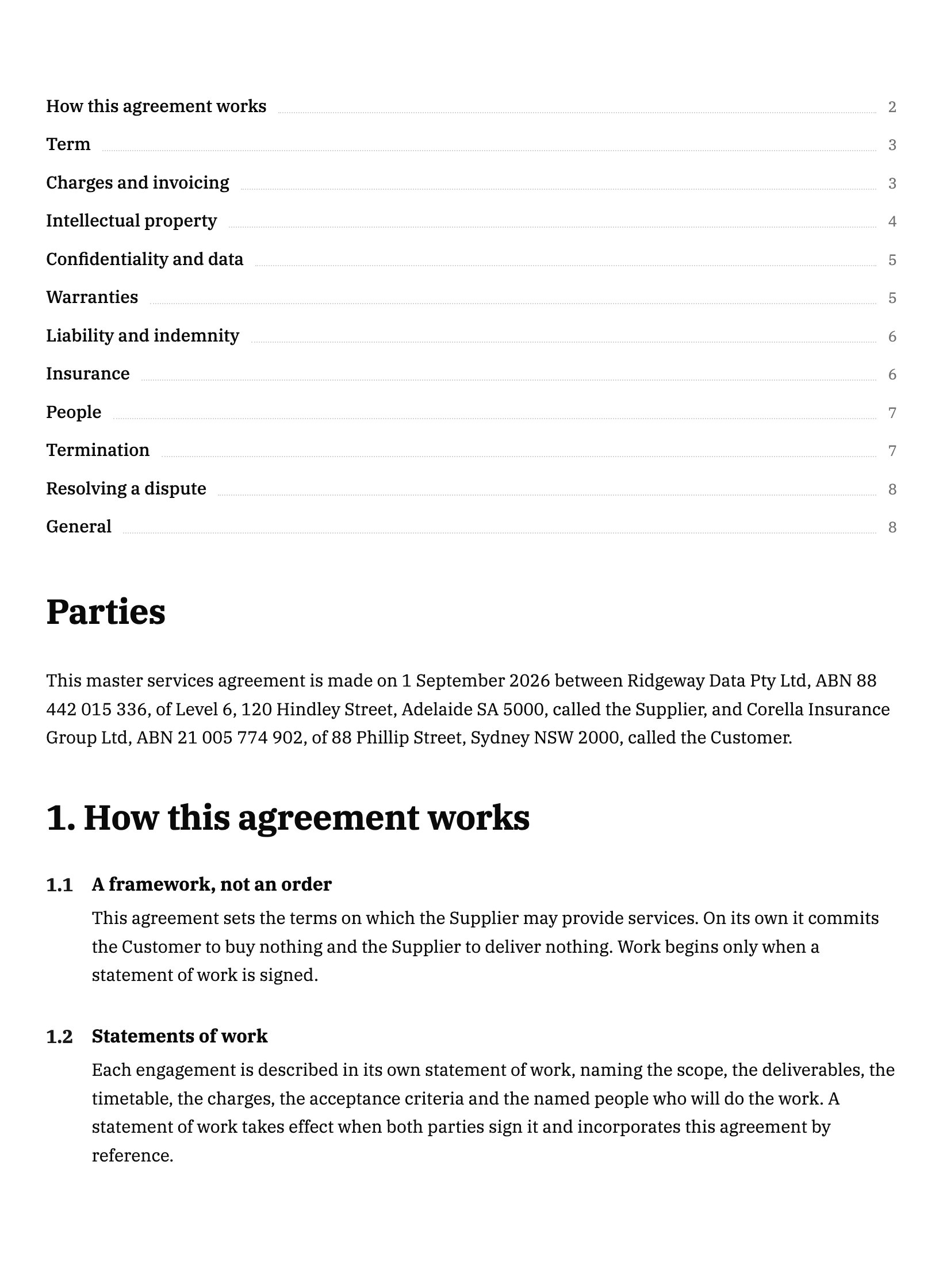 Master services agreementA data consultancy and an insurer sign this once and then buy work under it for three years. It is the rare contract whose whole purpose is to make the next twenty contracts short.
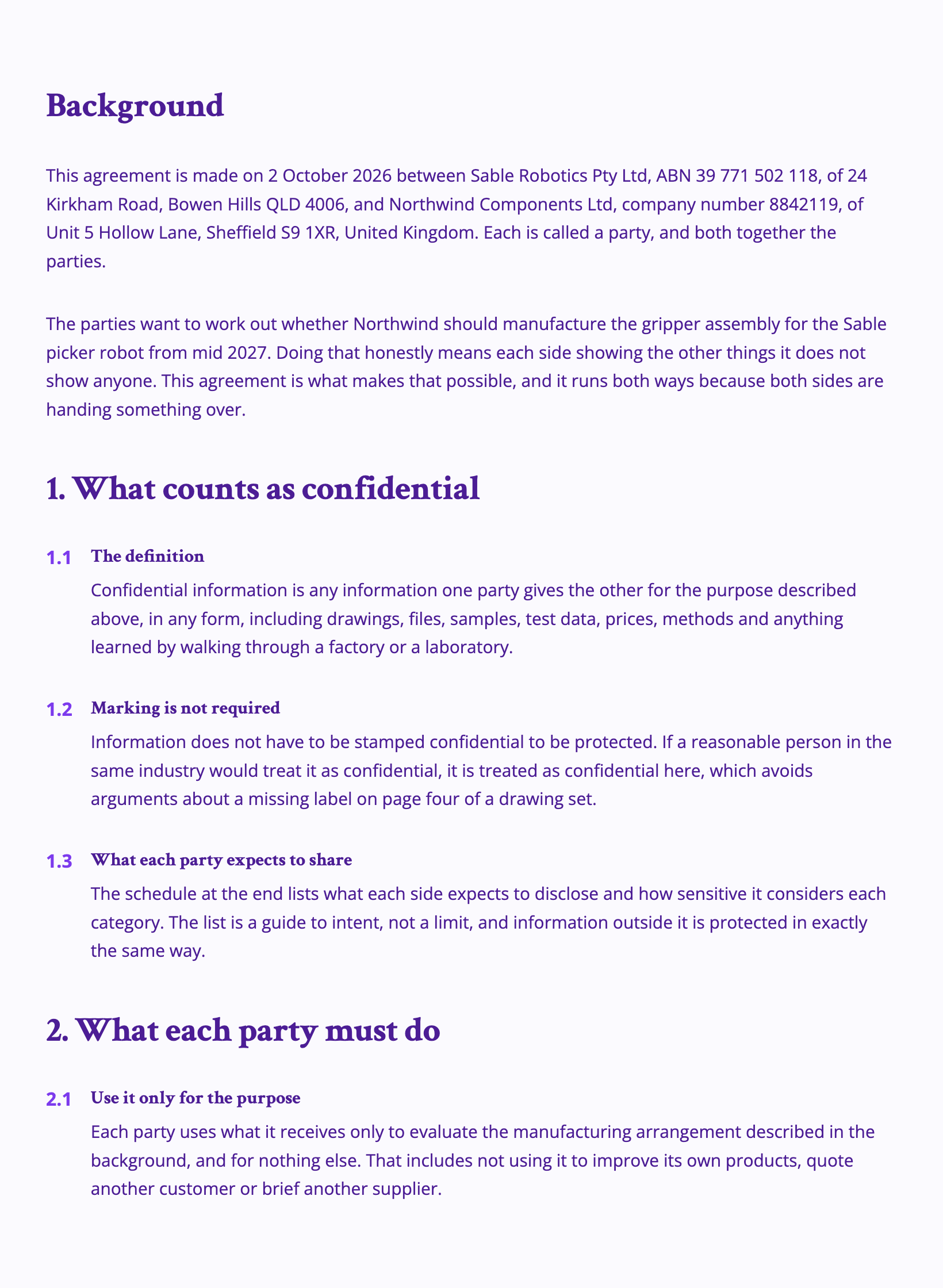 Mutual NDAA robotics company and a British parts maker want to look inside each other before agreeing to anything. Both sides are handing over trade secrets, which is the only real reason to make an NDA mutual.
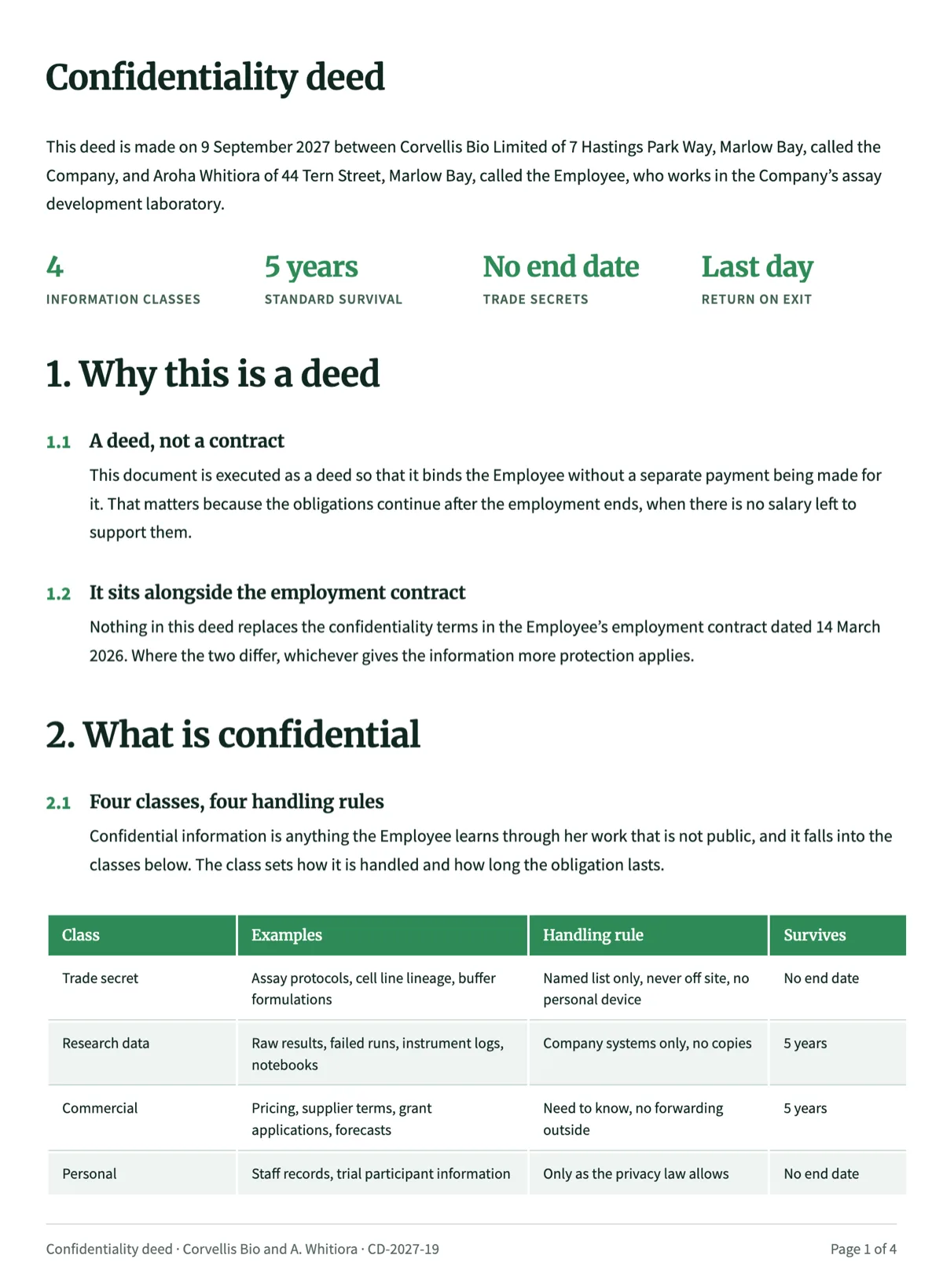 Employee confidentiality agreement with information classesMost employee confidentiality agreements treat every secret the same way. This one sorts information into four classes, gives each its own handling rule and its own survival period, and is executed as a deed so it still binds after the salary that supported it has stopped.
Questions people ask
Does a contract need an electronic signature clause to be signed electronically?
Usually not. Most Australian, UK and US contracts can be signed electronically without one. The clause is valuable because it records consent to the method before signing, describes the process, and fixes what evidence proves a signature, which is where disputes about electronic execution actually happen.
Can the clause cover documents signed later, such as variations?
Yes, and it should. Extending consent to variations, notices and documents signed under the agreement means the parties do not have to agree the method again each time. The variation clause should then allow electronic signature of a variation so the two clauses do not conflict.
Can an Australian company sign a deed electronically?
Yes, when it executes under section 127 of the Corporations Act 2001. The section allows a deed to be executed in electronic form without a witness, and a deed executed that way does not need delivery. Deeds signed by individuals or by other entities still depend on the relevant state or territory rules.
Should the clause name a signing platform?
Naming one gives a clear evidential trail and one identity check for everyone. The risk is that a counterparty cannot use it, or the platform changes. Many clauses name a preferred platform and also accept any method meeting the reliability test, with the signed record to be provided to all parties.
Does a typed name in an email satisfy the clause?
Only if the clause accepts any method that identifies the signer and shows intention, and even then it leaves the evidence thin. A clause naming a platform and identity check would not be satisfied by a typed name. Parties who want flexibility should say which informal methods are acceptable for which documents.
What wording suits a contract with a US party?
Wording that records agreement to transact electronically under the federal ESIGN Act and the state's enactment of UETA, and that gives electronic signatures and records the same effect as paper. Consumer dealings in the US carry specific disclosure and consent requirements under ESIGN that a business to business clause does not address.
Put the clause in a finished document
The button opens the document generator with a starting description already filled in. Change it to match your own agreement before you run it.
Create a document with OneCraftRelated clauses
- Counterparts clause: separate copies, one agreementA counterparts clause lets parties sign separate copies that together form one contract. Sample wording, electronic exchange and effective date variants, deeds.
- Notices clause: how a formal notice is sent and when it landsA notices clause sets how formal notices under a contract are sent and when they count as received. Sample email wording, a deemed receipt table and variants.
- Variation clause: the rule for changing the contract laterA variation clause sets how a contract can be changed after signing. Sample written variation wording, plus email and one sided price change variants.
For everything the document generator can do, see the document maker.
Step by step in the builder: Send a document for signature, then Create a document with AI.
Sources
Written and checked by the OneCraft team. Last checked .